“I Wanted To” vs. “I Want To”: Meaning, Difference, and Usage becomes easier when you focus on time.
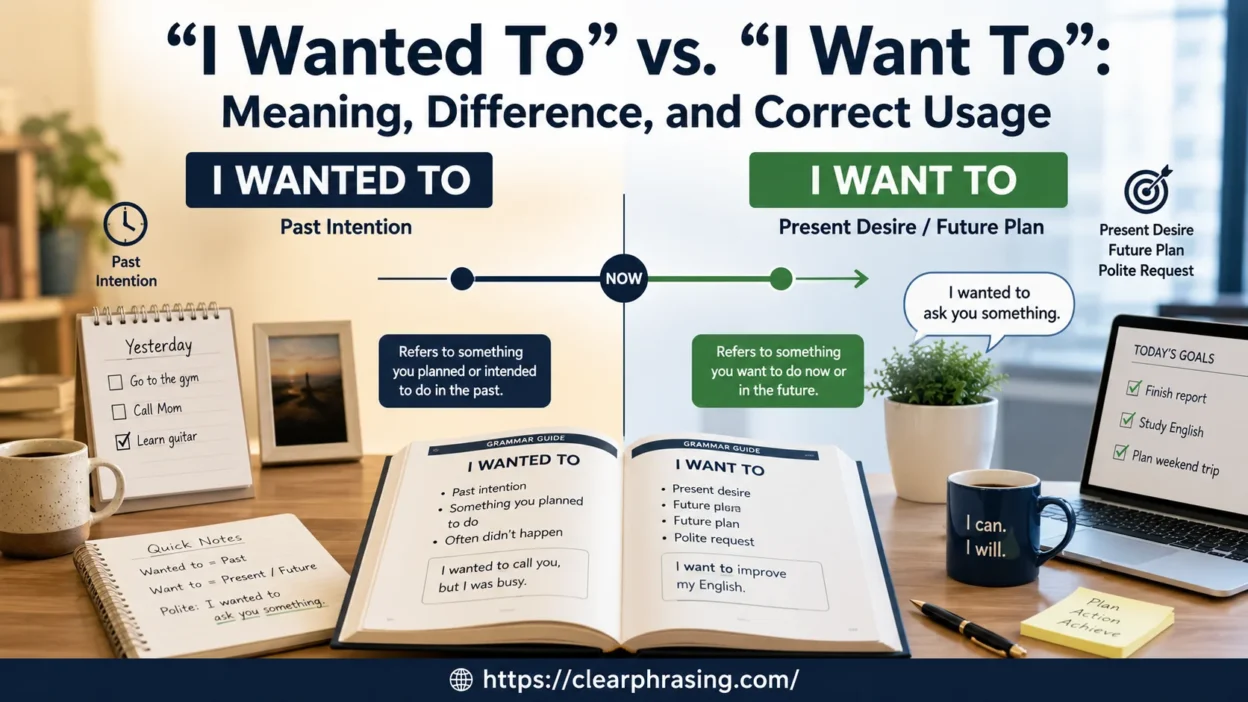
Many English learners find these phrases difficult while practicing English skills because “I wanted to” and “I want to” look almost the same. However, the small change from want to wanted changes the meaning and shows different tenses.Use “I want to” for a current desire, wish, need, plan, or intention.
Use “I wanted to” for a past desire or something you desired at an earlier time. For example, “I want to learn English” shows what you desire now, while “I wanted to learn English” describes a desire before. This grammar rule is simple once you understand when the action happens.
In my experience teaching English, I’ve seen students make this common mistake because the two expressions feel so similar. Real-life examples, sentence patterns, and grammar rules make the difference easy to remember.
Whether you’re speaking English with friends, writing emails, chatting online, or taking an English exam, choosing the right phrase helps you communicate clearly, sound more natural, and
Quick Answer:
I want to usually expresses a desire, intention, or plan that exists now.
I want to learn French.
The speaker currently has that desire.
I wanted to usually expresses a desire or intention that existed in the past.
I wanted to learn French when I was in college.
The desire belongs to an earlier period.
However, I wanted to can also sound more polite or less forceful when you make a request in the present:
I wanted to ask you a question.
The speaker may still want to ask the question right now. The past form softens the opening rather than necessarily placing the entire situation in the past.
The simplest rule
| Expression | Typical meaning | Example |
| I want to | Current desire or intention | I want to speak with you. |
| I wanted to | Earlier desire or intention | I wanted to speak with you yesterday. |
| I wanted to | Softer present request | I wanted to ask you something. |
| I’d like to | Polite current desire or request | I’d like to speak with you. |
So, if the desire is clearly current, I want to usually works. If the desire belonged to an earlier time, I wanted to is normally appropriate. If you’re making a present request, I wanted to may be more tactful.
What Does “I Want To” Mean?
The expression I want to uses the present form of want followed by a to-infinitive.
The verb want commonly expresses a wish, need, or desire. When another verb follows it, English normally uses to + base verb.
1.I want to leave.
2.I want to study.
3.I want to improve.
4.I want to call her.
The structure is straightforward:
Subject + want + to + base verb
For example:
- I want to travel.
- I want to learn.
- I want to work.
- I want to help.
Cambridge Grammar confirms that want can be followed by a verb in the to-infinitive form. It also distinguishes this pattern from constructions such as want + noun and want + object + to-infinitive.
“I Want To” Expresses a Present Desire
The most common use describes something the speaker wants now.
I want to buy a new laptop.
This doesn’t necessarily mean the purchase will happen immediately. The desire exists now while the action may happen later.
That distinction matters.
Consider:
I want to visit Japan next year.
The visit belongs to the future. The wanting belongs to the present.
In other words, the tense of want doesn’t automatically determine the tense of the action after to.
“I Want To” Can Describe a Future Plan
A present-tense verb can naturally introduce a future intention.
1.I want to start a business next year.
2.I want to move to another city someday.
3.I want to call him tonight.
All three sentences describe future actions. Yet want remains in the present because the desire or intention exists at the moment of speaking.
This is one of the most useful ideas to remember:
The action can be future while the desire is present.
That’s why I want to travel next summer is completely natural.
“I Want To” for Goals and Ambitions
The expression also works well for longer-term goals.
1.I want to become a better writer.
2.I want to improve my pronunciation.
3.I want to learn another language.
4.I want to build my own company.
These sentences don’t necessarily describe immediate actions. They describe current ambitions.
What Does “I Wanted To” Mean?
I wanted to is the simple past form of I want to.
The basic structure remains the same:
Subject + wanted + to + base verb
Examples include:
- I wanted to leave.
- I wanted to help.
- I wanted to ask.
- I wanted to learn.
- I wanted to visit.
The difference lies in the verb wanted, which places the desire or intention at an earlier point in time.
The British Council explains that the past simple commonly describes things that happened in the past. Wanted follows the regular -ed pattern used by many English verbs.
“I Wanted To” Expresses a Past Desire
Consider:
I wanted to become a doctor when I was young.
The desire existed in the past.
It might still exist. It might not. The sentence itself doesn’t necessarily tell us.
Now compare:
I want to become a doctor.
Here, the speaker presents the desire as current.
That difference is more important than the action itself.
“I Wanted To” Doesn’t Mean the Action Didn’t Happen
This is a common misunderstanding.
Some learners assume:
I wanted to do something = I didn’t do it.
That’s not necessarily true.
Look at these examples:
I wanted to visit Paris, so I booked a flight.
The speaker wanted to visit Paris and apparently acted on that desire.
Now compare:
I wanted to visit Paris, but I couldn’t afford the trip.
Here, the intention didn’t become reality.
The verb wanted tells us about the earlier desire. The rest of the sentence tells us what happened afterward.
A Useful Way to Think About It
Imagine wanting as a point on a timeline.
Past desire → decision → action or no action
For example:
I wanted to buy the book → I found it → I bought it.
Or:
I wanted to buy the book → It was unavailable → I didn’t buy it.
The word wanted doesn’t decide the ending. Context does.
The Main Difference
The most reliable distinction concerns the time of the desire or intention.
| Situation | Correct choice | Example |
| Desire exists now | I want to | I want to talk to her. |
| Desire existed earlier | I wanted to | I wanted to talk to her yesterday. |
| Current request with softer tone | I wanted to | I wanted to ask you something. |
| Former plan | I wanted to | I wanted to study medicine. |
| Current future plan | I want to | I want to study medicine next year. |
Ask Yourself One Question
Instead of asking:
“When will the action happen?”
ask:
“When did the desire or intention exist?”
That question solves many confusing examples.
Consider:
I want to meet you tomorrow.
The meeting is tomorrow. The desire exists now.
Now consider:
I wanted to meet you yesterday.
The desire existed yesterday.
The action and the desire don’t have to share exactly the same time.
Why “I Wanted To” Can Refer to Something Happening Right Now
Here’s where English gets particularly interesting.
Someone can say:
I wanted to ask you a question.
while standing in front of you and asking the question right now.
At first glance, that may seem contradictory. If the person is asking now, why use wanted?
The answer is tone.
English sometimes uses past-tense forms to make a present request sound less direct. The British Council specifically notes that English can use past forms for politeness, while Cambridge also gives examples of was wanting for indirect requests.
“I Wanted To” as a Softer Opening
Compare:
I want to ask you something.
with:
I wanted to ask you something.
Both can introduce a question being asked now.
The first sounds more direct. The second often sounds softer and more tentative.
For example, in a workplace:
I want to discuss the deadline.
This is clear and direct.
I wanted to discuss the deadline.
This can sound more diplomatic, particularly when introducing a potentially sensitive topic.
The difference isn’t necessarily about truth. It’s about interpersonal tone.
Common Examples
You might hear:
- I wanted to check something with you.
- I wanted to ask about the schedule.
- I wanted to talk about the report.
- I wanted to see if you were available.
- I wanted to clarify one point.
These can all refer to the present conversation.
The past form acts almost like a cushion around the request.
“I Wanted To” vs. “I Want To” in Requests
The choice becomes especially noticeable in professional communication.
| Sentence | Tone |
| I want to ask about the schedule. | Direct |
| I wanted to ask about the schedule. | Softer |
| I’d like to ask about the schedule. | Polite and neutral |
None of these sentences is automatically wrong.
The choice depends on the relationship, context, and desired tone.
At Work
I want to discuss the project budget.
This sounds straightforward.
I wanted to discuss the project budget.
This can feel less abrupt when opening the conversation.
With a Teacher
I want to ask about question five.
Direct and perfectly understandable.
I wanted to ask about question five.
A little softer.
With Customer Service
I want to return this item.
Direct.
I wanted to ask about returning this item.
More indirect and conversational.
The important point is that “wanted” doesn’t always mean “no longer want.”
Does “I Wanted To” Always Mean the Desire Is Over?
No.
Context determines that.
Consider:
I wanted to ask you something.
The speaker may clearly still want to ask.
Now consider:
I wanted to become a pilot when I was twelve.
Here, the sentence describes a past ambition.
The surrounding information makes the difference.
Compare These Examples
I wanted to call you, but I lost your number.
The earlier intention didn’t lead to the call.
I wanted to call you, so I did.
The intention led to the action.
I wanted to call you. Are you free now?
The speaker may be using the past form to introduce a present request.
The same two words can therefore carry different practical meanings.
Grammar Structure of “I Want To” and “I Wanted To”
Both expressions follow the same basic pattern.
Present Structure
I + want + to + base verb
Examples:
- I want to go.
- I want to learn.
- I want to speak.
- I want to help.
Past Structure
I + wanted + to + base verb
Examples:
- I wanted to go.
- I wanted to learn.
- I wanted to speak.
- I wanted to help.
Notice something important: the verb after to doesn’t become past tense.
Correct and Incorrect Forms
| Incorrect | Correct |
| I wanted to went home. | I wanted to go home. |
| I wanted to going home. | I wanted to go home. |
| I want to went there. | I want to go there. |
| I want to going there. | I want to go there. |
Why?
Because to go is a to-infinitive. The verb remains in its base form.
Cambridge describes the to-infinitive as to + the base form of the verb. The same pattern appears with many verbs that take a to-infinitive, including want.
“I Wanted To” vs. “I Want To” With Time Expressions
Time expressions can provide useful clues, but they aren’t the entire rule.
Common Present-Time Clues
- now
- today
- tonight
- this week
- these days
- at the moment
Example:
I want to talk to you today.
Common Past-Time Clues
- yesterday
- last night
- last year
- earlier
- when I was younger
- at that time
- back then
Example:
I wanted to talk to you yesterday.
However, don’t rely on time words mechanically.
Consider:
I wanted to ask you something.
There’s no word such as yesterday or last week. Yet the sentence can still be completely natural in a present conversation.
That’s because wanted can function as a polite past form.
“I Wanted To” and “I Want To” in Future Contexts
Both forms can occur with future time references, but the meaning changes.
Compare:
I want to see you tomorrow.
The speaker currently intends or desires to see you tomorrow.
Now:
I wanted to see you tomorrow.
The speaker describes an earlier intention concerning tomorrow. Context may suggest that the plan has changed.
For example:
I wanted to see you tomorrow, but my flight was canceled.
Here, wanted clearly points to an earlier plan.
However:
I wanted to see if you could meet tomorrow.
This can function as a polite present request.
The words are similar, but the construction and context guide the interpretation.
“I Wanted To” vs. “I’d Like To”
These expressions overlap, but they aren’t identical.
“I Want To”
Usually expresses a current desire.
I want to speak with the manager.
“I Wanted To”
Can describe a past intention or soften a current request.
I wanted to speak with the manager.
“I’d Like To”
Usually presents a current desire or request in a polite way.
I’d like to speak with the manager.
A useful comparison looks like this:
| Expression | Typical meaning | Directness |
| I want to | Current desire | More direct |
| I wanted to | Past desire or softened request | Softer |
| I’d like to | Polite current desire | Polite |
This doesn’t mean one expression is universally better. Good English depends on the situation.
“I Wanted To” in Reported Speech
The distinction becomes even more useful when you report what someone said.
Suppose someone says:
“I want to leave.”
When reporting that statement later, English can use:
She said that she wanted to leave.
The shift from want to wanted fits naturally into reported speech because the reporting verb said is in the past.
The important point is that wanted in reported speech doesn’t automatically prove that the person no longer wants to leave.
Context matters.
For example:
She said that she wanted to leave, but she stayed for another hour.
Or:
She said that she wanted to leave, and she eventually did.
The surrounding information determines what happened.
“I Did Want To” vs. “I Wanted To”
Another useful distinction is between:
I wanted to help.
and:
I did want to help.
The second version adds emphasis.
Imagine someone says:
“You didn’t want to help.”
You might respond:
I did want to help.
Here, did emphasizes the truth of the statement.
Compare:
- I wanted to help. → ordinary past statement
- I did want to help. → emphatic or corrective statement
The difference is subtle but useful in arguments, explanations, and emotionally charged conversations.
Common Mistakes
Mistake: Thinking “Wanted” Always Means “Didn’t Do It”
Incorrect assumption:
I wanted to call her = I didn’t call her.
Not necessarily.
Better interpretation:
I wanted to call her = At some past point, calling her was my desire or intention.
What happened afterward requires context.
Mistake: Using “Want” With a Clearly Past Time
❌ I want to see him yesterday.
✅ I wanted to see him yesterday.
The past time reference makes wanted appropriate when describing a desire that existed yesterday.
Mistake: Changing the Verb After “To”
❌ I wanted to went home.
✅ I wanted to go home.
The past tense belongs to wanted, not go.
Mistake: Assuming “Wanted” Always Sounds Old-Fashioned
It doesn’t.
I wanted to ask you something is extremely natural in everyday English.
It often sounds especially appropriate when someone wants to introduce a request without sounding too forceful.
Mistake: Assuming “I Want To” Is Always More Correct
Both forms are grammatically correct.
The question is which meaning and tone you intend.
I want to discuss your application.
I wanted to discuss your application.
The first is more direct. The second may feel more tactful.
Real-Life Case Studies:
Case Study: A Workplace Conversation
Imagine a manager speaking to an employee.
I want to discuss your performance.
This sounds direct and possibly serious.
Now:
I wanted to discuss your performance.
The second can sound less abrupt as an opening.
Neither sentence automatically communicates anger or friendliness. Tone also depends on voice, context, and the rest of the conversation.
Case Study: Asking a Teacher a Question
A student approaches a teacher.
I want to ask about the homework.
Clear and direct.
I wanted to ask about the homework.
Slightly softer.
The student isn’t necessarily saying the desire existed only in the past. The past form can simply make the request feel less blunt.
Case Study: A Former Career Goal
Consider:
I wanted to become a lawyer when I was younger.
Here, the past meaning is much clearer.
The sentence describes an earlier ambition.
If the person still has that ambition, the speaker could say:
I want to become a lawyer.
The tense changes because the speaker’s current relationship with the goal has changed.
A Practical Decision Guide
When you’re unsure which expression to use, run through these questions.
Use “I Want To” When:
- The desire exists now.
- The intention is still current.
- You’re discussing a present goal.
- You’re describing a current plan.
- You want to sound direct and straightforward.
Examples:
1.I want to improve my English.
2.I want to talk to you.
3.I want to apply for the position.
Use “I Wanted To” When:
- The desire existed in the past.
- You’re describing an earlier plan.
- You’re talking about a former ambition.
- You’re explaining a missed opportunity.
- You’re describing a past intention.
- You’re introducing a present request more softly.
Examples:
1.I wanted to call you yesterday.
2.I wanted to become a teacher when I was younger.
3.I wanted to ask you about the schedule.
Use “I’d Like To” When:
- You want a polite present expression.
- You’re making a request.
- You’re speaking in a formal or customer-facing setting.
- You want something less direct than I want to.
Example:
I’d like to speak with the manager.
More Examples
| Context | Current | Past or Softer |
| Conversation | I want to talk to you. | I wanted to talk to you. |
| Question | I want to ask something. | I wanted to ask something. |
| Travel | I want to visit Italy. | I wanted to visit Italy. |
| Work | I want to discuss the report. | I wanted to discuss the report. |
| Study | I want to study medicine. | I wanted to study medicine. |
| Shopping | I want to buy this. | I wanted to buy this. |
| Career | I want to become a writer. | I wanted to become a writer. |
| Help | I want to help you. | I wanted to help you. |
The surrounding context gives each sentence its precise meaning.
A Simple Timeline to Remember the Difference
Think of want as the speaker’s position on a timeline.
PAST ◄────────── NOW ──────────► FUTURE
I wanted to…
The desire or intention is associated with a point before now.
I want to…
The desire or intention exists now.
The action itself may occur at different points.
For example:
I want to travel next year.
Current desire → Future action
I wanted to travel last year.
Past desire → Past intended action
I wanted to ask you something.
Earlier intention to make a request → Present conversation
That third pattern is the one that causes the most confusion.
Practice:
Choose the expression that best fits the context.
Questions
- Yesterday, I ______ call you, but I forgot.
- I ______ improve my writing this year.
- I ______ ask you a quick question. Do you have a minute?
- When I was a child, I ______ become an astronaut.
- I ______ visit my sister next weekend.
- Last night, I ______ watch a movie, but I fell asleep.
- I ______ discuss the new schedule with you.
- When I lived in London, I ______ stay there permanently.
- I ______ learn how to play the guitar someday.
- I ______ check whether the meeting is still scheduled for Friday.
Answers
- wanted to
- want to
- wanted to
- wanted to
- want to
- wanted to
- want to or wanted to, depending on intended tone
- wanted to
- want to
- wanted to
Notice question three and question ten. Both can use wanted to even though the conversations may be happening now. Context and politeness matter.
Quick Revision:
Keep these points in mind:
- I want to normally expresses a current desire or intention.
- I wanted to normally expresses a past desire or intention.
- I wanted to does not automatically mean the intended action never happened.
- I wanted to can introduce a present request in a softer way.
- I want to can describe a future action when the desire exists now.
- The verb after to stays in its base form.
- I’d like to offers another polite way to express a current desire or request.
- Context often determines whether wanted refers strictly to the past or softens a present statement.
Read More: Poor vs. Pore vs. Pour vs. Por: Meaning, Differences, & Examples
FAQs
What is the main difference between “I wanted to” and “I want to”?
“I want to” usually describes a present desire, plan, or intention. It tells the listener that the feeling or intention exists now. For example, “I want to learn English” means you currently have that goal.
“I wanted to” generally refers to a desire or intention in the past. For example, “I wanted to learn English” tells us that you had that desire earlier, although it doesn’t necessarily tell us whether you still have it.
Does “I wanted to” always mean that I no longer want something?
No. “I wanted to” places the desire in the past, but it doesn’t automatically mean the desire has disappeared. Context matters. You might say, “I wanted to call you yesterday,” while still wanting to speak with that person today.
If you want to make your present intention completely clear, “I want to” is usually the better choice. This small distinction can prevent confusion when you’re explaining plans or describing something that happened earlier.
When should I use “I want to” in a sentence?
Use “I want to” when you are talking about something you desire, plan, or intend to do now. It works naturally in everyday conversations and formal situations. For example, “I want to improve my English” expresses a current goal.
You can also use it when making requests or discussing future actions. “I want to visit the library tomorrow” shows that the desire exists now, even though the action itself may happen later.
When should I use “I wanted to”?
Use “I wanted to” when you are referring to a desire or intention that existed at an earlier point. For example, “I wanted to buy a new phone last month” clearly connects the desire with the past.
It can also make a statement sound softer or more polite in some situations. For instance, “I wanted to ask you a question” is often used as a polite way to introduce a request, even when the speaker is asking the question right now.
Can “I wanted to” be used for polite requests?
Yes. English speakers often use the past form “I wanted to” to make a request sound less direct. “I wanted to ask if you could help me” can sound gentler than “I want to ask if you can help me.”
This doesn’t necessarily mean the speaker no longer wants help. Instead, the past form can create a softer tone. You’ll often hear this pattern in business communication, customer service, emails, and polite conversations.
Is “I want to” always about the future?
Not exactly. “I want to” expresses a present desire or intention, but the action can happen now, later, or at another time. “I want to eat” expresses a current desire, while “I want to travel next year” expresses a present plan for the future.
The important point is that want describes your current state of mind. The actual action doesn’t have to happen at the exact moment you speak.
Can both phrases appear in the same conversation?
Absolutely. In fact, using both can help you clearly separate past intentions from current ones. For example, you might say, “I wanted to study medicine when I was younger, but now I want to study law.”
Here, “wanted to” describes an earlier ambition, while “want to” identifies the speaker’s current goal. The contrast makes the change in plans easy to understand.
What is a common mistake with “I wanted to” and “I want to”?
A common mistake is choosing the verb form without thinking about time. Learners sometimes use “I wanted to” when they are describing a current desire, or use “I want to” when they are clearly talking about a past intention.
A useful habit is to ask yourself one simple question: Is this desire connected to now or to an earlier time? That quick check can help you choose the correct expression without memorizing complicated grammar rules.
Which phrase sounds more natural in everyday English?
Both expressions sound natural when you use them in the right context. “I want to” is common when talking about current desires, plans, and intentions, while “I wanted to” naturally describes past desires or works as a softer form for certain requests.
From my experience teaching English, learners often understand the difference faster when they stop treating the phrases as separate vocabulary items and instead connect each one with a time frame. That approach makes everyday English much easier to handle.
How can I remember the difference easily?
Think of want as a desire connected to now, and wanted as a desire connected to before. You can remember it with a simple contrast: “I want to go” means the desire exists now, while “I wanted to go” places that desire in the past.
Practice with real-life examples rather than memorizing isolated rules. Try describing your current plans with “I want to” and your earlier plans with “I wanted to.” With regular practice, the difference will become natural.
Conclusion
The difference between “I wanted to” and “I want to” may look tiny, but the change in tense can significantly affect how your meaning comes across. “I want to” normally connects a desire, plan, or intention with the present, while “I wanted to” usually places that desire or intention in the past. Understanding this time difference gives you better control over what you say.
However, English isn’t always as rigid as a simple tense chart might suggest. “I wanted to” can sometimes describe a past intention that still exists, and speakers also use it to make requests sound more polite. That’s why you should consider the full context rather than assuming that a past form always means the desire has completely ended.
The easiest way to build confidence is to pay attention to the situation before choosing the phrase. Ask yourself whether you’re describing something you want now, something you wanted before, or a request you want to express more gently. This approach is much more practical than trying to memorize a long list of rules.
After years of teaching English, I’ve found that learners make faster progress when they practice these expressions through ordinary situations—making plans, talking with friends, writing emails, or describing old goals. Once you connect want with the present and wanted with the past or a softer request, the distinction becomes much easier to use naturally.

Ayesha Siddiqa is an English specialist and professional content writer at ClearPhrasing.com. She is passionate about making the English language easy to understand through clear, accurate, and engaging content. Her expertise includes English grammar, spelling, vocabulary, punctuation, word usage, and writing techniques.
At ClearPhrasing.com, Ayesha creates well-researched, reader-friendly articles designed to help students, professionals, writers, and English learners strengthen their language skills. She focuses on providing practical explanations, real-world examples, and up-to-date guidance that readers can confidently apply in everyday communication.
Committed to accuracy and clarity, Ayesha ensures that every article meets high editorial standards and delivers reliable, easy-to-follow information that empowers readers to write and communicate with confidence.