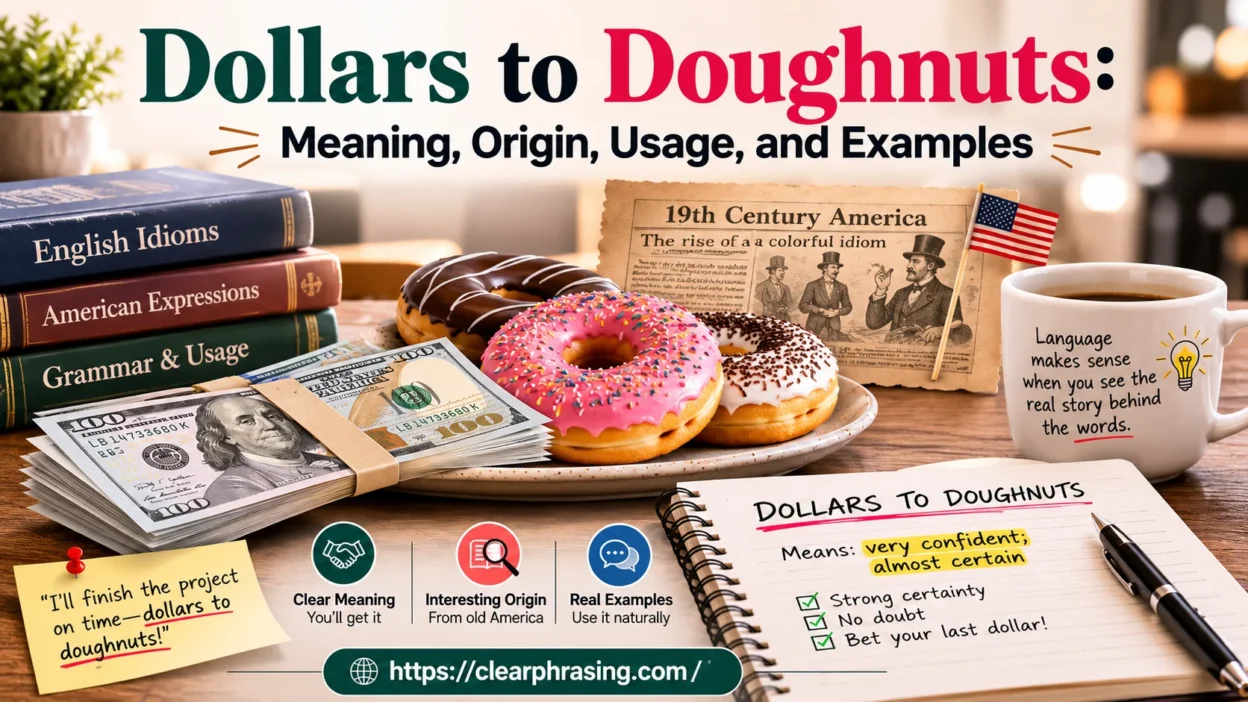
Dollars to Doughnuts: Meaning, Origin, Usage, and Examples explains a colorful American idiom that expresses strong certainty.
If your coworker keeps showing up late every Monday, you might tell a friend, “I’d bet dollars to donuts he’ll miss the morning meeting again.” This conversational expression shows you’re completely confident and absolutely sure about an expected outcome. In American English, it adds a punchy sense of certainty to everyday predictions.
The origin of Dollars to doughnuts comes from a time when doughnuts were cheaper, while dollars had greater value. A speaker could put dollars against a listener’s doughnuts in a wager, creating a clear comparison between something valuable and something less valuable. The American idiom originated in the middle 1800s and became part of American language and historical usage.
Today, the phrase means something is certain, likely, or very likely to happen. For example, “I’ll bet you dollars to doughnuts that it rains tomorrow” expresses strong confidence without suggesting an actual bet involving money and doughnuts. Google’s Ngram shows that the phrase reached peak popularity in 1915, although its popularity later declined considerably.
Quick Answer:
“Dollars to doughnuts” means you are very confident that something is true or will happen. It is similar to saying:
- I’m almost certain.
- I’d bet on it.
- It’s a sure thing.
- There’s no doubt in my mind.
- I’d wager that’s true.
For example:
Dollars to doughnuts, Jake forgot his keys again.
This means the speaker is highly confident that Jake forgot his keys.
The phrase doesn’t necessarily mean absolute certainty. In everyday speech, people use it to express strong confidence rather than a guaranteed fact.
What Does “Dollars to Doughnuts” Mean?
At its heart, “dollars to doughnuts” expresses confidence. You use it when you believe an outcome is extremely likely.
Imagine someone says:
“I think Mark will be late to the meeting.”
You could simply reply:
“I agree.”
But if Mark has a habit of arriving late, you might say:
“Dollars to doughnuts, he’ll be late.”
That version carries more attitude. It suggests, “I’m so confident that I’d be willing to make a bet.”
The phrase doesn’t require an actual wager. Instead, it uses the image of a bet to emphasize how strongly you believe something.
Simple Meaning of “Dollars to Doughnuts”
| Expression | Basic meaning |
| Dollars to doughnuts | I’m almost certain |
| I’d bet on it | I strongly believe it |
| A sure thing | Something very likely to happen |
| Without a doubt | Complete confidence |
| Highly likely | Strong probability |
The important point is confidence. The idiom tells you how strongly the speaker believes the prediction.
Why Do People Say “Dollars to Doughnuts”?
The expression comes from the idea of an uneven wager.
A dollar represented something more valuable than a doughnut in the context of the old expression. Therefore, putting dollars on one side and doughnuts on the other created an exaggerated difference in value.
That imbalance communicates confidence.
Think of the idea this way:
Valuable stake → dollars
Lower-value stake → doughnuts
Uneven wager → strong confidence
The wording also has a catchy quality. Dollars and doughnuts begin with the same prominent d sound. That makes the phrase rhythmic and easy to remember.
Historical research also records related expressions such as “dollars to buttons.” However, “dollars to doughnuts” became the version that survived in common usage.
Does “Dollars to Doughnuts” Mean You Literally Bet Doughnuts?
No.
When someone says:
“Dollars to doughnuts, she’ll call tonight.”
they aren’t proposing an actual wager involving money and pastries.
The expression is now a figurative idiom. The betting image gives the statement extra force.
That’s why you can use it without having anything to wager.
Origin
The history of “dollars to doughnuts” goes back much further than many people expect.
The expression is an American phrase dating to the nineteenth century. A documented singular form, “a dollar to a doughnut,” appeared in an 1871 newspaper. The plural form “dollars to doughnuts” also appeared in print that same year.
Historical research into the expression shows that related “dollars to ___” constructions existed around the same period. These phrases used an unequal comparison to communicate confidence in a wager.
The available evidence doesn’t identify one specific person as the inventor of the phrase. That’s worth noting because idiom origins are often presented with overly neat stories that the historical record doesn’t actually support.
The Earliest Known Uses
An early example from 1871 used the singular form:
“a dollar to a doughnut”
Later that year, the plural construction “Dollars to Doughnuts” appeared in print.
These early examples show that the expression was already functioning as a wager-related phrase in nineteenth-century American English.
The wording wasn’t invented recently. It has been part of the language for more than 150 years.
“Dollars to Buttons” and Other Variations
The doughnut version wasn’t the only expression of its kind.
Historical records contain related comparisons involving things such as:
- dollars to buttons
- dollars to dumplings
- dollars to doughnuts
These expressions shared the same basic concept: put something valuable against something of relatively low value to emphasize favorable odds.
“Dollars to doughnuts” ultimately became the familiar expression. Its memorable rhythm and alliteration likely helped it survive.
“Dollars to Doughnuts” vs. “Dollars to Donuts”
Both spellings can appear in American English:
- dollars to doughnuts
- dollars to donuts
The meaning remains the same.
Doughnut is the traditional spelling, while donut is a widely used American variant. Because the idiom itself dates back to the nineteenth century, “dollars to doughnuts” represents the traditional form.
Is “Dollars to Doughnuts” Correct?
Yes.
“Dollars to doughnuts” is completely correct and remains a recognizable English idiom.
Is “Dollars to Donuts” Correct?
Yes.
You may also see:
“Dollars to donuts, he’ll be there.”
The spelling changes, but the meaning doesn’t.
Which Spelling Should You Use?
| Version | Correct? | Usage |
| Dollars to doughnuts | Yes | Traditional form |
| Dollars to donuts | Yes | Common US variant |
| Dollars to doughnut | Context-dependent | Singular construction |
| Dollars for doughnuts | No | Not the standard idiom |
If you’re discussing the historical expression, “dollars to doughnuts” is the better choice because it preserves the traditional spelling.
How to Use “Dollars to Doughnuts” in a Sentence
The idiom commonly appears when you make a confident prediction or claim.
“Dollars to Doughnuts, …”
This is one of the simplest sentence patterns:
1.Dollars to doughnuts, she’ll be late.
2.Dollars to doughnuts, they already know about the problem.
3.Dollars to doughnuts, he forgot his password again.
The phrase can appear at the beginning of a sentence as an introductory expression.
“It’s Dollars to Doughnuts That …”
Another useful structure is:
It’s dollars to doughnuts that the team will win.
It’s dollars to doughnuts that she’ll call before dinner.
This structure directly connects the idiom with a confident prediction.
“I’d Bet Dollars to Doughnuts …”
You can also make the original betting idea more obvious:
I’d bet dollars to doughnuts that he’ll forget.
I’d bet dollars to doughnuts she knows the answer.
Here, the word “bet” reinforces the idea behind the idiom.
Examples
Seeing the expression in natural situations makes its meaning much easier to grasp.
Everyday Conversation
- Dollars to doughnuts, Mom already knows what happened.
- Dollars to doughnuts, Kevin left his phone in the car.
- Dollars to doughnuts, they’ll order pizza tonight.
- Dollars to doughnuts, she forgot about the appointment.
- Dollars to doughnuts, the dog ate the sandwich.
Each sentence communicates a strong prediction.
Work and Business
- Dollars to doughnuts, the client will ask for another revision.
- Dollars to doughnuts, we’ll discuss the deadline again tomorrow.
- I’d bet dollars to doughnuts that the meeting will run late.
- It’s dollars to doughnuts that sales will rise after the promotion.
The idiom works well when the workplace atmosphere is relaxed and conversational.
School and Learning
- Dollars to doughnuts, the teacher will check the homework.
- Dollars to doughnuts, someone will ask about the test.
- I’d bet dollars to doughnuts that the class will finish early.
Predictions About the Past
The phrase can also introduce a confident guess about something that has already happened.
Dollars to doughnuts, she left her notebook at home.
Dollars to doughnuts, they missed the earlier train.
Notice that the idiom doesn’t determine the tense. The verb does.
What Tone Does “Dollars to Doughnuts” Have?
“Dollars to doughnuts” is informal, colorful, and slightly playful.
That’s part of its appeal.
Instead of saying:
“I am highly confident that he will forget.”
you can say:
“Dollars to doughnuts, he’ll forget.”
The second sentence feels much more natural in casual conversation.
The expression can also sound slightly old-fashioned. That’s not a problem. In fact, that distinctive quality can give your writing or speech a little personality.
Is “Dollars to Doughnuts” Formal?
Not usually.
The phrase works particularly well in:
- Casual conversations
- Informal emails
- Blogs
- Personal writing
- Stories
- Friendly workplace conversations
- Social media posts
For formal writing, a clearer alternative may work better.
Instead of:
Dollars to doughnuts, the policy will change.
you could write:
The policy is highly likely to change.
Or:
The evidence strongly suggests that the policy will change.
The choice depends on your audience and purpose.
“Dollars to Doughnuts” vs. Similar Expressions
Several English expressions communicate strong confidence. However, each has a slightly different tone.
| Expression | Meaning | Tone |
| Dollars to doughnuts | Almost certain | Informal, playful |
| Bet your bottom dollar | Very confident | Informal |
| A safe bet | Very likely | Informal/neutral |
| Without a doubt | Completely confident | Neutral |
| You can count on it | Very reliable or certain | Conversational |
| Almost certainly | Extremely likely | Neutral/formal |
| Highly likely | Strong probability | Formal/neutral |
“Dollars to Doughnuts” vs. “Bet Your Bottom Dollar”
Both expressions use money-related imagery to communicate confidence.
However, “bet your bottom dollar” focuses on putting your money behind an outcome. “Dollars to doughnuts” focuses on the uneven value of the wager.
“Dollars to Doughnuts” vs. “Almost Certainly”
These expressions can communicate almost the same idea, but their tone differs.
Dollars to doughnuts, he’ll win.
sounds casual and colorful.
He will almost certainly win.
sounds neutral and works better in formal writing.
Common Mistakes
Taking It Literally
The expression isn’t normally about buying doughnuts.
Correct meaning: “I’m extremely confident.”
Thinking It Means “Cheap”
The word doughnuts doesn’t mean “cheap.”
The idiom depends on the contrast between the perceived value of dollars and doughnuts in the imagined wager.
Using It for Weak Predictions
If you’re only slightly confident, the idiom can sound too strong.
For example:
Dollars to doughnuts, it might rain.
This sounds awkward because “might” expresses uncertainty while the idiom expresses strong confidence.
A stronger construction would be:
Dollars to doughnuts, it’ll rain before dinner.
Using It in Highly Formal Writing
The phrase is understandable, but it has a distinctly conversational character.
In academic, legal, scientific, or highly formal business writing, alternatives such as “highly likely” or “almost certainly” usually fit better.
Is “Dollars to Doughnuts” Still Used Today?
Yes.
The expression remains recognizable in modern American English. It may not be as common as simpler phrases such as “I bet” or “no doubt,” but it hasn’t disappeared.
Because the phrase dates to the nineteenth century, some speakers may find it more familiar than others. Younger speakers may encounter it more often in books, articles, television, or older forms of American dialogue than in everyday conversation.
Still, its meaning remains easy to understand once you’ve heard it in context.
Old idioms often survive because their imagery remains memorable even after their original cultural context changes. “Dollars to doughnuts” is a good example.
You don’t need to know nineteenth-century betting practices to understand the message. The metaphor does the work.
Can “Dollars to Doughnuts” Describe a Negative Outcome?
Absolutely.
The expression communicates confidence, not positivity.
For example:
Dollars to doughnuts, he’ll miss the train.
That’s a negative prediction.
You could also say:
Dollars to doughnuts, they’ll win the competition.
That’s positive.
The emotional value of the outcome doesn’t determine whether the phrase works. What matters is the speaker’s strong confidence.
Can “Dollars to Doughnuts” Refer to the Past?
Yes.
Although people often use the idiom for predictions, it can also introduce a confident assumption about something that already happened.
For example:
Dollars to doughnuts, she left her wallet at home.
The speaker isn’t predicting what will happen. They’re making a confident guess about a past event.
Another example:
Dollars to doughnuts, they missed the earlier train.
Again, the phrase communicates confidence while the verb “missed” places the event in the past.
Quick Grammar and Usage Guide
| Feature | Details |
| Type | Idiom |
| Meaning | Very strong confidence |
| Main use | Predictions and confident claims |
| Register | Informal |
| Primary variety | American English |
| Traditional spelling | Dollars to doughnuts |
| Common US variant | Dollars to donuts |
| Literal wager required? | No |
| Can it refer to the past? | Yes |
| Can it describe a negative outcome? | Yes |
| Best for formal academic writing? | Usually no |
A Simple Case Study: Why “Dollars to Doughnuts” Works
Imagine a coworker named Daniel who has arrived late every Monday for the past six weeks.
On Sunday evening, Daniel says:
“Don’t worry. I’ll be early tomorrow.”
You know his pattern.
Instead of saying:
“I strongly predict that you will be late.”
you might respond:
“Dollars to doughnuts, you’ll walk in ten minutes late.”
Why does that sound natural?
Because the expression communicates more than a basic prediction. It shows that your confidence comes from a recognizable pattern.
The same structure works in countless situations:
Repeated pattern → strong expectation → confident prediction → “dollars to doughnuts.”
That’s one reason idioms can make everyday English more expressive.
25 “Dollars to Doughnuts” Example Sentences
- Dollars to doughnuts, he’ll forget the meeting.
- Dollars to doughnuts, Sarah already heard the news.
- Dollars to doughnuts, they’ll arrive after everyone else.
- Dollars to doughnuts, she left her umbrella at home.
- Dollars to doughnuts, the restaurant will be crowded tonight.
- Dollars to doughnuts, he’ll ask for another extension.
- Dollars to doughnuts, they won’t finish before Friday.
- I’d bet dollars to doughnuts that she knows the answer.
- Dollars to doughnuts, the bus is already gone.
- Dollars to doughnuts, Tom forgot his password again.
- Dollars to doughnuts, they’ll order dessert.
- Dollars to doughnuts, the baby will wake up soon.
- Dollars to doughnuts, he’ll change his mind.
- Dollars to doughnuts, she has another excuse ready.
- Dollars to doughnuts, the team will score first.
- Dollars to doughnuts, the weather will change tonight.
- Dollars to doughnuts, someone will ask about the deadline.
- Dollars to doughnuts, they missed the announcement.
- Dollars to doughnuts, he left his wallet in the office.
- Dollars to doughnuts, she’ll call before midnight.
- It’s dollars to doughnuts that the store will close early.
- It’s dollars to doughnuts that he’ll be late again.
- I’d bet dollars to doughnuts that they already know.
- Dollars to doughnuts, this won’t be the last revision.
- Dollars to doughnuts, you’ve seen this mistake before.
Key Insights
- Core idea: The expression signals an exceptionally high level of confidence regarding a claim or anticipated event.
- Cultural background: Its history is tied to nineteenth-century American speech and the imagery of an unequal wager.
- Language development: Earlier related formulations existed, but the familiar pastry-based version eventually became established.
- Spelling: American usage permits both doughnut and donut, although the older formulation retains the longer spelling.
- Practical function: Speakers employ it to strengthen predictions, assumptions, or guesses.
- Context: It fits relaxed dialogue, storytelling, informal correspondence, and conversational workplace exchanges.
- Register: The wording has a playful, colorful, somewhat traditional flavor, making it less suitable for highly technical or academic prose.
- Grammar: Its presence doesn’t determine verb tense; surrounding verbs can describe forthcoming, current, or completed situations.
- Literal interpretation: Modern speakers generally understand the wording figuratively rather than as an invitation to make a real monetary wager.
- Emotional direction: The construction can introduce either favorable or unfavorable expectations.
- Stylistic value: Its memorable sound pattern gives ordinary statements extra personality and emphasis.
- Modern relevance: Although less frequent than simpler certainty markers, the expression remains recognizable in contemporary American communication.
Files, images, and data analysis are unavailable until usage resets tomorrow at 12:30 AM. Continue chatting with text only, or upgrade for more access.
Read More: “I Wanted To” vs. “I Want To”: Meaning, Difference, and Usage
FAQs
1. What does “Dollars to Doughnuts” mean?
“Dollars to Doughnuts” means you’re very sure that something will happen or that something is true. It’s similar to saying, “I’m willing to bet on it.”
2. Is “Dollars to Doughnuts” an idiom?
Yes. Dollars to Doughnuts is an American idiom used to express strong confidence or certainty about an outcome.
3. Where did the phrase “Dollars to Doughnuts” come from?
The expression dates back to the 1800s, when dollars had considerably more value than doughnuts. The unusual comparison became a colorful way to describe confidence in a wager.
4. Is “Dollars to Doughnuts” still commonly used?
It’s still understood and occasionally used, especially in American English. However, you’re more likely to encounter it in informal conversation or writing than in formal communication.
5. Can I use “Dollars to Doughnuts” in everyday conversation?
Absolutely. The phrase works well when you want to sound confident about a prediction. For example, you could say, “Dollars to doughnuts, she’ll arrive before everyone else.”
6. Does “Dollars to Doughnuts” refer to an actual bet?
Not usually. When someone says “Dollars to Doughnuts,” they generally aren’t proposing that you exchange money for doughnuts. The phrase simply emphasizes how certain they feel.
7. What is a simple synonym for “Dollars to Doughnuts”?
Depending on the context, you can replace it with expressions such as “I bet,” “without a doubt,” “I’m sure,” or “almost certainly.” The exact choice depends on how strongly you want to express confidence.
8. Can “Dollars to Doughnuts” be used for predictions?
Yes. It’s especially natural when you’re making a confident prediction. For example, “Dollars to doughnuts, it’ll rain before the game starts.”
9. Is “Dollars to Doughnuts” formal or informal?
The expression is generally informal. It can add personality and humor to casual conversations, but you may want a more direct phrase such as “certainly” or “almost certainly” in formal writing.
10. What is an example of “Dollars to Doughnuts”?
You might say, “Dollars to doughnuts, James forgot his keys again.” This means you’re highly confident that James forgot his keys, even though you aren’t making a literal wager.
Conclusion
Dollars to Doughnuts is a memorable idiom because it turns an ordinary prediction into something more colorful. When you use it, you’re showing that you have strong confidence in what you’re saying. Instead of simply saying that something will probably happen, you add the idea that you’d be willing to bet on it.
The phrase also carries an interesting piece of American linguistic history. Its connection between dollars and doughnuts reflects an older comparison of value, giving the expression a meaning that goes beyond its literal words. Over time, the wager became less important than the sense of certainty behind it.
In everyday English, you can use the expression when you feel almost certain about a person’s behavior, an event, or a future outcome. It works particularly well in relaxed conversations because it sounds confident without becoming overly serious. That playful quality is part of what makes the idiom memorable.
As an English language teacher, I find expressions like this useful because they show you how English often communicates more than the dictionary meaning of individual words. Once you understand the idea behind Dollars to Doughnuts, you can recognize it easily and use it naturally when you want to make a confident prediction.

Shamsa Kanwal is an English specialist and content writer at ClearPhrasing.com, where she helps readers navigate the English language with confidence. She enjoys breaking down grammar rules, spelling differences, vocabulary, and everyday writing challenges into simple, practical lessons that anyone can understand.
Her writing is focused on making learning approachable rather than overwhelming. Whether she’s explaining commonly confused words, punctuation rules, or grammar concepts, Shamsa believes that clear explanations and real-life examples are the key to effective learning.
Every article she writes is carefully researched, fact-checked, and edited to ensure it is accurate, easy to read, and genuinely helpful. Her goal is to create trustworthy resources that enable students, professionals, writers, and English learners to improve their communication skills and write with greater clarity.
Through her work at ClearPhrasing.com, Shamsa is committed to making English learning simpler, more practical, and accessible for readers around the world.