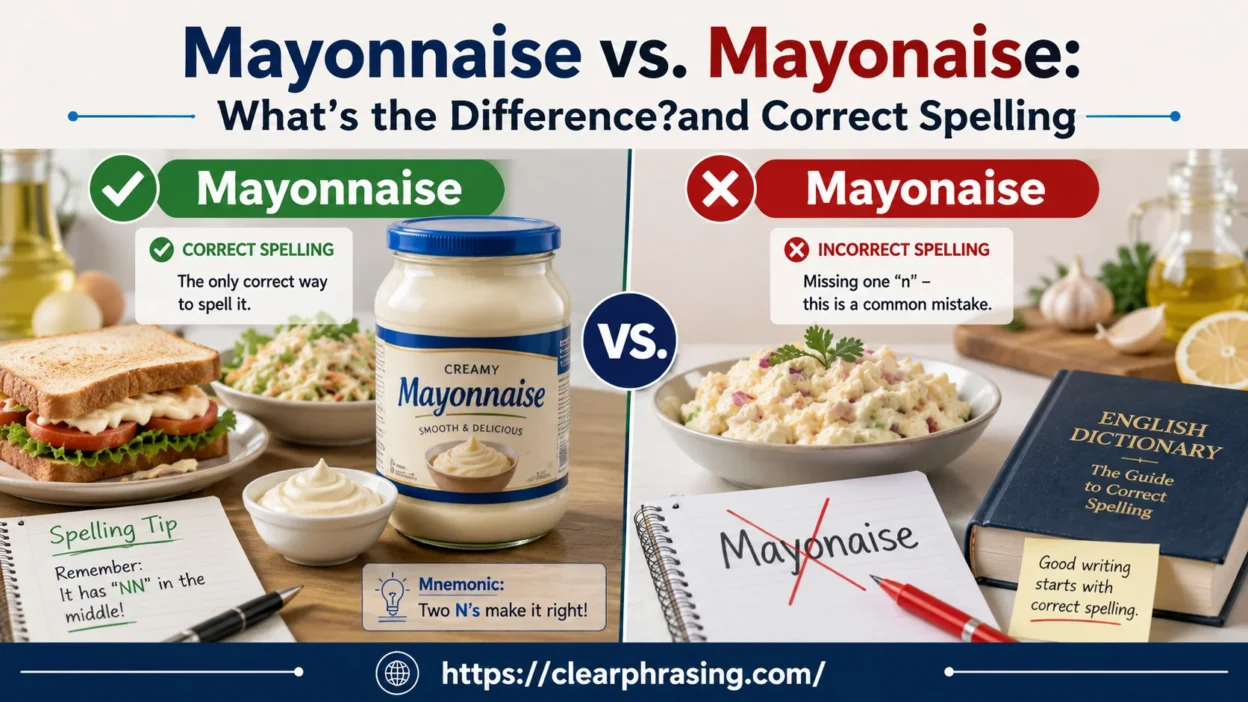
Mayonnaise vs. Mayonaise: Difference and Correct Spelling explains why correct spelling matters in English writing and improves language
The main difference between Mayonnaise and mayonaise is the spelling. Mayonnaise is the correct and standard form, while mayonaise is an incorrect variant and a common mistake in English. This creamy condiment is a popular sauce made with egg yolks, oil, vinegar, lemon juice, and seasonings. This French word means egg yolk sauce, and its definition explains a food preparation used in many dishes.
As an English teacher, I have noticed that spelling mistakes can affect credibility and effective communication. Using the correct spelling improves language usage and helps people write more accurately. Mayonnaise is used in sandwiches, salads, and dips, while homemade versions can be made from scratch. Its history includes spelling variations like mayonnaisse, mayonaisse, and mahonnaise, but none rivals the accepted form. Knowing this one-letter difference improves writing accuracy.
Quick Answer:
The correct spelling is mayonnaise.
Mayonaise is not the accepted spelling in standard English. It is simply a common misspelling that happens because many people write the word according to its pronunciation.
Here is the simple difference:
| Word | Correct Spelling | Usage |
| Mayonnaise | ✅ Correct | Used in English writing, recipes, and dictionaries |
| Mayonaise | ❌ Incorrect | Common spelling mistake |
Examples:
✅ I added mayonnaise to my sandwich.
✅ This salad tastes better with homemade mayonnaise.
❌ I bought a jar of mayonaise from the store.
If you want to write correctly in English, always choose mayonnaise.
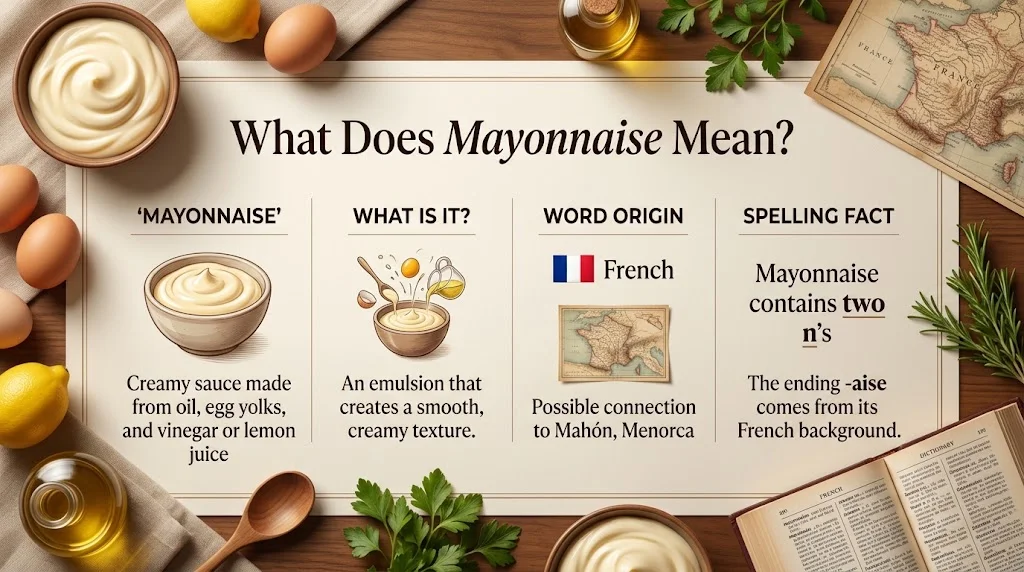
What Does Mayonnaise Mean?
Definition
Mayonnaise is a thick and creamy sauce made by combining oil, egg yolks, and an acidic ingredient such as vinegar or lemon juice. Some versions also include mustard, salt, sugar, herbs, or spices to create different flavors.
In cooking, mayonnaise is known as an emulsion. An emulsion happens when two ingredients that normally separate are blended together into a smooth mixture. In this case, oil combines with egg yolks and other liquids to create a creamy texture.
Many people use mayonnaise as a spread, dressing, dip, or ingredient. It adds moisture and richness to food, which is why it appears in thousands of recipes around the world.
Simple Meaning
Mayonnaise = A creamy sauce made mainly from oil, egg yolks, and vinegar or lemon juice.
Origin of the Word
The word mayonnaise comes from French. English adopted the word during the early nineteenth century when French cuisine became more influential around the world.
The exact origin of the name is still debated. However, one popular theory connects it to Mahón, a city on the Spanish island of Menorca. According to this explanation, French soldiers discovered a similar sauce after capturing the city in 1756 and later introduced it to French cuisine.
Over time, the French developed the sauce and the name became mayonnaise. When English borrowed the word, it kept much of the original spelling.
This explains why the spelling looks unusual today. The word carries its French history with it.
Key Facts About Mayonnaise
- The word entered English from French.
- The modern spelling has remained stable for many years.
- It contains two n’s.
- The ending -aise comes from its French background.
- Mayonnaise is the only accepted spelling in standard English.
Common Uses of Mayonnaise
Mayonnaise is one of the most popular condiments because it works well with many different foods.
Common uses include:
- Sandwich spreads
- Burger sauces
- Salad dressings
- Pasta salads
- Potato salads
- Coleslaw
- Chicken salad
- Tuna salad
- Dipping sauces
- Wrap fillings
- Homemade sauces
For example:
- The chef prepared a garlic mayonnaise for the seafood dish.
- She mixed mayonnaise with vegetables to make a creamy salad.
- Many restaurants use mayonnaise as a base for special sauces.
Whether you see it in a kitchen, restaurant, or grocery store, the spelling remains the same: mayonnaise.
Is Mayonaise a Real Word?
No, mayonaise is not considered a correct English word.
It appears frequently online because many people type it by mistake. However, common usage does not always mean correct usage. A word can appear thousands of times on the internet and still be considered incorrect.
For example, people often misspell words like:
- Definately instead of definitely
- Recieve instead of receive
- Seperate instead of separate
The same situation applies to mayonaise.
You should avoid using mayonaise in:
- Academic writing
- Professional documents
- Recipes
- Articles
- Business communication
- Food labels
The correct choice is always mayonnaise.
Why People Spell It This Way
There are several reasons why people write mayonaise instead of mayonnaise.
The Pronunciation Creates Confusion
The pronunciation of mayonnaise does not clearly reveal every letter.
Many people say it like:
may-uh-naze
When spoken quickly, the second n is easy to miss. Because of this, writers often spell the word based on sound rather than memory.
English has many words with unusual spelling patterns. Mayonnaise is another example where pronunciation and spelling do not perfectly match.
The Double “N” Is Easy to Forget
Repeated letters often create spelling problems.
Some examples include:
- Necessary
- Accommodation
- Committee
- Millennium
When people write quickly, their brain sometimes removes one repeated letter automatically.
The same mistake happens with mayonnaise. People remember the general shape of the word but forget the second n.
Typing Speed and Autocorrect Problems
Modern communication has increased spelling mistakes because people type faster than they write.
You may type mayonaise when:
- Writing a quick message
- Searching for a recipe
- Creating a shopping list
- Posting on social media
Autocorrect helps in many cases, but it doesn’t always catch every mistake. Some devices may even learn incorrect spelling patterns if users repeatedly type them.
That is why knowing the correct spelling remains important.
The French Ending Looks Unusual
The ending -aise is not common in everyday English words.
Many people expect familiar endings like:
- -ase
- -ace
- -ize
Because -aise looks unusual, some writers replace it with a simpler pattern and create the incorrect spelling mayonaise.
However, remembering the original spelling makes the word easier:
Mayon + naise = mayonnaise
The extra n is the key detail that separates the correct spelling from the mistake.
Does Any Dictionary Accept Mayonaise?
No major English dictionary accepts mayonaise as the standard spelling.
Reliable dictionaries list only mayonnaise.
These include:
- Merriam-Webster
- Cambridge Dictionary
- Oxford English Dictionary
- Collins Dictionary
If you search for mayonaise online, you may still find results. However, search engines show what people type, not always what is correct.
A common mistake can become popular, but popularity does not change grammar rules.
When you need accurate English, trust recognized dictionaries instead of internet habits.
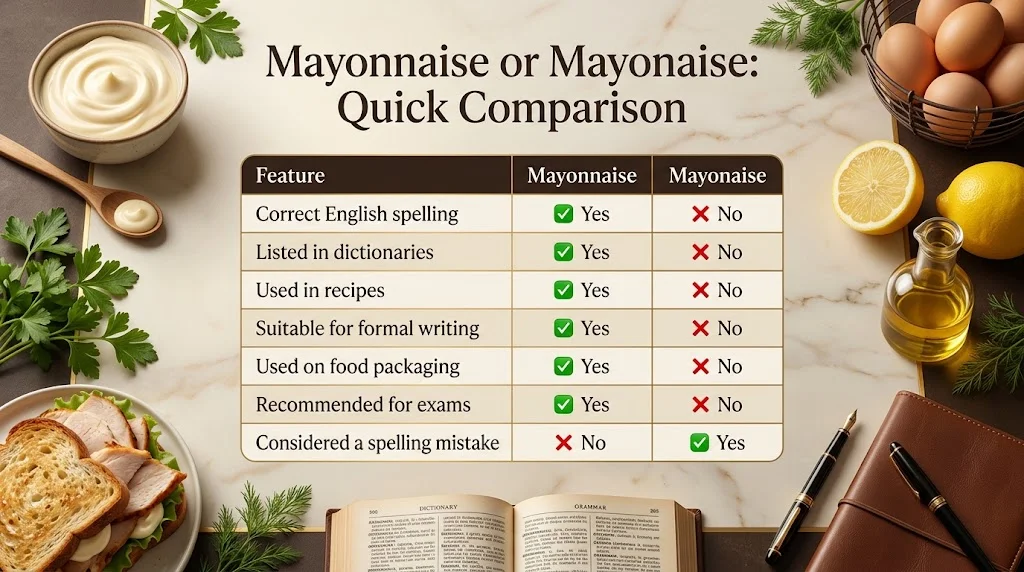
Side-by-Side Comparison
| Feature | Mayonnaise | Mayonaise |
| Correct English spelling | ✅ Yes | ❌ No |
| Listed in dictionaries | ✅ Yes | ❌ No |
| Used in recipes | ✅ Yes | ❌ No |
| Suitable for formal writing | ✅ Yes | ❌ No |
| Used on food packaging | ✅ Yes | ❌ No |
| Recommended for exams | ✅ Yes | ❌ No |
| Considered a spelling mistake | ❌ No | ✅Yes |
The answer is simple: mayonnaise is correct, and mayonaise should be avoided.
Examples of Mayonnaise in Sentences
Understanding the correct spelling becomes easier when you see mayonnaise used in real situations. The word appears mostly in food-related conversations, recipes, and everyday writing.
Here are some examples:
- I prefer mayonnaise instead of ketchup on my sandwich.
- The recipe requires one cup of mayonnaise and two tablespoons of mustard.
- She prepared a homemade garlic mayonnaise for the dinner party.
- Many restaurants create special sauces by mixing mayonnaise with herbs and spices.
- The chef added mayonnaise to make the salad creamier.
The word can also appear in more detailed sentences:
- The restaurant offers a spicy mayonnaise sauce that pairs well with fried chicken.
- Homemade mayonnaise often has a fresher taste because it contains simple ingredients.
- Some people replace traditional mayonnaise with lighter versions made from yogurt or other alternatives.
Whether you’re writing a recipe or having a casual conversation, the spelling remains mayonnaise.
Incorrect Examples Using Mayonaise (And How to Fix Them)
Because mayonaise looks and sounds reasonable, many people use it without realizing it is incorrect. The following examples show common mistakes and their corrections.
| Incorrect Sentence | Correct Sentence | Explanation |
| I added mayonaise to my burger. | I added mayonnaise to my burger. | The word needs two n’s. |
| This recipe uses homemade mayonaise. | This recipe uses homemade mayonnaise. | Mayonaise is not the standard spelling. |
| The chef prepared a spicy mayonaise sauce. | The chef prepared a spicy mayonnaise sauce. | Professional writing requires the correct form. |
| She bought a jar of mayonaise yesterday. | She bought a jar of mayonnaise yesterday. | The missing n creates a spelling error. |
A useful habit is to slow down when writing words that have unusual spelling patterns. Many mistakes happen because people write quickly and trust their memory instead of checking.
Common Foods That Contain Mayonnaise
Mayonnaise is much more than a simple sandwich spread. It plays an important role in many recipes because it adds creaminess, flavor, and moisture.
Some popular foods that commonly contain mayonnaise include:
Sandwiches and Burgers
Many sandwiches use mayonnaise as a spread because it prevents the bread from becoming dry while adding a smooth texture.
Common examples include:
- Chicken sandwiches
- Tuna sandwiches
- Club sandwiches
- Burgers
- Wraps
Salads
Mayonnaise is a key ingredient in many cold salads.
Examples include:
- Potato salad
- Egg salad
- Chicken salad
- Pasta salad
- Coleslaw
In these dishes, mayonnaise helps combine the ingredients and creates a creamy consistency.
Dips and Sauces
Many popular dipping sauces begin with a mayonnaise base.
Examples include:
- Garlic mayonnaise
- Spicy mayonnaise
- Chipotle mayonnaise
- Herb mayonnaise
- Aioli-style sauces
Restaurants often customize mayonnaise by adding spices, herbs, or other ingredients.
Baked and Prepared Foods
Some recipes use mayonnaise to improve texture.
Examples include:
- Casseroles
- Sandwich fillings
- Appetizers
- Seafood dishes
Because mayonnaise has a mild flavor and smooth texture, it works well with many different ingredients.
How to Remember the Correct Spelling of Mayonnaise
Many people struggle with mayonnaise because the spelling looks longer than the word sounds. A simple memory technique can make it easier.
Remember the Double N
The biggest difference between the correct and incorrect spelling is the second n.
Think of it this way:
Mayon + naise = mayonnaise
The word has:
- Mayon
- naise
Together, they create mayonnaise.
Break the Word Into Parts
Instead of memorizing the entire word at once, divide it into smaller sections:
May – on – naise
This method helps your brain recognize the spelling pattern.
Connect It With Food
You can also create a mental picture.
Imagine a sandwich with a label saying:
“Made with mayonnaise”
Visual connections often help people remember difficult spellings.
Practice Writing It
Writing the word several times can strengthen your memory.
Try writing:
- mayonnaise
- mayonnaise sauce
- homemade mayonnaise
- mayonnaise recipe
After repeated use, the correct spelling will feel natural.
Is the Spelling Different in American and British English?
No. The spelling mayonnaise is the same in both American and British English.
Unlike some words that change between the two varieties, such as:
- Color / Colour
- Center / Centre
- Flavor / Flavour
Mayonnaise does not have a different American or British spelling.
Both regions use:
✅ Mayonnaise
Not:
❌ Mayonaise
Examples:
American English:
- The sandwich contains mayonnaise.
British English:
- The sandwich contains mayonnaise.
The spelling stays consistent worldwide.
What Do Major Dictionaries Say About Mayonnaise?
Trusted dictionaries confirm that mayonnaise is the correct spelling.
Merriam-Webster
Merriam-Webster defines mayonnaise as a thick dressing made mainly from egg yolks, vegetable oil, and vinegar or lemon juice.
Cambridge Dictionary
Cambridge recognizes mayonnaise as a creamy sauce commonly used with food.
Oxford English Dictionary
Oxford records the word as an English borrowing from French.
Collins Dictionary
Collins also lists mayonnaise as the standard form.
The agreement among major dictionaries makes the spelling clear. There is no accepted variation called mayonaise.
Related Words You Should Know
Understanding similar food terms can help you use mayonnaise correctly.
Mayo
Mayo is a shortened informal form of mayonnaise.
Examples:
- I like extra mayo on my sandwich.
- This burger needs more mayo.
It is common in everyday speech but less formal than the full word.
Aioli
Aioli is another creamy sauce that is often compared with mayonnaise.
Traditional aioli comes from Mediterranean cuisine and is made mainly with garlic and olive oil. Modern versions may include egg, making them similar to mayonnaise.
Dressing
A dressing is usually a sauce added to salads.
Examples:
- Ranch dressing
- Caesar dressing
- Vinaigrette dressing
Mayonnaise can be an ingredient in some dressings.
Condiment
A condiment is any food item added to improve flavor.
Examples:
- Ketchup
- Mustard
- Relish
- Mayonnaise
Mayonnaise is considered a condiment because people add it to food rather than eat it as a main dish.
Common Mistakes to Avoid When Writing Mayonnaise
Even fluent English speakers sometimes make mistakes with this word. Here are the most common ones.
Writing Mayonaise Without the Second N
This is the biggest mistake.
Incorrect:
❌ mayonaise
Correct:
✅ mayonnaise
Assuming Pronunciation Shows the Spelling
English spelling does not always follow sound rules.
Just because you don’t clearly hear every letter doesn’t mean the letter is missing.
Using Incorrect Spellings in Professional Content
If you write food articles, menus, recipes, or product descriptions, spelling errors can affect credibility.
Readers may question other information if they notice repeated spelling mistakes.
Trusting Search Suggestions
Search engines often show popular searches, including mistakes.
A word appearing online does not automatically make it correct.
Always check reliable sources when you are unsure.
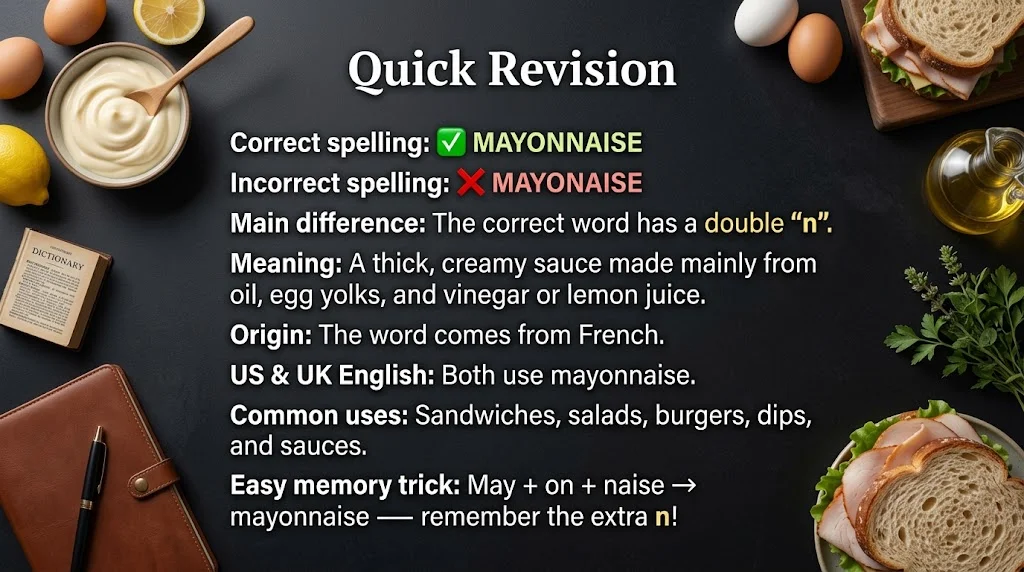
Quick Revision
- Correct spelling: ✅ Mayonnaise
- Incorrect spelling: ❌ Mayonaise
- Main difference: The correct word has a double “n”.
- Meaning: A thick, creamy sauce made mainly from oil, egg yolks, and vinegar or lemon juice.
- Origin: The word comes from French.
- US & UK English: Both use mayonnaise.
- Common uses: Sandwiches, salads, burgers, dips, and sauces.
- Easy memory trick: May + on + naise → mayonnaise — remember the extra n!
Quick Example
✅ I added mayonnaise to my sandwich.
❌ I added mayonaise to my sandwich.
Final rule: Always write mayonnaise, never mayonaise.
Practice Section ✍️
A. Choose the Correct Spelling
- I put (mayonnaise / mayonaise) on my sandwich.
- This recipe needs homemade (mayonnaise / mayonaise).
- She bought a jar of (mayonnaise / mayonaise).
- The chef made a spicy (mayonnaise / mayonaise) sauce.
- Potato salad often contains (mayonnaise / mayonaise).
B. Correct the Mistake
Rewrite these sentences correctly:
- I don’t like mayonaise on my burger.
- She made a sandwich with mayonaise.
- This mayonaise tastes delicious.
C. Fill in the Blank
Complete each sentence with mayonnaise:
- I added __________ to my chicken sandwich.
- Homemade __________ can taste very fresh.
- The salad dressing contains __________ and herbs.
Remember: ✅ Mayonnaise has a double “n.”
Read More: I Was Told vs. I Have Been Told vs. I Am Told: Complete Difference
FAQs
Q1. Is mayonnaise the correct spelling or is mayonaise also accepted?
Mayonnaise is the correct spelling used in standard English dictionaries. Mayonaise is only a common misspelling and is not considered a correct English word.
Q2. Why do people spell mayonnaise as mayonaise?
Many people write mayonaise because the pronunciation does not clearly show the extra “n.” This missing letter creates a common spelling mistake among English learners.
Q3. What is the meaning of mayonnaise?
Mayonnaise is a creamy sauce or condiment made from egg yolks, oil, vinegar or lemon juice, and seasonings. It is commonly used in sandwiches, salads, and dips.
Q4. Is mayonnaise an English word?
Yes, mayonnaise is used in English, although it originally comes from French. English adopted this word to describe a popular egg-based sauce.
Q5. What is the difference between mayonnaise and mayonaise?
The main difference is the spelling. Mayonnaise is the correct form, while mayonaise is an incorrect spelling that is not accepted in standard English.
Q6. Can I use mayonaise in a recipe?
No, you should use mayonnaise in recipes, articles, and formal writing. Using mayonaise can make your writing appear incorrect.
Q7. What ingredients are used to make mayonnaise?
Traditional mayonnaise contains egg yolks, oil, vinegar or lemon juice, and seasonings. Different recipes may include extra flavors for unique variations.
Q8. Are mayonnaisse, mayonaisse, and mahonnaise correct spellings?
No, mayonnaisse, mayonaisse, and mahonnaise are spelling variations that appeared over time, but mayonnaise is the accepted English spelling.
Q9. How can I remember the correct spelling of mayonnaise?
You can remember mayonnaise by focusing on the double “n” in the middle of the word. This helps avoid the common mayonaise mistake.
Q10. Why is correct spelling important when writing about mayonnaise?
Correct spelling improves accuracy, credibility, and communication. Using the right word helps readers understand your message and makes your writing more professional.
Conclusion
Choosing between mayonnaise and mayonaise is simple once you understand the correct spelling rule. Mayonnaise is the only accepted spelling in standard English, while mayonaise is a common mistake that should be avoided in writing, recipes, and professional communication.
As an English teacher, I believe that small spelling details create a big difference in clear communication. Learning the correct form not only improves your language usage but also builds confidence in your writing skills. Whenever you write about this popular condiment, remember that mayonnaise is the correct choice.Mayonnaise vs. Mayonaise:Difference and Correct Spelling explains why correct spelling matters in English writing and improves language
The main difference between Mayonnaise and mayonaise is the spelling. Mayonnaise is the correct and standard form, while mayonaise is an incorrect variant and a common mistake in English. This creamy condiment is a popular sauce made with egg yolks, oil, vinegar, lemon juice, and seasonings. This French word means egg yolk sauce, and its definition explains a food preparation used in many dishes.
As an English teacher, I have noticed that spelling mistakes can affect credibility and effective communication. Using the correct spelling improves language usage and helps people write more accurately. Mayonnaise is used in sandwiches, salads, and dips, while homemade versions can be made from scratch. Its history includes spelling variations like mayonnaisse, mayonaisse, and mahonnaise, but none rivals the accepted form. Knowing this one-letter difference improves writi

Shamsa Kanwal is an English specialist and content writer at ClearPhrasing.com, where she helps readers navigate the English language with confidence. She enjoys breaking down grammar rules, spelling differences, vocabulary, and everyday writing challenges into simple, practical lessons that anyone can understand.
Her writing is focused on making learning approachable rather than overwhelming. Whether she’s explaining commonly confused words, punctuation rules, or grammar concepts, Shamsa believes that clear explanations and real-life examples are the key to effective learning.
Every article she writes is carefully researched, fact-checked, and edited to ensure it is accurate, easy to read, and genuinely helpful. Her goal is to create trustworthy resources that enable students, professionals, writers, and English learners to improve their communication skills and write with greater clarity.
Through her work at ClearPhrasing.com, Shamsa is committed to making English learning simpler, more practical, and accessible for readers around the world.