Beside vs Besides: What’s the Difference? and Usage helps English learners understand the difference between these confusing words.
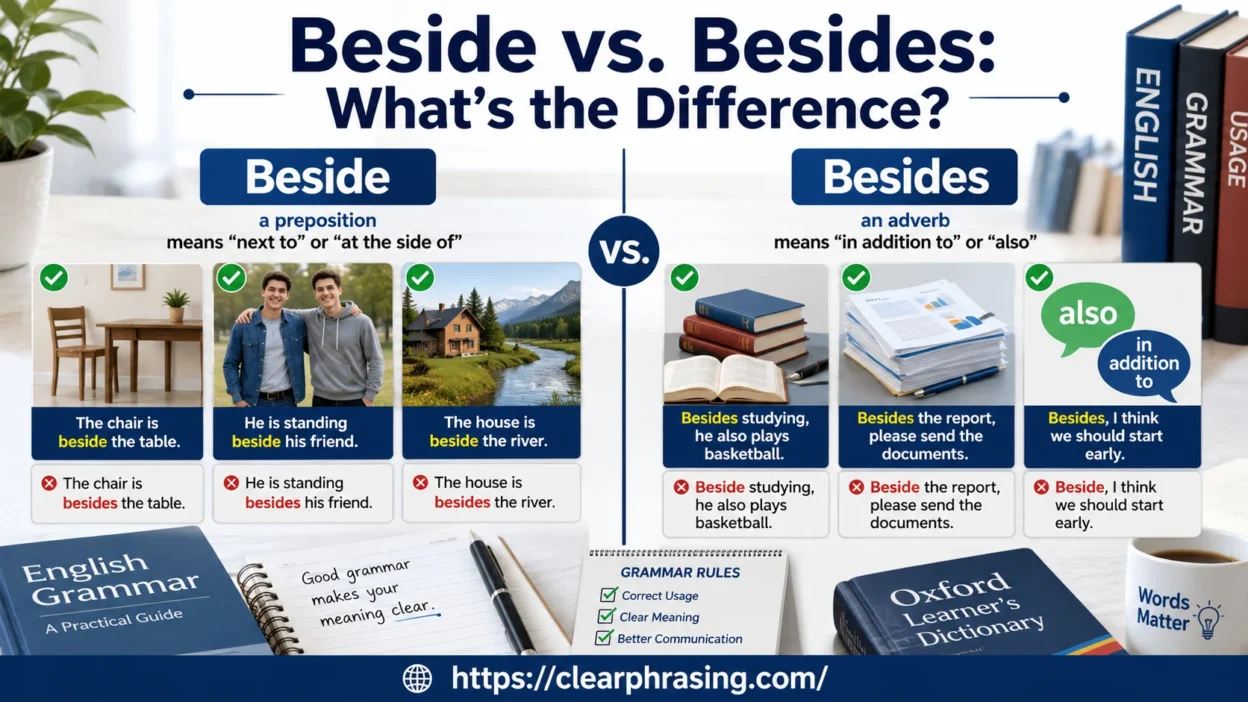
Their spelling, pronunciation, and sound are very similar, so many native speakers and students mix them. The trick is to focus on the meaning, context, and parts of speech. Beside is a preposition that means next to or at the side of. Besides works as a preposition and an adverb. It means in addition to, apart from, moreover, or furthermore. As an English teacher, I have found that one simple example with clear grammar rules always helps learners understand the distinction.
Think of the picture each word paints. Beside refers to location and physical proximity. Besides indicates addition or an alternative. These examples improve English grammar, English usage, sentence structure, communication, conversation, writing, speech, vocabulary, and word choice. Every learner should learn by using the words in real sentences.
This knowledge can impress others in class and make your language skills stronger. Don’t worry if you feel confusion at first. A quick glance at the comparison and the right explanation will help you figure out the entire rule.
Quick Answer
The difference between beside and besides is easy to remember.
- Beside means next to or at the side of.
- Besides means in addition to, also, or apart from.
For example:
- The chair is beside the table.
- Besides the table, we also bought new chairs.
If your sentence talks about location, use beside. If it adds another person, thing, or reason, use besides.
Why Do People Confuse Beside and Besides?
At first glance, the two words appear almost identical. Since they differ by only one letter, many people assume they have similar meanings. In reality, they serve completely different grammatical purposes.
Another reason for the confusion is that both words function as prepositions in certain situations. Without understanding the context, writers often choose the wrong one simply because it sounds familiar.
Many English learners also translate directly from their native language. In some languages, one word covers both meanings, which makes the distinction harder to notice in English.
Fortunately, once you connect beside with position and besides with addition, the confusion quickly disappears.
What Does “Beside” Mean?
Definition of Beside
Beside is a preposition that means next to, by the side of, or close to someone or something.
It answers one simple question:
Where?
When to Use Beside
Use beside whenever you’re describing the physical position of a person, place, or object.
Examples:
- She sat beside her grandmother.
- The bicycle is beside the garage.
- Our hotel stands beside the beach.
- He walked beside his friend.
- A lamp stood beside the sofa.
Each sentence describes the location of something.
Common Situations Where You Use Beside
You’ll often see beside in sentences about:
- Furniture placement
- People sitting or standing together
- Buildings and landmarks
- Vehicles
- Nature and landscapes
Examples:
- The hospital is beside the park.
- Please sit beside me.
- We found a cabin beside the lake.
- His office is beside the elevator.
- The restaurant is beside the hotel.
Figurative Meaning of Beside
Although less common, beside also appears in the expression beside yourself.
This idiom describes someone experiencing an overwhelming emotion.
Examples:
- She was beside herself with excitement.
- He was beside himself with anger.
- They were beside themselves with happiness.
Notice that this meaning has nothing to do with physical location.
What Does “Besides” Mean?
Definition of Besides
Besides means in addition to, also, furthermore, or apart from, depending on the sentence.
Unlike beside, it never describes physical position.
Instead, it introduces extra information.
When to Use Besides
Use besides whenever you add another person, object, reason, or idea.
Examples:
- Besides English, she speaks Italian.
- We packed blankets besides food.
- Besides his experience, he has excellent communication skills.
- She enjoys painting besides writing.
- Besides your passport, you’ll need your visa.
Each example expands the original statement.
Besides as a Transition Word
Writers also use besides to connect ideas.
In this role, it means also, moreover, or furthermore.
Examples:
- I don’t want to go. Besides, I’m busy.
- The restaurant was expensive. Besides, the service wasn’t good.
- We should leave now. Besides, it’s getting dark.
This use is common in both speech and writing.
Beside vs Besides: Side-by-Side Comparison
| Feature | Beside | Besides |
| Primary Meaning | Next to | In addition to |
| Indicates Position | Yes | No |
| Adds Information | No | Yes |
| Part of Speech | Preposition | Preposition or Adverb |
| Common Question Answered | Where? | What else? |
| Example | Sit beside me. | Besides me, John came too. |
Although the words look alike, their purposes never overlap. One points to location, while the other introduces additional information.
Grammar Rules for Beside and Besides
Beside Always Functions as a Preposition
A preposition links one noun to another by showing a relationship.
With beside, that relationship is always location.
Examples:
- The flowers grew beside the fence.
- He parked beside the building.
- My notebook is beside the keyboard.
Replacing beside with next to should still make perfect sense.
Besides Can Function as a Preposition
When besides introduces another item or person, it acts as a preposition.
Examples:
- Besides soccer, she enjoys tennis.
- Besides Alex, nobody arrived early.
- Besides homework, students completed a quiz.
Besides Can Also Function as an Adverb
When it introduces another reason or supporting point, besides becomes an adverb.
Examples:
- We shouldn’t leave yet. Besides, everyone is still here.
- The plan costs too much. Besides, it isn’t practical.
- She declined the offer. Besides, she had another opportunity.
Understanding these two grammatical roles makes besides much easier to identify.
Pronunciation Guide
Although the spellings are similar, the pronunciation changes slightly because of the final S.
| Word | Pronunciation | Sounds Like |
| Beside | bih-SYD | “be side” |
| Besides | bih-SYDZ | “be sides” |
Listening carefully to native speakers will help you notice this subtle difference in everyday conversation.
Easy Tricks to Remember the Difference
Think About Position
If someone asks, “Where is it?”, your answer probably needs beside.
Example:
- The keys are beside the wallet.
Think About Addition
If someone asks, “What else?”, your answer probably needs besides.
Example:
- Besides the keys, bring your phone.
Remember the Extra Letter
The extra S in besides can remind you of something extra.
Extra letter.
Extra information.
It’s a simple memory trick that works surprisingly well.
Real Sentence Comparisons
Seeing both words in similar sentences helps the rule stick.
| Beside | Besides |
| The cat slept beside the fireplace. | Besides the cat, the dog stayed inside too. |
| She stood beside her brother. | Besides her brother, her cousin attended. |
| The café sits beside the museum. | Besides coffee, the café serves fresh pastries. |
| Park beside the entrance. | Besides parking, the hotel offers free breakfast. |
| He walked beside me all afternoon. | Besides me, three coworkers joined the meeting. |
Notice how the word changes the meaning even though the sentence structure remains similar.
Most Common Mistakes
These mistakes appear frequently in school assignments, emails, business writing, and social media posts.
| Incorrect Sentence | Correct Sentence | Explanation |
| Besides the river stood a cabin. | Beside the river stood a cabin. | Location requires beside. |
| Beside science, she studies history. | Besides science, she studies history. | Additional subject requires besides. |
| My phone is besides my laptop. | My phone is beside my laptop. | Physical position. |
| Beside, we already agreed. | Besides, we already agreed. | Adds another reason. |
| Besides the door is a window. | Beside the door is a window. | Refers to place. |
A simple proofreading trick can prevent nearly every mistake.
Replace the word with next to. If the sentence still makes sense, beside is correct.
If in addition to, also, or apart from fits naturally, choose besides instead.
Beside Yourself: Meaning and Usage
One of the most common expressions that uses beside is beside yourself. This idiom doesn’t describe physical location. Instead, it describes a person experiencing such a strong emotion that they seem overwhelmed.
You can use it for both positive and negative emotions.
Examples
- She was beside herself with excitement after getting the job.
- He was beside himself with grief after hearing the news.
- They were beside themselves with joy when their team won.
- The parents were beside themselves with worry until their child arrived home safely.
A common mistake is writing besides yourself in this expression. That is incorrect because the phrase refers to an emotional state, not adding information.
Using Besides as a Transition Word
Besides acting as a preposition, besides often introduces another reason or supporting idea. In this role, it works much like moreover, furthermore, or also.
Examples in Everyday Conversation
- I don’t want pizza. Besides, we already have dinner planned.
- We should leave now. Besides, traffic will only get worse.
- She didn’t buy the dress. Besides, it didn’t fit well.
Examples in Academic Writing
- The study included more participants. Besides, researchers collected additional data over six months.
- Online learning saves time. Besides, it offers greater flexibility for many students.
Examples in Business Writing
- The proposal reduces costs. Besides, it improves customer satisfaction.
- We should upgrade the software. Besides, the current version no longer receives security updates.
Using besides as a transition creates smoother writing because it naturally connects related ideas.
Beside vs. Besides in Real-Life Situations
Understanding grammar rules is helpful, but applying them in everyday situations makes them stick.
At Home
Correct:
- The remote is beside the television.
- Besides the television, we bought a new sound system.
At School
Correct:
- Emma sat beside her teacher.
- Besides math, Emma enjoys science.
At Work
Correct:
- My office is beside the conference room.
- Besides managing projects, she trains new employees.
While Traveling
Correct:
- Our hotel is beside the beach.
- Besides visiting museums, we explored local markets.
These examples show that beside answers Where? while besides answers What else?
British vs American English
Good news for English learners: American English and British English use beside and besides in the same way.
There are no spelling differences between the two varieties of English.
| American English | British English | Meaning |
| Sit beside me. | Sit beside me. | Next to |
| Besides English, I speak French. | Besides English, I speak French. | In addition to |
Although vocabulary sometimes differs between American and British English, the grammar rules for these two words remain identical.
Words Commonly Confused with Beside and Besides
Several English words have similar meanings. Knowing how they differ helps you choose the most accurate one.
| Word | Meaning | Example |
| Beside | Next to | The chair is beside the desk. |
| Besides | In addition to | Besides coffee, we have tea. |
| Next to | Very close to | The school is next to the library. |
| Alongside | Together with or next to | She worked alongside experienced engineers. |
| Apart from | Except for or in addition to | Apart from one mistake, the report was excellent. |
| Moreover | Furthermore | Moreover, sales increased this year. |
| Furthermore | Adds another point | Furthermore, the results exceeded expectations. |
Each word has its own purpose, so choosing the right one improves clarity.
Quick Memory Cheat Sheet
| If You Mean… | Use |
| Next to | Beside |
| At the side of | Beside |
| In addition to | Besides |
| Also | Besides |
| Furthermore | Besides |
| Another reason | Besides |
Easy Rule to Remember
- Beside = Side
- Besides = Something Extra
That simple association helps many learners remember the difference instantly.
Mini Quiz
Choose the correct word.
- The bicycle is ________ the garage.
- ________ English, she speaks Japanese.
- My seat is ________ the window.
- I won’t attend the meeting. ________, I’m on vacation.
- The pharmacy is ________ the hospital.
- ________ homework, students completed a group project.
- He stood ________ his father during the ceremony.
- ________ Mark, everyone arrived early.
- The coffee shop is ________ the bookstore.
- She was ________ herself with happiness after winning the award.
Answers
- beside
- Besides
- beside
- Besides
- beside
- Besides
- beside
- Besides
- beside
- beside
Key Takeaways
- Beside refers to physical position.
- Besides introduces additional information.
- Beside always functions as a preposition.
- Besides functions as both a preposition and an adverb.
- The expression beside yourself is always correct.
- Besides yourself is incorrect in that idiom.
- Both American and British English follow the same grammar rules.
- Replacing beside with next to is a quick way to check your sentence.
- Replacing besides with also or in addition to helps confirm the correct choice.
Read More: Mayonnaise vs. Mayonaise: Difference and Correct Spelling
FAQs
Q1. What is the main difference between beside and besides?
Beside means next to or at the side of someone or something. Besides means in addition to, apart from, or moreover. Although they look similar, they serve different purposes in a sentence.
Q2. Is beside a preposition?
Yes. Beside is always used as a preposition. It shows physical location or position, such as The chair is beside the window.
Q3. Can besides be both a preposition and an adverb?
Yes. Besides works as a preposition when it means in addition to and as an adverb when it means moreover or also.
Q4. Why do people confuse beside and besides?
They have nearly identical spellings and similar pronunciation. Many learners focus on how the words look instead of what they mean, which leads to confusion.
Q5. Which word should I use to describe location?
Use beside whenever you are talking about physical position or something that is next to another object or person.
Q6. Which word adds extra information to a sentence?
Use besides when you want to add another point, mention something additional, or introduce more information.
Q7. Is besides correct in formal writing?
Yes. Besides is acceptable in both formal and informal writing as long as it is used with the correct meaning.
Q8. Can native English speakers mix up these words?
Yes. Even native speakers occasionally choose the wrong word, especially when writing quickly. Careful proofreading usually catches the mistake.
Q9. What is an easy way to remember the difference?
Remember that beside points to a place, while besides adds something extra. Think of the extra s in besides as standing for “something more.”
Q10. How can I master the use of beside and besides?
Practice by reading, writing, and creating your own example sentences. Seeing the words in context will help you remember them naturally.
Conclusion
Beside and besides may differ by only one letter, but they have very different meanings. Once you know that beside shows location and besides adds information, choosing the correct word becomes much easier.
As an English teacher, I have found that regular practice is the best way to remember grammar rules. Read real examples, write your own sentences, and review your mistakes. Before long, using beside and besides correctly will become a natural habit.

Mehwish Imtiaz is an English specialist and professional blog writer at ClearPhrasing.com. She specializes in grammar, spelling, vocabulary, punctuation, and writing improvement. With a strong passion for clear communication and language education, she creates reader-friendly articles that help students, professionals, and English learners understand complex language topics with ease.
Her writing focuses on accuracy, simplicity, and practical usage, ensuring that every article provides clear explanations and real-world examples. At ClearPhrasing.com, Mehwish is committed to publishing well-researched, original content that helps readers write more confidently and communicate more effectively in everyday and professional English.