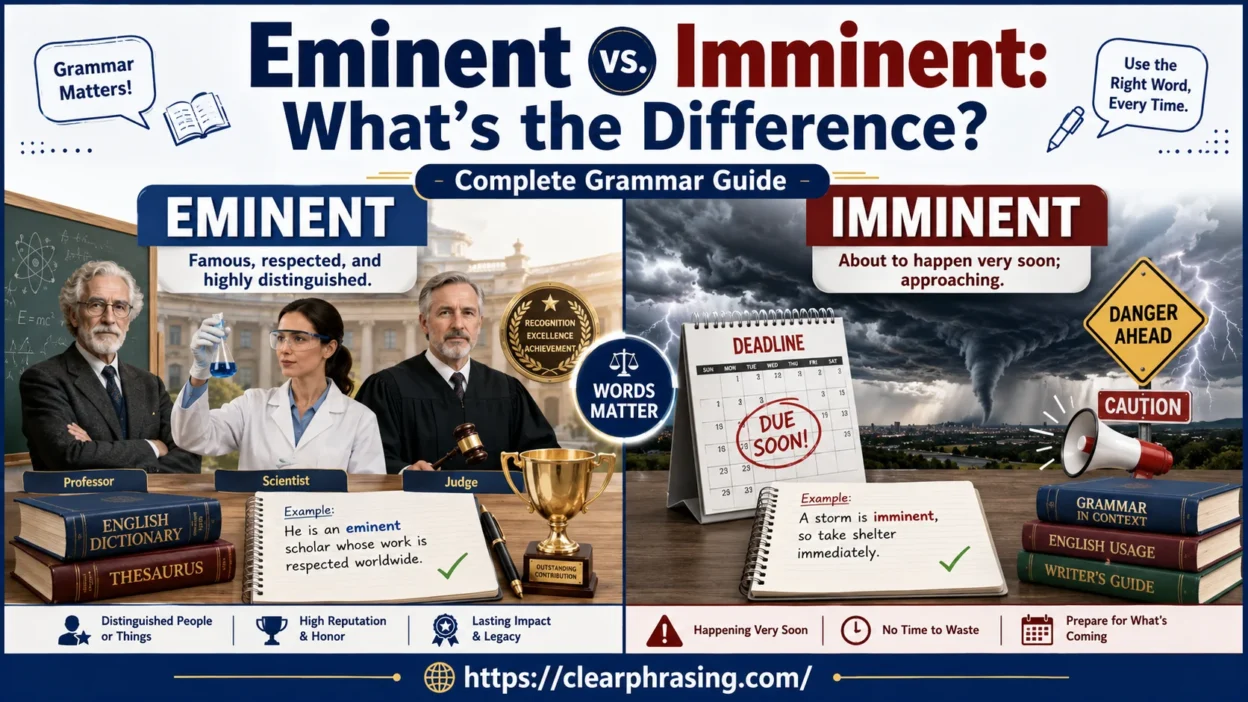
Eminent vs. Imminent: What’s the Difference? helps English learners understand two similar words with different meanings.
Many people confuse Eminent and Imminent because they sound alike, but their difference is clear. Eminent describes a famous, well-known, and respected person, such as an eminent scientist or eminent historian with recognition, expertise, and achievement.
Imminent means something is coming or about to occur very soon. A storm can be imminent when dark clouds gather, showing timing and nearness. Remembering this distinction improves English vocabulary, grammar, word choice, and helps avoid common mistakes in communication and writing.
This guide explains the meanings, grammar, examples, memory tricks, and common mistakes in simple language. By the end, you’ll know exactly when to use eminent and when imminent is the better choice.
Quick Answer:
| Word | Meaning | Part of Speech | Example |
| Eminent | Famous, respected, or distinguished | Adjective | She is an eminent surgeon. |
| Imminent | About to happen very soon | Adjective | Heavy rainfall is imminent. |
The difference is simple:
- Eminent describes someone’s high reputation or importance.
- Imminent describes something that is about to happen very soon.
Quick example:
- ✅ The university invited an eminent professor.
- ✅ Forecasters warned that flooding was imminent.
Although only one letter separates these words, their meanings have nothing in common.
What Does Eminent Mean?
The word eminent describes someone or something that is highly respected, famous, distinguished, or recognized for excellence.
An eminent person has earned admiration through knowledge, achievements, leadership, or long experience. The word usually refers to professionals who have built outstanding reputations.
Definition of Eminent
According to standard English dictionaries, eminent means:
Well-known and respected because of exceptional achievements, ability, or character.
Pronunciation: EM-uh-nent (/ˈɛmɪnənt/)
Origin of Eminent
The word comes from the Latin word eminere, which means to stand out or rise above. That origin perfectly matches its modern meaning because an eminent person stands above others through talent or accomplishment.
When to Use Eminent
Use eminent when describing someone with outstanding recognition or authority.
Common situations include:
- Distinguished scientists
- Famous doctors
- Respected lawyers
- Celebrated authors
- Influential researchers
- Award-winning artists
- Leading professors
- Experienced judges
- Historic leaders
- Recognized business executives
Notice that eminent almost always describes people. In some cases, it can describe organizations or institutions that have earned exceptional respect.
Examples of Eminent in Sentences
- The hospital hired an eminent heart surgeon.
- She became an eminent environmental scientist.
- An eminent historian delivered the keynote speech.
- The university recognized several eminent scholars.
- Their legal team included an eminent constitutional lawyer.
- The museum honored an eminent painter.
- He consulted an eminent economist before making the investment.
- The conference attracted many eminent researchers.
- Her work made her one of the country’s most eminent educators.
- The committee invited an eminent engineer to review the project.
Real-Life Examples
You often encounter the word eminent in professional and academic settings.
For example:
- An eminent physician publishes groundbreaking medical research.
- An eminent professor receives an international teaching award.
- An eminent architect designs landmark buildings.
- An eminent judge writes influential legal opinions.
These examples all focus on reputation rather than timing.
What Does Imminent Mean?
Unlike eminent, the word imminent refers to time. It describes something that is expected to happen almost immediately.
An event is imminent when there is strong evidence that it will occur very soon.
Definition of Imminent
Most dictionaries define imminent as:
Likely to happen very soon.
Pronunciation: IM-uh-nent (/ˈɪmɪnənt/)
Although the pronunciation closely resembles eminent, the meaning is completely different.
Origin of Imminent
The word comes from the Latin imminere, meaning to overhang or be close at hand.
Over time, English speakers adopted the word to describe events that seem ready to happen.
When to Use Imminent
Use imminent whenever you’re talking about events expected in the near future.
Common examples include:
- Severe storms
- Natural disasters
- Deadlines
- Business announcements
- Medical emergencies
- Product launches
- Elections
- Financial crises
- Policy changes
- School examinations
The focus isn’t whether the event is good or bad. The key idea is that it is very close.
Examples of Imminent in Sentences
- Meteorologists warned that severe thunderstorms were imminent.
- The company announced an imminent product launch.
- Doctors believed surgery was imminent.
- Officials ordered evacuations because flooding was imminent.
- The project deadline is imminent.
- Investors expected an imminent market correction.
- The president addressed the nation before an imminent vote.
- The rescue team prepared for imminent danger.
- A decision appeared imminent after several meetings.
- The arrival of the rescue helicopter was imminent.
Real-Life Examples
You frequently see imminent in news reports.
Examples include:
- Imminent hurricane warning
- Imminent volcanic eruption
- Imminent military action
- Imminent transportation strike
- Imminent school closure
Each phrase describes an event expected very soon.
Eminent vs. Imminent: Side-by-Side Comparison
| Feature | Eminent | Imminent |
| Meaning | Famous or highly respected | About to happen soon |
| Refers to | People, organizations, achievements | Events and situations |
| Part of Speech | Adjective | Adjective |
| Time Related | No | Yes |
| Reputation Related | Yes | No |
| Common Context | Education, law, medicine, science | Weather, business, emergencies, news |
| Example | An eminent lawyer | An imminent deadline |
Looking at both words together makes the distinction much easier.
Think of it this way:
- Eminent = Reputation
- Imminent = Timing
That single idea helps prevent most mistakes.
The Biggest Difference Between Eminent and Imminent
Many learners confuse these words because they sound similar. However, their meanings belong to completely different categories.
Eminent answers this question:
Who has earned great respect?
Imminent answers this question:
What is about to happen?
Consider these examples.
Correct Usage
- The hospital recruited an eminent neurologist.
- Heavy snowfall is imminent.
Incorrect Usage
- ❌ The hospital recruited an imminent neurologist.
- ❌ Heavy snowfall is eminent.
The first incorrect sentence mistakenly suggests the doctor is about to happen. The second incorrectly describes weather as famous or respected.
Changing just one word completely changes the meaning.
Eminent vs. Imminent in Real-Life Contexts
Understanding how professionals use these words makes them easier to remember.
Education
Schools and universities often describe distinguished academics as eminent.
Examples include:
- An eminent linguist
- An eminent mathematician
- An eminent education researcher
However, schools use imminent when discussing upcoming events.
Examples include:
- An imminent examination
- An imminent graduation deadline
- An imminent semester break
Business
Companies frequently use both words, but in different situations.
Eminent
- An eminent entrepreneur
- An eminent financial adviser
- An eminent consultant
Imminent
- An imminent merger
- An imminent product release
- An imminent board decision
News Headlines
News organizations regularly choose these words because they communicate precise meanings.
Examples:
- Eminent Scientist Wins Global Award
- Officials Warn of Imminent Flooding
- Eminent Economist Predicts Market Changes
- Residents Prepare for Imminent Wildfire Threat
The headlines instantly tell readers whether the focus is on a respected person or an approaching event.
Healthcare
Healthcare professionals also distinguish between these words carefully.
Examples of eminent:
- An eminent cardiologist
- An eminent cancer specialist
- An eminent medical researcher
Examples of imminent:
- Imminent delivery
- Imminent cardiac arrest
- Imminent risk of infection
Accuracy matters because confusing the two could change the intended meaning.
Law
Legal writing often includes respected professionals and upcoming actions.
Examples:
- An eminent judge wrote the opinion.
- The court announced an imminent ruling.
- An eminent constitutional lawyer argued the case.
- The hearing’s conclusion was imminent.
Common Mistakes
Because eminent and imminent sound alike, many writers accidentally swap them. This mistake appears in student essays, emails, news comments, and even professional documents.
Here are some of the most common errors:
| Incorrect Usage | Correct Usage | Why? |
| An imminent professor | An eminent professor | A professor can be respected, not about to happen. |
| Eminent danger | Imminent danger | Danger can occur soon. |
| An imminent scientist | An eminent scientist | Scientists earn reputations. |
| Eminent deadline | Imminent deadline | Deadlines relate to time. |
| An imminent lawyer | An eminent lawyer | Lawyers can be distinguished. |
A simple rule helps:
- People = Eminent
- Events = Imminent
That rule won’t solve every sentence, but it works most of the time.
Memory Tricks to Remember Eminent vs. Imminent
A good memory trick can save you from hesitation while writing.
Remembering Eminent
Think of the letter E:
- Expert
- Esteemed
- Excellent
- Educator
All of these words relate to reputation and achievement.
Remembering Imminent
Think of the letter I:
- Incoming
- Immediate
- Is near
These ideas connect to time and approaching events.
Visual Memory Trick
Imagine a famous professor standing on top of a hill.
That professor is eminent because people admire their achievements.
Now imagine dark storm clouds moving quickly toward the hill.
The storm is imminent because it is about to arrive.
Synonyms of Eminent and Imminent
Using synonyms adds variety to your writing.
Synonyms for Eminent
- Distinguished
- Renowned
- Prestigious
- Celebrated
- Influential
- Prominent
- Esteemed
- Respected
- Notable
- Accomplished
Synonyms for Imminent
- Approaching
- Near
- Pending
- Upcoming
- Impending
- Looming
- Close
- Forthcoming
- At hand
- Expected
Choosing the right synonym depends on context.
For example:
- An eminent surgeon = a distinguished surgeon.
- An imminent storm = an approaching storm.
Antonyms of Eminent and Imminent
Understanding opposites often makes meanings clearer.
Antonyms of Eminent
- Unknown
- Obscure
- Ordinary
- Unrecognized
- Average
Antonyms of Imminent
- Distant
- Remote
- Unlikely
- Far away
- Future
Common Collocations
Some words naturally appear together in English. These combinations are called collocations.
Common Eminent Collocations
- Eminent scholar
- Eminent doctor
- Eminent lawyer
- Eminent scientist
- Eminent author
- Eminent historian
- Eminent researcher
- Eminent professor
Common Imminent Collocations
- Imminent danger
- Imminent threat
- Imminent arrival
- Imminent decision
- Imminent collapse
- Imminent release
- Imminent deadline
- Imminent risk
Learning these combinations helps your writing sound more natural.
Eminent vs. Imminent in American and British English
Good news: there is no spelling difference between American and British English.
| Feature | American English | British English |
| Eminent | Same spelling | Same spelling |
| Imminent | Same spelling | Same spelling |
| Meaning | Same | Same |
| Usage | Same | Same |
Pronunciation may vary slightly because of regional accents, but the meanings remain identical.
Grammar Notes
Both eminent and imminent are adjectives.
Adjectives describe nouns.
Examples:
- An eminent scientist
- An imminent threat
They can also appear after linking verbs.
Examples:
- The professor is eminent.
- The danger is imminent.
Sentence Patterns
| Pattern | Example |
| Adjective + Noun | An eminent lawyer |
| Linking Verb + Adjective | The threat is imminent |
| Adverb + Adjective | Highly eminent |
| Very + Adjective | Very imminent |
Frequently Confused Words
Many people also compare these words with similar terms.
| Word | Meaning |
| Eminent | Highly respected |
| Prominent | Well-known or important |
| Famous | Widely recognized |
| Imminent | About to happen |
| Impending | Likely to happen soon |
| Immediate | Happening now |
Eminent vs. Prominent
A person can be prominent because they are visible or influential.
A person is eminent because they have earned great respect.
Imminent vs. Impending
These words are close in meaning.
However, imminent often suggests something very near in time.
Impending can refer to events that are approaching but not necessarily immediate.
Mini Case Study: How One Word Changed the Meaning
Imagine a newspaper headline:
Incorrect: “Imminent Scientist Wins Award”
Readers may wonder whether the scientist is about to happen.
Now read the corrected version:
Correct: “Eminent Scientist Wins Award”
The meaning becomes clear immediately.
This small example shows why word choice matters.
“The difference between the almost right word and the right word is really a large matter.”
— Mark Twain
Practice Quiz
Test your understanding.
Choose the Correct Word
- The university invited an ______ professor.
- Officials warned of ______ flooding.
- She became an ______ expert in genetics.
- The deadline is ______.
- An ______ judge led the investigation.
Answers
- Eminent
- Imminent
- Eminent
- Imminent
- Eminent
Read More: Knew or New: What’s the Difference and Which One Is Correct?
FAQs
Q1: What is the main difference between eminent and imminent?
Eminent describes someone or something that is highly respected, famous, or recognized for excellence. Imminent describes something that is about to happen soon or is approaching.
Q2: Can eminent and imminent be used interchangeably?
No, eminent and imminent cannot be used interchangeably. They have different meanings and are used in different contexts.
Q3: How can I easily remember the meaning of eminent?
You can remember eminent by connecting it with important and respected people. For example, an eminent scientist is someone known for great achievements.
Q4: How can I remember the meaning of imminent?
Think of imminent as something that is near or coming soon. For example, dark clouds may show that a storm is imminent.
Q5: Is eminent only used for people?
Mostly, eminent describes people who have a high reputation, such as an eminent professor or leader. However, it can sometimes describe things with outstanding importance.
Q6: What are some common mistakes people make with eminent and imminent?
Many people confuse these words because they sound similar. A common mistake is using eminent when they mean something is about to happen.
Q7: Can you give examples of eminent and imminent in sentences?
Yes. “The university invited an eminent historian to speak.” “The weather report warned that a storm was imminent.”
Q8: Why do English learners confuse eminent and imminent?
English learners often confuse them because they have similar spellings and pronunciation. Their meanings, however, are completely different.
Q9: What type of word is eminent and imminent?
Both are adjectives. They describe a person, thing, or situation by adding more information to a sentence.
Q10: Why is learning the difference between eminent and imminent important?
Understanding the difference improves your vocabulary, writing, and communication skills. It helps you choose the correct word and express your ideas clearly.
Conclusion
Understanding the difference between eminent and imminent makes your English more accurate and effective. Although these words look and sound similar, their meanings are completely different. Eminent highlights respect, reputation, and achievement, while imminent focuses on something that is about to happen soon.
By learning this simple distinction, you can avoid common vocabulary mistakes and improve your writing and communication skills. As an English teacher, I always encourage learners to understand word meanings in context because the right word choice creates clearer and more confident communication.

Shamsa Kanwal is an English specialist and content writer at ClearPhrasing.com, where she helps readers navigate the English language with confidence. She enjoys breaking down grammar rules, spelling differences, vocabulary, and everyday writing challenges into simple, practical lessons that anyone can understand.
Her writing is focused on making learning approachable rather than overwhelming. Whether she’s explaining commonly confused words, punctuation rules, or grammar concepts, Shamsa believes that clear explanations and real-life examples are the key to effective learning.
Every article she writes is carefully researched, fact-checked, and edited to ensure it is accurate, easy to read, and genuinely helpful. Her goal is to create trustworthy resources that enable students, professionals, writers, and English learners to improve their communication skills and write with greater clarity.
Through her work at ClearPhrasing.com, Shamsa is committed to making English learning simpler, more practical, and accessible for readers around the world.