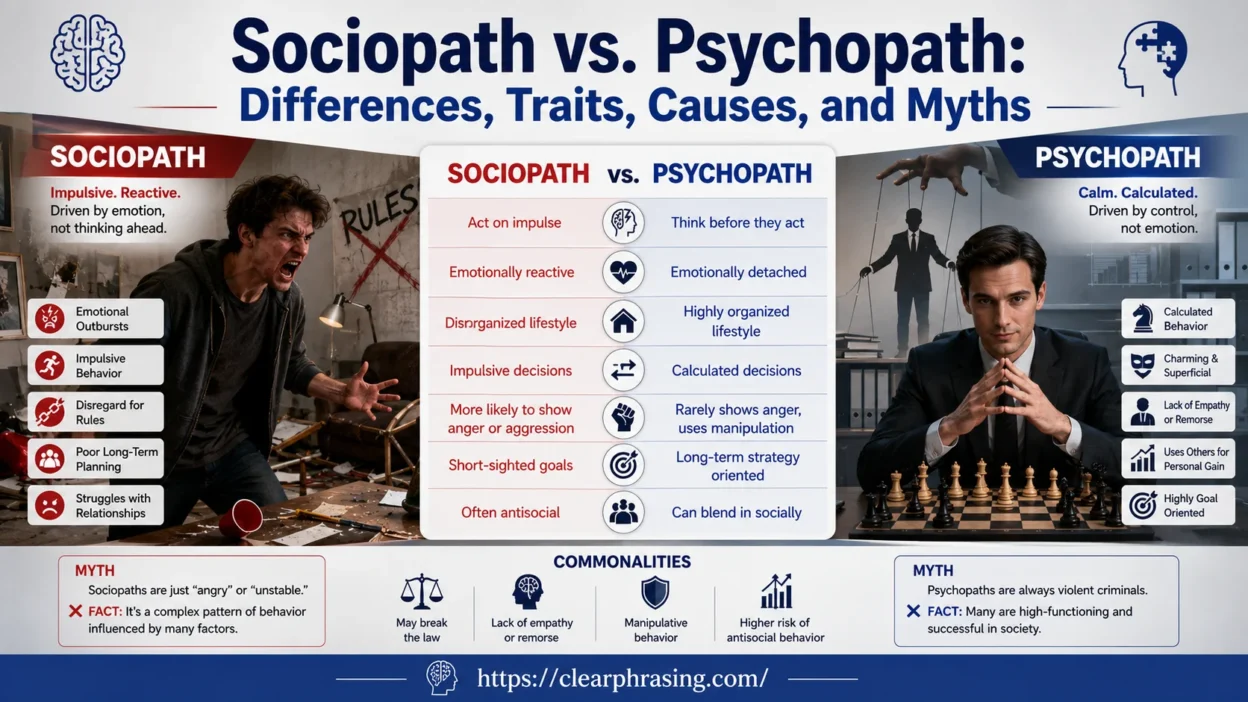
Sociopath vs. Psychopath: Differences, Traits, Causes, and Myths explains the main difference between these terms.
A Sociopath and a Psychopath may share behavioral traits, but the distinction is important. Psychopathy and Sociopathy are non-clinical terms linked to Antisocial Personality Disorder (ASPD), not separate medical diagnoses. In my teaching experience, I have noticed that TV shows, books, and pop culture often create misconceptions instead of improving understanding.
A psychologist uses psychological assessment, clinical understanding, and diagnosis to study human behavior, personality traits, emotional traits, social behavior, and criminal behavior. Environmental factors, upbringing, lack of empathy, impulsive behavior, calculated planning, manipulation, guilt, remorse, relationships, and society all help explain the Differences, Traits, Causes, and Myths.
Quick Answer
The main difference between a sociopath and a psychopath lies in how they think, behave, and interact with others. A sociopath tends to act impulsively, struggles to control emotions, and may form attachments to a few people. A psychopath usually appears calm, plans actions carefully, hides emotions well, and often manipulates others without guilt or remorse.
Neither sociopath nor psychopath is an official medical diagnosis. Mental health professionals typically diagnose Antisocial Personality Disorder (ASPD) when someone consistently ignores the rights of others and breaks social rules over time. Researchers often describe psychopathy as a specific pattern of traits that can exist within some people diagnosed with ASPD.
What Does “Sociopath” Mean?
Simple Definition
A sociopath is a person who consistently disregards social rules, the feelings of others, and accepted standards of behavior. The word is widely used in everyday conversation, but it does not appear as a formal diagnosis in the Diagnostic and Statistical Manual of Mental Disorders (DSM-5-TR).
Experts often use the term informally to describe someone who displays persistent antisocial behaviors, especially when those behaviors appear strongly influenced by environmental factors such as childhood trauma or unstable family relationships.
Common Behavioral Characteristics
A sociopath may display several recognizable behaviors, including:
- Frequently breaking rules or laws
- Acting without thinking about consequences
- Becoming angry or frustrated quickly
- Lying for personal gain
- Ignoring the rights of other people
- Struggling to maintain long-term responsibilities
- Blaming others for personal mistakes
Not every person with these behaviors is a sociopath. Many mental health conditions can cause similar actions, which is why professional evaluation is essential.
Emotional Patterns
Unlike the popular stereotype, sociopaths usually experience emotions. However, those emotions may be inconsistent or difficult to regulate.
Common emotional patterns include:
- Sudden anger
- Irritability
- Impulsive reactions
- Limited empathy
- Occasional feelings of guilt toward close individuals
- Difficulty managing frustration
Some sociopaths feel regret after hurting someone they genuinely care about, although this does not always change their future behavior.
Relationships with Other People
Sociopaths often struggle to build stable relationships. Trust becomes difficult because their behavior can be unpredictable.
They may:
- Form emotional attachments with family or close friends
- Have frequent conflicts with coworkers
- Experience unstable romantic relationships
- Break promises without considering the impact
- React aggressively during disagreements
Even when genuine affection exists, impulsive actions often damage those relationships.
Everyday Examples of Sociopathic Behavior
Real life rarely resembles crime dramas. Sociopathic behavior can appear in ordinary situations.
Examples include:
- Constantly violating workplace policies without concern.
- Starting physical fights over small disagreements.
- Repeatedly lying to family members for personal benefit.
- Ignoring financial responsibilities despite repeated warnings.
- Acting recklessly without considering who gets hurt.
These examples alone do not confirm a mental health condition. Context, history, and professional assessment all matter.
What Does “Psychopath” Mean?
Simple Definition
A psychopath is someone who demonstrates a pattern of emotional detachment, manipulation, superficial charm, and persistent disregard for other people’s rights. Like sociopath, the term is not an official psychiatric diagnosis. Instead, researchers use it to describe a cluster of personality traits that overlap with Antisocial Personality Disorder.
Many psychologists study psychopathy using specialized assessment tools, including the Psychopathy Checklist-Revised (PCL-R) developed by psychologist Robert Hare.
Common Behavioral Characteristics
Psychopaths often appear confident and composed. They may blend into society more easily than sociopaths because they carefully manage their public image.
Common characteristics include:
- Chronic lying
- Manipulation
- Superficial charm
- Lack of remorse
- Low emotional responsiveness
- Calculated decision-making
- Risk-taking without fear
- Persistent rule-breaking
Many psychopaths avoid attracting attention by planning their actions carefully.
Emotional Patterns
One of the defining features of psychopathy is emotional shallowness.
Researchers commonly observe:
- Very limited empathy
- Little or no remorse
- Reduced fear responses
- Shallow emotional experiences
- Difficulty forming genuine emotional bonds
This does not mean psychopaths never experience emotions. Instead, their emotional responses often differ in intensity and expression from those of most people.
Relationships with Other People
Psychopaths often view relationships as opportunities rather than emotional connections.
They may:
- Use charm to gain trust quickly.
- Manipulate friends or coworkers.
- Maintain relationships for personal advantage.
- End relationships without emotional distress.
- Hide their true intentions behind a pleasant personality.
Because they often appear intelligent and confident, many people fail to recognize manipulation until much later.
Everyday Examples of Psychopathic Behavior
Psychopathy does not always involve violent crime.
Examples may include:
- Deceiving coworkers to gain promotions.
- Running financial scams without guilt.
- Pretending to care about someone for personal benefit.
- Carefully manipulating business partners.
- Remaining unusually calm during serious conflicts.
These behaviors become concerning only when they form a long-term pattern rather than isolated incidents.
Sociopath vs. Psychopath: Side-by-Side Comparison
| Feature | Sociopath | Psychopath |
| Emotional control | Often poor | Usually excellent |
| Empathy | Very limited | Extremely limited |
| Guilt or remorse | May occasionally feel guilt | Rarely experiences genuine remorse |
| Impulsiveness | High | Usually low |
| Planning | Often spontaneous | Highly calculated |
| Anger | Easily triggered | Rarely loses control outwardly |
| Relationships | May bond with a few people | Relationships often serve personal goals |
| Social image | More obvious behavioral problems | Often appears charming and successful |
| Criminal behavior | More likely to act impulsively | More likely to plan illegal acts carefully |
| Workplace behavior | Can struggle with authority | Often manipulates situations strategically |
The Biggest Differences Between Sociopaths and Psychopaths
Emotional Attachment
One of the clearest differences involves emotional connection.
A sociopath may genuinely care about a small circle of people. Family members, childhood friends, or romantic partners may receive real affection despite unstable behavior.
A psychopath rarely forms deep emotional attachments. Relationships often exist because they provide money, influence, entertainment, or personal gain.
Impulse Control
Impulse control separates these personalities in many situations.
Sociopaths often react without thinking. They may become aggressive during arguments or make risky decisions within seconds.
Psychopaths usually pause before acting. They calculate possible outcomes and choose actions that maximize personal benefit while reducing the chance of getting caught.
Long-Term Planning
Planning ability is another major distinction.
A sociopath may abandon long-term goals because emotions interfere with decision-making.
A psychopath often spends months or even years pursuing carefully designed plans. This ability allows some individuals to maintain successful careers while hiding manipulative behavior.
Manipulation Tactics
Both personalities may manipulate others, but they do so differently.
A sociopath often manipulates emotionally during moments of frustration or anger.
A psychopath typically plans manipulation in advance. They study personalities, build trust slowly, and exploit weaknesses when the opportunity appears.
Reaction to Stress
Stress reveals another difference.
Sociopaths may become anxious, aggressive, or emotionally overwhelmed.
Psychopaths frequently remain calm even during highly stressful situations. Researchers believe differences in fear processing may contribute to this unusual composure.
Ability to Blend Into Society
Psychopaths generally hide their traits more effectively.
Their confidence, charm, and emotional control help them fit into workplaces, social groups, and leadership positions.
Sociopaths often struggle to maintain a consistent public image because impulsive behavior eventually creates conflict.
Violence and Aggression
Contrary to popular belief, neither term automatically means someone will become violent.
When violence occurs, sociopaths are more likely to act impulsively during emotional situations.
Psychopaths who commit violent crimes are more likely to plan them carefully. However, most people diagnosed with Antisocial Personality Disorder are not violent criminals, making this distinction important.
Workplace Behavior
The workplace highlights many practical differences.
A sociopath may argue openly with supervisors, ignore company rules, or quit suddenly after conflicts.
A psychopath often appears polished and professional. They may manipulate coworkers, take credit for others’ work, or use charm to advance their careers while avoiding responsibility.
Similarities Between Sociopaths and Psychopaths
Shared Personality Traits
Despite their differences, sociopaths and psychopaths share several important characteristics. These similarities explain why the two terms are often confused.
Common shared traits include:
- Persistent disregard for social rules
- Dishonesty
- Manipulative behavior
- Limited empathy
- Difficulty accepting responsibility
- Repeated violation of other people’s rights
Common Antisocial Behaviors
Both personalities may engage in behaviors that conflict with society’s expectations.
Examples include:
- Breaking laws repeatedly
- Ignoring workplace policies
- Taking advantage of others
- Disregarding personal responsibilities
- Violating trust without concern
These behaviors usually occur over many years rather than as isolated incidents.
Lack of Empathy
Empathy allows people to understand and respond to another person’s emotions.
Both sociopaths and psychopaths generally experience significant difficulties with empathy. However, sociopaths may occasionally show concern for people within their close circle, while psychopaths tend to display consistently shallow emotional responses.
Manipulation and Deceit
Manipulation is common in both personalities, although the methods often differ.
Some individuals lie impulsively to escape consequences. Others carefully construct elaborate stories to gain money, status, or influence. In both cases, honesty becomes secondary to personal benefit.
Disregard for Rules
Whether at school, work, or within the legal system, both sociopaths and psychopaths frequently ignore rules they believe interfere with their goals. Consequences that discourage most people often have little effect on their future decisions.
Is “Sociopath” or “Psychopath” an Official Medical Diagnosis?
Why These Terms Are Popular
The words sociopath and psychopath have been part of popular culture for decades. News reports, crime documentaries, and fictional stories use them frequently because they are familiar to the public. However, familiarity doesn’t make them official medical terms.
Mental health professionals are more careful with language because accurate diagnosis affects treatment, research, and patient care.
Antisocial Personality Disorder (ASPD) Explained
Today, psychiatrists diagnose Antisocial Personality Disorder (ASPD) instead of sociopathy or psychopathy.
According to the Diagnostic and Statistical Manual of Mental Disorders (DSM-5-TR), ASPD involves a long-term pattern of:
- Ignoring the rights of others
- Repeatedly breaking laws or social rules
- Deceitful behavior
- Impulsiveness
- Aggression or irritability
- Reckless disregard for safety
- Irresponsibility
- Lack of remorse
A diagnosis requires a detailed clinical assessment. A person cannot diagnose themselves based on online quizzes or social media posts.
How Mental Health Professionals Use These Terms Today
Many psychologists still use psychopathy in research because it describes a specific group of personality traits that are not fully captured by ASPD alone.
The term sociopathy is used less often in clinical settings. When it appears, it usually refers to antisocial behaviors believed to be influenced more heavily by environmental experiences.
What Causes Sociopathic and Psychopathic Traits?
There isn’t one single cause. Research suggests these traits develop through a combination of biological and environmental influences.
Genetics
Studies involving twins and families indicate that genetics may contribute to personality traits associated with psychopathy and ASPD.
Genetics don’t determine behavior on their own. Instead, they may increase vulnerability when combined with other risk factors.
Brain Structure and Function
Brain imaging studies have identified differences in areas involved in:
- Emotional processing
- Fear responses
- Decision-making
- Impulse control
- Moral judgment
These findings help explain why some individuals struggle with empathy or remorse.
Childhood Experiences
Early life experiences can strongly influence emotional development.
Risk factors include:
- Physical abuse
- Emotional neglect
- Chronic family conflict
- Exposure to violence
- Inconsistent parenting
- Lack of stable caregivers
Most children who experience trauma do not become sociopaths or psychopaths. These experiences simply increase risk in some individuals.
Trauma and Environment
Growing up in an unsafe environment may reinforce aggressive or manipulative behaviors.
Environmental influences include:
- Poverty
- Community violence
- Substance abuse within the family
- Criminal peer groups
- Lack of emotional support
These factors interact differently for every person.
Risk Factors Researchers Have Identified
Researchers commonly associate the following with higher risk:
- Family history of antisocial behavior
- Childhood conduct disorder
- Head injuries affecting the frontal brain regions
- Early exposure to violence
- Persistent behavioral problems during adolescence
No single factor predicts future behavior with certainty.
Can Someone Be Both a Sociopath and a Psychopath?
Where the Traits Overlap
Yes. Many traits overlap because both concepts describe patterns within antisocial behavior.
A person may display:
- Manipulation
- Dishonesty
- Limited empathy
- Rule-breaking
- Lack of responsibility
The degree and expression of these traits often vary.
Why Experts Disagree
Researchers continue debating how psychopathy and sociopathy should be classified.
Some experts believe psychopathy is a subtype of ASPD.
Others argue psychopathy is a separate personality construct with distinct neurological features.
There is still no universal agreement.
What Current Research Suggests
Current evidence suggests psychopathy exists on a spectrum rather than as an all-or-nothing condition.
Some people display only a few traits.
Others display many characteristics associated with severe psychopathy.
Signs You May Notice in Daily Life
Social Interactions
Possible signs include:
- Frequent lying
- Lack of accountability
- Ignoring social boundaries
- Manipulating conversations
- Difficulty accepting criticism
Friendships
Relationships may become one-sided.
Some individuals:
- Borrow money without repayment.
- Break trust repeatedly.
- End friendships without concern.
- Take advantage of generous people.
Romantic Relationships
Partners may notice:
- Emotional coldness
- Controlling behavior
- Repeated dishonesty
- Lack of genuine accountability
- Manipulation during disagreements
These signs alone do not confirm a personality disorder.
Family Dynamics
Family members often report:
- Frequent conflict
- Broken promises
- Emotional distance
- Financial irresponsibility
- Little concern for household rules
Workplace Behavior
Possible workplace behaviors include:
- Taking credit for others’ work
- Ignoring company policies
- Manipulating coworkers
- Blaming colleagues for mistakes
- Using charm to gain promotions
Common Myths About Sociopaths and Psychopaths
Myth: They Are All Violent
Most individuals with ASPD never commit violent crimes.
Violence receives media attention, but it does not define every person with antisocial traits.
Myth: They Cannot Have Successful Careers
Some people with psychopathic traits perform well in competitive environments because they remain calm under pressure.
Success alone never indicates psychopathy.
Myth: They Never Feel Emotions
Emotional experiences differ widely.
Sociopaths often experience anger and frustration intensely.
Psychopaths may experience emotions more shallowly, but they are not emotionless robots.
Myth: Movies Accurately Portray Them
Films often exaggerate behaviors to entertain audiences.
Real-life personality disorders are far more complex than fictional villains.
Myth: Every Criminal Is a Psychopath
Most criminals are not psychopaths.
Likewise, not every person with psychopathic traits commits serious crimes.
How Are These Traits Diagnosed?
Psychological Evaluations
Mental health professionals conduct detailed assessments that examine:
- Personal history
- Behavioral patterns
- Emotional functioning
- Family background
- Social relationships
Clinical Interviews
Interviews help clinicians understand long-term behavior rather than isolated incidents.
Questions explore childhood experiences, employment history, relationships, and decision-making.
Diagnostic Criteria for ASPD
Clinicians compare observed behaviors with established diagnostic criteria.
Diagnosis depends on consistent patterns over many years rather than a single event.
Why Self-Diagnosis Is Unreliable
Online personality quizzes cannot replace professional evaluation.
Many conditions share similar symptoms, including trauma-related disorders, mood disorders, and substance use disorders.
Can Sociopathy or Psychopathy Be Treated?
Available Treatment Approaches
Treatment depends on the individual’s willingness to participate.
Options may include:
- Cognitive behavioral therapy (CBT)
- Group therapy
- Anger management
- Substance abuse treatment
- Social skills training
Therapy Goals
Treatment often focuses on:
- Improving impulse control
- Reducing harmful behaviors
- Building healthier relationships
- Increasing personal responsibility
- Managing aggression
Medication Limitations
There is no medication that cures psychopathy or sociopathy.
Doctors may prescribe medication for related conditions such as depression, anxiety, or mood instability when appropriate.
Long-Term Outlook
Outcomes vary widely.
Early intervention, stable environments, and consistent treatment generally improve the chances of positive behavioral change.
Sociopath vs. Psychopath in Popular Culture
Common Movie Stereotypes
Popular films often portray psychopaths as criminal masterminds and sociopaths as uncontrollably violent individuals.
These portrayals simplify complex psychological conditions.
Fiction Versus Reality
Reality is far less dramatic.
Many individuals with antisocial traits never become serial offenders or headline news stories.
How Media Shapes Public Perception
Repeated stereotypes create misunderstandings that contribute to stigma and fear.
Learning the science behind these terms helps separate fact from fiction.
Real-World Examples Without Naming Individuals
Workplace Manipulation
An employee earns promotions by taking credit for coworkers’ achievements while appearing exceptionally cooperative to management.
Financial Fraud
A scam organizer builds trust over several months before convincing victims to invest in a fake business opportunity.
Personal Relationships
Someone repeatedly lies, manipulates emotions, and exploits loved ones for financial or emotional benefit without accepting responsibility.
Community Settings
An individual consistently violates community rules, intimidates neighbors, and shows little concern for the consequences of their actions.
These examples illustrate behavioral patterns rather than provide diagnoses.
When Should You Seek Professional Help?
Warning Signs in Yourself
Consider speaking with a licensed mental health professional if you notice:
- Persistent aggression
- Chronic dishonesty
- Frequent legal problems
- Difficulty maintaining relationships
- Repeated disregard for other people’s rights
Concerns About Someone Close to You
If someone repeatedly manipulates, threatens, or emotionally harms you, prioritize your safety and seek advice from qualified professionals.
When to Contact a Licensed Mental Health Professional
Professional help is appropriate whenever behavior causes significant distress, legal problems, relationship difficulties, or safety concerns.
Read More: Tide vs. Tied: What’s the Difference and Correct Usage
FAQs
What is the main difference between a sociopath and a psychopath?
The biggest difference is how they think, feel, and act. A psychopath is usually more controlled and calculated, while a sociopath is often more impulsive and emotionally reactive.
Are sociopath and psychopath official medical diagnoses?
No. These are not official medical diagnoses. Mental health professionals diagnose Antisocial Personality Disorder (ASPD) instead of sociopathy or psychopathy.
Can a psychopath feel emotions?
A psychopath can experience some emotions, but they often have limited empathy, guilt, and remorse. Their emotional responses are usually much weaker than most people’s.
Are sociopaths born or made?
There is no simple answer. Many experts believe sociopathy is more strongly influenced by environmental factors such as childhood experiences, trauma, and upbringing.
Which is more dangerous: a sociopath or a psychopath?
Neither group is automatically dangerous. Risk depends on the individual, their behavior, and other personal and environmental factors.
Can someone with ASPD live a normal life?
Yes. Some people with ASPD maintain jobs, relationships, and daily responsibilities, especially if they receive treatment and support.
Do all criminals have psychopathy or sociopathy?
No. Most criminals do not meet the criteria for psychopathy or ASPD, and many people with ASPD never commit violent crimes.
Can psychopathy or sociopathy be treated?
While there is no cure, therapy, behavioral interventions, and support can help some people manage harmful behaviors and improve daily functioning.
Why are sociopaths and psychopaths often confused?
Movies, TV shows, books, and social media frequently use the terms interchangeably, which creates confusion and spreads common myths.
Why is it important to know the difference?
Understanding the differences helps reduce stigma, improves mental health awareness, and encourages people to rely on accurate psychological information instead of stereotypes.
Conclusion
Understanding Sociopath vs. Psychopath: Differences, Traits, Causes, and Myths is about more than learning two popular terms. While both are linked to Antisocial Personality Disorder (ASPD), they describe different patterns of behavior, emotional responses, and social interactions. Knowing these differences can help you avoid common myths and understand the topic with greater accuracy.
Instead of relying on movie stereotypes or internet rumors, look at the facts and remember that every person is different. A better understanding of sociopathy, psychopathy, and mental health encourages empathy, reduces stigma, and promotes informed discussions based on evidence rather than misconceptions.

Mehwish Imtiaz is an English specialist and professional blog writer at ClearPhrasing.com. She specializes in grammar, spelling, vocabulary, punctuation, and writing improvement. With a strong passion for clear communication and language education, she creates reader-friendly articles that help students, professionals, and English learners understand complex language topics with ease.
Her writing focuses on accuracy, simplicity, and practical usage, ensuring that every article provides clear explanations and real-world examples. At ClearPhrasing.com, Mehwish is committed to publishing well-researched, original content that helps readers write more confidently and communicate more effectively in everyday and professional English.