Worth It vs Worthy: Difference, Meaning, and Correct Usage helps you choose the right expression in everyday English with confidence.
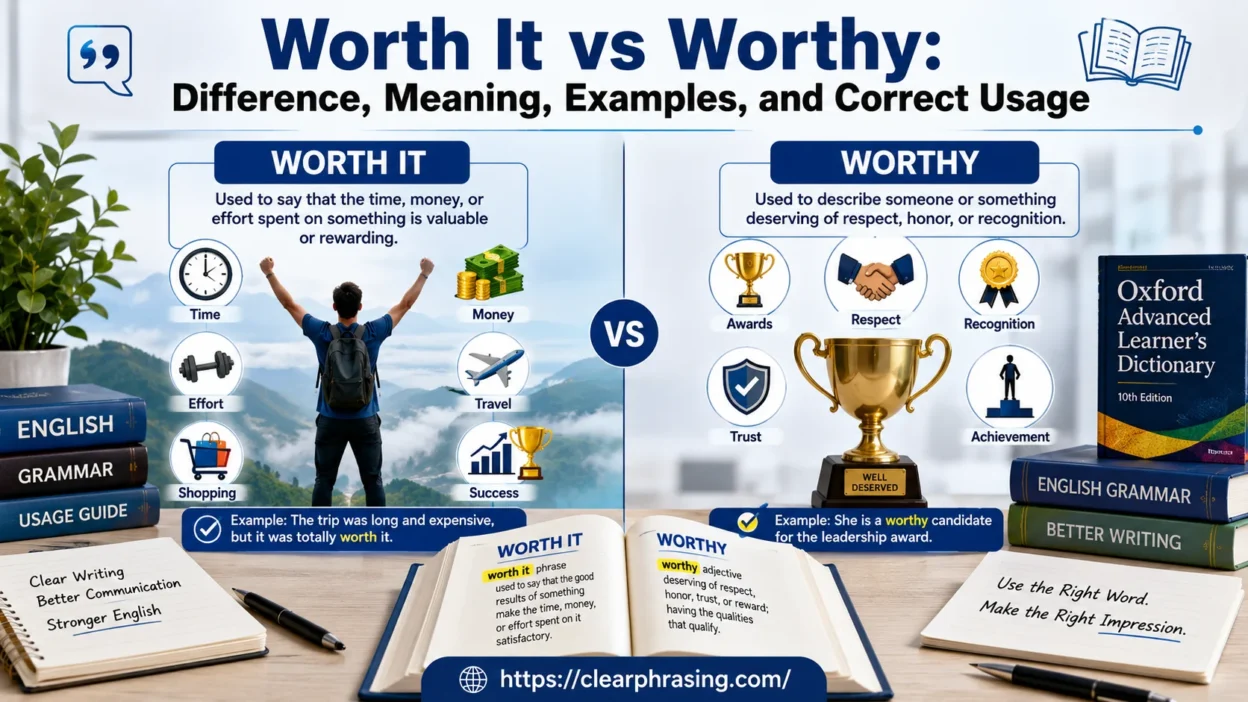
Many English learners and native speakers find these tricky words confusing because they look alike but have different meanings. Worth It refers to something valuable enough to justify the effort, cost, time, or investment, while Worthy describes a person, object, or thing that deserves respect, support, or admiration because of its qualities.
From my teaching experience, focusing on contextual usage, semantic meaning, grammar examples, and sentence examples works better than simply memorizing rules.Regular grammar practice, writing practice, and language practice improve language accuracy, English fluency, and communication skills.
Whether you are studying for an exam, writing an email, or using spoken English, this distinction helps you use each phrase correctly.As a result, your writing becomes clearer, more accurate, and more confident.
Quick Answer:
Worth it means something gives enough benefit to justify what you spent. It usually relates to time, money, effort, or risk.
Worthy means someone or something deserves admiration, respect, attention, or recognition.
| Expression | Meaning | Example |
| Worth it | Valuable enough to justify the cost or effort | The course was worth it. |
| Worthy | Deserving respect, praise, or attention | She is worthy of recognition. |
A simple way to remember:
- Worth it = Was the result worth the cost?
- Worthy = Does it deserve respect or recognition?
Worth It Meaning
What Does “Worth It” Mean?
Worth it is an English expression used when the benefits of something are greater than the effort, cost, or difficulty involved.
It focuses on the final result. You look at what you gained and compare it with what you gave.
For example:
- The restaurant was expensive, but the food was worth it.
- Studying every night was worth it when she passed the exam.
- The long wait was worth it because the view was beautiful.
In each sentence, the speaker evaluates an experience or decision.
When to Use “Worth It”
You can use worth it when discussing:
- Money
- Time
- Hard work
- Waiting
- Travel
- Learning
- Personal sacrifices
- Business decisions
Examples:
- Buying a quality laptop was worth it because it lasted for years.
- Learning English grammar takes effort, but it is worth it.
- The extra hours at work were worth it because the project succeeded.
Common Sentence Patterns With “Worth It”
English speakers commonly use these structures:
| Pattern | Example |
| It is worth it | The experience is worth it. |
| It was worth it | The trip was worth it. |
| It will be worth it | Keep practicing because it will be worth it. |
| Is it worth it? | Is buying a new phone worth it? |
| It wasn’t worth it | The purchase wasn’t worth it. |
Worthy Meaning
What Does “Worthy” Mean?
Worthy is an adjective that describes someone or something that deserves value, respect, admiration, or attention.
Unlike worth it, it does not compare a cost with a result. Instead, it focuses on quality, importance, or deserving nature.
Examples:
- She is worthy of respect.
- This charity is worthy of support.
- His research is worthy of publication.
- The movie is worthy of attention.
When to Use “Worthy”
Use worthy when you want to describe something deserving.
Common situations include:
- Awards
- Recognition
- Respect
- Trust
- Support
- Praise
- Attention
- Admiration
Examples:
- The athlete was worthy of the championship title.
- The teacher is worthy of appreciation.
- The organization supports a worthy cause.
Common Sentence Patterns With “Worthy”
| Pattern | Example |
| Worthy of + noun | She is worthy of praise. |
| A worthy + noun | It is a worthy goal. |
| Truly worthy | This book is truly worthy. |
| Worthy candidate | He is a worthy candidate for the position. |
Worth It vs Worthy: The Main Difference
The biggest difference between worth it and worthy is the type of value they describe.
| Feature | Worth It | Worthy |
| Grammar role | Fixed expression | Adjective |
| Main idea | Value after effort or cost | Deserving quality |
| Focus | Result or benefit | Character or importance |
| Common structure | Be + worth it | Be + worthy of |
| Example | The trip was worth it. | The trip is worthy of attention. |
Think of it like this:
Worth it looks at the reward after an investment.
Worthy looks at the qualities that make something deserve recognition.
Worth It vs Worthy in Grammar
Why “Worth It” Works Differently
Many learners try to use worth it like a normal adjective. However, English does not use it that way.
Correct:
- The movie was worth it.
- The training was worth it.
Incorrect:
- It was a worth it experience.
- She is a worth it person.
The phrase stays together as worth it.
Why “Worthy” Is an Adjective
Because worthy is an adjective, it can describe nouns.
Examples:
- A worthy leader
- A worthy cause
- A worthy investment
- A worthy achievement
It can also follow linking verbs.
Examples:
- He is worthy of trust.
- The project is worthy of funding.
Worth It vs Worthy Examples Side by Side
| Worth It | Worthy |
| The expensive meal was worth it. | The chef is worthy of praise. |
| The long journey was worth it. | The destination is worthy of a visit. |
| The training was worth it. | The athlete is worthy of the award. |
| The upgrade was worth it. | The product is worthy of attention. |
| The extra effort was worth it. | Their work is worthy of recognition. |
Worth It vs Worthy in Everyday English
At Work
Employees often evaluate their efforts by using worth it.
Example:
“Working late for the deadline was worth it because the client loved the final project.”
However, when talking about someone’s qualities:
“Maria is worthy of a leadership position because she consistently helps the team.”
In Education
Students often use worth it when discussing learning.
Examples:
- Practicing speaking every day was worth it.
- The extra study hours were worth it.
Teachers may use worthy when discussing achievements:
- Her research is worthy of publication.
In Shopping
Consumers often ask whether something is worth the price.
Examples:
- Is this phone worth it?
- The expensive shoes were worth it because they lasted five years.
But worthy describes reputation or quality.
Example:
- This brand is worthy of customer trust.
In Travel
Travelers often say:
- The eight-hour flight was worth it.
- The difficult hike was worth it.
They may also say:
- The historical site is worthy of protection.
Common Mistakes With Worth It and Worthy
Using “Worthy” When You Mean “Worth It”
Incorrect:
- The vacation was worthy.
Correct:
- The vacation was worth it.
The first sentence suggests the vacation deserves respect. The second sentence means the experience justified the cost.
Using “Worth It” With “Of”
Incorrect:
- She is worth it of respect.
Correct:
- She is worthy of respect.
Remember:
Worthy + of
Examples:
- worthy of praise
- worthy of attention
- worthy of support
Using “Worth It” Before a Noun
Incorrect:
- It was a worth it decision.
Correct:
- It was a worthwhile decision.
- The decision was worth it.
Worthwhile is the adjective form when describing something valuable.
Worth It vs Worthy in Formal and Informal English
| Situation | Better Choice |
| Casual conversation | Worth it |
| Personal opinions | Worth it |
| Academic writing | Worthy |
| Awards and recognition | Worthy |
| Professional praise | Worthy |
| Buying decisions | Worth it |
Both expressions work in different situations. The key is choosing the one that matches your meaning.
Common Collocations
Phrases With Worth It
- definitely worth it
- absolutely worth it
- totally worth it
- well worth it
- not worth it
- probably worth it
Examples:
- The experience was definitely worth it.
- The ticket price was not worth it.
Phrases With Worthy
- worthy of respect
- worthy of praise
- worthy of attention
- worthy of trust
- worthy cause
- worthy goal
- worthy candidate
- worthy achievement
Examples:
- The organization supports a worthy cause.
- She is worthy of the award.
Synonyms of Worth It and Worthy
➜Synonyms for Worth It
| Word | Meaning |
| Worthwhile | Worth the time or effort |
| Rewarding | Providing benefits or satisfaction |
| Valuable | Having importance or usefulness |
| Beneficial | Producing good results |
➜Synonyms for Worthy
| Word | Meaning |
| Deserving | Suitable for receiving something |
| Admirable | Worth respect |
| Honorable | Showing strong moral qualities |
| Commendable | Deserving approval |
Easy Memory Trick: Worth It vs Worthy
Use this simple formula:
Worth It = Investment → Result
You spend something and receive something valuable.
Example:
“The course was worth it.”
You spent time and money. You gained knowledge.
Worthy = Quality → Respect
Something has qualities that deserve recognition.
Example:
“The teacher is worthy of respect.”
The person’s actions create admiration.
Real-Life Case Study
Imagine two people discussing a volunteer event.
Person A says:
“The event was worth it.”
This means the time and energy spent attending the event created a valuable experience.
Person B says:
“The organization is worthy of support.”
This means the organization deserves help because of its mission and work.
Both sentences discuss value, but they measure different things.
The first measures the result of an experience. The second measures deserving qualities.
Mini Practice Quiz
Choose the correct option.
- The new computer was ______ because it improved my work.
1. Answer: worth it
- She is ______ of the award because of her achievements.
2. Answer: worthy
- The long preparation was ______ after winning the competition.
3. Answer: worth it
- This charity is ______ of donations.
4. Answer: worthy
- Was the expensive hotel ______?
5. Answer: worth it
Read More: Polygamy vs Polygyny: Key Differences, Meaning, and History
FAQs
Is mid next week grammatically correct?
Yes. Mid next week is grammatically correct and commonly used to refer to the middle of the following week, usually Tuesday through Thursday depending on the context.
Does midweek always mean Wednesday?
Not always. While many people associate midweek with Wednesday, it can also refer to the middle part of the current week, including Tuesday through Thursday, depending on the speaker.
What is the difference between midweek and mid next week?
Midweek refers to the middle of the current week, whereas mid next week refers to the middle of the following week. The key difference is the time reference.
Can I use mid next week in business emails?
Absolutely. It is a professional and widely accepted expression for scheduling meetings, setting deadlines, or discussing future plans.
Is mid-week with a hyphen correct?
Yes. Both midweek and mid-week are acceptable spellings. However, midweek is the more common modern form in American English.
How do I avoid confusion when using these expressions?
Mention the specific day if there is any chance of misunderstanding. For example, write “Let’s meet on Wednesday next week” instead of simply saying “mid next week.”
Does midweek have the same meaning in every country?
The general meaning is the same, but people may interpret the exact days differently based on regional usage and workplace culture.
Which expression is better for formal writing?
Both are appropriate when used correctly. Choose midweek for the current week’s middle and mid next week for the following week’s middle.
Why do English learners confuse these phrases?
Many learners focus on the shared word week and overlook the important time marker next, which completely changes the meaning.
Can I replace mid next week with next Wednesday?
Yes. If you mean Wednesday specifically, next Wednesday is often clearer and removes any ambiguity about your intended timeframe.
Conclusion
Understanding the difference between mid next week and midweek helps you communicate more clearly in both professional and everyday situations. Although the phrases look similar, they point to different periods of time. Midweek usually refers to the middle of the current week, while mid next week refers to the middle of the following week. Choosing the correct expression prevents misunderstandings when scheduling meetings, planning events, or discussing deadlines.
From my experience teaching English, I have found that learners become much more confident once they start paying attention to time references instead of individual words. A small change like adding next can completely change the meaning of a sentence. When clarity matters, don’t hesitate to mention the exact day as well. Doing so makes your writing more precise, your conversations easier to follow, and your English sound natural and professional.

Mehwish Imtiaz is an English specialist and professional blog writer at ClearPhrasing.com. She specializes in grammar, spelling, vocabulary, punctuation, and writing improvement. With a strong passion for clear communication and language education, she creates reader-friendly articles that help students, professionals, and English learners understand complex language topics with ease.
Her writing focuses on accuracy, simplicity, and practical usage, ensuring that every article provides clear explanations and real-world examples. At ClearPhrasing.com, Mehwish is committed to publishing well-researched, original content that helps readers write more confidently and communicate more effectively in everyday and professional English.