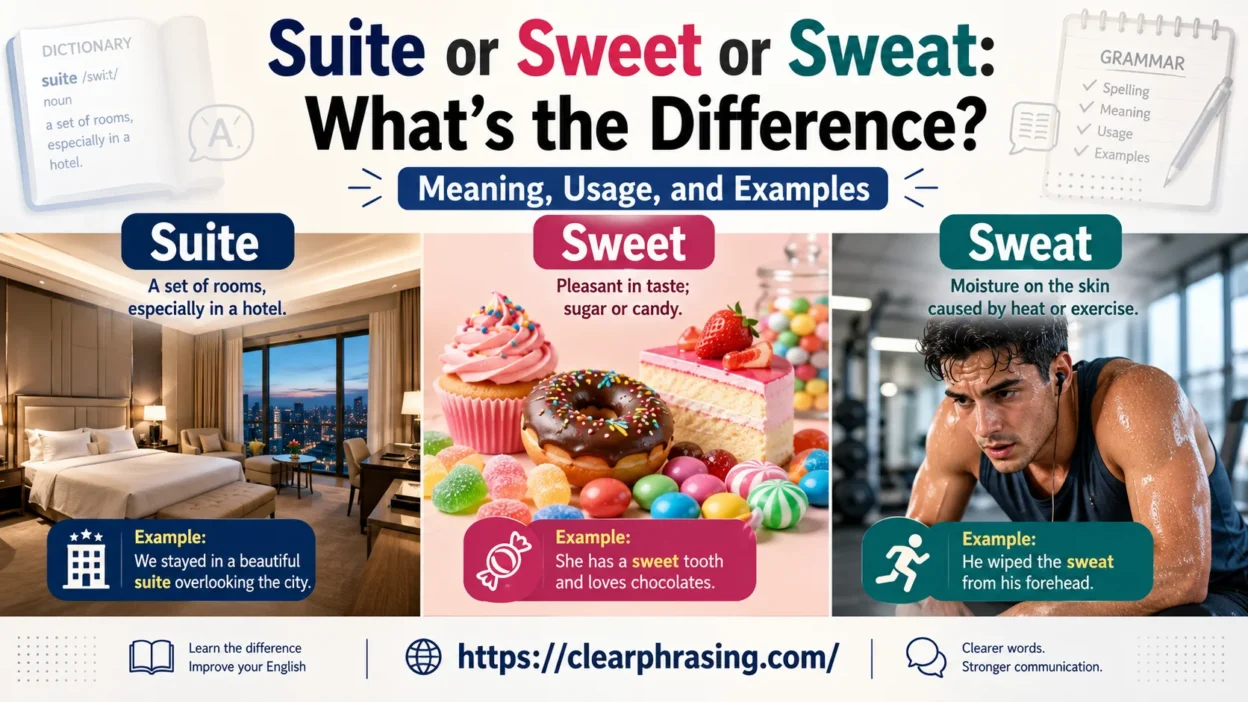
Suite or Sweet or Sweat: What’s the Difference? Meaning, and Usage helps you understand these confusing English words with clear meanings and everyday examples.
The Difference, Meaning, and Usage of Suite, Sweet, and Sweat become easier when you study each word carefully. These similar but different terms often confuse learners. From my teaching experience, I tell students to think of them as twins with opposite personalities. Sweet talks about pleasure, taste, kindness, charm, sugar, or a pleasant smell, while Sweat refers to body moisture during heat, work, stress, or exercise.
A Suite is a set of rooms in hotels, often with multiple bedrooms and a feeling of luxury. The key is learning through comparison, examples, grammar, pronunciation, context, and word meanings. Regular writing, reading, and speaking build English vocabulary, improve accuracy and confidence, help you avoid common mistakes, and strengthen both written English and spoken English.
Quick Answer
Here’s the simplest way to remember the difference between suite, sweet, and sweat.
| Word | Meaning | Example |
| Suite | A set of connected rooms or a group of related things | We reserved a hotel suite for our vacation. |
| Sweet | Sugary, pleasant, kind, or enjoyable | The cake tastes sweet. |
| Sweat | Moisture produced by the body or the act of perspiring | You’ll sweat during an intense workout. |
Quick memory tip:
- Suite = rooms, offices, software, or collections.
- Sweet = sugar, kindness, compliments, or pleasant experiences.
- Sweat = exercise, heat, stress, or physical effort.
If you’re talking about a hotel room, choose suite. Asyou’re describing flavor or personality, choose sweet. If you’re referring to perspiration or hard work, use sweat.
Suite Meaning and Definition
What Does “Suite” Mean?
The word suite is a noun with several related meanings. Its most common definition is a set of connected rooms designed for one person, family, or group. Hotels often advertise executive suites, honeymoon suites, or family suites because these accommodations offer more space than a standard room.
Beyond hotels, suite also refers to a collection of related items that function together. For example, a software suite contains multiple applications designed to work as a package.
Dictionary Definition
Suite (noun):
- A group of connected rooms used together.
- A collection of related items designed to work as one unit.
- A sequence of musical compositions intended to be performed together.
- A group of attendants or companions accompanying an important person.
Although these meanings differ, they all share the idea of things belonging together as a complete set.
Pronunciation
IPA: /swiːt/
Interestingly, suite is pronounced exactly like sweet. These words are homophones, which means they sound the same even though they have different meanings and spellings.
Origin and Etymology
The word suite entered English through French during the seventeenth century. It comes from the Old French word suite, meaning a sequence, following, or set of things. That historical meaning still appears today in phrases like software suite and hotel suite, where multiple related elements are grouped together.
Common Parts of Speech
Suite functions almost exclusively as a noun.
Examples:
- The presidential suite overlooks the ocean.
- Our office moved into a larger business suite.
- The design suite includes several creative applications.
Common Uses of “Suite”
Hotel Suite
This is the meaning most people recognize.
A hotel suite usually contains:
- A bedroom
- A separate living area
- One or more bathrooms
- Extra amenities compared with a standard room
Luxury hotels often provide executive suites, family suites, and penthouse suites to accommodate different travelers.
Examples
- They upgraded us to a luxury suite.
- The honeymoon suite included a private balcony.
- We booked a family suite for our vacation.
Office Suite
In commercial buildings, a suite identifies an office space occupied by a business.
Instead of writing only a room number, business addresses often include:
- Suite 100
- Suite 450
- Suite B
Example:
1450 Main Street, Suite 300
This simply tells visitors which office occupies that section of the building.
Software Suite
Technology has given suite another widely recognized meaning.
A software suite is a collection of programs designed to work together.
Examples include:
- Word processing software
- Spreadsheet applications
- Presentation tools
- Database management programs
Instead of installing separate unrelated applications, users receive one integrated package.
Music Suite
In classical music, a suite is a series of musical pieces performed in a specific order.
Each movement has its own character while contributing to a larger composition.
Although this meaning appears less often in everyday conversation, musicians and music historians still use the term regularly.
Bathroom Suite
In British English, a bathroom suite refers to matching bathroom fixtures such as:
- Bathtub
- Sink
- Toilet
American English rarely uses suite in this context.
Examples of “Suite” in Sentences
Seeing the word in context makes its meaning much clearer.
- The hotel offered a spacious executive suite.
- Our company relocated to Suite 502 downtown.
- She purchased a graphic design software suite.
- The orchestra performed a beautiful orchestral suite.
- They celebrated their anniversary in a luxurious honeymoon suite.
- Every guest admired the presidential suite’s panoramic view.
- The business suite includes meeting rooms and private offices.
- We stayed in a family suite because we were traveling with children.
Sweet Meaning and Definition
What Does “Sweet” Mean?
The word sweet is one of the most versatile words in English. It most commonly describes something containing sugar or tasting pleasant, but it can also describe people, actions, sounds, memories, smells, and experiences.
Depending on the situation, sweet can function as both an adjective and a noun.
Dictionary Definition
Sweet (adjective):
- Having the taste of sugar.
- Pleasant or enjoyable.
- Kind, thoughtful, or gentle.
- Fragrant or pleasing.
Sweet (noun):
- Candy or confectionery, especially in British English.
- A sweet dish or dessert in some regions.
Pronunciation
IPA: /swiːt/
Notice that sweet and suite share exactly the same pronunciation. That’s one reason many writers accidentally type the wrong spelling.
Origin and Etymology
The word sweet has ancient Germanic roots and has been part of English for well over a thousand years.
Originally, it referred only to pleasant taste. Over time, its meaning expanded to include positive emotions, attractive qualities, pleasant sounds, and affectionate descriptions.
Today, sweet is one of the most commonly used descriptive words in English.
Common Parts of Speech
Most often, sweet acts as an adjective.
Examples:
- The strawberries are sweet.
- She has a sweet smile.
- That was a sweet gesture.
Less commonly, it serves as a noun.
Examples:
- The children bought sweets after school.
- He skipped the sweet and ordered coffee instead.
Common Uses of “Sweet”
Sweet Food and Drinks
This is the most familiar meaning.
Foods high in natural or added sugar are described as sweet.
Examples include:
- Chocolate
- Honey
- Cake
- Cookies
- Ice cream
- Fruit
Example sentences:
- This lemonade is too sweet.
- The peaches taste naturally sweet.
- I prefer sweet desserts over salty snacks.
Sweet Personality
People often use sweet to describe someone who is thoughtful, caring, generous, or polite.
Examples:
- She’s incredibly sweet to everyone.
- That was a sweet thing to say.
- He always leaves sweet notes for his family.
Here, sweet has nothing to do with sugar. Instead, it expresses warmth and kindness.
Sweet Smell
Many pleasant fragrances are described as sweet.
Examples:
- Roses have a sweet fragrance.
- Vanilla gives the room a sweet aroma.
- Fresh flowers filled the house with a sweet scent.
Sweet Voice or Music
A gentle, pleasant sound can also be called sweet.
Examples:
- The singer has a sweet voice.
- Birds greeted us with sweet songs.
- The violin produced a sweet melody.
Informal Expressions
Modern English frequently uses sweet as an informal expression of approval or excitement.
For example:
- Sweet! We won the game.
- That’s a sweet deal.
- What a sweet surprise.
- You bought tickets? Sweet!
In these situations, sweet simply means excellent, great, or wonderful.
Examples of “Sweet” in Sentences
The following examples show how flexible this word can be.
- The apples became sweeter after ripening.
- She baked a sweet chocolate cake.
- That was a sweet compliment.
- His grandmother always gives sweet hugs.
- We enjoyed the sweet smell of fresh cinnamon.
- Their daughter has a sweet laugh.
- What a sweet surprise to see everyone waiting.
- The tea wasn’t sweet enough for my taste.
Sweat Meaning and Definition
What Does “Sweat” Mean?
Sweat refers to the moisture your body releases through sweat glands to help regulate body temperature. It also functions as a verb, meaning to produce perspiration. In everyday English, the word can describe physical activity, hot weather, nervousness, or intense effort.
Unlike suite and sweet, sweat has a different pronunciation and a completely different meaning. Although the spelling differs by just one letter, confusing it with sweet can completely change the meaning of a sentence.
Dictionary Definition
Sweat (noun):
- The moisture produced by sweat glands on the skin.
Sweat (verb):
- To produce perspiration.
- To work very hard or worry intensely.
Pronunciation
IPA: /swet/
The vowel sound in sweat is shorter than the sound in suite and sweet. Listening carefully to native speakers can help you recognize this distinction.
Origin and Etymology
The word sweat comes from the Old English word swāt, meaning perspiration. It has remained remarkably consistent in meaning for centuries and still describes the body’s natural cooling process.
Noun vs. Verb
As a noun:
- Sweat covered his forehead.
- The athlete wiped the sweat from her face.
As a verb:
- You’ll sweat if you exercise outdoors today.
- She began to sweat before her presentation.
Common Uses of “Sweat”
Physical Perspiration
The most common use refers to the body’s natural response to heat.
Examples:
- Running
- Hiking
- Playing sports
- Working outdoors
Example sentences:
- I started to sweat after jogging for twenty minutes.
- His shirt was soaked with sweat.
Exercise and Fitness
Fitness experts often encourage workouts that make you sweat because sweating usually indicates your body is regulating its temperature during physical activity.
Examples:
- Sweat during cardio sessions.
- Sweat after lifting weights.
- Sweat while cycling.
Hot Weather
High temperatures naturally increase perspiration.
Examples:
- Everyone began to sweat in the afternoon heat.
- Summer humidity makes people sweat more.
Stress or Anxiety
People don’t only sweat because they’re hot. Stress and nervousness can also trigger sweating.
Examples:
- She started to sweat before the interview.
- He was sweating during the difficult exam.
Idioms with Sweat
English includes many expressions using sweat.
Examples include:
- Don’t sweat it.
- Blood, sweat, and tears.
- Work up a sweat.
- Sweat it out.
These expressions often describe effort, perseverance, or staying calm.
Examples of “Sweat” in Sentences
- You’ll sweat less if you stay in the shade.
- She wiped the sweat from her forehead.
- Don’t sweat the small mistakes.
- They worked up a sweat while moving furniture.
- He began to sweat during the interview.
- The humid weather made everyone sweat.
- Blood, sweat, and tears helped the team reach the championship.
- After the workout, his clothes were covered in sweat.
Suite vs Sweet vs Sweat: Side-by-Side Comparison
| Feature | Suite | Sweet | Sweat |
| Part of Speech | Noun | Adjective, Noun | Noun, Verb |
| Meaning | Connected rooms or a collection | Sugary, pleasant, kind | Perspiration or to perspire |
| Pronunciation | /swiːt/ | /swiːt/ | /swet/ |
| Common Context | Hotels, offices, software, music | Food, personality, compliments | Exercise, weather, health |
| Example | Hotel suite | Sweet dessert | Sweat during exercise |
Pronunciation Differences
Why “Suite” and “Sweet” Sound the Same
Suite and sweet are homophones, meaning they share the same pronunciation despite having different spellings and meanings.
For example:
- We booked a luxury suite.
- The cookies taste sweet.
You can’t determine which word someone means by listening alone. The surrounding sentence provides the answer.
Why “Sweat” Sounds Different
Sweat uses a shorter vowel sound. Although the spelling looks similar, native speakers pronounce it differently.
Compare these words aloud:
- Suite
- Sweet
- Sweat
Practicing them together helps train your ear.
IPA Pronunciation Guide
| Word | IPA |
| Suite | /swiːt/ |
| Sweet | /swiːt/ |
| Sweat | /swet/ |
Simple Memory Trick
- Suite contains “ui,” which can remind you of units or connected rooms.
- Sweet contains “ee,” like the long sound in tree and often reminds people of sugar.
- Sweat contains “ea,” which appears in many words related to the body such as breath and health.
How to Remember the Difference
Remembering “Suite”
Think about places or collections.
- Hotel suite
- Office suite
- Software suite
- Music suite
If several related things belong together, suite is usually correct.
Remembering “Sweet”
Think about pleasant experiences.
Ask yourself:
- Does it taste like sugar?
- Is someone being kind?
- Does it describe something enjoyable?
If the answer is yes, use sweet.
Remembering “Sweat”
Think about your body.
Whenever you imagine exercise, heat, stress, or perspiration, the correct word is sweat.
Common Mistakes People Make
Mixing Up Suite and Sweet
Because they sound identical, spell-check won’t always catch mistakes.
Incorrect:
- We stayed in a beautiful sweet at the hotel.
Correct:
- We stayed in a beautiful suite at the hotel.
Confusing Sweat with Sweet
Incorrect:
- I started to sweet after running.
Correct:
- I started to sweat after running.
Autocorrect Errors
Phones occasionally replace one word with another if the surrounding sentence isn’t clear. Always proofread important emails and documents before sending them.
Business Writing Mistakes
Professional communication often includes words like office suite or software suite. Accidentally writing office sweet can appear careless.
Hotel Booking Mistakes
Travel websites frequently list:
- Executive Suite
- Deluxe Suite
- Family Suite
- Presidential Suite
Reading too quickly can lead to embarrassing misunderstandings.
Real-Life Examples
In Travel
“We upgraded to an ocean-view suite with a private balcony.”
In Business
“Our accounting software suite includes payroll, reporting, and invoicing tools.”
In Everyday Conversation
“That was incredibly sweet of you.”
In Health and Fitness
“You’ll naturally sweat more during high-intensity workouts.”
In Technology
Many businesses purchase productivity suites because the applications integrate seamlessly and improve workflow.
Idioms and Common Expressions
1. Expressions with “Sweet”
- Sweet dreams
- Sweet tooth
- Sweet spot
- Home sweet home
- Sweet talk
- Sweet success
2. Expressions with “Sweat”
- Don’t sweat it
- Blood, sweat, and tears
- Sweat it out
- Work up a sweat
- Break into a sweat
3. Expressions with “Suite”
- Executive suite
- Bridal suite
- Presidential suite
- Software suite
- Office suite
Which Word Should You Use?
- Choose suite when discussing:
- Hotels
- Offices
- Software packages
- Musical compositions
- Groups of connected things
2. Choose sweet when describing:
- Food
- Drinks
- Kind people
- Pleasant smells
- Gentle voices
- Positive experiences
3. Choose sweat when referring to:
- Perspiration
- Exercise
- Hot weather
- Nervousness
- Hard work
Grammar Tips
Parts of Speech Explained
| Word | Part of Speech |
| Suite | Noun |
| Sweet | Adjective, Noun |
| Sweat | Noun, Verb |
Singular and Plural Forms
| Singular | Plural |
| Suite | Suites |
| Sweet | Sweets |
| Sweat | Sweats* |
*The plural sweats is uncommon when referring to perspiration but appears in contexts such as cold sweats or night sweats.
Common Collocations
| Suite | Sweet | Sweat |
| Hotel suite | Sweet smile | Sweat glands |
| Software suite | Sweet voice | Sweat drops |
| Office suite | Sweet aroma | Sweat heavily |
| Executive suite | Sweet memory | Sweat profusely |
Practice Quiz
Choose the correct word.
- We booked a luxury ______ for our anniversary.
- The strawberries are naturally ______.
- You’ll ______ if you keep running.
- She works in Office ______ 410.
- That was a very ______ thing to say.
- His forehead was covered in ______.
- The company purchased a new software ______.
- Don’t ______ the small problems.
- The bakery smells wonderfully ______.
- They stayed in the presidential ______.
Answer Key
- Suite
- Sweet
- Sweat
- Suite
- Sweet
- Sweat
- Suite
- Sweat
- Sweet
- Suite
Read More: Mid Next Week vs Midweek: Meaning, Differences, and Usage
FAQs
1. What is the difference between suite, sweet, and sweat?
A suite is a group of connected rooms, usually in a hotel. Sweet describes a sugary taste or a kind and pleasant person. Sweat is the moisture your body produces when you are hot or exercising. Although they sound similar, their meanings are completely different.
2. Why do people confuse suite, sweet, and sweat?
These words have similar pronunciation, especially for English learners. Their spellings are close, but each belongs to a different context. Learning them with examples makes them easier to remember.
3. Is suite related to hotels only?
No. While a hotel suite is the most common meaning, suite can also refer to a connected set of offices, software applications, or a collection of musical pieces, depending on the context.
4. Can sweet describe a person?
Yes. Besides describing taste, sweet can describe someone who is kind, caring, thoughtful, or friendly. It is commonly used as a compliment in everyday English.
5. What does sweat mean in English?
Sweat is the natural moisture your skin produces to cool your body. It can also be used as a verb, meaning to perspire during heat, exercise, or stress.
6. How can I remember the difference between these words?
Think of simple associations: suite equals rooms, sweet equals sugar, and sweat equals exercise. These mental connections make the correct word easier to recall.
7. Are suite, sweet, and sweat homophones?
Not exactly. They are near-homophones because their pronunciation is very similar in many accents, but they are different words with different spellings and meanings.
8. Which word should I use when talking about body moisture?
Use sweat. It is the correct word for the moisture your body produces during physical activity, warm weather, or stressful situations.
9. How do I use suite in a sentence?
Example: We booked a spacious suite with two bedrooms for our family vacation. In this sentence, suite refers to a set of connected rooms.
10. How can I avoid mixing up these words in writing?
Practice reading and writing sentences with each word in its proper context. Regular grammar practice, vocabulary building, and proofreading will help you choose the correct word with confidence.
Conclusion
Understanding the difference between suite, sweet, and sweat is easier when you focus on their meanings instead of their similar spellings. Each word has a unique purpose, and using the right one makes your writing and speaking clearer and more accurate.
From my teaching experience, learners improve fastest when they practice these words in real-life sentences rather than memorizing definitions alone. With consistent reading, writing, and conversation practice, you’ll recognize the correct word naturally and communicate with greater confidence.

Shamsa Kanwal is an English specialist and content writer at ClearPhrasing.com, where she helps readers navigate the English language with confidence. She enjoys breaking down grammar rules, spelling differences, vocabulary, and everyday writing challenges into simple, practical lessons that anyone can understand.
Her writing is focused on making learning approachable rather than overwhelming. Whether she’s explaining commonly confused words, punctuation rules, or grammar concepts, Shamsa believes that clear explanations and real-life examples are the key to effective learning.
Every article she writes is carefully researched, fact-checked, and edited to ensure it is accurate, easy to read, and genuinely helpful. Her goal is to create trustworthy resources that enable students, professionals, writers, and English learners to improve their communication skills and write with greater clarity.
Through her work at ClearPhrasing.com, Shamsa is committed to making English learning simpler, more practical, and accessible for readers around the world.