Who Should I Ask or Whom Should I Ask: Correct Usage, and Examples helps you understand the correct usage of who and whom in English.
In English grammar, who is a subject pronoun, while whom is an object pronoun that receives the action of a verb or preposition. Although traditional English prefers whom in formal writing, modern English accepts who in most conversations.
From my teaching experience, many learners feel confused at first, but the rules become clear with practice. Native speakers often use who should I ask because it is the more popular choice, while whom should I ask remains technically correct in formal situations. Google Ngram Viewer also shows this trend.
Learning the meaning, grammar rules, and language usage will improve your language skills and writing confidence.
Quick Answer:
The grammatically traditional answer is “Whom should I ask?” because the person receiving the action of the verb ask is the object.
Example:
- I should ask him.
- Whom should I ask?
However, “Who should I ask?” is also widely accepted in modern English, especially in everyday conversations.
| Phrase | Grammar Function | Common Usage |
| Who should I ask? | Subject form | Casual conversations and informal writing |
| Whom should I ask? | Object form | Formal writing and traditional grammar |
A quick memory rule:
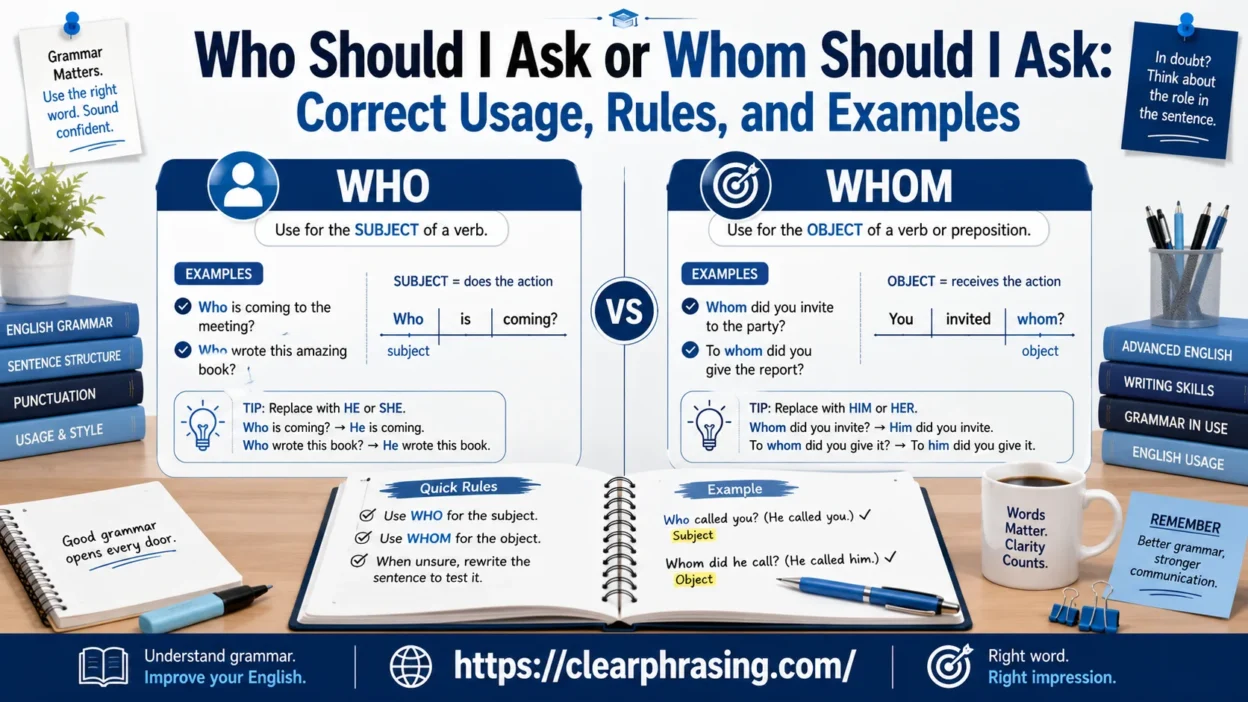
- If the answer is he, she, or they, use who.
- If the answer is him, her, or them, use whom.
What Is the Difference Between Who and Whom?
The difference between who and whom depends on the role a person plays in a sentence.
Every sentence has different parts. One person usually performs an action, while another person receives that action.
For example:
Emma helped David.
- Emma performs the action.
- David receives the action.
If you ask about Emma, you use who:
- Who helped David?
If you ask about David, you use whom:
- Whom did Emma help?
Understanding this relationship makes the rule much easier than simply memorizing examples.
What Does Who Mean?
Who is a subject pronoun. It refers to the person doing the action in a sentence.
Examples:
- Who called you?
- Who wrote this article?
- Who manages the team?
- Who wants to join the discussion?
In these examples, the person represented by who performs the action.
The Who Test
Replace who with he, she, or they.
Example:
Who created this design?
Answer:
She created this design.
Because she works in the answer, who is correct.
More examples:
| Question | Answer | Correct Word |
| Who sent the email? | He sent the email. | Who |
| Who organized the event? | They organized it. | Who |
| Who made this decision? | She made it. | Who |
What Does Whom Mean?
Whom is an object pronoun. It refers to the person who receives an action.
Examples:
- Whom did you invite?
- Whom should I contact?
- Whom are you waiting for?
- Whom did they select?
The Whom Test
Replace whom with him, her, or them.
Example:
Whom did you call?
Answer:
I called her.
Because her works in the answer, whom is correct.
More examples:
| Question | Answer | Correct Word |
| Whom did you meet? | I met him. | Whom |
| Whom are you helping? | I am helping them. | Whom |
| Whom should we choose? | We should choose her. | Whom |
Why Is Whom Should I Ask Grammatically Correct?
The phrase “Whom should I ask?” follows traditional grammar rules.
Let’s look at the sentence:
I should ask whom.
The parts are:
- I = subject
- should ask = verb
- whom = object
The person being asked receives the action.
Examples:
- I should ask the manager.
- I should ask her.
- Whom should I ask?
The word whom works the same way as her in this sentence.
For formal situations, this version is often preferred because it follows standard grammar rules.
Why Do People Say Who Should I Ask More Often?
Language changes naturally. The way people speak every day does not always follow traditional grammar rules.
Many English speakers now use who instead of whom because it feels simpler and more natural.
Examples:
- Who should I ask about the meeting?
- Who should I contact for help?
- Who should I speak with?
These sentences sound normal in everyday English.
Modern English often values clear communication over strict traditional forms. That is why who has become common in places where older grammar rules would suggest whom.
When Should You Use Who Should I Ask?
Use “Who should I ask?” when you are speaking casually or writing informal messages.
Common situations include:
- Conversations with friends
- Workplace chats
- Social media messages
- Everyday questions
Examples:
- Who should I ask about the schedule?
- Who should I ask for directions?
- Who should I ask to fix this problem?
This version sounds friendly and natural.
When Should You Use Whom Should I Ask?
Use “Whom should I ask?” when writing in formal settings.
Common situations include:
- Academic writing
- Official letters
- Professional documents
- Formal emails
Examples:
- Whom should I ask regarding the application process?
- Whom should I contact for additional information?
- Whom should I ask about the legal requirements?
However, remember that whom only works when it is grammatically correct. Using it incorrectly can make your writing sound less polished.
Easy He and Him Trick to Remember Who vs Whom
The fastest way to choose between who and whom is the he/him replacement test.
Use Who When You Can Say He
Example:
Who is waiting outside?
Check:
He is waiting outside.
The sentence works, so use who.
Use Whom When You Can Say Him
Example:
Whom did you call?
Check:
I called him.
The sentence works, so use whom.
| Question | Replacement | Correct Word |
| Who is speaking? | He is speaking. | Who |
| Whom did you visit? | I visited him. | Whom |
Common Mistakes With Who and Whom
Using Whom Just to Sound Formal
Many people believe whom always sounds more professional. That is not true.
Incorrect:
- Whom is responsible for this project?
Correct:
- Who is responsible for this project?
Why?
The person performs the action of being responsible, so who is correct.
Using Who in Every Formal Situation
Although who is common, formal writing may require more traditional grammar.
Example:
Casual:
- Who should I contact about the report?
Formal:
- Whom should I contact about the report?
Both are understandable, but the second option fits a formal tone better.
Ignoring Sentence Structure
Choosing between who and whom is not about making a sentence sound fancy. It is about understanding the role of the person in the sentence.
Ask yourself:
- Is the person doing the action? → Who
- Is the person receiving the action? → Whom
Who Should I Ask or Whom Should I Ask in Different Situations?
Workplace Communication
Professional communication requires clarity and the right tone.
Examples:
Informal workplace message:
Who should I ask about the project deadline?
Formal business email:
Whom should I ask regarding the contract details?
Both sentences work. The difference is formality.
Academic Writing
Academic writing often follows traditional grammar rules.
Examples:
- Whom should I ask for research approval?
- Who conducted the study?
Using precise grammar can make academic writing appear more professional.
Everyday Conversations
In daily conversations, people usually choose who.
Examples:
- Who knows the answer?
- Who should I ask for help?
- Who can explain this?
Native speakers often prefer these forms because they sound natural.
Why Is Whom Becoming Less Common?
The English language changes as people use it. Over time, many complicated grammar forms become simpler.
The word whom has not disappeared, but people use it less often than they did in the past.
Today, it appears mostly in:
- Formal writing
- Legal documents
- Academic texts
- Traditional phrases
Examples:
- To whom it may concern.
- Whom did you invite?
- With whom are you working?
Who vs Whom Comparison Table
| Feature | Who | Whom |
| Grammar role | Subject | Object |
| Replacement | He/She/They | Him/Her/Them |
| Common speech | Very common | Less common |
| Formal writing | Accepted | Often preferred |
| Example | Who called you? | Whom did you call? |
Real Examples of Correcting Who and Whom
| Incorrect or Less Formal | Better Version | Reason |
| Whom is coming today? | Who is coming today? | The person performs the action |
| Who did you invite? | Whom did you invite? | The person receives the action |
| Whom should I ask? | Correct | Object form is needed |
| Who should I ask? | Accepted | Common modern usage |
Personal Experience With Who and Whom Confusion
Many English learners struggle with who and whom because they try to memorize rules without understanding sentence structure. A common mistake is choosing whom because it sounds more advanced or choosing who simply because it feels easier.
The easiest way to solve this problem is to teach the role of each word. Once learners understand that who performs an action and whom receives an action, the difference becomes much clearer. Grammar becomes less about memorizing and more about recognizing patterns.
Read More: Affective vs Effective: Difference, Meaning, Examples, and Usage
FAQs
1. Is it correct to say “Who should I ask” or “Whom should I ask”?
Both are correct. “Whom should I ask” is grammatically traditional because whom is the object of the verb. However, “Who should I ask” is the preferred form in modern English and is widely accepted in both speech and writing.
2. Why do people use “who” instead of “whom” today?
Most native English speakers use who because it sounds more natural in everyday conversation. Over time, common usage has made who acceptable in places where whom was once expected.
3. When should I use “whom” in a sentence?
Use whom when it functions as the object of a verb or preposition, especially in formal writing, academic work, legal documents, or professional communication.
4. Is “whom” becoming outdated?
Not completely. While whom is less common in casual English, it still appears in formal writing and edited publications where traditional grammar rules are followed.
5. How can I quickly decide between “who” and “whom”?
A simple trick is to replace the word with he or him. If him fits, use whom. If he fits, use who.
6. Do native English speakers always follow the who/whom rule?
No. Even fluent native speakers often choose who in everyday speech because it feels more natural and is rarely misunderstood.
7. Is “Who should I ask?” acceptable in business emails?
Yes. It is perfectly acceptable in most business emails and professional communication. Only very formal documents may benefit from using whom.
8. Does using “whom” make my English better?
Using whom correctly shows a strong understanding of grammar, but overusing it can make your writing sound overly formal. The best choice depends on your audience and purpose.
9. What mistakes do learners usually make with “who” and “whom”?
Many learners assume whom should always sound more correct. The real key is understanding whether the word acts as the subject or the object in the sentence.
10. Which form should I use in daily conversations?
For everyday conversations, “Who should I ask?” is the safest and most natural choice. It is widely accepted and understood by native speakers around the world.
Conclusion
Choosing between who and whom does not have to feel confusing. While traditional grammar favors whom as the object of a verb or preposition, modern English has shifted toward who in most real-life situations. Understanding the role each word plays helps you make confident decisions instead of relying on guesswork. The more examples you read and practice, the easier it becomes to recognize the correct form naturally.
From my experience teaching English, students improve much faster when they focus on real communication rather than memorizing rules alone. Learning when who sounds natural and when whom is appropriate will strengthen your grammar, writing, and speaking skills. With regular practice, you’ll know which form fits the situation and communicate with greater clarity and confidence.

Shamsa Kanwal is an English specialist and content writer at ClearPhrasing.com, where she helps readers navigate the English language with confidence. She enjoys breaking down grammar rules, spelling differences, vocabulary, and everyday writing challenges into simple, practical lessons that anyone can understand.
Her writing is focused on making learning approachable rather than overwhelming. Whether she’s explaining commonly confused words, punctuation rules, or grammar concepts, Shamsa believes that clear explanations and real-life examples are the key to effective learning.
Every article she writes is carefully researched, fact-checked, and edited to ensure it is accurate, easy to read, and genuinely helpful. Her goal is to create trustworthy resources that enable students, professionals, writers, and English learners to improve their communication skills and write with greater clarity.
Through her work at ClearPhrasing.com, Shamsa is committed to making English learning simpler, more practical, and accessible for readers around the world.