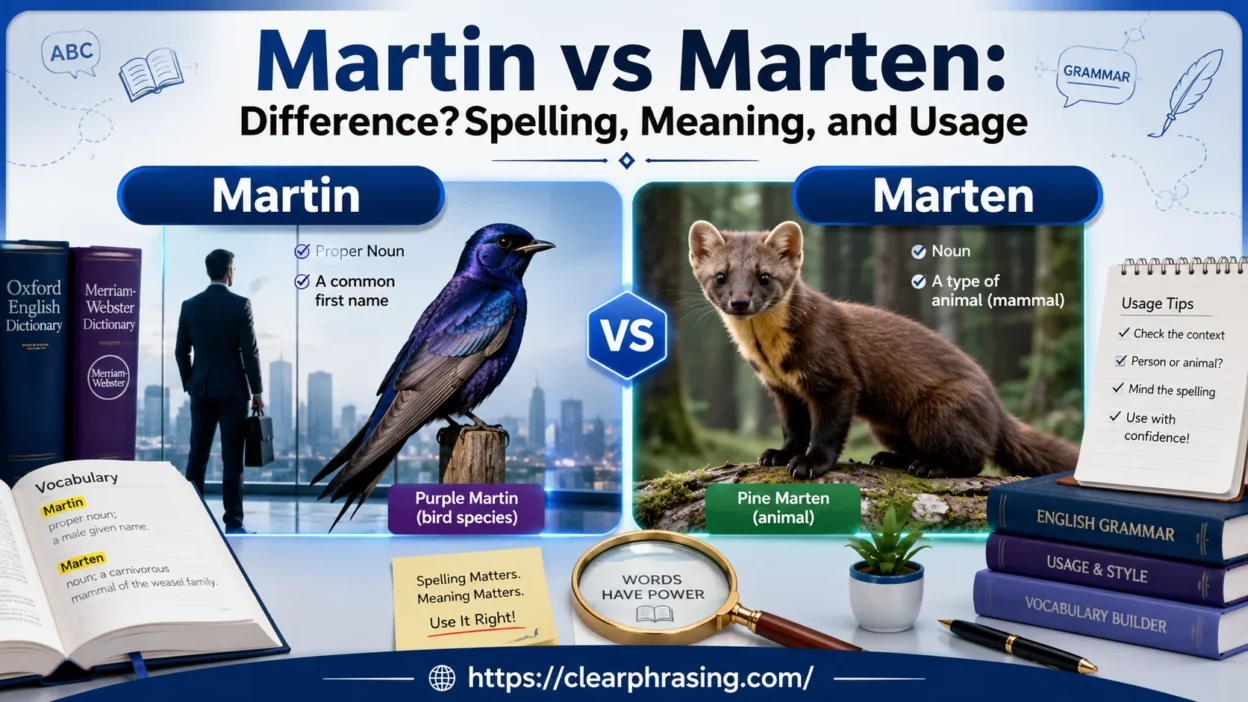
Martin vs Marten: Difference, Spelling, Meaning, and Usage explains why these similar words often confuse English learners.
Martin is a familiar name used as a first name, last name, or person’s given name. It also denotes a bird, especially the Purple Martin, a North American bird species of swallow. Marten refers to a mammal from the Mustelidae family, including weasels, otters, ferrets, Pine Marten, and Stone Marten found in forests across North America and Eurasia.
The word matin is an adjective relating to the morning, often used in phrases like matin prayer and matin song during religious services. As an English teacher, I have found that simple examples, clear definitions, and regular practice help students distinguish these terms in writing and speaking.
Learning the correct Spelling, Meaning, and Usage improves understanding, reduces confusion, and helps you use each word correctly in different contexts.
Quick Answer
The difference between Martin and Marten is simple.
- Martin is usually a proper name for a person. It is also the common name of several species of swallows, such as the purple martin and the house martin.
- Marten is a small mammal belonging to the genus Martes in the weasel family (Mustelidae). Animals such as the pine marten and American marten fall into this category.
| Word | Meaning | Example |
| Martin | A person’s name or a species of swallow | Martin gave the presentation yesterday. |
| Martin | A bird | The purple martin returned in early spring. |
| Marten | A weasel-like mammal | The pine marten climbed the tree with ease. |
If you’re talking about a person or a swallow, use Martin. If you’re referring to the forest-dwelling mammal, use Marten.
Why People Confuse Martin vs Marten
The confusion comes from several factors.
First, the spellings differ by only one letter. Second, many English speakers pronounce both words almost the same, especially during casual conversation. Finally, most people encounter Martin far more often because it is a common first name and surname.
Here are the most common reasons people mix them up:
- They differ by only one vowel.
- Their pronunciation is nearly identical.
- Both words appear in dictionaries.
- Autocorrect rarely flags either spelling.
- Many people have never heard of a marten.
For example, someone writing about wildlife may accidentally write:
The Martin lives in dense forests.
This sentence is incorrect because the animal is a marten, not Martin.
What Does Martin Mean?
Definition of Martin
The word Martin has two primary meanings.
It is most commonly a proper noun used as a given name or surname. Around the world, millions of people carry the name Martin.
It is also the common name for several species of swallows, birds known for their graceful flight and insect-catching abilities.
Martin as a Personal Name
Martin has been popular for centuries. It comes from the Latin name Martinus, meaning “dedicated to Mars,” the Roman god of war.
Many notable figures have carried this name, including:
- Martin Luther King Jr.
- Martin Scorsese
- Martin Freeman
- Martin Sheen
- Martin Van Buren
Because it is a proper noun, Martin is always capitalized when referring to a person.
Examples
- Martin starts his new job on Monday.
- My neighbor’s name is Martin.
- Professor Martin published a new research paper.
Martin as a Bird
Less commonly, martin refers to several members of the swallow family.
Some well-known species include:
- Purple martin
- House martin
- Sand martin
These birds are admired for their speed, aerial hunting skills, and seasonal migrations.
Unlike the personal name, the bird name is usually written in lowercase unless it begins a sentence.
Examples
- A purple martin can consume hundreds of insects each day.
- House martins often build nests beneath roof edges.
- Birdwatchers spotted several martins near the lake.
Origin and Etymology of Martin
The personal name traces back to Latin Martinus, while the bird name developed through Old French before entering Middle English.
Although both meanings share the same spelling, context immediately tells readers which one is intended.
What Does Marten Mean?
Definition of Marten
A marten is a small carnivorous mammal belonging to the genus Martes. It is closely related to weasels, mink, fishers, and otters.
Martens are agile climbers that live mainly in forests across North America, Europe, and Asia.
Different Species of Martens
Scientists recognize several species, including:
- American marten
- Pine marten
- Japanese marten
- Yellow-throated marten
- Nilgiri marten
- Sable
Each species has unique physical features and habitats, although they all belong to the same general group.
Habitat and Characteristics
Martens typically prefer mature forests with plenty of trees.
Common characteristics include:
- Long slender body
- Bushy tail
- Sharp claws
- Thick fur
- Excellent climbing ability
- Mostly solitary behavior
Their diet often includes:
- Small mammals
- Birds
- Eggs
- Insects
- Fruit
- Berries
These adaptable animals help maintain ecological balance by controlling rodent populations.
Origin and Etymology of Marten
The word marten entered English through Old French and ultimately traces back to Germanic languages.
Historically, martens became well known because their soft fur was highly valued in the fur trade.
Common Examples of Marten in Sentences
- A pine marten crossed the hiking trail.
- Wildlife cameras recorded a marten overnight.
- Conservationists are protecting marten habitats.
- The American marten spends much of its time in trees.
- Researchers tracked the marten using GPS collars.
Martin vs Marten: Side-by-Side Comparison
| Feature | Martin | Marten |
| Meaning | Person’s name or swallow | Small mammal |
| Part of Speech | Proper noun or common noun | Common noun |
| Category | Human name or bird | Wildlife |
| Capitalization | Capitalized for names | Usually lowercase |
| Pronunciation | MAR-tin | MAR-ten |
| Origin | Latin Martinus | Germanic through Old French |
| Common Context | Names, birds | Forest animals |
Martin vs Marten Pronunciation
IPA Pronunciation
Although they look similar, dictionaries distinguish them slightly.
| Word | IPA (American English) |
| Martin | /ˈmɑr.tɪn/ |
| Marten | /ˈmɑr.tən/ |
The final syllable changes only slightly.
American English Pronunciation
Many Americans pronounce the words almost identically during everyday speech.
Because of this, written context becomes much more important than pronunciation.
British English Pronunciation
British English generally preserves a clearer distinction between the endings, although regional accents vary.
Why They Sound Similar
English contains many pairs of words with nearly identical pronunciation.
Examples include:
- Principal vs principle
- Desert vs dessert
- Affect vs effect
- Martin vs Marten
The small pronunciation difference makes careful spelling essential, especially in formal writing.
Martin vs Marten: Key Differences Explained
Meaning
The biggest difference lies in meaning.
Martin refers to either a person or a species of swallow.
Marten refers only to the mammal.
Usage
Use Martin when discussing:
- People’s names
- Family names
- Historical figures
- Swallow species
Use Marten when discussing:
- Wildlife
- Forest ecosystems
- Mammals
- Conservation biology
Context
Context almost always reveals the intended meaning.
Consider these examples:
Martin accepted the award.✔️- The purple martin returned in April. ✔️
- The pine marten hunted at dusk. ✔️
Replacing any of these with the other spelling changes the meaning completely or creates an obvious error.
Grammar
When referring to a person’s name, Martin functions as a proper noun and should always begin with a capital letter.
When referring to the bird, martin acts as a common noun and is written in lowercase unless it starts a sentence.
Marten is also a common noun, so it follows normal capitalization rules.
Frequency of Use
The word Martin appears far more often in books, newspapers, and online writing because millions of people share the name.
By comparison, marten is mainly used in wildlife studies, zoology, conservation reports, and nature articlesWhen to Use Martin
Choosing Martin is straightforward once you understand the context. Use this word when you’re referring to a person’s name or a species of swallow.
Referring to a Person
Martin is a proper noun, so it should always begin with a capital letter.
Correct examples
- Martin finished the report before lunch.
- I met Martin at the conference.
- Dr. Martin specializes in environmental science.
- Martin volunteered to lead the project.
- Everyone congratulated Martin on his promotion.
Referring to a Bird
When martin refers to a swallow, it is a common noun. It remains lowercase unless it begins a sentence or forms part of an official species name.
Correct examples
- A purple martin nested near the lake.
- The house martin builds mud nests beneath roof eaves.
- We watched several martins catching insects over the field.
- Every spring, martins return from migration.
- Bird enthusiasts enjoy observing martins in flight.
When to Use Marten
Use marten only when discussing the mammal. This word appears most often in wildlife guides, biology textbooks, conservation reports, and nature articles.
Referring to the Mammal
Martens belong to the weasel family and are known for their agility and climbing ability.
Correct examples
- The pine marten disappeared into the forest.
- Scientists tracked the marten using GPS collars.
- A marten can climb trees with remarkable speed.
- Rangers spotted an American marten during the survey.
- The marten hunted small rodents at dusk.
Wildlife and Scientific Writing
You’ll frequently see marten in subjects such as:
- Zoology
- Wildlife conservation
- Ecology
- Forestry
- Environmental science
Because it is a common noun, marten is usually lowercase.
Martin vs Marten in Sentences
Seeing both words in context makes the difference much easier to remember.
Correct Examples Using Martin
- Martin accepted the award with gratitude.
- Martin teaches English at the local college.
- We invited Martin to dinner.
- The purple martin feeds mostly on flying insects.
- House martins migrate long distances every year.
- Martin organized the charity event.
- The author dedicated the book to Martin.
- Birdwatchers counted dozens of martins near the river.
- Martin called earlier this afternoon.
- A flock of martins circled above the meadow.
Correct Examples Using Marten
- The marten quickly climbed the oak tree.
- Pine martens prefer dense woodland habitats.
- Researchers observed a marten at sunrise.
- The American marten thrives in northern forests.
- A marten leaves distinctive footprints in fresh snow.
- Wildlife photographers patiently waited for the marten to appear.
- The marten searched for berries during summer.
- Conservation efforts have helped marten populations recover in several regions.
- The trapped marten was safely released.
- Forest ecosystems benefit from healthy marten populations.
Incorrect Examples and Corrections
| Incorrect Sentence | Correct Sentence | Why? |
| Martin lives in the forest and hunts mice. | The marten lives in the forest and hunts mice. | Refers to the mammal. |
| Marten won the science competition. | Martin won the science competition. | Refers to a person’s name. |
| I saw a purple marten flying overhead. | I saw a purple martin flying overhead. | Purple martin is the bird. |
| The Martin climbed a pine tree searching for prey. | The marten climbed a pine tree searching for prey. | Refers to the animal. |
| Martin habitat is shrinking. | Marten habitat is shrinking. | Wildlife context requires marten. |
Martin vs Marten in Literature and Everyday Writing
Usage in Books
Books commonly use Martin as a character’s name because it has been popular for centuries. Fiction, biographies, and historical works all feature people named Martin.
In wildlife books, marten appears when discussing mammals native to forests in Europe, Asia, or North America.
Usage in News Articles
News organizations use Martin far more frequently because it appears in people’s names.
Environmental reporting, however, regularly mentions martens when covering conservation projects, habitat restoration, or wildlife research.
Usage in Wildlife Publications
Biologists and conservationists use marten with precise scientific meaning.
For example:
- Pine marten populations
- American marten habitat
- Marten conservation programs
- Marten behavior studies
Usage in Everyday Conversation
Most people encounter Martin far more often than marten.
That’s one reason the spelling mistake happens so frequently. Someone unfamiliar with wildlife may instinctively write Martin even when discussing the animal.
Common Collocations
Certain words naturally appear together. Learning these combinations makes correct usage easier.
Martin
Common collocations include:
- Purple martin
- House martin
- Sand martin
- Martin Luther King Jr.
- Martin family
- Martin surname
- Martin residence
- Martin attended
- Martin explained
- Martin replied
Marten
Common collocations include:
- Pine marten
- American marten
- Yellow-throated marten
- Marten habitat
- Marten population
- Marten conservation
- Marten tracks
- Marten den
- Marten fur
- Marten species
Idioms and Expressions
Neither Martin nor marten forms part of common English idioms.
However, Martin frequently appears in proper names, organizations, businesses, schools, and historical references.
Marten appears mainly in scientific, educational, and environmental contexts.
Memory Tricks to Remember the Difference
Simple memory devices can prevent future mistakes.
Trick One
Martin = Man
Both words begin with Mar, and Martin contains “tin.” Think of Martin as someone’s name.
Trick Two
Marten = Animal
The ending -en can remind you of forest den, helping you associate the word with wildlife.
Trick Three
Ask yourself one question:
Am I talking about a person or a forest animal?
If it’s a person or a swallow, choose Martin.
If it’s a weasel-like mammal, choose marten.
Common Mistakes Writers Make
Many errors occur because both spellings are legitimate English words.
Watch out for these common mistakes:
- Writing Martin when referring to the mammal.
- Writing marten as someone’s name.
- Capitalizing marten unnecessarily.
- Misspelling purple martin as purple marten.
- Assuming spell check will catch the mistake.
Proofreading Tip
Whenever you see Martin or marten, pause and ask:
- Is this a person’s name?
- Is this a bird?
- Is this the mammal?
Answering that question usually reveals the correct spelling immediately.
Read More: Lyme Disease vs Lime Disease: Correct Spelling, and Difference
FAQs
What is the difference between Martin and Marten?
Martin usually refers to a person’s name or a type of swallow, while Marten is a small mammal from the weasel family. Although they sound alike, they have completely different meanings.
Is Martin a bird or a person’s name?
It can be both. Martin is a common first or last name, and it is also the name of several bird species, including the Purple Martin.
What kind of animal is a Marten?
A Marten is a carnivorous mammal that belongs to the Mustelidae family, which also includes weasels, otters, and ferrets.
What does matin mean?
Matin is an adjective related to the morning. It commonly appears in religious expressions such as matin prayer or matin song.
Why do people confuse Martin and Marten?
They are often confused because they are pronounced almost the same, even though their spellings and meanings are different.
Is Martin the same as matin?
No. Martin is a name or a bird, while matin refers to something connected with the morning.
How can I remember the difference between Martin and Marten?
Think of Martin as a person’s name or a bird, and remember that Marten ends with -en, which refers to the forest-dwelling mammal.
Are Martin and Marten homophones?
They are considered near-homophones because many English speakers pronounce them very similarly, making them easy to confuse.
Can Martin and Marten be used interchangeably?
No. They refer to different things, so replacing one with the other changes the meaning of the sentence.
Which spelling is correct: Martin or Marten?
Both spellings are correct, but the right choice depends on whether you mean the name or bird (Martin) or the mammal (Marten).
Conclusion
Learning the difference between Martin, Marten, and matin becomes much easier when you connect each word with its meaning instead of relying only on pronunciation. Many English learners make this mistake because the words sound alike, but a little practice with real examples quickly removes the confusion. Paying attention to the context is the best way to choose the correct spelling.
After teaching English for many years, I have seen students remember these words more easily by creating simple associations. Think of Martin as a name or a bird, Marten as a forest mammal, and matin as something related to the morning. This small memory trick improves your writing, strengthens your vocabulary, and helps you communicate with greater accuracy and confidence.

Mariam Asghar is an English specialist and professional content writer at ClearPhrasing.com. She is dedicated to helping readers improve their English through clear, practical, and easy-to-understand content. Her areas of expertise include grammar, spelling, vocabulary, punctuation, sentence structure, and effective writing.
At ClearPhrasing.com, Mariam writes comprehensive, well-researched articles that simplify complex language concepts for students, professionals, writers, and English learners. She believes that strong communication begins with a solid understanding of the English language and strives to make every lesson accessible and engaging.
With a strong commitment to quality, accuracy, and continuous learning, Mariam ensures that each article is carefully researched, thoroughly reviewed, and written to help readers communicate with greater confidence and clarity.