Affective vs Effective: Difference, Meaning, Examples, and Usage explains the difference between these commonly confused words in simple English.
Although the words have almost identical letters, their meaning and usage are very different. This article uses plain English, clear definitions, and an example to remove confusion. As a teacher, I have seen many learners improve their understanding after focusing on the correct grammar, vocabulary, word choice, and context instead of guessing.
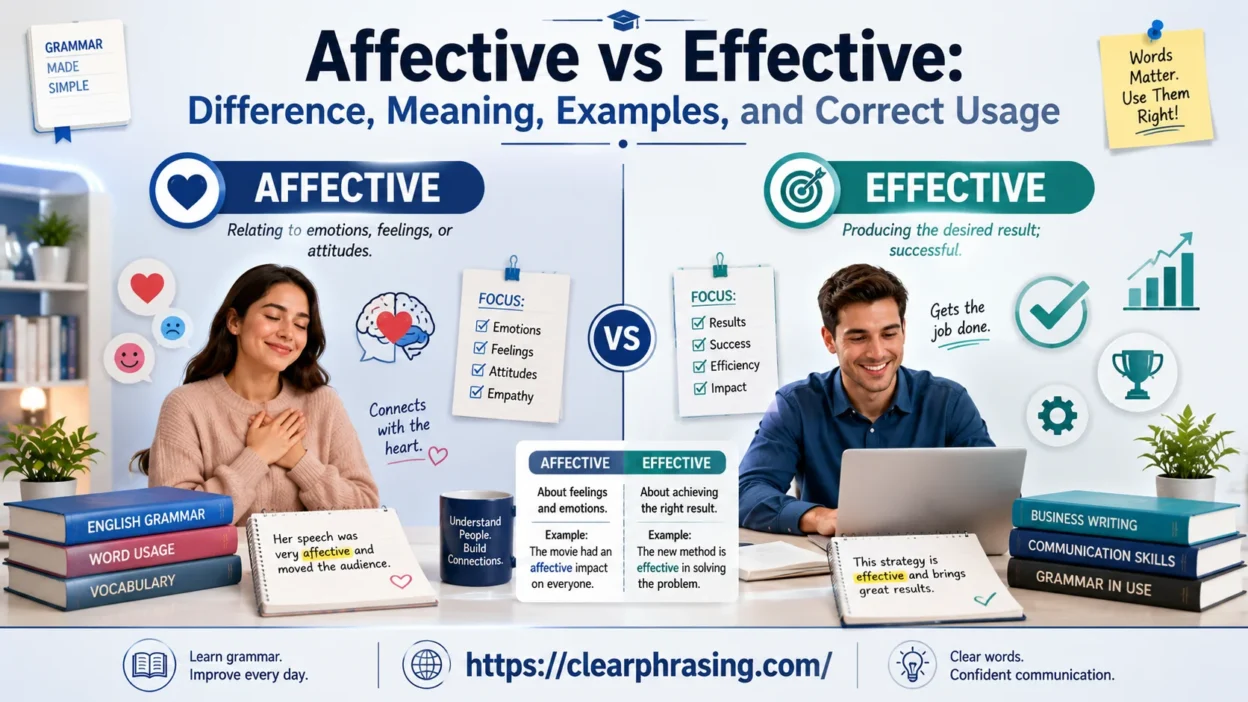
Affective relates to feelings, emotions, moods, and the emotional side of people, especially in psychology. Effective comes from effect and describes something that works well, produces a desired result, and achieves its goal.
For instance, a movie may make you feel sad, while a new study method helps you remember information. Knowing this distinction improves communication, learning, writing, and correct usage.
Quick Answer: Affective vs Effective
The main difference between affective and effective is simple:
- Affective means related to emotions, feelings, moods, or attitudes.
- Effective means successful, useful, or able to produce the desired result.
| Word | Meaning | Focus | Example |
| Affective | Related to emotions or feelings | Emotional response | The teacher used affective activities to build students’ confidence. |
| Effective | Producing a successful result | Achievement or outcome | The new study method was effective for improving grades. |
A quick memory trick:
- Affective = Affect = Feelings
- Effective = Effect = Results
If you are talking about emotions, choose affective. If you are talking about success or results, choose effective.
What Does Affective Mean?
Affective Definition and Meaning
Affective is an adjective that describes something connected to emotions, feelings, moods, or personal attitudes.
The word comes from affect, which relates to emotional influence or feelings. It is commonly used in fields such as psychology, education, healthcare, and communication.
When something is affective, it focuses on the emotional side of human experience.
For example:
- A teacher who encourages confidence and motivation uses affective teaching methods.
- A movie that creates a strong emotional reaction has an affective impact.
- A person’s mood can influence their affective behavior.
The key question to identify affective is:
“Does this sentence describe feelings or emotions?”
If the answer is yes, affective is likely the correct choice.
Common Uses of Affective
The word affective appears more often in academic and professional contexts than everyday conversations.
Common phrases include:
| Term | Meaning |
| Affective response | An emotional reaction to something |
| Affective learning | Learning connected with emotions, values, and attitudes |
| Affective behavior | Actions influenced by emotions |
| Affective skills | Emotional abilities such as empathy and self-awareness |
| Affective development | Growth in emotional understanding |
Examples of Affective in Sentences
- The teacher focused on students’ affective development by encouraging teamwork and confidence.
- The advertisement created an affective connection with customers.
- Music often creates a powerful affective response among listeners.
- The research studied how emotions influence affective behavior.
Notice that none of these examples focus on success or results. They focus on feelings.
What Does Effective Mean?
Effective Definition and Meaning
Effective means successful, efficient, or capable of producing the intended outcome.
When something is effective, it works. It solves a problem, reaches a goal, or creates the expected result.
The word appears frequently in business, education, health, technology, and everyday communication.
For example:
- An effective study plan helps students learn better.
- An effective leader helps a team achieve goals.
- An effective solution fixes a problem.
The key question for effective is:
“Does this thing work successfully?”
If the answer is yes, effective is the correct word.
Common Uses of Effective
| Phrase | Meaning |
| Effective communication | Communication that creates understanding |
| Effective strategy | A plan that achieves goals |
| Effective treatment | A treatment that improves a condition |
| Effective method | A method that produces good results |
| Effective leadership | Leadership that helps people and organizations succeed |
Examples of Effective in Sentences
- The company created an effective marketing strategy that increased sales.
- Regular practice is an effective way to improve English skills.
- The doctor recommended an effective treatment for the condition.
- Good time management is an effective tool for reducing stress.
In each example, the focus is on results.
Affective vs Effective: Key Differences Explained
Although these words look similar, their meanings move in different directions.
Affective points inward toward emotions. Effective points outward toward results.
Think about it this way:
- Affective asks: “How does someone feel?”
- Effective asks: “What result does something produce?”
| Feature | Affective | Effective |
| Word type | Adjective | Adjective |
| Main idea | Emotion and feelings | Success and results |
| Related word | Affect | Effect |
| Common fields | Psychology, education, healthcare | Business, communication, daily life |
| Example question | How does it influence emotions? | Does it achieve the goal? |
A Simple Comparison Example
Consider a teaching method.
Sentence 1:
“The teacher used affective techniques to make students feel more confident.”
Here, the focus is emotions.
Sentence 2:
“The teacher used effective techniques to improve students’ test scores.”
Here, the focus is results.
A teaching method can actually be both affective and effective. It may support students emotionally while also improving performance.
Affective vs Effective in Grammar and Word Formation
How Affect and Effect Connect With Affective and Effective
Many learners confuse these words because they come from the related words affect and effect.
Here is the connection:
| Word | Meaning | Example |
| Affect | To influence something | Stress can affect your health. |
| Effect | A result or outcome | The effect was noticeable. |
| Affective | Related to emotions | The study examined affective responses. |
| Effective | Producing results | The method was effective. |
Understanding the root words makes the difference easier.
Affective and Affect
The connection between affect and affective is mainly emotional.
Example:
- “The experience affected her emotionally.”
- “The experience created an affective response.”
Both sentences involve feelings.
Effective and Effect
The connection between effect and effective focuses on results.
Example:
- “The new policy had a positive effect.”
- “The new policy was effective.”
Both sentences describe successful outcomes.
Common Mistakes When Using Affective and Effective
Using Affective When You Mean Successful
Incorrect:
The new learning technique was affective.
Correct:
The new learning technique was effective.
Why?
The sentence talks about a technique producing results, not creating emotions.
Using Effective When You Mean Emotional
Incorrect:
The film created an effective emotional reaction.
Correct:
The film created an affective emotional reaction.
Why?
The focus is the viewer’s feelings.
Confusing Affect, Effect, Affective, and Effective
| Word | Meaning | Example |
| Affect | Influence | The weather can affect your mood. |
| Effect | Result | The effect was immediate. |
| Affective | Emotional | The song created an affective response. |
| Effective | Successful | The solution was effective. |
A helpful habit is to identify the purpose of the sentence before choosing the word.
Memory Tricks to Remember Affective vs Effective
Remembering these words does not have to feel difficult.
Use the “A and E Rule”
Affective starts with A. Think: A = Attitude and emotions.
Effective starts with E. Think: E = End result.
This simple connection helps many learners avoid mistakes.
Ask Yourself One Question
Before using the word, ask:
Is this about feelings or results?
- Feelings → Affective
- Results → Effective
Use Real Life Examples
Imagine a movie:
- The movie creates strong emotions → Affective
- The movie successfully entertains viewers → Effective
One movie can be both.
Affective vs Effective Examples in Different Contexts
Workplace Examples
A workplace needs both emotional awareness and successful strategies.
- Effective communication helps employees understand tasks clearly.
- Affective communication considers emotions and relationships.
Education Examples
Teachers often use both approaches.
| Type | Example |
| Affective teaching | Building confidence and motivation |
| Effective teaching | Helping students achieve learning goals |
A successful teacher understands both sides.
Healthcare Examples
Healthcare professionals consider emotions and outcomes.
- An effective treatment improves a patient’s condition.
- Affective support helps patients feel understood and cared for.
Everyday Conversation Examples
- “This exercise routine is effective because it improves fitness.”
- “The speech had an affective impact because it inspired people.”
How to Choose Between Affective and Effective Correctly
Follow these simple steps:
Identify the Main Focus
Look at what the sentence describes.
Is it:
- A feeling?
- A mood?
- An emotional reaction?
Use affective.
Is it:
- A result?
- A solution?
- A successful action?
Use effective.
Replace the Word Mentally
Try replacing the word:
- Can you replace it with “emotional”? → Use affective
- Can you replace it with “successful”? → Use effective
Examples:
“The campaign created an emotional connection.”
This works with affective.
“The campaign created a successful result.”
This works with effective.
Read More: Suite or Sweet or Sweat: What’s the Difference? Meaning & Usage
FAQs
1. What is the difference between affective and effective?
Affective relates to emotions, feelings, and moods, while effective describes something that works well or achieves the intended result.
2. Is affective the same as effective?
No. Although the words look similar, they have different meanings and are used in different contexts.
3. When should I use affective?
Use affective when discussing emotions, emotional responses, or topics related to psychology and human feelings.
4. When should I use effective?
Use effective when talking about something that successfully produces the desired outcome or solves a problem.
5. Is affective commonly used in everyday English?
Not as often. Affective mainly appears in psychology, education, and academic writing, while effective is common in daily conversation.
6. Can a movie be affective and effective at the same time?
Yes. A movie can create a strong emotional response (affective) and successfully deliver its message (effective).
7. Why do people confuse affective and effective?
People often confuse them because they have similar spelling and pronunciation, even though their meanings are completely different.
8. How can I remember the difference?
Think of affective as connected to affect and emotions, while effective is linked to achieving results and being successful.
9. Are affective and effective derived from affect and effect?
They are related to the nouns affect and effect, but each adjective has its own meaning and should be learned based on usage.
10. Which word is more common in writing?
Effective is much more common because it applies to everyday communication, business, education, and general writing.
Conclusion
Understanding the difference between affective and effective helps you communicate with greater accuracy and confidence. Even though the words look alike, they belong in different situations and express different ideas. Learning their meanings through real examples makes them much easier to remember.
From my teaching experience, students master this pair faster when they focus on context instead of spelling alone. With regular reading, writing, and practice, you will naturally recognize when to use affective for emotions and effective for successful results, making your English clearer and more professional.

Mehwish Imtiaz is an English specialist and professional blog writer at ClearPhrasing.com. She specializes in grammar, spelling, vocabulary, punctuation, and writing improvement. With a strong passion for clear communication and language education, she creates reader-friendly articles that help students, professionals, and English learners understand complex language topics with ease.
Her writing focuses on accuracy, simplicity, and practical usage, ensuring that every article provides clear explanations and real-world examples. At ClearPhrasing.com, Mehwish is committed to publishing well-researched, original content that helps readers write more confidently and communicate more effectively in everyday and professional English.