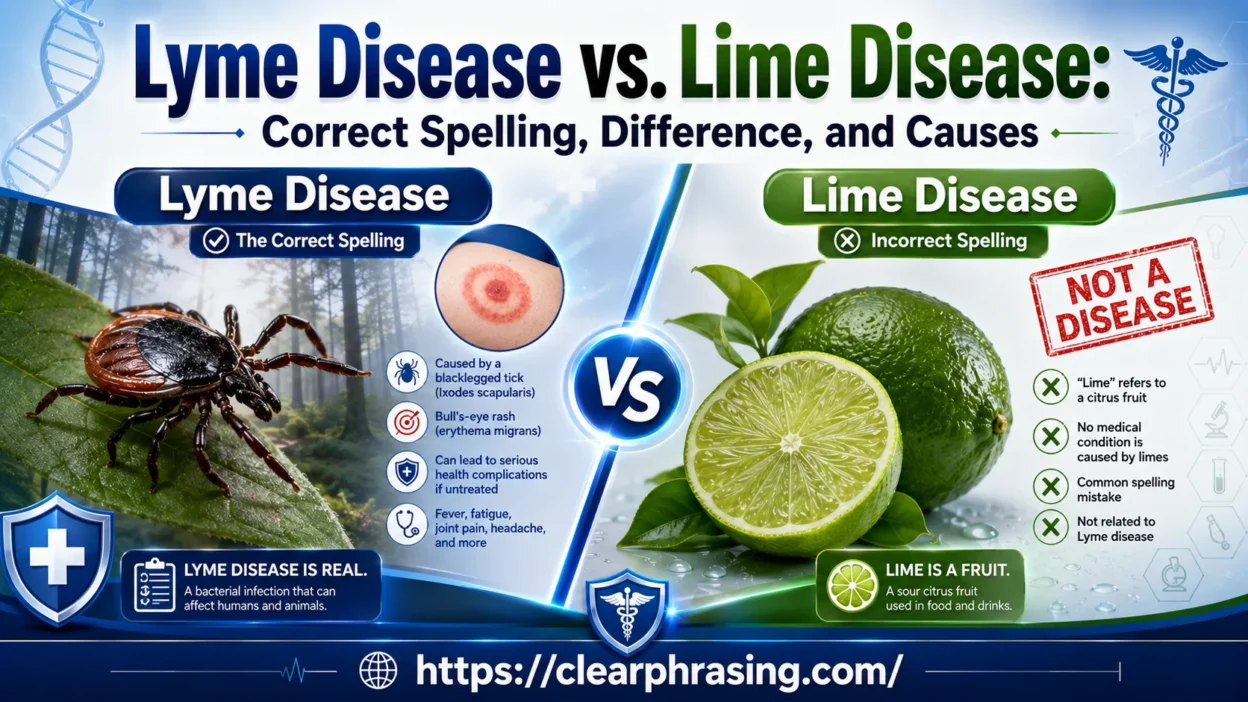
Lyme Disease vs. Lime Disease: Correct Spelling, and Difference explains a common spelling mistake.
Many people confuse Lyme disease, Lymes disease, Lyme’s disease, and Lime Disease because they sound alike. As an English teacher, I often see this mix-up in class. The correct name is Lyme disease, while Lime Disease is not a recognized medical condition. Knowing the difference prevents misinformation and improves clear communication.
Lyme Borreliosis, or Borreliosis, is the medical term for a bacterial infection caused by Borrelia burgdorferi. It spreads through infected tick bites and may cause fever, fatigue, and a skin rash. Other strains, including B. afzelii and B. garinii, are common in Europe. Always use trusted resources and the technical name when discussing this disease to ensure accurate information.
Quick Answer: Lyme Disease vs. Lime Disease
The difference is simple.
- Lyme disease is a real bacterial illness caused by Borrelia burgdorferi and spread by infected blacklegged ticks.
- Lime disease is not a medical condition. It is only a spelling mistake.
- The disease was named after Lyme, Connecticut, where doctors first identified a cluster of unusual arthritis cases during the 1970s.
- If you are searching for health information, always use Lyme disease instead of lime disease.
| Feature | Lyme Disease | Lime Disease |
| Correct spelling | ✅ Yes | ❌ No |
| Medical condition | ✅ Yes | ❌ No |
| Cause | Tick-borne bacteria | None |
| Official medical term | ✅ Yes | ❌ No |
| Named after | Lyme, Connecticut | Not applicable |
Lyme Disease vs. Lime Disease at a Glance
Although the words sound identical, their meanings are completely different.
| Category | Lyme Disease | Lime Disease |
| Meaning | Tick-borne bacterial infection | Misspelling |
| Exists medically | Yes | No |
| Diagnosis | Medical testing | Impossible |
| Treatment | Antibiotics | None |
| Recognized by health authorities | Yes | No |
| Correct usage | Always | Never |
Many search engines automatically correct lime disease to Lyme disease because there is no officially recognized illness called lime disease.
What Is Lyme Disease?
Medical Definition
Lyme disease is an infectious disease caused primarily by the bacterium Borrelia burgdorferi in North America. In Europe and parts of Asia, additional Borrelia species can also cause Lyme disease.
Humans usually become infected after being bitten by an infected blacklegged tick (Ixodes tick).
Without treatment, the infection can affect several body systems, including:
- Skin
- Joints
- Nervous system
- Heart
- Muscles
Fortunately, most people recover completely when doctors diagnose and treat the infection early.
How Lyme Disease Got Its Name
The disease takes its name from Lyme, Connecticut, where doctors investigated an unusual number of children and adults experiencing arthritis-like symptoms in the mid-1970s.
Researchers later discovered that infected ticks were responsible.
The Bacteria Behind Lyme Disease
The main bacterium is:
- Borrelia burgdorferi
In Europe, doctors may also identify:
- Borrelia afzelii
- Borrelia garinii
These spiral-shaped bacteria enter the bloodstream after an infected tick remains attached long enough to transmit the infection.
How the Infection Spreads
Transmission usually occurs when:
- An infected tick bites a person.
- The tick stays attached for roughly 24–36 hours or longer.
- The bacteria move from the tick into the bloodstream.
Lyme disease does not spread through casual contact between people.
What Is Lime Disease?
Is Lime Disease a Real Medical Condition?
No.
Medical organizations, hospitals, and infectious disease specialists do not recognize lime disease.
If someone uses the phrase, they almost always mean Lyme disease.
Why People Make This Mistake
Several factors explain the confusion.
- The words sound exactly alike.
- Autocorrect occasionally changes “Lyme” to “lime.”
- Many people have never seen the word written before.
- Speech recognition software sometimes selects the wrong spelling.
Is There Any Disease Related to Limes?
No.
Eating limes cannot cause Lyme disease.
There is a skin condition called phytophotodermatitis, sometimes nicknamed “margarita burn.” It occurs when lime juice on the skin reacts with sunlight. However, it has nothing to do with Lyme disease.
Lyme Disease vs. Lime Disease: Side-by-Side Comparison
| Feature | Lyme Disease | Lime Disease |
| Correct spelling | Yes | No |
| Pronunciation | Same | Same |
| Medical diagnosis | Yes | No |
| Cause | Borrelia bacteria | None |
| Tick-related | Yes | No |
| Requires treatment | Yes | No |
| Appears in medical textbooks | Yes | No |
What Causes Lyme Disease?
Blacklegged Ticks
The primary carriers include:
- Blacklegged ticks
- Deer ticks
- Western blacklegged ticks
Not every tick carries Lyme disease. Infection rates vary by region.
The Role of Borrelia Bacteria
Ticks become infected after feeding on infected wildlife, particularly rodents.
Later, they can pass the bacteria to humans during another blood meal.
Tick Life Cycle
Ticks have four stages:
- Egg
- Larva
- Nymph
- Adult
Most human infections occur during the nymph stage because these ticks are tiny and difficult to notice.
Areas with Higher Risk
Lyme disease is more common in:
- Northeastern United States
- Upper Midwest
- Mid-Atlantic states
- Parts of southern Canada
- Central Europe
- Northern Europe
Can Pets Carry Infected Ticks?
Yes.
Dogs and outdoor cats can bring infected ticks into your home. However, pets do not directly spread Lyme disease to people.
Common Symptoms of Lyme Disease
Symptoms often appear within 3 to 30 days after a tick bite.
Early Symptoms
Common signs include:
- Fever
- Chills
- Fatigue
- Headache
- Swollen lymph nodes
- Muscle aches
The Bull’s-Eye Rash
The classic erythema migrans rash appears in many—but not all—patients.
Characteristics include:
- Expands gradually
- Often forms a circular pattern
- May resemble a bull’s-eye
- Usually isn’t painful
Not everyone develops this rash.
Later Symptoms
Without treatment, people may experience:
- Severe joint pain
- Facial paralysis
- Neck stiffness
- Memory problems
- Dizziness
- Numbness
Heart Complications
Some patients develop Lyme carditis, which can affect the heart’s electrical system and cause irregular heart rhythms.
How Doctors Diagnose Lyme Disease
Diagnosing Lyme disease isn’t always straightforward because early symptoms resemble many viral illnesses.
Physical Examination
Doctors check for:
- Characteristic rash
- Tick bite history
- Neurological symptoms
- Joint swelling
Medical History
Healthcare providers ask questions about:
- Outdoor activities
- Hiking or camping
- Geographic location
- Recent tick exposure
Blood Tests
When appropriate, doctors may recommend:
- Enzyme immunoassay (EIA)
- ELISA test
- Western blot confirmation (or another approved confirmatory test)
Testing too early can produce false-negative results because the immune system may not yet have produced detectable antibodies.
Treatment for Lyme Disease
Antibiotics
Most early infections respond well to antibiotics such as:
- Doxycycline
- Amoxicillin
- Cefuroxime
Treatment commonly lasts 10 to 21 days, depending on the patient’s condition and the antibiotic prescribed.
Advanced Cases
Patients with neurological or cardiac complications may require intravenous antibiotics and closer medical monitoring.
Recovery
Most people recover completely after timely treatment.
Some individuals continue to experience fatigue, pain, or cognitive symptoms after treatment. This is known as Post-Treatment Lyme Disease Syndrome (PTLDS). Researchers continue to study why it occurs.
Can Lyme Disease Be Prevented?
Prevention remains the best defense.
Avoid Tick Bites
When spending time outdoors:
- Wear long sleeves.
- Use EPA-registered insect repellents.
- Stay on marked trails.
- Avoid tall grass.
- Wear light-colored clothing.
Perform Tick Checks
After outdoor activities, inspect:
- Hair
- Behind the ears
- Underarms
- Waistline
- Knees
- Groin
- Ankles
Remove Ticks Correctly
Use fine-tipped tweezers.
- Grasp the tick close to the skin.
- Pull upward slowly.
- Avoid twisting or crushing the tick.
- Clean the area afterward.
Protect Pets
Talk to your veterinarian about tick prevention products for dogs and cats.
Myths and Misconceptions About Lyme Disease
Myth: Lime Disease Is Different
Fact: It is simply a misspelling.
Myth: Every Tick Carries Lyme Disease
Fact: Only some ticks carry Borrelia bacteria.
Myth: Everyone Gets a Bull’s-Eye Rash
Fact: Many infected people never develop one.
Myth: Lyme Disease Is Contagious
Fact: It doesn’t spread through hugging, kissing, coughing, or sharing food.
Myth: Pets Infect Humans
Fact: Pets can carry infected ticks into the home but don’t transmit Lyme disease directly.
Common Grammar and Spelling Mistakes
Medical terminology often causes confusion.
Incorrect spellings include:
- Lime disease
- Lymes disease
- Lyme’s disease
The correct spelling is:
Lyme disease
A simple way to remember it is this:
Lyme comes from Lyme, Connecticut, not the citrus fruit.
Real-Life Examples of Correct Usage
Medical Writing
“The patient was diagnosed with Lyme disease after developing erythema migrans.”
News Report
“Health officials reminded residents to check for ticks to reduce the risk of Lyme disease.”
Everyday Conversation
✅ “My doctor tested me for Lyme disease.”
❌ “I think I have lime disease.”
Lyme Disease in Numbers
| Fact | Statistic |
| Typical symptom onset | 3–30 days after a tick bite |
| Common antibiotic treatment | 10–21 days |
| Peak tick season | Late spring through summer |
| Main transmission | Infected blacklegged tick bite |
| Primary bacterium in North America | Borrelia burgdorferi |
Case Study: Why Correct Spelling Matters
A family searched online for “lime disease treatment” after their child developed a rash following a camping trip. The search returned mixed results, including unrelated pages about citrus fruit. Once they corrected the search to “Lyme disease,” they found trusted public health guidance, recognized the symptoms, and sought medical care promptly. The child received antibiotics early and recovered without serious complications.
This example shows how a simple spelling error can delay access to accurate health information.
“Early recognition and prompt antibiotic treatment offer the best chance for a full recovery.”
Read More: Who Should I Ask or Whom Should I Ask: Usage, and Examples
FAQs
1. Is Lyme Disease the correct spelling?
Yes. Lyme disease is the correct and medically accepted spelling. “Lime Disease” is incorrect.
2. Does Lime Disease really exist?
No. Lime Disease is not a recognized medical condition. It is only a common spelling mistake.
3. Why do people confuse Lyme and Lime?
The words sound very similar when spoken, making them easy to mix up in everyday conversation.
4. What causes Lyme disease?
Lyme disease is caused by Borrelia burgdorferi bacteria, which are transmitted through the bite of infected ticks.
5. What are the first symptoms of Lyme disease?
Common early symptoms include fever, fatigue, headache, and a circular skin rash that may appear after a tick bite.
6. Is Lyme disease contagious?
No. Lyme disease does not spread from one person to another through normal daily contact.
7. What is Lyme Borreliosis?
Lyme Borreliosis is another name for Lyme disease and is commonly used in many European countries.
8. Can Lyme disease be treated?
Yes. Most cases can be treated successfully with antibiotics, especially when diagnosed early.
9. Where is Lyme disease most common?
It is found in many parts of North America, Europe, and other regions where infected ticks live.
10. How can I avoid Lyme disease?
Reduce your risk by using insect repellent, wearing protective clothing in wooded or grassy areas, checking for ticks after spending time outdoors, and removing attached ticks promptly.
Conclusion
Understanding the difference between Lyme disease and Lime Disease is more than a spelling lesson. Using the correct term helps you communicate clearly and prevents confusion, especially when discussing health. Although the names sound alike, only Lyme disease is a real bacterial illness spread by infected ticks. Learning the proper spelling and meaning ensures that you share accurate information with others.
As an English teacher, I have seen many students and writers make this mistake because of similar pronunciation. A few minutes spent learning the correct word can prevent misunderstandings in conversations, school assignments, and online posts. Whenever you are unsure, rely on trusted medical sources and remember that Lyme disease is the correct and recognized name, while Lime Disease is simply a common spelling error.

Shamsa Kanwal is an English specialist and content writer at ClearPhrasing.com, where she helps readers navigate the English language with confidence. She enjoys breaking down grammar rules, spelling differences, vocabulary, and everyday writing challenges into simple, practical lessons that anyone can understand.
Her writing is focused on making learning approachable rather than overwhelming. Whether she’s explaining commonly confused words, punctuation rules, or grammar concepts, Shamsa believes that clear explanations and real-life examples are the key to effective learning.
Every article she writes is carefully researched, fact-checked, and edited to ensure it is accurate, easy to read, and genuinely helpful. Her goal is to create trustworthy resources that enable students, professionals, writers, and English learners to improve their communication skills and write with greater clarity.
Through her work at ClearPhrasing.com, Shamsa is committed to making English learning simpler, more practical, and accessible for readers around the world.