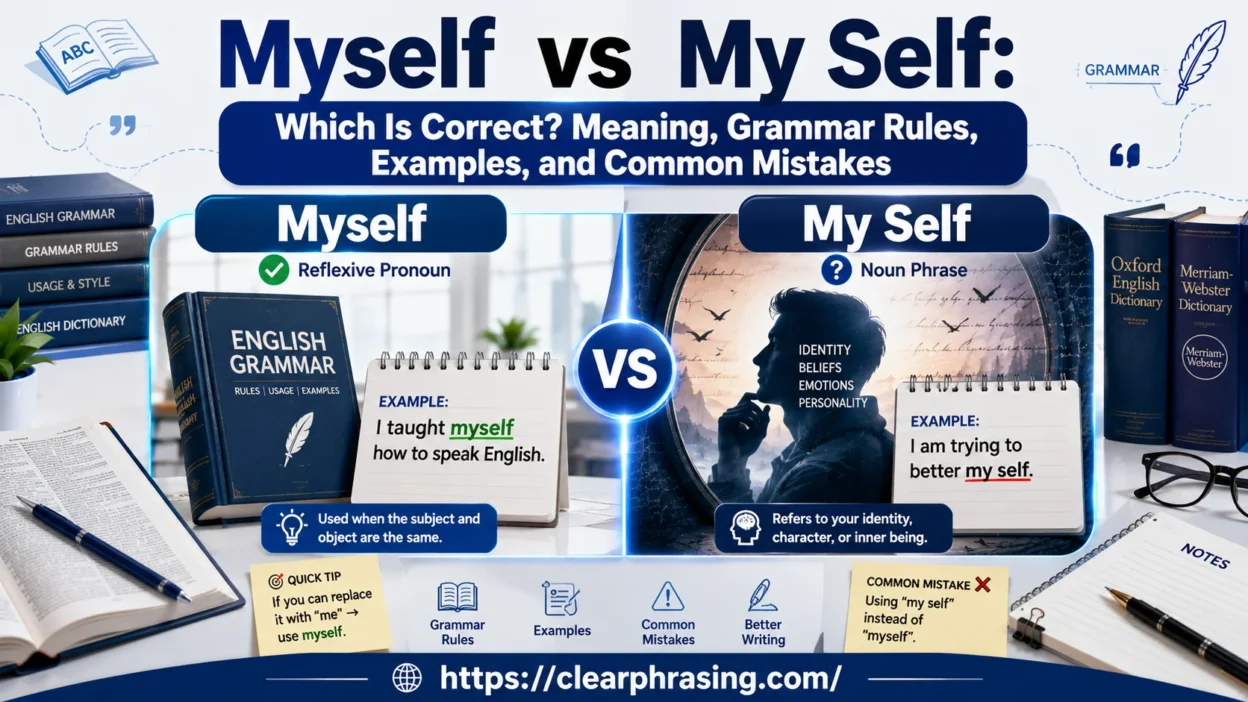
Myself vs My Self: Which Is Correct? Meaning & Grammar Rules explains this confusing grammar point in a simple way.
At first glance, myself and my self may look and sound interchangeable, but they have different meanings. Many English learners, students, writers, professionals, and native speakers mix them in everyday English, academic writing, and professional communication. As an English teacher, I often see this confusion, and learning the grammar rules, usage rules, and correct usage helps you use both forms confidently.
In standard English, myself is a reflexive pronoun used when the subject and object are the same person, as in “I made this myself.” In contrast, my self treats self as a noun in philosophical, psychological, or stylistic contexts. It refers to identity, selfhood, self-awareness, self-discovery, and personal growth
Understanding this difference improves communication, expression, English usage, and grammar, helping you avoid common mistakes with ease.
Quick Answer
Myself is the correct form for almost every everyday situation. It functions as a reflexive pronoun or an intensive pronoun.
My self is written as two words only when self is being used as a noun referring to your identity, personality, or inner being. This usage mainly appears in philosophy, psychology, spirituality, and literary writing.
| Expression | Correct? | Common Use |
| Myself | ✅ Yes | Everyday English, grammar, business writing |
| My self | ✅ Yes, but rare | Identity, psychology, philosophy, literature |
For most writers, myself is the correct choice.
What Does “Myself” Mean?
Definition of Myself
Myself is a reflexive pronoun. It refers back to the subject of a sentence.
For example:
- I taught myself Spanish.
- I blamed myself for the mistake.
- I introduced myself to the new manager.
In each sentence, the person performing the action and receiving the action is the same person.
Why It Is One Word
English combines my and self into a single word because they function together as one grammatical unit.
Other reflexive pronouns follow the same pattern:
- yourself
- himself
- herself
- itself
- ourselves
- yourselves
- themselves
Writing my self instead of myself changes the grammatical function completely.
Part of Speech
Myself can work as:
- Reflexive pronoun
- Intensive pronoun
Those are its only standard grammatical roles.
What Does “My Self” Mean?
Definition
When written as my self, my is a possessive adjective and self is a noun.
Instead of functioning as a pronoun, the phrase refers to a person’s identity or inner nature.
Examples include:
- I am trying to understand my self better.
- Meditation helped me reconnect with my self.
- She discovered my self through years of reflection.
Although these examples are grammatically possible, modern writers often prefer expressions such as:
- my true self
- my authentic self
- my inner self
These sound more natural in modern English.
Where You May See “My Self”
You may encounter my self in:
- philosophical essays
- psychology books
- spiritual writing
- poetry
- classic literature
It is uncommon in everyday conversation.
The Main Difference Between Myself and My Self
| Feature | Myself | My Self |
| Word type | Reflexive or intensive pronoun | Possessive adjective + noun |
| Everyday use | Very common | Rare |
| Business writing | Yes | Usually no |
| Academic grammar | Yes | Only in special contexts |
| Literature | Sometimes | Common |
The biggest difference is grammatical function.
Myself acts as a pronoun.
My self refers to identity.
Myself as a Reflexive Pronoun
A reflexive pronoun reflects the action back to the subject.
When to Use It
Use myself whenever the subject performs an action on itself.
Examples:
- I reminded myself about the meeting.
- I cut myself while cooking.
- I challenged myself to read fifty books.
Notice that I and myself refer to the same person.
Without the reflexive pronoun, these sentences would be incomplete or incorrect.
Why Reflexive Pronouns Matter
They help avoid confusion.
Compare these:
- I hurt myself.
- I hurt John.
The first sentence shows that the action affects the speaker.
The second affects someone else.
Myself as an Intensive Pronoun
An intensive pronoun emphasizes another noun or pronoun.
Examples:
- I baked the cake myself.
- I completed the project myself.
- I fixed the computer myself.
Removing myself does not change the basic meaning.
For example:
- I baked the cake.
- I baked the cake myself.
The second sentence simply adds emphasis.
When NOT to Use Myself
Many people use myself because they think it sounds more professional.
It usually has the opposite effect.
Incorrect:
- Please contact Sarah or myself.
Correct:
- Please contact Sarah or me.
Incorrect:
- David and myself attended the meeting.
Correct:
- David and I attended the meeting.
Simple Rule
Use:
- I as the subject.
- Me as the object.
- Myself only when referring back to I or adding emphasis.
This single rule eliminates most mistakes.
Understanding “My Self” as a Noun Phrase
Unlike myself, my self contains two separate words.
Here:
- My describes ownership.
- Self acts as a noun.
That changes everything.
Examples include:
- My self has changed over the years.
- My self continues to evolve.
Even though these are grammatically acceptable, modern English usually prefers:
- My identity
- My personality
- My inner self
- My true self
Those alternatives sound smoother and clearer.
Historical Development of Myself
English did not always use reflexive pronouns exactly as it does today.
In Middle English, writers sometimes separated words that are now written together.
Over time, myself became standardized as one word because speakers treated it as a single grammatical unit rather than two separate words.
Today, every major English dictionary recognizes myself as the standard spelling for the reflexive pronoun.
The two-word form survives mainly in specialized writing about personal identity.
Is “My Self” Wrong?
Not necessarily.
It simply belongs in a different context.
Use my self when discussing identity.
Examples:
- I wanted to discover my self after years of change.
- The novel explores my self through symbolism.
Do not use it when you mean the reflexive pronoun.
Incorrect:
- I introduced my self.
Correct:
- I introduced myself.
Context determines which form is appropriate.
Myself in Different Types of Writing
Everyday Conversation
You’ll almost always use myself.
Examples:
- I made dinner myself.
- I taught myself guitar.
- I blamed myself.
Academic Writing
Academic writing follows the same grammar rules.
Correct:
- I limited myself to primary sources.
Incorrect:
- Myself completed the research.
Business Communication
Professional writing values clarity.
Correct:
- Please send the report to me.
- I reviewed the proposal myself.
Avoid unnecessary uses of myself because they often sound overly formal.
Creative Writing
Creative writers sometimes use my self to explore identity.
Example:
“She searched for my self beneath years of fear.”
Here, the phrase expresses personal identity rather than grammar.
Psychology and Self-Reflection
Psychologists often discuss:
- self-awareness
- self-concept
- authentic self
- ideal self
In these discussions, self functions as a noun rather than a pronoun.
Common Mistakes Native and ESL Speakers Make
Many grammar mistakes come from trying to sound formal.
Here are the most common ones.
Replacing “Me”
Incorrect:
- Please email myself.
Correct:
- Please email me.
Replacing “I”
Incorrect:
- John and myself finished early.
Correct:
- John and I finished early.
Separating the Word
Incorrect:
- I taught my self coding.
Correct:
- I taught myself coding.
Using Myself Without Need
Incorrect:
- Myself believes this is correct.
Correct:
- I believe this is correct.
Correct vs Incorrect Examples
| Incorrect | Correct | Why |
| John and myself attended. | John and I attended. | Subject pronoun needed |
| Please call myself tomorrow. | Please call me tomorrow. | Object pronoun needed |
| I introduced my self. | I introduced myself. | Reflexive pronoun |
| I completed the report myself. | ✅ Correct | Intensive pronoun |
| I discovered my self through meditation. | ✅ Context dependent | Identity noun |
Everyday Examples
1. At Work
- I completed the presentation myself.
- I reminded myself about the deadline.
- I introduced myself to the new client.
2. At School
- I challenged myself to improve my grades.
- I taught myself algebra.
3. At Home
- I repaired the shelf myself.
- I blamed myself for forgetting the groceries.
During Self-Reflection
- I wanted to understand my true self.
- My self changed after years of travel.
Memory Tricks to Remember the Difference
Think About the Action
If the action comes back to you, use myself.
Example:
- I hurt myself.
Think About Identity
If you’re discussing personality or identity, my self may be correct.
Example:
- I wanted to understand my self.
The One-Word Rule
If you could replace it with:
- yourself
- himself
- herself
then myself should also be one word.
Synonyms and Related Expressions
Alternatives to Myself
- personally
- on my own
- alone
- independently
Alternatives to My Self
- authentic self
- true self
- inner self
- personal identity
- sense of self
Similar Grammar Pairs You Might Confuse
Understanding myself vs my self becomes easier once you recognize similar grammar patterns.
Examples include:
- I vs Me
- Yourself vs Your Self
- Himself vs Him Self
- Ourselves vs Our Selves
- Its vs It’s
- Who vs Whom
Each pair depends on grammar rather than appearance.
Expert Grammar Tips
Professional editors follow a simple principle.
Choose the shortest correct form.
That means:
- Use I when it’s the subject.
- Use me when it’s the object.
- Use myself only as a reflexive or intensive pronoun.
Avoid using myself simply because it sounds formal.
Clear writing always beats complicated writing.
“Good grammar isn’t about sounding smarter. It’s about making your meaning impossible to misunderstand.”
Read More: Martin vs Marten: Difference, Spelling, Meaning, and Usage
FAQs
What is the main difference between myself and my self?
Myself is a reflexive pronoun, while my self is a noun phrase used mainly when talking about identity or selfhood.
Is my self grammatically incorrect?
No. It is uncommon in everyday English but can be correct in philosophical, psychological, or literary writing.
Can I write “I made this my self”?
No. The correct sentence is “I made this myself.” The reflexive pronoun is always written as one word.
Why do people confuse myself and my self?
Because both forms look very similar, many people assume they have the same meaning even though they serve different purposes.
When should I use myself for emphasis?
Use myself when you want to stress the subject, as in “I myself completed the project.”
Is myself always a reflexive pronoun?
No. It is often reflexive, but it can also be used to add emphasis to a sentence.
Does my self appear in academic writing?
Yes. It is mostly found in discussions about identity, psychology, philosophy, and self-awareness.
Can native speakers make this mistake?
Yes. Native speakers also confuse these forms from time to time, especially in informal writing.
How can I remember the correct usage?
Remember that myself is for grammar, while my self is for discussions about identity and the self.
Will learning this rule improve my writing?
Yes. Using the correct form makes your writing more accurate, professional, and easier for readers to understand.
Conclusion
Understanding the difference between myself and my self is easier once you know the role each one plays. Myself is the correct choice in normal English grammar because it works as a reflexive pronoun or adds emphasis. My self, however, is only suitable in special discussions about identity, philosophy, or psychology, where self is treated as a noun. Knowing this small distinction will make your writing clearer and more professional.
As an English teacher, I have noticed that many learners repeat this mistake simply because the two forms look alike. The best way to remember the rule is to focus on the meaning instead of the spelling. With regular reading and practice, you will naturally recognize which form fits the sentence. Once you master this grammar point, you will write with greater confidence and avoid a common error that even native speakers sometimes make.

Mehwish Imtiaz is an English specialist and professional blog writer at ClearPhrasing.com. She specializes in grammar, spelling, vocabulary, punctuation, and writing improvement. With a strong passion for clear communication and language education, she creates reader-friendly articles that help students, professionals, and English learners understand complex language topics with ease.
Her writing focuses on accuracy, simplicity, and practical usage, ensuring that every article provides clear explanations and real-world examples. At ClearPhrasing.com, Mehwish is committed to publishing well-researched, original content that helps readers write more confidently and communicate more effectively in everyday and professional English.