Compound vs Complex Sentence: Difference and Correct Usage helps you understand compound sentence, complex sentence, sentence structure, grammar, and correct usage.
From my teaching experience, many students confuse simple sentences, independent clauses, and run-on sentences. I always compare and contrast examples to build better understanding and improve writing with clear, cohesive ideas.
I explain how coordinating conjunctions, subordinating conjunctions, subjects, verbs, and a semicolon connect related ideas into complete thoughts. Using sentence examples, anchor charts, and practice activities gives learners more opportunities to create, compose, and communicate correctly.
This straightforward method helps capable writers flourish, avoid sentence fragments, and apply grammar rules with confidence.
Quick Answer
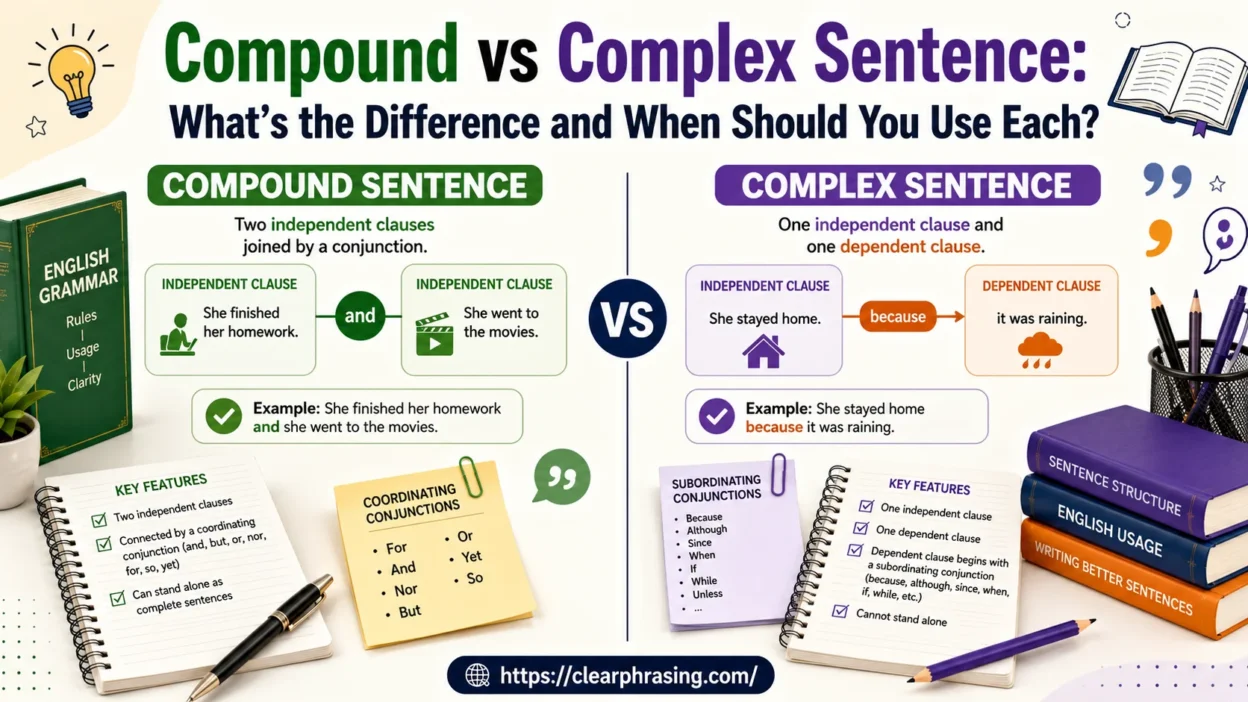
A compound sentence contains two or more independent clauses joined by a coordinating conjunction such as and, but, or, so, yet, for, or nor, or by a semicolon.
A complex sentence contains one independent clause and at least one dependent clause connected by a subordinating conjunction or a relative pronoun.
| Feature | Compound Sentence | Complex Sentence |
| Independent Clauses | Two or more | One |
| Dependent Clauses | None | One or more |
| Common Joining Words | and, but, or, so, yet | because, although, since, while, if |
| Main Purpose | Join equal ideas | Show relationships between ideas |
| Example | I studied hard, and I passed the exam. | Because I studied hard, I passed the exam. |
Quick Tip: If every clause can stand alone as a complete sentence, you probably have a compound sentence. If one clause cannot stand alone, it’s a complex sentence.
What Is a Compound Sentence?
A compound sentence joins two or more complete thoughts into one sentence. Each part could stand alone as its own sentence because each contains its own subject and verb.
Instead of writing several short sentences, a compound sentence combines related ideas. This creates smoother writing and prevents your text from sounding repetitive.
Definition of a Compound Sentence
A compound sentence consists of at least two independent clauses connected by:
- A coordinating conjunction
- A semicolon
- A semicolon with a conjunctive adverb
Formula
Independent Clause + Coordinating Conjunction + Independent Clause
Example:
Sarah baked a cake, and Tom decorated it.
Both clauses make complete sense on their own.
- Sarah baked a cake.
- Tom decorated it.
Key Characteristics of a Compound Sentence
- Contains two or more complete thoughts
- Each clause has its own subject and verb
- Clauses have equal importance
- Uses coordinating conjunctions or semicolons
- Improves sentence variety
Why Writers Use Compound Sentences
Compound sentences help writing sound more natural because conversations rarely consist of isolated short sentences.
For example, compare these:
Without a compound sentence
- The meeting ended.
- Everyone went home.
With a compound sentence
- The meeting ended, and everyone went home.
The second version flows more smoothly because it connects related actions.
Everyday Examples
- I called my friend, but she didn’t answer.
- The weather looked terrible, yet we continued hiking.
- The movie finished, so everyone applauded.
- He enjoys reading, and his sister prefers painting.
- We arrived early, but the doors were still locked.
Academic Examples
- The researchers collected the data, and they analyzed it carefully.
- The experiment produced consistent results, so the team expanded the study.
Business Examples
- The client approved the proposal, and the project started immediately.
- Sales increased this quarter, but operating costs also rose.
Compound Sentence Pattern Table
| Pattern | Example |
| Clause + and + Clause | I cooked dinner, and my brother washed the dishes. |
| Clause + but + Clause | She wanted coffee, but the café was closed. |
| Clause + or + Clause | Hurry up, or you’ll miss the train. |
| Clause ; Clause | The storm ended; the sun appeared. |
| Clause ; however, Clause | The plan looked simple; however, it required careful preparation. |
What Is a Complex Sentence?
A complex sentence combines one complete idea with another idea that depends on it for meaning.
Unlike compound sentences, the clauses do not have equal importance. One clause expresses the main idea, while the other provides additional information such as time, reason, condition, contrast, or purpose.
Definition of a Complex Sentence
A complex sentence contains:
- One independent clause
- At least one dependent clause
The dependent clause cannot stand alone because it begins with words like because, although, if, while, or since.
Formula
Dependent Clause + Independent Clause
or
Independent Clause + Dependent Clause
Examples
Because it was raining, we stayed inside.
We stayed inside because it was raining.
Both sentences express the same idea using different structures.
Characteristics of a Complex Sentence
- Contains one complete thought
- Includes one or more dependent clauses
- Shows relationships between ideas
- Often explains causes, conditions, or timing
- Creates more detailed and sophisticated writing
Why Writers Use Complex Sentences
Complex sentences help readers understand why, when, where, or how something happened.
Instead of presenting disconnected facts, they connect ideas logically.
Compare these examples.
Simple Version
- The roads were icy.
- Schools closed.
Complex Version
- Because the roads were icy, schools closed.
The relationship between the ideas becomes immediately clear.
Everyday Examples
- Although she felt tired, she finished her homework.
- If you practice daily, you’ll improve quickly.
- Since the restaurant was full, we chose another place.
- Whenever it rains, the garden looks beautiful.
- While they were talking, the phone rang.
Academic Examples
- Because the sample size increased, the results became more reliable.
- Although the theory remains popular, researchers continue testing it.
Business Examples
- If customers submit feedback, the company reviews every response.
- Since demand increased significantly, production expanded.
Complex Sentence Structure Table
| Structure | Example |
| Because + Clause, Clause | Because traffic was heavy, we arrived late. |
| Although + Clause, Clause | Although he studied hard, he felt nervous. |
| Clause + because + Clause | She smiled because she recognized him. |
| Clause + while + Clause | I listened while she explained the process. |
| If + Clause, Clause | If you save regularly, you’ll reach your goal faster. |
Compound vs Complex Sentence: Side-by-Side Comparison
Although both sentence types connect ideas, they serve different purposes. Understanding their structural differences helps you choose the right one for every situation.
| Feature | Compound Sentence | Complex Sentence |
| Number of Independent Clauses | Two or more | One |
| Number of Dependent Clauses | None | One or more |
| Clause Importance | Equal | Unequal |
| Main Function | Join equal ideas | Explain relationships |
| Joining Words | and, but, so, or, yet, nor, for | because, although, while, if, since, unless |
| Comma Rule | Usually before the coordinating conjunction | Depends on clause placement |
| Writing Style | Balanced and direct | Detailed and explanatory |
| Example | She laughed, and everyone smiled. | Because she laughed, everyone smiled. |
Which One Should You Use?
Choose a compound sentence when two ideas deserve equal attention.
Choose a complex sentence when one idea explains or supports another.
For example:
- The concert ended, and everyone left happily. (Both events are equally important.)
- Because the concert ended, everyone left happily. (The first event explains the second.)
That small difference changes how readers understand your message.
“Strong writing isn’t about using longer sentences. It’s about choosing the structure that communicates your ideas most clearly.”
Independent Clauses Explained
An independent clause is a group of words that expresses a complete thought. It contains a subject and a verb, and it makes sense on its own. If you write only an independent clause, your reader still understands the message without needing additional information.
Independent clauses are the building blocks of English sentences. Every compound sentence contains at least two independent clauses, while every complex sentence contains one independent clause.
What Makes an Independent Clause?
An independent clause must include:
- A subject
- A verb
- A complete thought
Examples: - Emma finished the report.
- The children played outside.
- My phone stopped working.
- The train arrived early.
- Everyone enjoyed the presentation.
Each example can stand alone as a complete sentence.
How to Identify an Independent Clause
Ask yourself these questions:
- Does it have a subject?
- Does it have a verb?
- Does it express a complete thought?
If the answer is yes to all three, you’ve found an independent clause.
Independent Clause Examples
| Sentence | Independent Clause? | Reason |
| The baby laughed. | Yes | Complete thought |
| We finished dinner. | Yes | Subject and verb present |
| They opened the store. | Yes | Can stand alone |
| My computer crashed. | Yes | Complete sentence |
| Birds migrated south. | Yes | Expresses a complete idea |
Independent Clauses in Compound Sentences
In a compound sentence, each independent clause could become its own sentence.
- The meeting started on time, and everyone took their seats.
- I wanted pizza, but my friends preferred burgers.
- The lights went out, so we used flashlights.
If you separate the clauses, they still make complete sense. - The meeting started on time.
- Everyone took their seats.
This is the easiest way to recognize a compound sentence.
Dependent Clauses Explained
A dependent clause contains a subject and a verb, but it does not express a complete thought. It depends on an independent clause to complete its meaning. Reading a dependent clause by itself leaves the reader expecting more information.
Dependent clauses usually begin with a subordinating conjunction or a relative pronoun, which signals that the idea depends on another clause.
Common Words That Begin Dependent Clauses
Subordinating Conjunctions
- because
- although
- since
- while
- after
- before
- unless
- until
- whenever
- if
- though
- whereas
Relative Pronouns - who
- whom
- whose
- which
- that
- where
- when
Examples of Dependent Clauses
- Because it was snowing
- Although she was tired
- Since the meeting ended
- If you need help
- While I was cooking
- When the bell rang
None of these examples can stand alone because each leaves an unfinished idea.
Completing the Thought
| Dependent Clause | Complete Sentence |
| Because it was raining | Because it was raining, we stayed inside. |
| Although he practiced daily | Although he practiced daily, he felt nervous. |
| If you study regularly | If you study regularly, you’ll improve quickly. |
| Since the store closed | Since the store closed, we ordered online. |
| While they were talking | While they were talking, the teacher entered the room. |
Why Dependent Clauses Matter
Dependent clauses explain relationships between ideas. They show time, reason, condition, contrast, or purpose, making your writing clearer and more engaging.
Compare these examples:
- The game ended. Everyone celebrated.
- After the game ended, everyone celebrated.
The second sentence immediately tells readers when the celebration happened, making the relationship between the two ideas much clearer.
Coordinating Conjunctions in Compound Sentences
The easiest way to identify a compound sentence is by recognizing the seven coordinating conjunctions. They connect two independent clauses that have equal importance. These conjunctions are easy to remember with the acronym FANBOYS.
| Letter | Conjunction | Purpose |
| F | For | Shows reason |
| A | And | Adds information |
| N | Nor | Continues a negative idea |
| B | But | Shows contrast |
| O | Or | Shows a choice |
| Y | Yet | Shows unexpected contrast |
| S | So | Shows a result |
Using For
For means because or since, although it sounds more formal in modern English.
Examples:
- The roads were empty, for everyone stayed home.
- She canceled the trip, for the weather became dangerous.
Using And
And joins similar or related ideas.
Examples:
- I cleaned the kitchen, and my brother vacuumed the living room.
- She speaks French, and she also understands Italian.
Using Nor
Nor continues a negative statement.
Examples:
- He didn’t call, nor did he send a message.
- They weren’t interested, nor were they willing to negotiate.
Using But
But introduces contrast.
Examples:
- I wanted to leave early, but traffic delayed us.
- The recipe looked simple, but it required careful preparation.
Using Or
Or presents alternatives.
Examples:
- Finish your homework, or you can’t watch television.
- We can drive, or we can take the train.
Using Yet
Yet introduces an unexpected contrast.
Examples:
- The puzzle was difficult, yet everyone solved it.
- She trained for months, yet she remained humble after winning.
Using So
So shows a result or consequence.
Examples:
- The weather improved, so we went hiking.
- He forgot his wallet, so his friend paid the bill.
Comma Rule for Compound Sentences
Use a comma before a coordinating conjunction only when it joins two independent clauses.
Correct
- I finished my assignment, and I submitted it early.
- The alarm rang, but nobody heard it.
- The power went out, so we lit candles.
Incorrect - I finished my assignment and I submitted it early.
- The alarm rang but nobody heard it.
The comma helps separate two complete thoughts and improves readability.
Using Semicolons in Compound Sentences
A semicolon can join two closely related independent clauses without using a coordinating conjunction.
Examples:
- The rain finally stopped; the children rushed outside.
- The proposal looked promising; investors requested more information.
- Everyone completed the project; the manager praised the entire team.
A semicolon creates a stronger connection than a period while keeping both ideas independent.
Semicolons with Conjunctive Adverbs
A semicolon also appears before conjunctive adverbs such as however, therefore, moreover, and nevertheless.
Examples:
- The evidence seemed convincing; however, the jury requested additional testimony.
- Sales increased dramatically; therefore, the company hired more employees.
- The instructions were clear; nevertheless, several participants misunderstood them.
This structure is common in academic, professional, and formal writing because it connects related ideas smoothly without sacrificing clarity.
Subordinating Conjunctions in Complex Sentences
A complex sentence depends on subordinating conjunctions to connect a dependent clause with an independent clause. These words show how the two ideas relate to each other. They can express time, reason, condition, contrast, purpose, or place, making your writing more precise and engaging.
Common Subordinating Conjunctions
| Purpose | Common Words |
| Time | after, before, when, whenever, while, until, once, as soon as |
| Reason | because, since, as |
| Condition | if, unless, provided that, even if |
| Contrast | although, though, even though, whereas, while |
| Purpose | so that, in order that |
| Place | where, wherever |
Examples
- Because the weather improved, we went hiking.
- Although she was nervous, she gave an excellent presentation.
- If you practice every day, your writing will improve.
- While I was reading, someone knocked at the door.
- Wherever you travel, respect local customs.
These conjunctions help readers understand exactly how one idea connects to another.
Relative Clauses in Complex Sentences
A relative clause is a dependent clause that describes or gives more information about a noun. Relative clauses begin with who, whom, whose, which, or that.
Examples
- The teacher who inspired me retired last year.
- The book that you recommended was excellent.
- The student whose project won received a scholarship.
- The restaurant which opened recently is already popular.
- The city where I grew up has changed dramatically.
Relative clauses make writing more descriptive without creating separate sentences.
Compound and Complex Sentence Formulas
Learning sentence patterns makes it easier to identify and write both sentence types correctly.
Compound Sentence Formulas
| Formula | Example |
| Independent Clause + Coordinating Conjunction + Independent Clause | I studied hard, and I passed the test. |
| Independent Clause ; Independent Clause | The rain stopped; the sun appeared. |
| Independent Clause ; Conjunctive Adverb, Independent Clause | She practiced daily; therefore, she improved quickly. |
Complex Sentence Formulas
| Formula | Example |
| Dependent Clause + Independent Clause | Because it snowed, school closed. |
| Independent Clause + Dependent Clause | School closed because it snowed. |
| Independent Clause + Relative Clause | I visited the museum that everyone recommended. |
| Recognizing these patterns helps you identify sentence structures almost instantly. |
Compound Sentence Examples
Compound sentences connect two equally important ideas. Both clauses can stand alone.
Everyday English
- I watered the plants, and my sister cleaned the windows.
- He wanted coffee, but the café had already closed.
- The movie ended, so everyone applauded.
- You can stay here, or you can join us outside.
- She trained every morning, yet she never complained.
Academic Writing
- The researchers gathered the evidence, and they analyzed every result carefully.
- The hypothesis seemed reasonable, but additional testing was necessary.
Business Writing
- The client signed the contract, and the project began immediately.
- Sales increased this quarter, but expenses also rose.
Professional Emails
- We received your request, and we’ll respond within two business days.
- The shipment arrived today, so your order will be delivered tomorrow.
Complex Sentence Examples
Complex sentences explain relationships such as cause, condition, contrast, or time.
Everyday English
- Because I woke up early, I finished my workout.
- Although the restaurant looked busy, we found a table quickly.
- If you need assistance, let me know.
- Since the store was closed, we ordered online.
- While they were discussing the project, the manager entered the room.
Academic Writing
- Although the data supported the theory, researchers recommended further studies.
- Because the sample size increased, the findings became more reliable.
Business Writing
- If demand continues to grow, the company will hire more employees.
- Since customer satisfaction improved, repeat sales increased significantly.
Professional Emails
- Because your application meets our requirements, we’d like to schedule an interview.
- Although the meeting has been postponed, the deadline remains unchanged.
Compound vs Complex Sentence Examples
The easiest way to understand the difference is by comparing similar ideas.
| Compound Sentence | Complex Sentence | Difference |
| I finished my homework, and I watched TV. | After I finished my homework, I watched TV. | Equal ideas vs. time relationship |
| She studied hard, so she passed. | Because she studied hard, she passed. | Result vs. reason |
| We arrived early, but the gates remained closed. | Although we arrived early, the gates remained closed. | Contrast expressed differently |
| The rain stopped, and the children played outside. | When the rain stopped, the children played outside. | Addition vs. time |
| He apologized, yet she remained upset. | Even though he apologized, she remained upset. | Contrast with dependency |
When Should You Use a Compound Sentence?
A compound sentence works best when both ideas deserve equal attention.
Use one when you want to:
- Join related actions.
- Compare two ideas.
- Show contrast.
- Present a result.
- Improve sentence variety.
Example: - The presentation ended, and everyone asked thoughtful questions.
When Should You Use a Complex Sentence?
A complex sentence is the better choice when one idea explains another.
Use one when you want to:
- Show cause and effect.
- Explain conditions.
- Describe time relationships.
- Add background information.
- Express contrast.
- Clarify purpose.
Example: - Because everyone asked thoughtful questions, the discussion lasted another hour.
Common Mistakes Writers Make
Many grammar mistakes happen because writers confuse independent and dependent clauses.
Creating Run-on Sentences
❌ I finished the report I emailed the client.
✅ I finished the report, and I emailed the client.
Writing Sentence Fragments
❌ Because I was late.
✅ Because I was late, I missed the opening speech.
Using the Wrong Conjunction
❌ I stayed home, because I felt sick. (Compound punctuation rule applied incorrectly.)
✅ I stayed home because I felt sick.
Forgetting the Comma
❌ I called my friend but she didn’t answer.
✅ I called my friend, but she didn’t answer.
Confusing Compound and Complex Sentences
- Compound: I felt tired, so I went to bed.
- Complex: Because I felt tired, I went to bed.
The meaning is similar, but the sentence structure is completely different.
Read more: Verbiage vs. Verbage: Correct Spelling, Difference,and Usage
FAQs
What is the main difference between a compound sentence and a complex sentence?
A compound sentence joins two independent clauses using a coordinating conjunction or a semicolon. A complex sentence combines one independent clause with at least one dependent clause using a subordinating conjunction.
Which is easier to understand, a compound sentence or a complex sentence?
Both are easy when used correctly. Compound sentences usually present equal ideas, while complex sentences show relationships such as time, reason, or condition between ideas.
Can a compound sentence use a semicolon instead of a conjunction?
Yes. A semicolon can connect two closely related independent clauses without using a coordinating conjunction, as long as the ideas are clearly connected.
How can I identify a complex sentence?
Look for one independent clause and at least one dependent clause connected by a subordinating conjunction such as because, although, when, or since.
What are common mistakes people make with compound sentences?
The most common mistakes include creating run-on sentences, forgetting punctuation, or joining clauses that are not closely related.
Are compound and complex sentences important in academic writing?
Yes. They help you explain ideas clearly, improve sentence variety, and create a smoother flow in essays, reports, and research papers.
Can a sentence be both compound and complex?
Yes. A compound-complex sentence contains at least two independent clauses and one or more dependent clauses.
How can students practice using compound and complex sentences?
Students can rewrite simple sentences, combine related ideas, complete sentence-building exercises, and analyze examples from books or articles.
Do compound and complex sentences improve writing quality?
Yes. Using a mix of sentence types makes writing more engaging, reduces repetition, and helps readers follow your ideas more easily.
When should I use a compound sentence instead of a complex sentence?
Use a compound sentence when both ideas are equally important. Use a complex sentence when one idea depends on or explains the other.
Conclusion
Understanding the difference between a compound sentence and a complex sentence is more than a grammar exercise. It helps you express ideas in a clear, logical, and natural way. Once you know how independent and dependent clauses work together, choosing the right sentence structure becomes much easier. In my experience teaching English, students improve their writing much faster when they focus on the purpose of a sentence instead of memorizing rules. Regular practice with real examples builds confidence and makes grammar feel practical rather than difficult.
Whether you are writing emails, essays, blog posts, or everyday messages, using the correct sentence type makes your writing more effective and engaging. Start with simple sentences, then gradually combine ideas into compound or complex sentences as your skills grow. Over time, you’ll write with greater clarity, better flow, and stronger communication, making your ideas easier for every reader to understand.

Mariam Asghar is an English specialist and professional content writer at ClearPhrasing.com. She is dedicated to helping readers improve their English through clear, practical, and easy-to-understand content. Her areas of expertise include grammar, spelling, vocabulary, punctuation, sentence structure, and effective writing.
At ClearPhrasing.com, Mariam writes comprehensive, well-researched articles that simplify complex language concepts for students, professionals, writers, and English learners. She believes that strong communication begins with a solid understanding of the English language and strives to make every lesson accessible and engaging.
With a strong commitment to quality, accuracy, and continuous learning, Mariam ensures that each article is carefully researched, thoroughly reviewed, and written to help readers communicate with greater confidence and clarity.