You Too or You To: Which Is Correct? and Differences helps you understand the difference between you too and you to in simple English.
Many English learners, native speakers, and other users hesitate while typing a text message, email, or social media comment because both phrases sound the same, but their meanings, grammar, and usage are different. As an English teacher, I often see this common grammar mistake in everyday writing and communication.
This guide explains the correct phrase, grammar rules, and proper usage with examples and real-life examples.You will learn how you to works as a preposition or infinitive, while you too is used in a reply, response, or wish.Remember the rule, improve your word choice, sentence structure, and writing skills.
Avoid the wrong spelling and use the correct form with confidence in formal writing, informal writing, and everyday conversation.
Quick Answer:
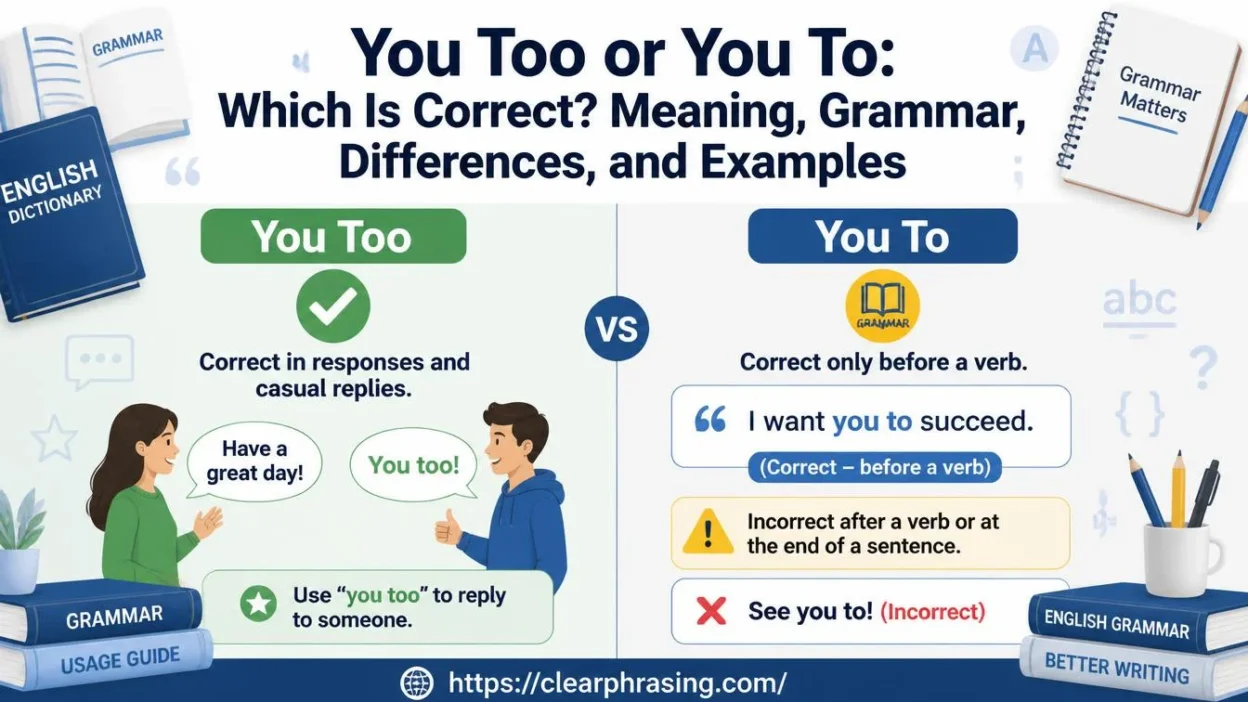
“You too” is the correct expression when you want to say “the same to you” or “also you.”
Examples
- Have a wonderful weekend!
You too! ✅ - Good luck with your interview.
You too! ✅
On the other hand, “you to” is not a complete expression by itself. It only becomes correct when it is part of a longer sentence.
Examples
- I want you to join us.
- They invited you to speak.
- We expect you to arrive early.
Quick Rule
| Expression | Correct? | Usage |
| You too | ✅ Yes | Replying to greetings, wishes, compliments, or saying “also you.” |
| You to | ✅ Yes, only in a sentence | Followed by a verb or phrase, such as you to help or you to attend. |
| You to as a reply | ❌ No | Incorrect replacement for you too. |
What Does “You Too” Mean?
The phrase “you too” means “the same to you,” “also you,” or “likewise.” People use it to return a greeting, wish, compliment, or friendly remark without repeating the entire sentence.
Instead of saying, “I hope you have a wonderful vacation as well,” English speakers simply reply, “You too!” It’s short, polite, and natural.
Common situations where people say “you too”
- Returning a greeting
- Returning good wishes
- Returning a compliment
- Agreeing with someone
- Ending a conversation politely
Examples
- Have a safe flight!
You too! - Enjoy your dinner.
You too! - Good luck on your exam.
You too! - Stay healthy.
You too! - Have a productive week.
You too!
Notice how you too works as a complete response. Nothing else needs to be added because the rest of the sentence is understood.
Everyday conversation examples
Friend: Have fun at the concert!
Reply: You too!
Coworker: Have a relaxing weekend.
Reply: Thanks! You too!
Neighbor: Stay cool in this heat.
Reply: You too!
These conversations sound natural because you too returns the same wish to the other person.
What Does “You To” Mean?
Unlike you too, the words you to do not form a complete expression. Instead, to usually begins an infinitive verb or functions as a preposition.
That means you to almost always needs another word after it.
Examples
- I expect you to finish the report.
- She asked you to call later.
- They encouraged you to apply.
- We need you to lead the meeting.
- I reminded you to lock the door.
If you stop after you to, the sentence feels incomplete.
❌ I expect you to.
✅ I expect you to arrive on time.
The missing verb is what makes the sentence complete.
Why people confuse the two
The confusion happens because to and too are homophones. They sound almost identical in everyday speech.
When people type quickly, they often write:
❌ Thank you, you to.
Instead, it should be:
✅ Thank you, you too.
The mistake usually comes from spelling rather than grammar knowledge.
You Too vs. You To: The Main Difference
Understanding one simple difference will help you avoid this mistake forever.
| Feature | You Too | You To |
| Meaning | Also you, the same to you | Part of a longer grammatical structure |
| Complete response | Yes | No |
| Used after greetings | Yes | No |
| Requires another verb | No | Yes |
| Common in conversations | Very common | Only inside sentences |
| Example | Have fun! You too! | I need you to help me. |
Think about it this way
If you could replace the phrase with “also” or “likewise,” then too is the correct word.
If another verb follows, to is probably correct.
For example:
- I need you to listen carefully.
- Happy Birthday!
You too!
Different grammar. Different purpose.
Is “You To” Ever Grammatically Correct?
Yes. Many people mistakenly believe you to is always wrong. That isn’t true.
It becomes perfectly correct whenever to introduces an infinitive verb or connects part of a sentence.
After verbs of request
Many English verbs require the pattern:
Verb + you + to + base verb
Examples include:
- ask
- tell
- remind
- encourage
- persuade
- expect
- invite
- allow
- advise
Examples
- She told you to wait.
- They encouraged you to continue.
- I reminded you to submit the assignment.
- We advised you to save your work.
- The doctor asked you to drink more water.
In every example, to belongs to the infinitive verb.
After verbs expressing desire
Examples
- I want you to succeed.
- We need you to cooperate.
- They expect you to improve.
- I’d like you to join us.
Again, you to isn’t the complete idea. The verb that follows completes the sentence.
In professional writing
Business English frequently uses this structure.
Examples
- We expect you to review the contract.
- I’d like you to confirm the appointment.
- The manager instructed you to update the schedule.
- Our team needs you to finish the proposal today.
These are grammatically correct because to introduces an action.
When Should You Use “You Too”?
Use you too whenever you return someone else’s greeting, wish, compliment, or positive statement.
Think of it as saying:
- The same to you.
- Likewise.
- Also you.
Returning greetings
Examples
- Have a nice day!
You too! - Good morning!
You too! - Have a great evening!
You too!
Returning compliments
Examples
- You look amazing today.
You too! - You’re always so kind.
You too! - Nice presentation today.
You too!
Returning good wishes
Examples
- Good luck!
You too! - Have fun!
You too! - Stay safe.
You too! - Enjoy your vacation.
You too! - Happy holidays!
You too!
In emails
Professional communication often ends with friendly wishes.
Example
Thank you for your help.
Have a wonderful weekend.
You too!
This response sounds polite without being overly formal.
In text messages
Text conversations use you too constantly because it’s short and friendly.
Examples
- Sleep well!
You too! - Drive safely.
You too! - Good luck tomorrow!
You too! - Have an awesome trip.
You too!
Mini Case Study: One Small Word, One Big Difference
Imagine a customer emails a business representative:
Representative: Have a great day!
If the customer replies:
You to. ❌
The message contains a spelling error that can leave a less polished impression.
Instead, the correct reply is:
You too. ✅
It’s a tiny change, but it reflects stronger writing skills and attention to detail. In professional communication, small grammar choices often make a positive difference.
“Good grammar isn’t about using difficult words. It’s about choosing the right word at the right time.”
When Should You Use “You To”?
Many people think you to is always incorrect. It isn’t. The phrase is correct when to introduces an infinitive verb. In this structure, to connects you with an action.
The basic pattern is:
Subject + Verb + You + To + Base Verb
Once you recognize this pattern, you’ll know exactly when you to is correct.
After Verbs Like Want
The verb want is commonly followed by an infinitive.
Examples
- I want you to succeed.
- We want you to enjoy your stay.
- They want you to understand the instructions.
- She wants you to arrive early.
After Verbs Like Need
Examples
- I need you to help me.
- We need you to complete the report.
- They need you to finish the project today.
- The coach needs you to stay focused.
After Verbs Like Tell
Examples
- I told you to be careful.
- She told you to call home.
- They told you to wait outside.
- The teacher told you to finish your homework.
After Verbs Like Ask
Examples
- I asked you to send the email.
- She asked you to stay a little longer.
- They asked you to complete the survey.
- We asked you to arrive on time.
After Verbs Like Expect
Examples
- We expect you to meet the deadline.
- I expect you to be honest.
- They expect you to follow the rules.
- Your manager expects you to communicate clearly.
Other Common Verbs That Use This Pattern
Many English verbs follow the same structure.
- Allow
- Advise
- Encourage
- Invite
- Persuade
- Remind
- Teach
- Warn
- Help
- Force
Examples
- She encouraged you to keep learning.
- They reminded you to lock the door.
- We invited you to attend the meeting.
- The coach persuaded you to try again.
- I advised you to save your work.
In every example, to belongs to the infinitive verb that follows. It does not replace too.
Grammar Rule Behind You Too and You To
Understanding how too and to work makes this grammar point easy to remember.
What Does Too Mean?
The word too usually has two meanings.
- Also
- More than enough
Examples meaning also
- I enjoyed the movie, and you too.
- She is coming, and I’m coming too.
- We want to join too.
Examples meaning more than enough
- The coffee is too hot.
- The bag is too heavy.
- The room is too noisy.
When someone replies with You too!, the word too means also or the same to you.
What Does To Mean?
The word to has two main grammatical functions.
As a Preposition
It shows direction, destination, or connection.
Examples
- Go to school.
- Drive to work.
- Walk to the park.
- Send the package to me.
As Part of an Infinitive
It appears before the base form of a verb.
Examples
- To study
- To learn
- To improve
- To understand
- To write
In sentences such as I want you to study or We expect you to arrive early, to introduces the infinitive verb.
Common Situations Where People Confuse You Too and You To
Because to and too sound the same, many writers choose the wrong spelling without noticing.
The table below shows the correct response in common situations.
| Situation | Correct Reply |
| Have a great day! | You too! |
| Good luck! | You too! |
| Happy Birthday! | You too! |
| Merry Christmas! | You too! |
| Happy New Year! | You too! |
| Enjoy your vacation! | You too! |
| Stay safe! | You too! |
| Have fun! | You too! |
| Sleep well! | You too! |
| Take care! | You too! |
Every reply above uses too because it means also or the same to you.
Examples of You Too in Sentences
These examples show how naturally you too fits into everyday conversations.
Daily Conversations
- Have a wonderful afternoon. You too!
- Enjoy your lunch. You too!
- Stay warm this winter. You too!
- Have a relaxing evening. You too!
Workplace Communication
- Have a productive meeting. You too!
- Good luck with your presentation. You too!
- Have a successful week. You too!
School
- Good luck on your exam. You too!
- Enjoy your summer break. You too!
Family
- Drive safely. You too!
- Have a great vacation. You too!
Customer Service
Customer: Have a wonderful day!
Employee: Thank you. You too!
Social Media and Text Messages
- Have an amazing weekend! You too!
- Enjoy your holiday! You too!
- Stay healthy! You too!
Each example returns the same wish to the other person.
Examples of You To in Sentences
Unlike you too, the phrase you to always continues with another word.
With Infinitive Verbs
- I’d like you to review this report.
- We need you to complete the form.
- They asked you to join the meeting.
- I expect you to finish today.
- She wants you to understand the process.
Formal Writing
- The committee expects you to follow all guidelines.
- Management encourages you to participate.
- We invite you to register online.
Academic Writing
- Your instructor expects you to cite reliable sources.
- Professors encourage you to think critically.
- The university advises you to check deadlines regularly.
Side-by-Side Sentence Comparisons
| Incorrect | Correct | Why |
| Have a nice day. You to! | Have a nice day. You too! | Too means also or the same to you. |
| Good luck. You to. | Good luck. You too. | Replies require too. |
| I want you too help. | I want you to help. | An infinitive verb requires to. |
| They asked you too attend. | They asked you to attend. | To attend is an infinitive. |
| We expect you too improve. | We expect you to improve. | The verb pattern requires to. |
Common Mistakes and How to Avoid Them
Many writers repeat the same mistakes because to and too sound alike.
Using To Instead of Too
Incorrect:
- You to!
Correct:
- You too!
Using Too Before an Infinitive
Incorrect:
- I need you too help.
Correct:
- I need you to help.
Trusting Autocorrect
Autocorrect often replaces too with to because to is more common. Always read your message before sending it.
Typing Too Quickly
Fast typing leads to small spelling mistakes. Taking a few seconds to proofread usually catches the error.
Memory Tricks to Remember the Difference
Simple memory tricks can help you remember the correct spelling every time.
The Extra O Rule
The word too has an extra O. Think of that extra letter as meaning also or an extra person.
Too = Also
The Verb Test
If another verb follows immediately after to, you almost certainly need to.
Examples
- You to study
- You to work
- You to help
The Likewise Test
Replace you too with likewise.
If the sentence still makes sense, too is the correct choice.
Example:
- Have a great day!
- Likewise!
Since likewise works, the correct reply is You too!
Why This Mistake Happens
The confusion between you too and you to is one of the most common spelling mistakes in English. The main reason is that to and too are homophones. They sound the same when spoken, so many people choose the wrong spelling while typing.
Several other factors contribute to this mistake.
- Fast typing on phones and computers
- Autocorrect replacing too with to
- Limited understanding of infinitive verbs
- Learning English by listening instead of reading
- Not proofreading short replies
The good news is that once you know the grammar rule, this mistake becomes easy to avoid.
British vs. American English
Whether you write in British English or American English, the grammar rule remains exactly the same.
| Feature | American English | British English |
| You too | Correct | Correct |
| You to in replies | Incorrect | Incorrect |
| You to before a verb | Correct | Correct |
| Meaning | Same | Same |
| Pronunciation | Nearly identical | Nearly identical |
There is no regional difference in spelling or meaning. English speakers around the world follow the same rule.
Formal vs. Informal Usage
Both expressions appear in different situations, but they serve different purposes.
| Situation | You Too | You To |
| Casual conversation | Yes | Only in complete sentences |
| Text messages | Yes | Only before a verb |
| Emails | Yes | Yes |
| Business communication | Yes | Yes |
| Academic writing | Rare as a reply | Common |
| Professional documents | Occasionally | Frequently |
In professional communication, you too often appears when ending an email politely.
Example
Thank you for your assistance.
Have a wonderful day.
You too!
Meanwhile, you to frequently appears inside complete business sentences.
Example
We expect you to submit the report before Friday.
Can You End a Sentence with Too?
Yes. Ending a sentence with too is completely correct.
Many native English speakers naturally place too at the end of a sentence because it sounds conversational.
Examples
- I’m coming too.
- We’d love to join too.
- Thank you. You too!
- They enjoyed it too.
- I’ll be there too.
Although you can place too in different positions, ending the sentence with it is one of the most common choices in everyday English.
Similar Word Pairs People Also Confuse
English contains many words that sound alike but have different meanings.
| Word Pair | Difference |
| To vs Too | Direction or infinitive vs also or excessively |
| Two vs Too vs To | Number vs also vs preposition |
| Me Too vs Me To | Correct reply vs incorrect spelling |
| Us Too vs Us To | Correct reply vs infinitive structure |
| Their vs There vs They’re | Possession vs place vs contraction |
| Your vs You’re | Possession vs you are |
| Its vs It’s | Possessive vs it is |
Learning these common word pairs improves both writing accuracy and confidence.
Real-Life Conversation Examples
The following conversations show how native speakers naturally use you too and you to.
Friends
Emma: Have fun at the concert!
Jake: Thanks! You too!
Coworkers
Manager: Have a productive afternoon.
Employee: Thank you. You too!
Teacher and Student
Teacher: I want you to review Chapter Five tonight.
Student: I’ll do that.
Parent and Child
Parent: I need you to clean your room before dinner.
Child: I’ll finish it soon.
Customer and Cashier
Cashier: Have a wonderful day!
Customer: You too!
Team Meeting
Supervisor: We expect you to complete the training by Monday.
Employee: I’ll have it finished before then.
These examples show an important pattern.
- Use you too when returning a greeting or wish.
- Use you to only when another verb follows.
Editor’s Checklist Before You Write
Before sending an email, text message, or assignment, ask yourself these simple questions.
- Does too mean also or the same to you?
- Does to come before another verb?
- Is my reply complete by itself?
- Would likewise work in this sentence?
- Did I accidentally let autocorrect change too to to?
- Have I proofread the sentence before sending it?
Following this quick checklist helps eliminate one of the most common grammar mistakes in English.
Key Takeaways
Here are the most important points to remember.
- You too is the correct reply when returning a greeting, wish, compliment, or kind remark.
- You to is only correct when it introduces an infinitive verb in a complete sentence.
- If you can replace the phrase with also or likewise, use too.
- If another verb follows, use to.
- Proofreading short messages prevents simple spelling mistakes.
- Understanding this one grammar rule will improve your everyday writing and professional communication.
Read More: Sweetie or Sweety, or Sweatie: Correct Spelling, and Differences
FAQs
Is you too always the correct choice in a reply?
In most replies, you too is the correct phrase because it returns the same wish, compliment, or greeting to another person. For example, if someone says, “Have a great day,” the natural response is, “You too.”
However, always check the sentence before writing. If to belongs to the next word or verb, then you to may be part of a grammatically correct sentence instead of the complete phrase you too.
Why do people confuse you too and you to?
The biggest reason is that both expressions sound exactly alike when spoken. English contains many words that share the same pronunciation but have different spellings and meanings.
Fast texting, social media, and casual conversations also encourage quick typing, making it easy to choose the wrong spelling without noticing the mistake.
Can you to ever be correct?
Yes. Although it is uncommon as a standalone expression, you to is correct when to functions as a preposition or begins an infinitive phrase. For example, “I want to talk to you to explain everything.”
In these cases, to belongs to the rest of the sentence rather than acting as part of the phrase you too.
Is using you to instead of you too considered a grammar mistake?
Yes, if you are replying to someone’s greeting, wish, or compliment, writing you to is a grammar and spelling mistake. The intended phrase should be you too.
Because the words sound identical, many people overlook the error until they proofread their writing.
How can I remember the difference easily?
Think of too as meaning “also.” If you can replace too with also and the sentence still makes sense, then you too is the correct choice.
If to connects to another word or verb, it is serving a grammatical purpose rather than meaning “also.”
Is you too appropriate in formal writing?
Yes. You too is perfectly acceptable in both formal and informal writing when you are returning a greeting or wish.
Whether you are writing an email, a business message, or a friendly text, the phrase remains grammatically correct.
Do native English speakers make this mistake?
Yes. Even native speakers occasionally type you to by accident, especially when sending quick messages on their phones.
The mistake usually happens because of speed, autocorrect, or not proofreading before sending.
Does punctuation affect the meaning of you too?
Punctuation does not change the meaning of you too, but it can improve clarity. A period, comma, or exclamation mark simply changes the tone of the sentence.
For example, “You too!” sounds warmer and more enthusiastic than “You too.”
What is the easiest way to check if my sentence is correct?
Read the sentence aloud and replace too with also. If the meaning stays the same, you too is the right choice.
If the sentence sounds incomplete after replacing it, check whether to belongs with the following word or verb.
Are there other English words similar to you too and you to?
Yes. English has many commonly confused word pairs, including their/there/they’re, your/you’re, its/it’s, and then/than.
Learning the meaning and grammar behind each pair is the best way to avoid repeated mistakes and write with confidence.
Conclusion
Understanding the difference between you too and you to is much easier than it first appears. Although both expressions sound exactly the same, they serve different purposes in English grammar. You too is the phrase you should use when returning a greeting, wish, compliment, or similar statement because it means “also.” On the other hand, you to is only correct when to belongs to the rest of the sentence, usually as a preposition or part of an infinitive. Knowing this simple distinction helps you avoid one of the most common writing mistakes.
As an English teacher, I have noticed that students rarely struggle because the rule is difficult. Instead, they make the mistake because they type quickly and rely on how the words sound instead of how they function in a sentence. Once they learn to pause for a moment and ask whether too means “also” or to connects to another word, their accuracy improves immediately. This small habit builds stronger grammar skills over time.
Whether you are writing an email, sending a text message, posting on social media, or preparing professional documents, using the correct phrase leaves a better impression. Clear and accurate writing improves communication, reduces misunderstandings, and shows attention to detail. Keep practicing with real examples, proofread before sending important messages, and soon choosing between you too and you to will become completely natural.

Mehwish Imtiaz is an English specialist and professional blog writer at ClearPhrasing.com. She specializes in grammar, spelling, vocabulary, punctuation, and writing improvement. With a strong passion for clear communication and language education, she creates reader-friendly articles that help students, professionals, and English learners understand complex language topics with ease.
Her writing focuses on accuracy, simplicity, and practical usage, ensuring that every article provides clear explanations and real-world examples. At ClearPhrasing.com, Mehwish is committed to publishing well-researched, original content that helps readers write more confidently and communicate more effectively in everyday and professional English.