Will Resume or Will Be Resumed Which Is Correct? and Difference can seem confusing, especially when resummed and resumed appear similar.
In English grammar, resumed is the correct, commonly used word for continuing an activity, returning to a previous state, or restarting a process after a break. Resummed is a rarely used variant in modern English. From my teaching experience, students often face this common dilemma because they focus on spelling instead of proper usage.
When you use will resume, you choose active voice, as in “Classes will resume tomorrow.” Will be resumed uses passive voice, as in “The meeting will be resumed by the manager.” The difference depends on what you want to emphasize: the subject and doer, or the action itself. In professional settings, choosing the right form improves clarity, precision, and your message.
This guide explains the difference between will resume vs. will be resumed, shows when each form works best, and clears up common mistakes that often trip writers up.
Quick Answer:
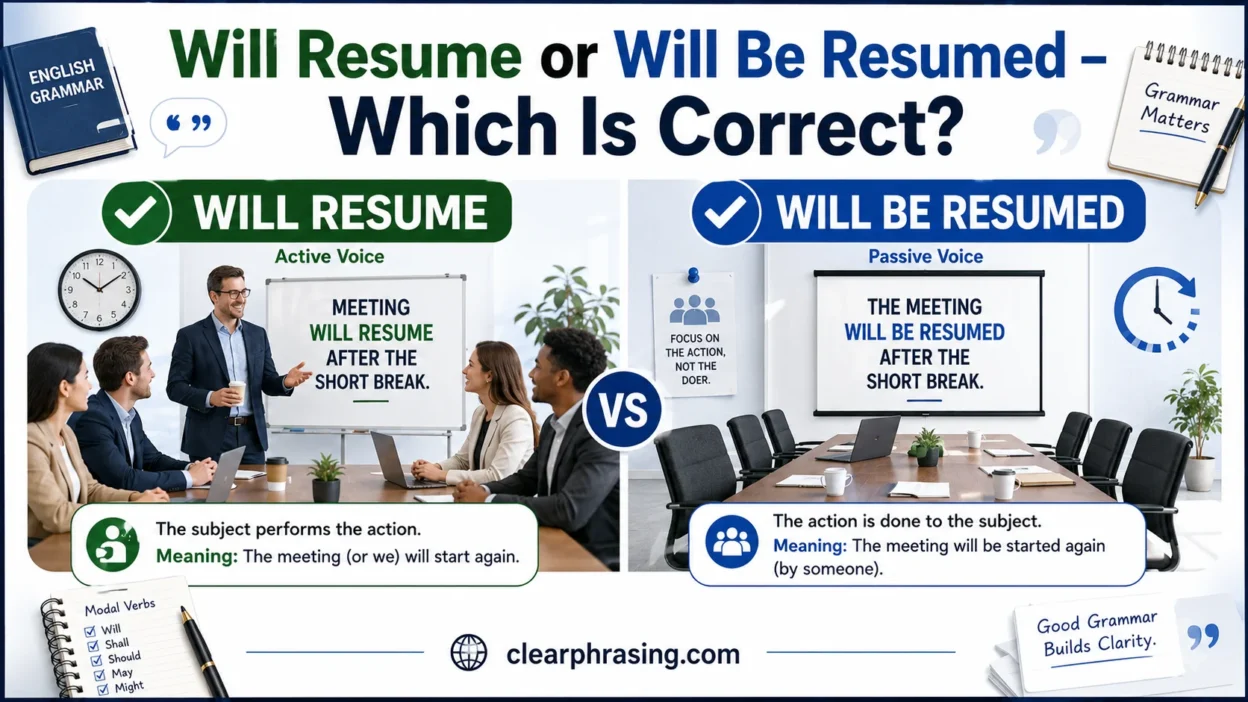
Both “will resume” and “will be resumed” are correct.
The key difference is grammatical voice:
- Will resume uses the active voice.
- Will be resumed uses the passive voice.
Use will resume when the subject performs the action or when the activity itself starts again.
The meeting will resume at 3 p.m.
Use will be resumed when you want to present the activity as something that someone will restart or continue.
The meeting will be resumed after the break.
Here’s the difference at a glance:
| Expression | Voice | Meaning | Example |
| Will resume | Active | Something will start again | The meeting will resume at noon. |
| Will be resumed | Passive | Something will be started again by someone | The meeting will be resumed after lunch. |
In everyday English, will resume is often the cleaner choice when the activity naturally continues on its own. Cambridge Dictionary gives examples such as “The meeting will resume after lunch” and explains that resume can mean an activity starts again after a pause.
Quick Comparison:
| Feature | Will Resume | Will Be Resumed |
| Voice | Active | Passive |
| Structure | will + base verb | will + be + past participle |
| Focus | Doer or activity | Activity receiving the action |
| Actor required? | Often identified or naturally implied | Can remain unnamed |
| Style | Usually direct and concise | Often more formal or process-focused |
| Example | The committee will resume talks. | Talks will be resumed tomorrow. |
| Best use | Direct communication | When the activity deserves emphasis |
What Does “Will Resume” Mean?
Will resume means that something will start again after a pause or interruption.
The structure is simple:
Subject + will + resume
For example:
- The meeting will resume at 2 p.m.
- Classes will resume next Monday.
- The game will resume after the rain stops.
- Negotiations will resume tomorrow.
- Normal operations will resume shortly.
Here, resume appears in its base form because it follows the modal verb will.
That’s an important grammar rule:
After “will,” use the base form of the verb.
Therefore:
- will resume ✓
- will resumes ✗
- will resumed✗
- will resuming ✗
The subject doesn’t have to be a person. An activity, event, service, or process can also be the grammatical subject.
For instance:
The conference will resume after the lunch break.
The conference isn’t literally performing an action like a person would. Instead, the sentence uses resume in its intransitive sense to say that the event will start again.
Cambridge Dictionary specifically identifies resume as both an intransitive and transitive verb. An activity can resume, or someone can resume an activity.
What Does “Will Be Resumed” Mean?
Will be resumed is the future passive form of resume.
Its grammatical structure is:
Subject + will + be + past participle
In this expression:
- will expresses the future.
- be forms the passive construction.
- resumed is the past participle of resume.
For example:
The investigation will be resumed next week.
The sentence doesn’t tell us who will resume the investigation. The focus stays on the investigation.
Other examples include:
- The service will be resumed shortly.
- The negotiations will be resumed tomorrow.
- The hearing will be resumed next Tuesday.
- The program will be resumed after repairs.
- The investigation will be resumed when new evidence becomes available.
English forms passive constructions with a form of be plus a past participle. With a modal such as will, the pattern becomes will + be + past participle.
So:
The committee will resume the discussion.
becomes:
The discussion will be resumed by the committee.
Both sentences communicate essentially the same event. However, they put the spotlight in different places.
Will Resume vs. Will Be Resumed: The Main Difference
The easiest way to understand the distinction is to ask:
What does the sentence want you to notice first?
With will resume, the sentence uses active voice.
The committee will resume negotiations tomorrow.
The committee appears as the subject and performs the action.
With will be resumed, the sentence uses passive voice.
Negotiations will be resumed tomorrow.
Now the negotiations become the subject. The people responsible for restarting them disappear from the foreground.
Cambridge explains that active voice typically places the doer first, while passive voice allows the writer to focus on the person or thing affected by an action. The passive can also omit the doer when that person isn’t important, isn’t known, or doesn’t need to be mentioned.
Compare These Two Sentences
The committee will resume negotiations tomorrow.
Negotiations will be resumed tomorrow.
The first version answers who will act?
The second version emphasizes what will happen?
That distinction is small but useful. It can make professional writing more precise.
When Should You Use “Will Resume”?
Use will resume when you want a direct active construction or when an activity naturally starts again.
When an Activity Starts Again
This is one of the most common uses.
The meeting will resume at 1 p.m.
The game will resume after the storm passes.
Classes will resume on Monday.
In these examples, the activities themselves are restarting after an interruption.
When a Person or Group Continues Something
Resume can also take a direct object.
The manager will resume the discussion after lunch.
The students will resume their work after the break.
The researchers will resume testing tomorrow.
Here, a person or group clearly performs the action.
The structure becomes:
Subject + will + resume + object
For example:
The manager + will + resume + the discussion.
This is an active construction because the manager performs the action.
When You Want Clear, Concise Writing
Active voice often makes a sentence more direct.
Compare:
The committee will resume the discussion.
with:
The discussion will be resumed by the committee.
The first version gets to the point faster. The second isn’t wrong, but it adds a passive structure that may not be necessary.
That doesn’t mean passive voice should never be used. It simply means you should use it for a reason.
When Should You Use “Will Be Resumed”?
Use will be resumed when the action itself matters more than the person performing it.
When the Actor Isn’t Important
Suppose a public notice says:
Train service will be resumed after repairs are completed.
Passengers mainly need to know when service returns. They don’t need to know which employee or department will restore it.
The passive form works well because the actor isn’t useful information.
When the Activity Is the Main Focus
Consider:
Negotiations will be resumed next month.
The important information concerns the negotiations. The identity of the people restarting them may already be obvious from context.
A passive sentence can therefore keep the focus where readers need it.
In Formal Announcements
Passive constructions commonly appear in institutional and formal writing because they can emphasize processes, decisions, services, and events.
For example:
The hearing will be resumed at 10 a.m.
Normal services will be resumed once safety checks are complete.
The investigation will be resumed when additional evidence becomes available.
These sentences sound appropriate in notices and official updates because the event or process takes center stage.
“The Meeting Will Resume” vs. “The Meeting Will Be Resumed”
This pair causes a lot of confusion.
Both sentences can be grammatical:
The meeting will resume at 2 p.m.
The meeting will be resumed at 2 p.m.
However, the first sentence is usually more natural when you simply mean that the meeting will continue after a break.
Why?
Because resume can be used intransitively:
The meeting will resume.
No object is required.
The second version is passive:
The meeting will be resumed.
It implies that someone will resume the meeting, even if that person isn’t named.
If you want to identify the person responsible, you can make that explicit:
The chair will resume the meeting at 2 p.m.
Or:
The meeting will be resumed by the chair at 2 p.m.
The active sentence is generally more straightforward.
Which Sounds More Natural?
For an ordinary announcement, this is usually the best choice:
The meeting will resume at 2 p.m.
If the context emphasizes an official action taken by a particular person or authority, the passive can make sense:
The meeting will be resumed by the chair after the security review.
The distinction isn’t about correctness. It’s about focus and information structure.
Can “Resume” Be Used Without an Object?
Yes.
This is one of the most useful points to remember.
Resume can function as an intransitive verb, meaning it doesn’t always need a direct object.
For example:
The meeting will resume soon.
The game will resume after the delay.
Classes will resume next week.
Talks will resume tomorrow.
In each sentence, resume means that the activity itself will start again.
But resume can also be transitive:
The manager will resume the meeting.
The company will resume production.
The team will resume training.
Here, the verb has an object.
This flexibility explains why will resume can appear in two slightly different patterns.
| Pattern | Example |
| Subject + will + resume | The meeting will resume. |
| Subject + will + resume + object | The manager will resume the meeting. |
Can “Will Be Resumed” Omit the Person Who Performs the Action?
Yes. In fact, that’s one of the main reasons to use the passive.
Consider:
The investigation will be resumed next month.
We don’t know who will resume it from the sentence alone. Finally the police will. Perhaps a government agency will. Perhaps a research team will.
The sentence doesn’t need to tell us.
If the actor isn’t relevant, naming that person could add unnecessary detail.
That’s one of the core functions of passive voice. It lets writers shift attention away from the doer and toward the action or its recipient.
Grammar Breakdown of “Will Resume”
The expression contains two essential parts:
will + resume
1. “Will”
Will is a modal auxiliary used to refer to future situations.
2. “Resume”
Resume stays in the base form after will.
That’s why these forms are incorrect:
- will resumes ✗
- will resumed ✗
- will resuming ✗
The correct form is:
- will resume ✓
Examples:
The service will resume tomorrow.
The students will resume their work later.
Production will resume next month.
Grammar Breakdown of “Will Be Resumed”
The passive construction has three components:
will + be + resumed
Each part has a job.
- Will marks the future.
- Be creates the passive construction after the modal.
- Resumed supplies the past participle.
This pattern appears with many verbs:
- will be completed
- will be announced
- will be postponed
- will be restored
- will be resumed
Therefore:
The service will be resumed shortly.
is grammatically parallel to:
The service will be restored shortly.
The passive form isn’t a special feature of resume. It follows the ordinary English passive pattern.
Resume vs. Continue: What’s the Difference?
Resume and continue overlap, but they aren’t always interchangeable.
The clearest distinction is interruption.
Resume generally suggests that something stopped and then started again.
Continue can describe something that keeps going without interruption.
Compare:
The meeting continued for three hours.
This tells us that the meeting kept going.
Now consider:
The meeting resumed after lunch.
This tells us that the meeting stopped and later started again.
A useful memory trick is:
Resume = start again after stopping.
For example:
- The concert resumed after the power outage.
- The negotiations resumed after a week-long pause.
- Classes resumed after the holiday.
- The discussion resumed after lunch.
Cambridge Dictionary similarly defines resume as starting again after a pause.
Will Resume or Will Be Resumed in Different Contexts
The best form often becomes obvious when you look at the situation.
Meetings
Natural active use:
The meeting will resume at 3 p.m.
Passive alternative:
The meeting will be resumed after the break.
The active version is usually more concise when no actor needs emphasis.
Classes
Classes will resume next Monday.
This sounds natural because the classes themselves are starting again.
A passive alternative might appear in an official notice:
Classes will be resumed once the building has been cleared.
Here, the passive construction emphasizes the condition that must be met before classes restart.
Games and Sports
Play will resume after the rain stops.
This is a common and natural construction.
You could also write:
Play will be resumed once the field is declared safe.
The second version places greater emphasis on the action of restoring play.
Negotiations
The two sides will resume negotiations tomorrow.
Here, the parties are the subject and clearly perform the action.
Alternatively:
Negotiations will be resumed tomorrow.
This version puts negotiations at the center.
Services
Train service will resume at 6 a.m.
This sounds natural in an ordinary announcement.
A formal notice might say:
Train service will be resumed after essential maintenance is completed.
Both communicate the same general idea, but the second emphasizes restoration.
Investigations
Detectives will resume the investigation next week.
This active form tells readers who is taking action.
The investigation will be resumed next week.
This passive version focuses on the investigation itself.
Common Mistakes With “Will Resume” and “Will Be Resumed”
Small errors can change an otherwise clear sentence.
Mistake: “Will Resumed”
Incorrect:
The meeting will resumed at noon.
Correct:
The meeting will resume at noon.
After will, use the base form.
Mistake: “Will Be Resume”
Incorrect:
The service will be resume tomorrow.
Correct:
The service will be resumed tomorrow.
The passive construction needs the past participle.
Mistake: “Will Resumes”
Incorrect:
Classes will resumes next week.
Correct:
Classes will resume next week.
The modal will doesn’t take a third-person -s form on the following verb.
Mistake: Using Passive Voice Without a Reason
Consider:
The discussion will be resumed by the committee.
This is grammatical. Yet:
The committee will resume the discussion.
is often clearer.
If the committee matters, put it first.
Mistake: Assuming Passive Means More Professional
Passive voice can work well in formal writing. It isn’t automatically more polished.
A sentence should be judged by clarity, purpose, and context, not by how formal it sounds.
Will Resume or Will Be Resumed in Professional Writing
Professional writing often benefits from choosing the shortest construction that preserves the intended meaning.
For example:
The team will resume testing tomorrow.
is direct and easy to understand.
However:
Testing will be resumed after the equipment passes inspection.
works well when the testing process is more important than the team.
Consider these examples:
| Situation | Better Choice | Reason |
| Manager tells employees what the team will do | The team will resume testing. | The team matters. |
| Notice explains when testing returns | Testing will be resumed tomorrow. | The activity matters. |
| Meeting announcement | The meeting will resume at 2 p.m. | Natural and concise. |
| Formal procedural notice | The hearing will be resumed at 10 a.m. | The proceeding is the focus. |
| Group action | The committee will resume negotiations. | The actor is important. |
The goal isn’t to eliminate passive voice. The goal is to use it deliberately.
Will Resume or Will Be Resumed in Announcements
Announcements often need to deliver information quickly.
That’s why active constructions can be especially effective:
Bus service will resume at 5 a.m.
Classes will resume on Tuesday.
The event will resume shortly.
These sentences are compact and reader-friendly.
Passive voice can still be useful when an announcement describes an action being restored:
Service will be resumed once repairs are complete.
Here, the condition matters. The passive structure keeps attention on the service rather than the people carrying out the repairs.
A Practical Way to Choose the Correct Form
When you’re unsure which expression to use, ask four quick questions.
Is something starting again?
If yes, resume may be the right verb.
The meeting will resume at noon.
Who performs the action?
If the person or group matters, use the active voice.
The committee will resume negotiations.
Is the activity more important than the actor?
If yes, the passive may work better.
Negotiations will be resumed next week.
Would the active sentence sound clearer?
If the answer is yes, choose will resume.
Good writing doesn’t make readers work harder than necessary.
Real-Life Examples You Can Use
Here are practical sentences that demonstrate the difference clearly:
Meetings
The meeting will resume after lunch.
The chair will resume the meeting at 2 p.m.
Education
Classes will resume next Monday.
Classes will be resumed after the building inspection.
Business
The company will resume production next month.
Production will be resumed once the machinery is repaired.
Sports
Play will resume when the weather improves.
The match will be resumed after the field is inspected.
Negotiations
The two sides will resume negotiations tomorrow.
Negotiations will be resumed following the consultation.
Public services
Train services will resume at 6 a.m.
Normal service will be resumed once repairs are complete.
Notice the recurring pattern: active voice identifies the actor, while passive voice shifts attention toward the activity.
Read More: Rein or Reign: Differences, Meaning, and Correct Usage
FAQs
Is “Will Resume” Grammatically Correct?
Yes, “will resume” is grammatically correct. It uses the active voice to show that something will start again.
Is “Will Be Resumed” Correct?
Yes, “will be resumed” is also correct. It uses the passive voice and focuses on the activity rather than the person performing it.
What Is the Difference Between “Will Resume” and “Will Be Resumed”?
“Will resume” focuses on the subject restarting, while “will be resumed” focuses on the action being restarted.
Can I Say “Classes Will Resume Tomorrow”?
Yes. “Classes will resume tomorrow” is natural and commonly used because classes will start again.
Can I Say “The Meeting Will Be Resumed”?
Yes. “The meeting will be resumed” is correct when you want to emphasize the meeting or the action of restarting it.
Is “Resummed” a Correct Word?
“Resummed” is a rare variant and isn’t commonly used in modern English. “Resumed” is the standard choice.
Should I Use “Resumed” in Formal Writing?
Yes. “Resumed” is appropriate for formal writing, professional communication, reports, and academic contexts.
Does “Resume” Mean to Start Again?
Yes. As a verb, resume means to continue something after a pause or interruption.
Which Is Better: “The Work Will Resume” or “The Work Will Be Resumed”?
Both can be correct, but “the work will resume” sounds more direct and natural when the focus is on the work starting again.
How Can I Remember “Resume” vs. “Resummed”?
Remember that resumed is the standard past or past participle form. When something starts again after a pause, resume is the verb you normally need.
Conclusion
Understanding the difference between will resume and will be resumed helps you write with greater clarity and confidence. Will resume uses the active voice and usually sounds more natural when something starts again after a pause. Will be resumed uses the passive voice and places more attention on the activity being restarted. Choosing between them depends on what you want to emphasize in your sentence. Similarly, resumed is the standard and commonly accepted form, while resummed is rarely used in modern English.
As an English teacher, I’ve found that learners often remember these forms more easily when they connect grammar with meaning rather than memorizing rules alone. Think about who or what performs the action, then choose the structure that communicates your idea most clearly. Whether you’re writing about classes, meetings, work, or other activities, using the right form makes your sentences sound more natural, accurate, and professional.

Shamsa Kanwal is an English specialist and content writer at ClearPhrasing.com, where she helps readers navigate the English language with confidence. She enjoys breaking down grammar rules, spelling differences, vocabulary, and everyday writing challenges into simple, practical lessons that anyone can understand.
Her writing is focused on making learning approachable rather than overwhelming. Whether she’s explaining commonly confused words, punctuation rules, or grammar concepts, Shamsa believes that clear explanations and real-life examples are the key to effective learning.
Every article she writes is carefully researched, fact-checked, and edited to ensure it is accurate, easy to read, and genuinely helpful. Her goal is to create trustworthy resources that enable students, professionals, writers, and English learners to improve their communication skills and write with greater clarity.
Through her work at ClearPhrasing.com, Shamsa is committed to making English learning simpler, more practical, and accessible for readers around the world.