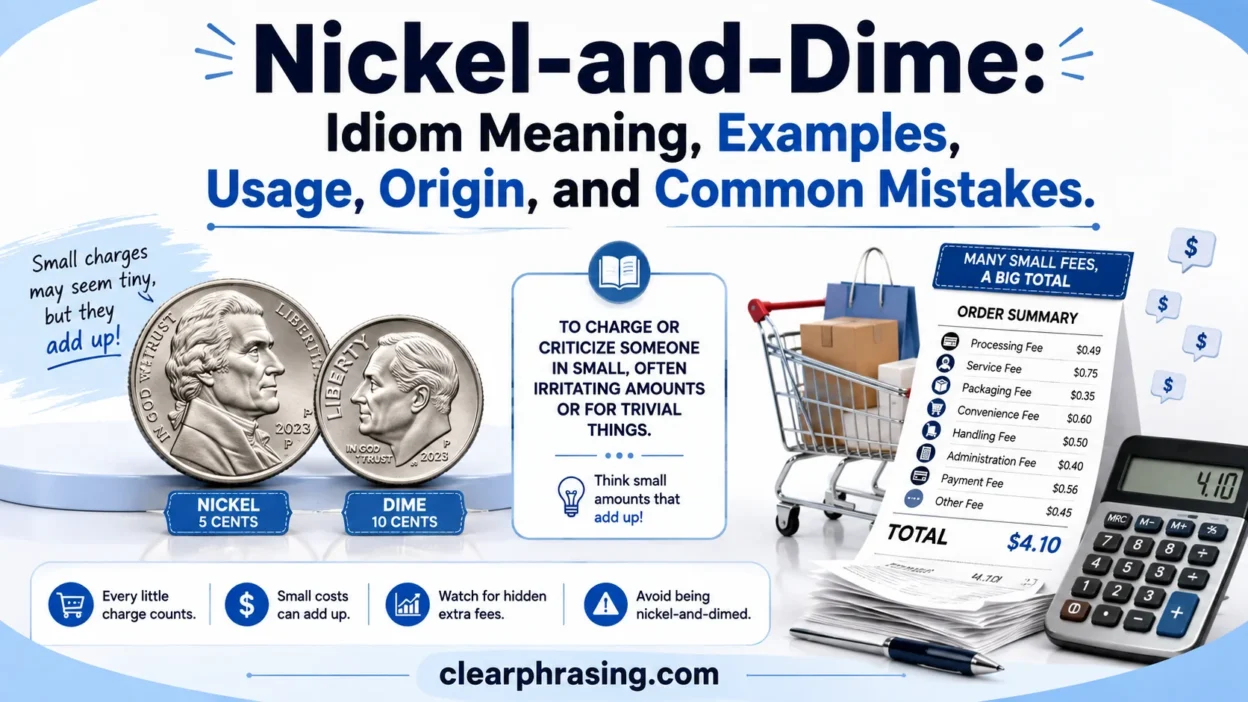
Nickel and Dime: Idiom Meaning, Examples, and Usage describes how small amounts of money can add up when you pay repeatedly.
A company may nickel-and-dime customers through extra fees for every little thing, such as printing a page or making a phone call. The phrase can also describe minor costs, petty costs, or small expenses that accumulate into a large amount over time.
As an idiom, nickel-and-dime can have a negative connotation when someone focuses on minor details, trivial issues, or small mistakes instead of larger concerns. In my teaching experience, examples help learners understand this phrase clearly and use it in everyday conversation.
Nickel-and-Dime: Quick Answer
Nickel-and-dime means to deal with small amounts of money repeatedly, especially in a way that seems petty, excessive, or annoying.
It can describe charging many small fees or being overly concerned about minor expenses.
Example:
“The airline nickel-and-dimed us with extra charges for every little thing.”
Here, the speaker means that the airline kept adding small costs instead of presenting one straightforward price.
As a verb, you’ll commonly see nickel-and-dime someone.
As an adjective, you’ll see nickel-and-dime fees, nickel-and-dime charges, or nickel-and-dime tactics.
The expression usually carries a negative or critical tone.
What Does Nickel-and-Dime Mean?
The idiom nickel-and-dime refers to repeated dealings involving small amounts of money. The individual amounts might seem insignificant. Together, however, they can become costly or frustrating.
Imagine buying a service advertised at $50. Then you discover a $2 processing fee, a $3 service charge, a $5 convenience fee, and another $4 for a basic feature.
None of those charges seems enormous by itself. Together, they change the experience.
That’s the idea behind nickel-and-dime.
The expression can also describe someone who worries excessively about small expenses. For example:
“My manager nickel-and-dimes employees over every reimbursement.”
This suggests that the manager makes an issue out of small financial claims.
The Core Meaning of Nickel-and-Dime
The phrase generally involves three ideas:
- Small amounts of money
- Repeated financial decisions or charges
- A sense that the behavior is petty, excessive, or irritating
The third point matters. Not every small payment qualifies as nickel-and-diming.
A business charging $3 for an optional service isn’t automatically nickel-and-diming its customers. The phrase becomes more appropriate when many small charges accumulate or when someone appears excessively focused on minor financial details.
Why Is Nickel-and-Dime an Idiom?
The literal words refer to American coins. A nickel is worth five cents while a dime is worth ten cents.
Together, these coins represent very small amounts of money. The idiomatic expression developed from that idea of handling money in tiny increments.
Instead of saying someone is repeatedly dealing with insignificant amounts, English speakers can simply say that the person is nickel-and-diming someone.
That makes the phrase efficient and expressive.
Compare these two sentences:
“The company repeatedly charged customers very small additional fees.”
“The company nickel-and-dimed its customers.”
The second sentence communicates the same basic idea much more naturally in casual American English.
How to Use Nickel-and-Dime as a Verb
Nickel-and-dime commonly functions as a verb.
The usual construction is:
nickel-and-dime + person or group
For example:
- The hotel nickel-and-dimed its guests.
- Don’t let contractors nickel-and-dime you.
- The company keeps nickel-and-diming customers.
- They nickel-and-dimed us throughout the project.
The phrase usually takes a direct object. That object identifies the person experiencing the repeated small charges or financial demands.
Nickel-and-Dime in Different Verb Tenses
You can change the form according to the sentence.
| Tense | Example |
| Present | They nickel-and-dime their customers. |
| Past | They nickel-and-dimed their customers. |
| Present progressive | They are nickel-and-diming their customers. |
| Future | They may nickel-and-dime customers later. |
| Perfect | They have nickel-and-dimed customers for years. |
Notice the hyphens remain part of the expression in these forms.
How to Use Nickel-and-Dime as an Adjective
Nickel-and-dime can also work as a compound adjective before a noun.
Examples include:
- nickel-and-dime charges
- nickel-and-dime fees
- nickel-and-dime tactics
- nickel-and-dime approach
- nickel-and-dime strategy
- nickel-and-dime expenses
For example:
“Customers are tired of the company’s nickel-and-dime pricing strategy.”
Here, the phrase describes the type of pricing strategy.
The hyphens help show that the entire expression functions together as one modifier.
Nickel-and-Dime Fees
A nickel-and-dime fee isn’t necessarily a specific type of fee. Instead, the description criticizes the way fees are applied.
For example:
“The basic membership looks affordable, but nickel-and-dime fees push the final price much higher.”
The writer isn’t saying every fee is unreasonable. The criticism focuses on numerous small charges that gradually increase the overall cost.
Nickel-and-Dime Meaning in Different Contexts
The phrase appears in several everyday situations. Its basic meaning stays consistent, but the context gives it a slightly different flavor.
Business and Pricing
Businesses often face accusations of nickel-and-diming when they separate costs into numerous small charges.
Consider a service with a base price of $40. Customers might then encounter several additional costs for basic features.
The complaint isn’t necessarily about one expensive fee. It’s about the accumulation of small charges.
“Customers complained that the company nickel-and-dimed them with extra service fees.”
This usage is common when discussing pricing transparency.
Travel
Travel provides plenty of situations where the expression feels natural.
A traveler might pay separately for baggage, seat selection, meals, priority boarding, and other extras.
A frustrated customer could say:
“The airline nickel-and-dimed us from the moment we booked the flight.”
The phrase communicates annoyance more strongly than simply saying “the airline charged additional fees.”
Subscriptions and Online Services
Digital services can also trigger this expression.
Suppose a platform advertises an inexpensive monthly plan but places several basic tools behind separate charges. A customer might describe that pricing model as nickel-and-diming.
However, the phrase expresses an opinion. It doesn’t objectively prove that the pricing is unfair.
That distinction matters in professional writing.
Workplace Expenses
The idiom can describe situations involving employee expenses and reimbursements.
For example:
“The company nickel-and-dimes employees over small travel expenses.”
The speaker suggests that management spends too much time challenging minor costs.
Negotiations
You might also hear the phrase during business negotiations.
Imagine two companies have already agreed on a major contract. One side then repeatedly argues over tiny details involving small amounts of money.
The other side might complain:
“We agreed on the major terms. Now they’re nickel-and-diming us over every minor expense.”
Here, the phrase suggests unnecessary attention to small financial details.
Nickel-and-Dime Examples
Realistic examples make this idiom easier to recognize.
Examples With the Verb
- The hotel nickel-and-dimed guests with extra charges.
- Don’t let the contractor nickel-and-dime you over minor repairs.
- The company nickel-and-dimes customers for basic features.
- We felt nickel-and-dimed throughout the entire transaction.
- They kept nickel-and-diming us after we signed the agreement.
- The landlord shouldn’t nickel-and-dime tenants over every tiny repair.
Examples With the Adjective
- The company uses nickel-and-dime pricing.
- Customers are frustrated by nickel-and-dime fees.
- We rejected the vendor’s nickel-and-dime tactics.
- The contract contains too many nickel-and-dime charges.
- His nickel-and-dime approach damaged the relationship.
Nickel-and-Dime in Conversation
A: “How was the hotel?”
B: “The room was fine, but they nickel-and-dimed us.”
A: “What do you mean?”
B: “They charged extra for parking, Wi-Fi, and almost everything else.”
This short exchange shows how naturally the idiom works in casual conversation.
Nickel-and-Dime vs. Penny-Pinch
These expressions overlap, but they’re not identical.
Penny-pinching usually means trying very hard to save money, often by avoiding unnecessary spending.
Nickel-and-dime, however, often focuses on repeated small charges or financial demands.
| Expression | Main idea | Typical example |
| Nickel-and-dime | Repeated small financial charges or demands | A company adds many small fees. |
| Penny-pinch | Try hard to save money | Someone refuses to spend $5 unnecessarily. |
| Haggle | Negotiate over a price | A customer asks for a lower price. |
| Nitpick | Focus on tiny faults or details | Someone criticizes minor wording. |
| Rip off | Charge far too much or provide poor value | A store charges $100 for a $20 item. |
| Skimp | Spend or provide less than needed | A company cuts necessary resources. |
The distinction becomes easier if you remember the direction of the money.
Penny-pinching often means trying to keep money.
Nickel-and-diming often describes someone taking or demanding small amounts repeatedly.
Nickel-and-Dime vs. Haggle
These expressions aren’t interchangeable.
To haggle means to negotiate over a price. Haggling doesn’t necessarily involve petty behavior.
For example:
“She haggled with the vendor over the price of the rug.”
That’s normal bargaining.
By contrast:
“The vendor nickel-and-dimed us over every tiny charge.”
This suggests repeated small financial demands.
A person can haggle once without nickel-and-diming anyone.
Nickel-and-Dime vs. Rip Off
Rip off is generally stronger.
If you say something nickel-and-dimes you, you’re complaining about repeated small costs.
If you say something is a rip-off, you’re usually saying the price is unfairly high compared with the value received.
For example:
“The hotel nickel-and-dimed us with small fees.”
versus:
“That hotel was a rip-off.”
The first focuses on many small charges. The second focuses on poor value or excessive pricing.
Is Nickel-and-Dime Negative?
Usually, yes.
The expression commonly carries a critical, annoyed, or disapproving tone.
Calling a company “nickel-and-dime” suggests that its pricing feels petty or unnecessarily fragmented.
Calling a manager “nickel-and-dime” suggests that the person focuses too much on minor financial matters.
However, context still matters.
Someone might use the phrase humorously:
“My brother nickel-and-dimes me for every pizza topping.”
The speaker may be annoyed without making a serious accusation.
Why Tone Matters
Be careful when using the phrase in professional communication. It can sound confrontational.
Instead of writing:
“Your company is nickel-and-diming customers.”
A more neutral business sentence might say:
“The additional fees make the total cost difficult to predict.”
The second version communicates the concern without directly accusing the company of poor behavior.
Common Mistakes
Using It for One Large Expense
The phrase isn’t normally appropriate for a single large payment.
Weak usage:
“The car cost $30,000, so the dealer nickel-and-dimed me.”
That sentence doesn’t clearly communicate repeated small charges.
Better:
“The dealer nickel-and-dimed me with several small administrative fees.”
Now the intended meaning becomes clear.
Assuming Every Small Fee Is Nickel-and-Diming
A single $2 fee doesn’t automatically qualify.
The phrase usually suggests repetition, accumulation, or unnecessary focus on minor amounts.
Context provides the missing piece.
Confusing Nickel-and-Dime With Penny-Pinch
Someone who carefully saves money isn’t necessarily nickel-and-diming another person.
For example:
“She penny-pinches because she’s saving for a house.”
That’s different from:
“The company nickel-and-dimes its customers.”
The first describes personal spending behavior. The second describes repeated small financial charges or demands.
Using the Phrase in Highly Formal Writing
The expression is widely understood in American English. Still, it has a conversational and critical flavor.
For formal reports, alternatives such as these may work better:
- impose numerous minor charges
- add multiple additional fees
- focus excessively on minor costs
- apply several small surcharges
- increase costs through additional fees
The best choice depends on the context.
Nickel-and-Dime Hyphenation
The standard expression is commonly written:
nickel-and-dime
The hyphens are especially important when the phrase functions as a compound modifier.
Examples:
- nickel-and-dime pricing
- nickel-and-dime tactics
- nickel-and-dime charges
As a verb, the phrase also commonly retains the hyphenation:
“They nickel-and-dimed us.”
“The company keeps nickel-and-diming customers.”
Avoid randomly removing the hyphens because the phrase functions as a recognized compound expression.
Where Did Nickel-and-Dime Come From?
The expression comes from the values of two American coins: the nickel, worth five cents, and the dime, worth ten cents.
The pairing emphasizes tiny sums of money. Over time, the expression developed a figurative meaning associated with handling money in small increments.
The important historical idea is straightforward: nickels and dimes represent small denominations, so nickel-and-dime came to suggest dealing with small amounts repeatedly.
Its modern usage expanded beyond literal coins. Today, the phrase can describe everything from service fees to negotiations.
Rather than focusing on the exact value of five or ten cents, modern speakers use the expression to convey the broader idea of small financial amounts accumulating or being treated with excessive attention.
Is Nickel-and-Dime American English?
Yes. Nickel-and-dime is strongly associated with American English because both words refer to familiar US coins.
American speakers commonly use it in:
- everyday conversations
- business discussions
- consumer complaints
- workplace conversations
- negotiations
- reviews
- journalism and commentary
People outside the United States may understand the phrase through exposure to American English. However, its coin-based imagery is especially natural within US usage.
When Should You Use Nickel-and-Dime?
Use nickel-and-dime when the situation involves small financial amounts that become significant through repetition.
Good Situations for the Expression
Use it when:
- A company repeatedly adds small charges.
- A customer faces many minor fees.
- Someone argues over every small expense.
- A negotiation gets bogged down in tiny financial details.
- Small costs accumulate into a larger total.
- A pricing structure feels fragmented.
- Someone makes repeated minor financial demands.
Situations to Avoid
Avoid it when:
- You’re discussing one large expense.
- The situation has nothing to do with money.
- You need completely neutral legal or financial wording.
- You haven’t established a pattern of repeated small costs.
A Simple Way to Remember Nickel-and-Dime
Think of one small charge becoming a pile of small charges.
A nickel is small.
A dime is small.
But repeated small amounts can eventually make a noticeable dent in your wallet.
That is the heart of nickel-and-dime.
Small charges + repetition + frustration = nickel-and-dime
This simple formula can help you distinguish the expression from related terms such as haggle, penny-pinch, and rip off.
Nickel-and-Dime in a Real-World Case Study
Consider a fictional streaming service called StreamBox.
The company advertises a plan for $12 per month. At checkout, customers discover a $1 processing charge. They then need to pay another $3 for offline downloads and $2 for a feature that competitors normally include.
Each amount seems small.
The final price, however, becomes noticeably higher than the advertised price.
A customer might say:
“StreamBox keeps nickel-and-diming subscribers with extra charges.”
The criticism isn’t necessarily that every fee is illegal or objectively unfair. The phrase simply expresses the customer’s perception that the company keeps adding small costs instead of offering a straightforward price.
That distinction is important. Nickel-and-dime is descriptive and evaluative language rather than a technical financial term.
Read More: Should I vs. Shall I: Difference, Meaning, Usage, and Examples
Nickel-and-Dime: Facts at a Glance
| Feature | Explanation |
| Expression | Nickel-and-dime |
| Language | American English |
| Main idea | Repeated small financial amounts |
| Common verb form | Nickel-and-dime someone |
| Past tense | Nickel-and-dimed |
| -ing form | Nickel-and-diming |
| Adjective use | Nickel-and-dime fees |
| Typical tone | Negative or critical |
| Literal basis | US nickel and dime coins |
| Common contexts | Fees, pricing, business, travel, negotiations |
| Main concept | Small costs or demands accumulating |
FAQs
What does “nickel-and-dime” mean?
Nickel-and-dime means to charge or pay small amounts repeatedly, especially when those costs eventually become significant. It can also describe focusing too much on minor matters.
Is “nickel-and-dime” an idiom or a verb?
It can function as both. As a verb, nickel-and-dime means to burden someone with repeated small charges. It can also describe gradually weakening something through minor actions.
Why does “nickel-and-dime” have a negative meaning?
The phrase usually suggests annoyance because many small charges or complaints seem petty. Individually, they may seem insignificant, but together they can create a bigger problem.
How do you use “nickel-and-dime” in a sentence?
You can say, “The airline kept nickel-and-diming passengers with extra fees.” Here, the phrase means the airline repeatedly added small charges.
Is “nickel-and-dimed” the correct past tense?
Yes. Nickel-and-dimed is the standard past-tense form. For example, “We were nickel-and-dimed by unexpected service charges.”
What’s the difference between “nickel-and-dime” and “nickel and dime”?
Nickel-and-dime is the standard hyphenated form when it functions as a verb or adjective. You may occasionally see the phrase without hyphens, but the hyphenated form is widely preferred.
Can “nickel-and-dime” describe more than money?
Yes. It can describe repeated attention to tiny issues, criticisms, or details. For example, someone may nickel-and-dime a project by constantly focusing on insignificant problems.
Can a person be nickel-and-dimed by a company?
Yes. A person can be nickel-and-dimed when a company repeatedly adds small charges for services, features, upgrades, or other minor expenses.
What are some everyday examples of nickel-and-diming?
Common examples include charging for printing, phone calls, online features, baggage, minor services, or small upgrades. These separate charges can quickly add up.
Is “nickel-and-dime” appropriate in formal writing?
It depends on the context. The phrase is common and widely understood, but formal business or academic writing may benefit from clearer alternatives such as “impose repeated small charges” or “focus excessively on minor costs.”
Conclusion
Nickel-and-dime captures a familiar frustration: something seems harmless at first, yet the little charges, complaints, or demands keep piling up. That’s why the expression works so well beyond money. Whether you’re talking about unexpected fees, constant criticism, or endless attention to tiny matters, it points to the bigger effect created by many small actions.
After years of teaching English, I’ve noticed that learners remember idioms more easily when they connect them with everyday situations. Think about a service that keeps adding tiny fees or a coworker who focuses on every minor mistake. Those situations make nickel-and-dime easier to recognize, understand, and use naturally in conversation.

Shamsa Kanwal is an English specialist and content writer at ClearPhrasing.com, where she helps readers navigate the English language with confidence. She enjoys breaking down grammar rules, spelling differences, vocabulary, and everyday writing challenges into simple, practical lessons that anyone can understand.
Her writing is focused on making learning approachable rather than overwhelming. Whether she’s explaining commonly confused words, punctuation rules, or grammar concepts, Shamsa believes that clear explanations and real-life examples are the key to effective learning.
Every article she writes is carefully researched, fact-checked, and edited to ensure it is accurate, easy to read, and genuinely helpful. Her goal is to create trustworthy resources that enable students, professionals, writers, and English learners to improve their communication skills and write with greater clarity.
Through her work at ClearPhrasing.com, Shamsa is committed to making English learning simpler, more practical, and accessible for readers around the world.