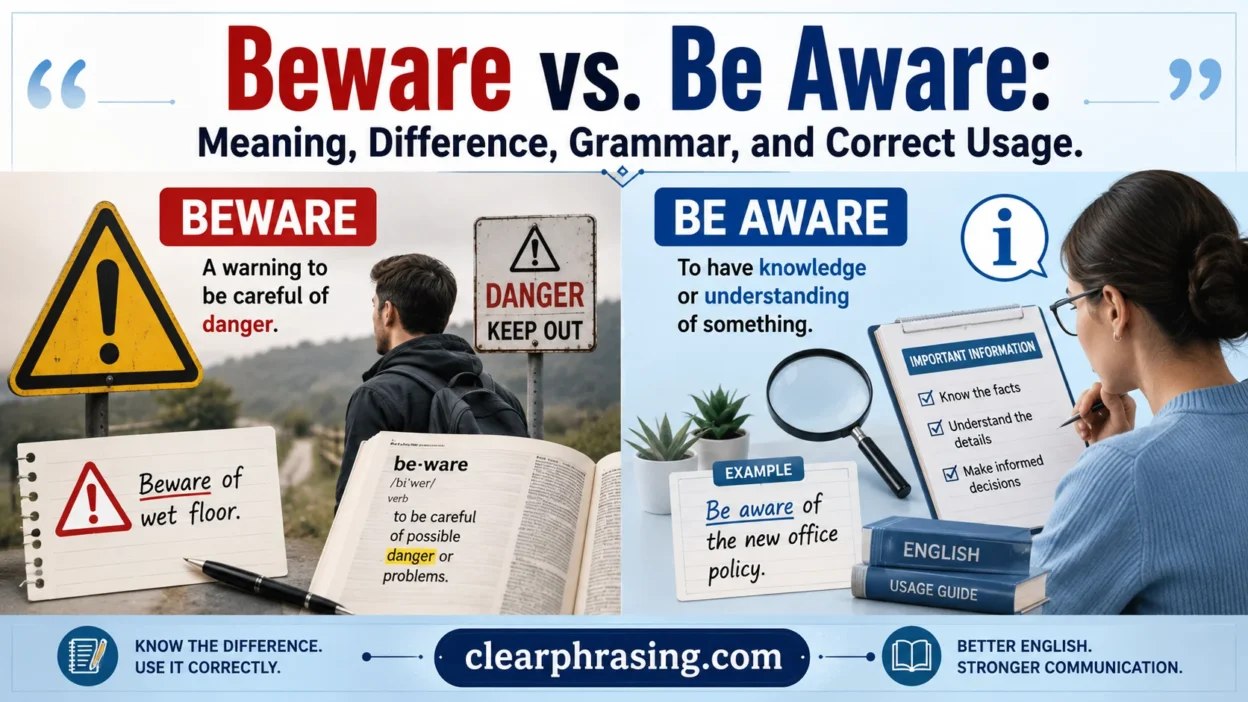
Beware vs. Be Aware: Difference, Meaning, and Usage explains why these similar phrases have different meanings.
Beware gives a warning about danger, harm, or a threat, while be aware means having knowledge or understanding of something. As an English teacher, I’ve noticed English learners often face confusion because these phrases sound similar and seem interchangeable.
However, their context helps you choose the proper word. Beware tells someone to stay cautious, wary, and on guard when something bad may be ahead.Be aware has a more neutral meaning. It encourages paying attention, being informed, or staying mindful of a fact or situation. For example, “Be aware of traffic” provides information, while “Beware of traffic” suggests a riskier situation.
This distinction sets apart the two phrases and helps you make the appropriate choice. When you remember this key difference, you can avoid downright confusion and use both expressions correctly.
Quick Answer:
Beware means “watch out” or “be cautious about something potentially dangerous, harmful, or troublesome.”
Be aware means “know, recognize, notice, or understand something.”
| Expression | Basic meaning | Main purpose | Typical tone |
| Beware | Watch out | Give a warning | Strong and cautionary |
| Be aware | Know or recognize | Give information or draw attention | Neutral or mildly cautionary |
| Be wary | Be cautious or suspicious | Encourage careful judgment | Cautious |
Compare These Examples
Beware of scammers.
This tells you to watch out because scammers may harm or deceive you.
Be aware of common scam tactics.
This tells you to understand or recognize those tactics.
Both sentences concern scams. Yet the first emphasizes danger, while the second emphasizes knowledge.
A useful memory trick is:
Beware = Watch out.
Be aware = Know about it.
That distinction covers most everyday situations.
What Does “Beware” Mean?
Beware is a verb that means to be cautious about something dangerous, harmful, deceptive, or unpleasant.
It often appears in warnings. When someone says “Beware!”, they’re essentially telling you to stop, look carefully, and protect yourself from a possible problem.
For example:
- Beware of the dog.
- Beware of fake websites.
- Beware of hidden charges.
- Beware of falling rocks.
- Beware of misleading claims.
The expression has a built-in sense of caution. You don’t normally use beware simply to tell someone about an ordinary fact.
For instance:
Beware of the meeting at 3 p.m.
This sounds strange unless the meeting itself presents some kind of problem or threat.
Instead, you would normally say:
Be aware that the meeting starts at 3 p.m.
How to Use “Beware” in a Sentence
The most common pattern is:
beware of + noun or noun phrase
Examples include:
- Beware of strangers offering suspicious deals.
- Beware of counterfeit products.
- Beware of icy roads during winter.
- Beware of websites asking for unnecessary personal information.
You can also use beware by itself:
Beware!
This form works particularly well in short warnings, signs, labels, and dramatic statements.
Why Does “Beware” Sound Strong?
The word doesn’t merely describe awareness. It signals potential trouble.
Imagine walking through a park and seeing a sign that says:
BEWARE OF SNAKES
The sign doesn’t simply want you to know snakes exist. It wants you to behave carefully because encountering one could create danger.
That’s the heart of beware.
What Does “Be Aware” Mean?
Be aware means to know, recognize, notice, or understand something.
Here, aware functions as an adjective. The verb be comes before it to create the expression be aware.
Examples include:
- Be aware of the new deadline.
- Be aware that the store closes early.
- Be aware of changes to the schedule.
- Be aware of your surroundings.
- Be aware of the terms before signing the agreement.
Notice something important: none of these situations necessarily involves danger.
A deadline isn’t dangerous. A schedule change isn’t necessarily harmful. A store closing early isn’t a threat.
The speaker simply wants the listener to know or recognize important information.
Common Grammar Patterns With “Be Aware”
You can use be aware in several useful structures.
1. Be Aware of + Noun
i)aware of the new parking rules.
ii)Be aware of additional fees.
iii)Be aware of your surroundings.
2. Be Aware That + Clause
i)Be aware that the policy has changed.
ii)Be aware that delivery times may vary.
iii)Be aware that the building closes at 8 p.m.
3. Be Aware of + -ing Form
- Be aware of using outdated information.
2. Be aware of sharing sensitive details online.
The exact structure depends on what you want the reader or listener to recognize.
Beware vs. Be Aware: The Main Difference
The easiest way to understand beware vs. be aware is to focus on the speaker’s intention.
Beware emphasizes caution.
Be aware emphasizes knowledge or recognition.
Consider this example:
Beware of hidden fees.
The speaker suspects that hidden fees could cause a problem.
Now compare it with:
Be aware of the additional fees listed below.
The second sentence focuses on information. It tells the reader to notice the fees rather than simply warning them about a possible trap.
A Simple Comparison
| Feature | Beware | Be Aware |
| Meaning | Watch out | Know or recognize |
| Grammar | Verb | Verb + adjective |
| Danger implied? | Usually | Not necessarily |
| Common structure | Beware of | Be aware of / Be aware that |
| Tone | Strong warning | Neutral or informative |
| Common contexts | Signs, hazards, scams | Instructions, announcements, information |
Beware vs. Be Aware: Grammar Differences
The expressions differ grammatically even though they share similar words.
Is “Beware” a Verb?
Yes. Beware functions as a verb.
It can appear as an imperative:
Beware of the dog.
An imperative gives a command or instruction. In this case, the command means “Watch out for the dog.”
That’s why beware can stand alone:
Beware!
It doesn’t need “be” before it.
Is “Aware” a Verb?
No. Aware is an adjective.
That’s why English uses the verb be with it:
Be aware of the changes.
You wouldn’t normally say:
❌ Aware of the changes.
as a complete command.
The natural construction is:
✅ Be aware of the changes.
This grammatical difference explains why beware and be aware aren’t interchangeable expressions.
Why Do We Say “Beware of” and “Be Aware of”?
Both expressions commonly use of, which contributes to the confusion.
Compare:
Beware of the dog.
Be aware of the dog.
Although the structure looks similar, the meaning changes.
In the first sentence, the speaker warns you to watch out for the dog.
In the second, the speaker tells you to recognize or notice the dog’s presence.
The same noun can follow both expressions, yet the speaker’s intention determines which construction works best.
Beware vs. Be Aware: Tone and Meaning
Meaning isn’t the only difference. Tone matters, too.
“Beware” Sounds Like a Warning
Beware has a sharp, cautionary quality.
You’ll often see it on:
- Safety signs
- Warning labels
- Public notices
- Scam alerts
- Security messages
- Hazard warnings
For example:
Beware of Pickpockets
The wording immediately creates a sense of risk.
“Be Aware” Sounds More Informative
Be aware usually feels softer and more measured.
For example:
Be aware that construction may cause delays.
This sentence gives useful information. It doesn’t necessarily suggest that something dangerous will happen.
However, be aware can still function as a warning when the context calls for caution.
Be aware of traffic when crossing the road.
The sentence clearly encourages careful behavior. It simply sounds less forceful than:
Beware of traffic.
Beware vs. Be Aware Examples
Seeing the expressions side by side makes the distinction much clearer.
Examples With “Beware”
- Beware of fake job offers.
- Beware of slippery surfaces.
- Beware of online scams.
- Beware of aggressive dogs.
- Beware of hidden conditions in the contract.
- Beware of products with unusually low prices.
Each sentence contains an implied reason for caution.
Examples With “Be Aware”
- Be aware of the revised deadline.
- Be aware that the office closes at 5 p.m.
- Be aware of changes to the policy.
- Be aware of your surroundings.
- Be aware that prices may change.
- Be aware of the information provided in the agreement.
These sentences focus primarily on knowledge, recognition, or attention.
Beware vs. Be Aware in Different Situations
Context often determines which expression sounds natural.
Signs and Public Warnings
Beware works especially well on signs because signs need to communicate danger quickly.
Examples:
1.Beware of Dog
2.Beware of Falling Objects
3.Beware of Wet Paint
The direct wording gets the message across immediately.
Be aware can work too, especially when the sign provides information rather than a sharp warning.
Be aware that the floor may become slippery when wet.
That’s more explanatory and less abrupt.
Workplace Communication
In professional communication, be aware often fits better.
For example:
Please be aware that the deadline has moved to Friday.
The purpose is to make employees aware of a change.
Using beware would make the sentence sound unnecessarily dramatic:
Please beware that the deadline has moved to Friday.
That wording suggests the deadline itself poses some kind of danger.
Online Safety
Both expressions work naturally in digital safety contexts.
Beware of phishing emails.
This is a direct warning.
Be aware of common phishing techniques.
This focuses on knowledge and prevention.
A cybersecurity guide might use both expressions because they perform different jobs. One warns you about the threat. The other helps you understand it.
Everyday Conversation
In casual conversation, be aware is generally more flexible.
For example:
Be aware that parking is difficult downtown.
That’s perfectly natural.
You could say:
Beware of parking downtown.
However, this sounds more dramatic and suggests that parking itself is hazardous or troublesome.
The second sentence might work humorously, but it isn’t the normal neutral choice.
Beware vs. Be Aware vs. Be Wary
A third expression often enters the conversation: be wary.
Although beware, be aware, and be wary overlap, they aren’t identical.
| Expression | Meaning | Example |
| Beware | Watch out for danger | Beware of suspicious links. |
| Be aware | Know or recognize something | Be aware of suspicious links. |
| Be wary | Be cautious or suspicious | Be wary of suspicious links. |
The difference becomes clearer when you focus on the action.
Beware gives a warning.
Be aware encourages knowledge.
Be wary describes a cautious attitude.
For example:
Beware of that seller.
This directly warns someone.
Be aware of that seller’s refund policy.
This tells someone to understand relevant information.
Be wary of that seller.
This advises someone to remain cautious or suspicious.
Common Mistakes With Beware and Be Aware
Mistake: Treating Them as Exact Synonyms
Because the expressions look similar, writers sometimes substitute one for the other without considering tone.
That’s risky.
Beware of the deadline.
This sounds as though the deadline is dangerous.
Be aware of the deadline.
This simply tells someone to remember it.
Mistake: Using “Beware” for Ordinary Information
Not every important fact requires a warning.
Awareness is enough when the information doesn’t involve a meaningful threat.
Instead of:
❌ Beware of the schedule change.
Use:
✅ Be aware of the schedule change.
Mistake: Assuming “Be Aware” Always Means Danger
The expression can certainly appear in warnings. Still, be aware has a much wider range.
You can say:
Be aware that the library closes at noon.
There’s nothing dangerous about the library closing.
The phrase simply tells the listener to know an important fact.
Mistake: Writing “Be Beware”
This is one of the clearest errors.
❌ Be beware of the dog.
✅ Beware of the dog.
✅ Be aware of the dog.
Why? Because beware already functions as a verb. It doesn’t need be before it.
Mistake: Confusing “Beware” With “Be Wary”
These expressions aren’t interchangeable either.
Beware of the dog.
means watch out for the dog.
Be wary of the dog.
means remain cautious or suspicious around the dog.
The first sounds like a warning. The second describes the attitude you should adopt.
Case Study: A Warning Sign
Imagine a store has just mopped its entrance.
Which sign communicates the risk most directly?
Be aware of wet floors.
This is grammatically correct. It tells customers about the condition.
However:
Beware of wet floors.
creates a stronger warning.
Now imagine the store wants to explain the situation more politely:
Please be aware that the floor may be slippery.
That version provides context and sounds appropriate for a customer notice.
The lesson is simple: the right expression depends on whether the message primarily warns, informs, or does both.
Case Study: Online Shopping
Suppose an online store advertises an expensive product at an unusually low price.
A warning might say:
Beware of counterfeit products.
The sentence tells shoppers to protect themselves from a possible problem.
An educational article might instead say:
Be aware of signs that a product may be counterfeit.
Now the focus shifts toward recognition and knowledge.
A stronger advisory could combine both ideas:
Beware of counterfeit products and be aware of the signs that reveal them.
Here, each expression performs a different job.
Is “Beware” Formal or Informal?
Beware is standard English, but its tone can feel more forceful than ordinary conversational language.
It’s particularly common in warnings and signs.
In everyday conversation, people often choose alternatives such as:
- Watch out for…
- Be careful around…
- Be careful of…
- Look out for…
For example:
Beware of that loose step.
is correct.
But a friend might naturally say:
Watch out for that loose step.
Neither is grammatically superior. The choice depends on tone and context.
Is “Be Aware” More Polite Than “Beware”?
Often, yes.
Be aware usually sounds less commanding and less alarming.
Compare:
Beware of additional charges.
with:
Please be aware that additional charges may apply.
The second sentence sounds more professional and measured. That’s one reason be aware appears frequently in workplace emails, policies, customer notices, and formal communication.
However, politeness isn’t the only consideration. If people face immediate danger, a stronger expression may communicate the situation more effectively.
How to Choose Between Beware and Be Aware
Use this quick decision process.
Choose “Beware” When:
- You want to warn someone.
- A genuine risk exists.
- Something could cause harm, loss, trouble, or danger.
- You need a short and direct warning.
- You’re writing a sign or safety notice.
Example:
Beware of fraudulent messages.
Choose “Be Aware” When:
- You want someone to know something.
- You’re explaining a condition or fact.
- You’re announcing a change.
- You’re writing professional or informational content.
- Danger isn’t necessarily involved.
Example:
Be aware that the policy changes next month.
Choose “Be Wary” When:
- You want someone to remain cautious.
- Suspicion or uncertainty matters.
- You want to describe a careful attitude.
Example:
Be wary of offers that seem too good to be true.
A Practical Memory Trick
If you’re still unsure, replace the expression mentally.
If “watch out” fits naturally, choose beware.
Beware of scams.
Watch out for scams.
Both express a warning.
If “know” or “recognize” fits better, choose be aware.
Be aware of the new rule.
Know about the new rule.
That quick substitution test can solve many usage questions in seconds.
Read More: Criteria vs. Criterion: Meaning, Difference, and Correct Usage
Beware vs. Be Aware: Final Comparison
| Question | Beware | Be Aware |
| Does it mean “watch out”? | Yes | Sometimes, depending on context |
| Does it mean “know or recognize”? | No | Yes |
| Does it usually imply danger? | Yes | Not necessarily |
| Can it stand alone? | Yes: Beware! | Usually needs more context |
| Common with “of”? | Yes | Yes |
| Suitable for warning signs? | Excellent | Possible |
| Suitable for neutral information? | Usually no | Yes |
| Common in professional communication? | Sometimes | Very common |
| Is “be beware” correct? | No | N/A |
FAQs
Is “beware” the same as “be aware”?
No. Beware means to be careful about possible danger, harm, or a threat. Be aware means to know, notice, or pay attention to something.
When should you use “beware”?
Use beware when you want to give someone a warning. For example, “Beware of the slippery floor” tells someone that the floor could be dangerous.
When should you use “be aware”?
Use be aware when you want someone to notice or understand something. For example, “Be aware of the deadline” simply tells someone to remember an important fact.
Does “beware” always indicate danger?
Usually, yes. Beware carries a warning and often suggests that something could cause trouble, harm, or risk. That’s why it sounds stronger than be aware.
Can “be aware” be used for warnings?
Yes, but it usually sounds softer and more neutral. “Be aware of possible delays” informs someone about a situation without directly telling them that danger exists.
Is “beware of” grammatically correct?
Yes. Beware of is a common structure used before a noun or noun phrase. For example, “Beware of strangers” gives a direct warning about a possible threat.
Can you say “be aware of” something?
Yes. Be aware of is one of the most common patterns with this phrase. You can say, “Be aware of the rules,” “Be aware of your surroundings,” or “Be aware of the changes.”
Why do English learners confuse “beware” and “be aware”?
They look and sound closely related, so it’s easy to assume they work the same way. The important clue is meaning: beware warns, while be aware informs or reminds.
Which sounds stronger: “beware” or “be aware”?
Beware sounds stronger because it signals caution or possible danger. Be aware usually carries a calmer message and simply asks someone to notice or understand something.
How can you remember the difference easily?
Think of beware as a warning sign and be aware as a reminder. If you want someone to watch out, choose beware. If you want them to notice or understand, choose be aware.
Conclusion
The difference between beware and be aware becomes much easier once you connect each expression with its purpose. Beware tells you to stay alert because something may be dangerous, harmful, or threatening. Be aware, meanwhile, simply encourages knowledge, attention, or understanding. The two expressions may look like close relatives, but they don’t do the same job.
As an English teacher, I’ve found that learners remember this distinction better when they focus on the situation rather than memorizing a complicated grammar rule. When a sentence carries a genuine warning, beware is usually the natural choice. When it simply gives information or asks someone to notice something, be aware fits better. Once you make that small mental connection, choosing between them becomes almost automatic.

Shamsa Kanwal is an English specialist and content writer at ClearPhrasing.com, where she helps readers navigate the English language with confidence. She enjoys breaking down grammar rules, spelling differences, vocabulary, and everyday writing challenges into simple, practical lessons that anyone can understand.
Her writing is focused on making learning approachable rather than overwhelming. Whether she’s explaining commonly confused words, punctuation rules, or grammar concepts, Shamsa believes that clear explanations and real-life examples are the key to effective learning.
Every article she writes is carefully researched, fact-checked, and edited to ensure it is accurate, easy to read, and genuinely helpful. Her goal is to create trustworthy resources that enable students, professionals, writers, and English learners to improve their communication skills and write with greater clarity.
Through her work at ClearPhrasing.com, Shamsa is committed to making English learning simpler, more practical, and accessible for readers around the world.