Ware vs. Wear: Difference, Meaning, Examples explains why where, were, wear, and ware are homophones with similar sound but different meanings, spelling, and functions.
In English writing, writers often mix up these commonly confused words. As an English teacher, I’ve found that focusing on context and word usage makes the differences easier to remember. Where refers to a place, were works as a verb, wear relates to clothes, and ware refers to products or goods.
A simple trick is to separate these terms by their roles. You wear a jacket or shoes, while kitchenware and software describe different types of products. Learning their correct functions improves grammar, word choice, and English usage.
Once you understand each word’s specific role, you can use them confidently in sentences and conversations without getting mixed up or misused.
Quick Answer
The simplest distinction is this:
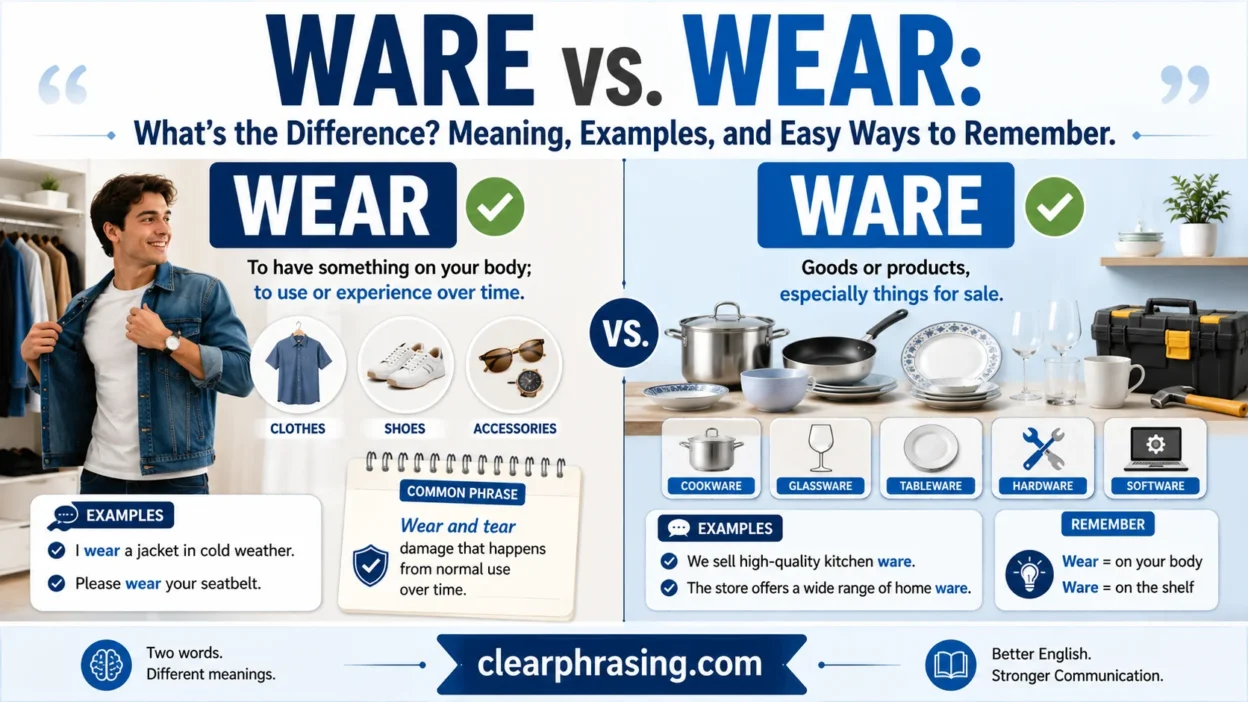
- Wear means to have clothing, jewelry, glasses, or another item on your body. It can also mean to become damaged through continued use.
- Ware means goods or manufactured products. It frequently appears in compound nouns that describe particular types of goods.
| Word | Meaning | Part of Speech | Example |
| Wear | To have something on your body | Verb | I wear glasses every day. |
| Wear | Damage caused by continued use | Noun | The carpet shows signs of wear. |
| Ware | Goods or manufactured products | Noun | The shop sells handmade ceramic ware. |
| Ware | A category of products in a compound word | Noun element | We bought new cookware. |
A useful memory trick is simple:
Wear is what you put on. Ware is what you buy or sell.
There are exceptions to that shortcut, but it works well for everyday writing.
What Does “Wear” Mean?
The word wear has several related meanings. Most commonly, it works as a verb connected with clothing or personal items.
It can also function as a noun when it describes damage caused by regular use.
Wear as a Verb
When wear describes clothing or an accessory, it means to have that item on your body.
For example:
- I wear a blue shirt to work.
- She wears glasses when she reads.
- He wore a black suit to the wedding.
- They are wearing matching jackets.
- What are you going to wear tonight?
Notice how naturally wear connects with things that people put on their bodies.
You can wear:
- clothes
- shoes
- hats
- watches
- glasses
- jewelry
- uniforms
- costumes
- makeup
- protective equipment
So if you’re talking about something you’re putting on or keeping on your body, wear is usually the correct choice.
Wear Can Also Mean Gradual Damage
Here’s where wear becomes more interesting.
The word doesn’t only concern clothing. It can also describe the gradual deterioration that happens when something gets used repeatedly.
Consider these examples:
- The tires are starting to wear out.
- Years of traffic have worn down the road.
- The wooden floor shows signs of wear.
- The machine has suffered considerable wear.
- Constant friction can wear away the surface.
Think about a favorite pair of shoes. You might wear them every day. Eventually, the soles become thin. The shoes have experienced wear.
The same idea applies to roads, machines, furniture, carpets, tools, clothing, and countless other objects.
Wear Can Describe an Expression
English also uses wear with facial expressions and appearances.
For example:
- She wore a bright smile.
- He wore a serious expression.
- The child wore a confused look.
- She wore a confident smile during the interview.
Here, wear doesn’t literally mean clothing. Instead, it suggests that someone displays an expression or appearance as if it were something they had put on.
That’s a useful figurative extension of the basic meaning.
What Does “Ware” Mean?
Ware is mainly a noun that refers to goods, merchandise, or manufactured products.
You might encounter it as a standalone word in phrases such as ceramic ware or metal ware, although everyday English more often uses it as part of a compound word.
For example:
- The market sells handmade ceramic ware.
- The company exports traditional metalware.
- The museum displays ancient pottery ware.
The exact meaning depends on the word that comes before -ware.
Ware in Compound Words
The most important thing to understand about ware is its role in compound nouns.
English uses -ware to form words describing particular groups or types of goods.
Some are extremely common.
| Word | Meaning | Example |
| Kitchenware | Items used in a kitchen | The kitchenware is on sale. |
| Cookware | Pots, pans, and cooking equipment | This cookware is easy to clean. |
| Tableware | Items used when serving or eating food | The restaurant replaced its tableware. |
| Glassware | Items made from glass, especially drinking vessels | Please put the glassware away. |
| Hardware | Physical tools, equipment, or computer components | The computer needs better hardware. |
| Software | Computer programs and applications | The software needs an update. |
| Silverware | Eating utensils, especially knives, forks, and spoons | The silverware is in the drawer. |
| Dinnerware | Plates, bowls, cups, and related dining items | She bought a new dinnerware set. |
| Earthenware | Pottery made from baked clay | The shop specializes in earthenware. |
| Stoneware | Durable pottery fired at high temperatures | The bowls are made from stoneware. |
This pattern gives you a powerful spelling clue.
If you’re writing a word that describes a category of goods and ends with this common suffix, -ware is often the correct spelling.
Ware vs. Wear: Key Differences
The easiest way to understand ware vs. wear is to compare their meanings directly.
Meaning
Wear generally connects to:
- putting something on
- having something on your body
- using something repeatedly
- gradual deterioration
- displaying an expression
Ware generally connects to:
- goods
- merchandise
- manufactured products
- categories of products
For example:
I wear new shoes.
Here, wear describes what you’re doing with the shoes.
The store sells footwear.
Here, ware appears inside footwear, a word describing goods worn on the feet.
Grammar
Wear commonly functions as both a verb and a noun.
As a verb:
I wear a uniform.
As a noun:
The uniform shows some wear.
Ware primarily functions as a noun.
The shop sells kitchenware.
You wouldn’t normally use ware as a verb.
Spelling
The spelling difference is small but meaningful:
- Wear → W-E-A-R
- Ware → W-A-R-E
Both sound like “wair” in standard pronunciation. That’s why context matters so much when you’re writing.
Why Do Ware and Wear Sound the Same?
Ware and wear are homophones.
Homophones are words that have the same pronunciation but different meanings and spellings.
English has many of them:
- to / too / two
- there / their / they’re
- right / write / rite
- flower / flour
- see / sea
- where / wear / ware
This creates a particular challenge for writers. When you hear the word, you can’t always determine its spelling.
That’s why spelling depends on meaning.
If you hear someone say:
“I need to ___ a coat.”
You can’t know the spelling from the sound alone. But the meaning tells you the answer: wear.
If someone says:
“The store sells kitchen___.”
The compound word tells you the answer: kitchenware.
Wear vs. Ware Examples in Sentences
Seeing the words in context makes the distinction much easier.
Examples With Wear
- I wear a uniform to school.
- She wears a silver necklace.
- He wore his favorite jacket yesterday.
- They are wearing protective gloves.
- These shoes wear out quickly.
- The stairs have worn down after years of use.
- The carpet shows signs of wear.
- She wore a nervous smile during the interview.
Each example connects wear with clothing, appearance, use, or deterioration.
Examples With Ware
- The store sells handmade ceramic ware.
- We need new cookware.
- The restaurant ordered expensive glassware.
- She bought matching tableware.
- The company develops computer software.
- The technician replaced several pieces of hardware.
- The museum has an impressive collection of stoneware.
In these examples, ware refers to goods or appears as part of a compound noun.
Ware vs. Wear: Incorrect and Correct Examples
| Incorrect | Correct | Explanation |
| I ware a jacket. | I wear a jacket. | Wear means to have clothing on. |
| She will ware a dress. | She will wear a dress. | Wear is the correct verb. |
| The shoes show signs of ware. | The shoes show signs of wear. | Wear means deterioration from use. |
| We bought new kitchenwear. | We bought new kitchenware. | Kitchenware refers to kitchen goods. |
| The store sells glasswear. | The store sells glassware. | Glassware refers to glass items. |
| The company created new hardwear. | The company created new hardware. | Hardware refers to physical equipment. |
One letter can completely change the meaning.
Common Words That Use “-Ware”
The -ware ending appears in many familiar English words. Learning these compounds can help you recognize the correct spelling automatically.
Household and Kitchen Words
Common examples include:
- cookware
- kitchenware
- tableware
- dinnerware
- glassware
- silverware
- housewares
These words usually describe groups of household or dining products.
For example, cookware includes pots and pans. Tableware covers items used for serving or eating food. Glassware commonly refers to drinking glasses and other glass vessels.
Technology Words
The technology world also uses -ware extensively.
The two most familiar examples are:
- hardware
- software
These terms form an especially useful pair.
Hardware refers to physical computer equipment. A keyboard, monitor, processor, and hard drive are examples.
Software refers to programs and digital instructions that run on hardware.
So although these words look similar to wear, their -ware spelling reflects the same word-forming element found in cookware and glassware.
Common Words and Phrases With “Wear”
The word wear appears in many everyday expressions.
1.Wear Out
Wear out means to become unusable or extremely tired through continued use.
- My old sneakers finally wore out.
- The constant pressure wore him out.
2.Wear Down
Wear down means to gradually reduce strength, condition, or resistance.
- Years of rain wore down the stone.
- The long negotiations wore down both sides.
3.Wear Away
Wear away means to gradually remove or erode something.
- Water slowly wore away the rock.
4.Wear Off
Wear off means that an effect gradually disappears.
- The pain medication began to wear off.
- The excitement wore off after a few days.
5.Wear and Tear
Wear and tear refers to ordinary damage caused by regular use.
For example:
The landlord agreed to repair the apartment except for ordinary wear and tear.
This phrase is extremely common in everyday and legal contexts.
Wear Verb Forms You Should Know
One reason wear causes additional confusion is that it’s an irregular verb.
Its main forms are:
| Verb Form | Word | Example |
| Base form | wear | I wear sneakers every day. |
| Past tense | wore | I wore sneakers yesterday. |
| Past participle | worn | I have worn these shoes before. |
| Present participle | wearing | She is wearing a coat. |
A common mistake is weared.
That’s incorrect in standard English.
Don’t write:
I weared my new shoes yesterday.
Write:
I wore my new shoes yesterday.
Likewise, after have, has, or had, use worn:
She has worn that dress before.
Understanding these forms helps prevent a second layer of confusion around wear.
Common Mistakes With Ware and Wear
Writing “Ware” When You Mean “Wear”
This usually happens when someone relies on pronunciation instead of meaning.
Incorrect:
What will you ware tonight?
Correct:
What will you wear tonight?
Ask yourself what the sentence describes. If someone is putting on clothing, the answer is wear.
Writing “Wear” in Compound Words
The opposite mistake happens with words ending in -ware.
Incorrect:
We bought new kitchenwear.
Correct:
We bought new kitchenware.
The same principle applies to hardware, software, cookware, glassware, and tableware.
Confusing Wear With Wore or Worn
These words belong to the same verb family, but they serve different grammatical roles.
- wear → present or base form
- wore → simple past
- worn → past participle
Compare:
1.I wear a coat every winter.
2.I wore a coat yesterday.
3.I have worn that coat many times.
The timeline changes. The verb form changes with it.
Assuming Wear Only Relates to Clothing
Clothing is probably the first meaning that comes to mind. However, wear has a much broader range.
You can wear clothes. You can also wear down a surface, wear out a machine, or wear a smile.
Context determines the meaning.
Case Examples: Choosing Ware or Wear in Real Situations
Case Example: Getting Dressed
Imagine you’re writing about someone’s morning routine:
Maria gets ready for work and wears a navy-blue uniform.
The correct word is wear because Maria has the uniform on her body.
Case Example: Shopping for Kitchen Items
Now imagine a shopping guide:
The store offers cookware, glassware, and tableware.
Here, ware appears in several compound nouns because the text describes categories of goods.
Case Example: Describing an Old Building
Suppose you’re describing an old staircase:
The wooden steps show significant wear after decades of daily use.
The correct word is wear because the sentence describes deterioration.
Case Example: Discussing Computers
Consider this sentence:
The technician replaced the computer’s hardware and installed new software.
Both words use -ware because they describe categories of computer products and programs.
These examples reveal the real trick: don’t focus on how the word sounds. Focus on what the sentence means.
How to Remember the Difference Between Ware and Wear
You don’t need a complicated grammar rule.
Try these three memory tricks.
Wear = What You Put On
Think:
Wear → clothes
If you can put it on your body, wear will often be the correct word.
I wear shoes.
She wears a hat.
He wore a jacket.
Wear = Wear Out
Connect wear with wear out.
If something becomes damaged because you repeatedly use it, think wear.
The tires show wear.
The fabric has worn thin.
Ware = Goods
Connect ware with product categories:
- cookware
- software
- hardware
- glassware
- tableware
If you’re talking about goods or merchandise, ware is often the spelling you need.
Ware vs. Wear vs. Where
There’s one more word worth adding to the comparison: where.
These three words are pronounced alike, but their meanings are completely different.
| Word | Meaning | Example |
| Wear | Put on or deteriorate through use | What should I wear? |
| Ware | Goods or products | The store sells kitchenware. |
| Where | Refers to a place | Where are my keys? |
A quick memory trick works here:
- Wear → clothing or use
- Ware → goods
- Where → place
This distinction becomes especially useful in proofreading because all three can sound identical in conversation.
Ware vs. Wear: A Simple Decision Guide
When you’re unsure which spelling to use, ask yourself one question:
What does the word mean in this sentence?
When it refers to clothing, accessories, having something on, or damage from use, choose wear.
If it refers to goods, products, merchandise, or a compound word such as software or cookware, choose ware.
If it refers to a location, choose where.
That small mental check can prevent many spelling mistakes.
Practice Quiz: Ware or Wear?
Choose ware or wear to complete each sentence.
- What will you ___ to the party?
- The shop sells handmade ceramic ___.
- The tires show considerable ___.
- She always ___ a watch.
- We bought new kitchen___ last month.
- The carpet has begun to show ___.
- He ___ his favorite jacket yesterday.
- The company manufactures glass___.
- I have ___ these shoes many times.
- The computer needs new hard___.
Answers and Explanations
- wear — You’re putting clothing on your body.
- ware — Ceramic ware refers to ceramic goods.
- wear — This means deterioration caused by use.
- wear — A watch is something you can have on your body.
- ware — The correct compound is kitchenware.
- wear — The carpet is deteriorating from use.
- wore — Wore is the simple past form of wear.
- ware — The correct word is glassware.
- worn — Worn is the past participle of wear.
- ware — The correct compound is hardware.
Read More: Passed vs Past: Difference and Correct Usage
FAQs
1. What is the main difference between ware and wear?
Ware usually refers to goods or products, while wear relates to putting something on your body or becoming damaged through use. For example, kitchenware means kitchen products, while you wear a jacket.
2. Is ware a noun or a verb?
Ware is generally used as a noun. It refers to manufactured goods or products, especially when it appears in compounds such as glassware, silverware, kitchenware, and software.
3. How do you use wear correctly in a sentence?
Use wear when talking about clothing, accessories, or something gradually becoming damaged through use. For example, “I wear comfortable shoes to work” and “These shoes are starting to wear out.”
4. Are ware and wear pronounced the same?
Yes. Ware and wear are pronounced the same in standard English, although they have different spellings and meanings. They are therefore considered homophones.
5. What does ware mean when discussing products?
When discussing products, ware refers to goods or items made, sold, or grouped according to their purpose. Examples include kitchenware, glassware, hardware, and software.
6. Can wear describe both clothes and damage?
Yes. Wear has several related uses. You can wear clothing on your body, and something can wear or wear out when repeated use causes gradual damage or deterioration.
7. What is the difference between wear and wear out?
Wear can describe the general process of use or gradual deterioration. Wear out means something becomes damaged, weakened, or unusable because of continued use. For example, “My shoes wore out.”
8. How can you remember when to use ware or wear?
Think of wear when you see clothing, the body, or repeated use. Think of ware when you see products or goods. Connecting each word with a real-life example makes the distinction easier to remember.
9. Are where, were, wear, and ware all homophones?
In standard English, where, were, wear, and ware aren’t all universally pronounced alike. Where, wear, and ware commonly share a pronunciation, while were usually has a different vowel sound.
10. Why do writers often confuse ware and wear?
Writers confuse ware and wear mainly because they sound identical but have unrelated meanings and spellings. Learning their grammatical roles and practicing them in context can prevent this common mistake.
Conclusion
Understanding ware and wear becomes much easier once you stop relying on sound alone. These words may sound identical, but they perform different jobs in English. Wear connects with clothing, putting something on your body, or gradual damage caused by repeated use. Ware, meanwhile, refers to goods, products, or items made for a particular purpose. You can see this distinction in words such as kitchenware, glassware, and software. Once you connect each word with its meaning, you don’t have to guess which spelling belongs in your sentence.
After years of teaching English, I’ve noticed that learners remember confusing words more effectively when they connect them with familiar situations. Picture yourself putting on a jacket: you wear it. Picture a store displaying kitchen products: those items can be called kitchenware. That simple mental link can make correct word choice much easier. The same strategy helps when you encounter other confusing words, including where, were, wear, and ware. Don’t just memorize their spellings. Pay attention to the meaning, grammatical function, and context surrounding each word. With regular practice, you’ll use ware and wear more confidently in everyday conversations, schoolwork, professional communication, and formal English writing.

Mehwish Imtiaz is an English specialist and professional blog writer at ClearPhrasing.com. She specializes in grammar, spelling, vocabulary, punctuation, and writing improvement. With a strong passion for clear communication and language education, she creates reader-friendly articles that help students, professionals, and English learners understand complex language topics with ease.
Her writing focuses on accuracy, simplicity, and practical usage, ensuring that every article provides clear explanations and real-world examples. At ClearPhrasing.com, Mehwish is committed to publishing well-researched, original content that helps readers write more confidently and communicate more effectively in everyday and professional English.