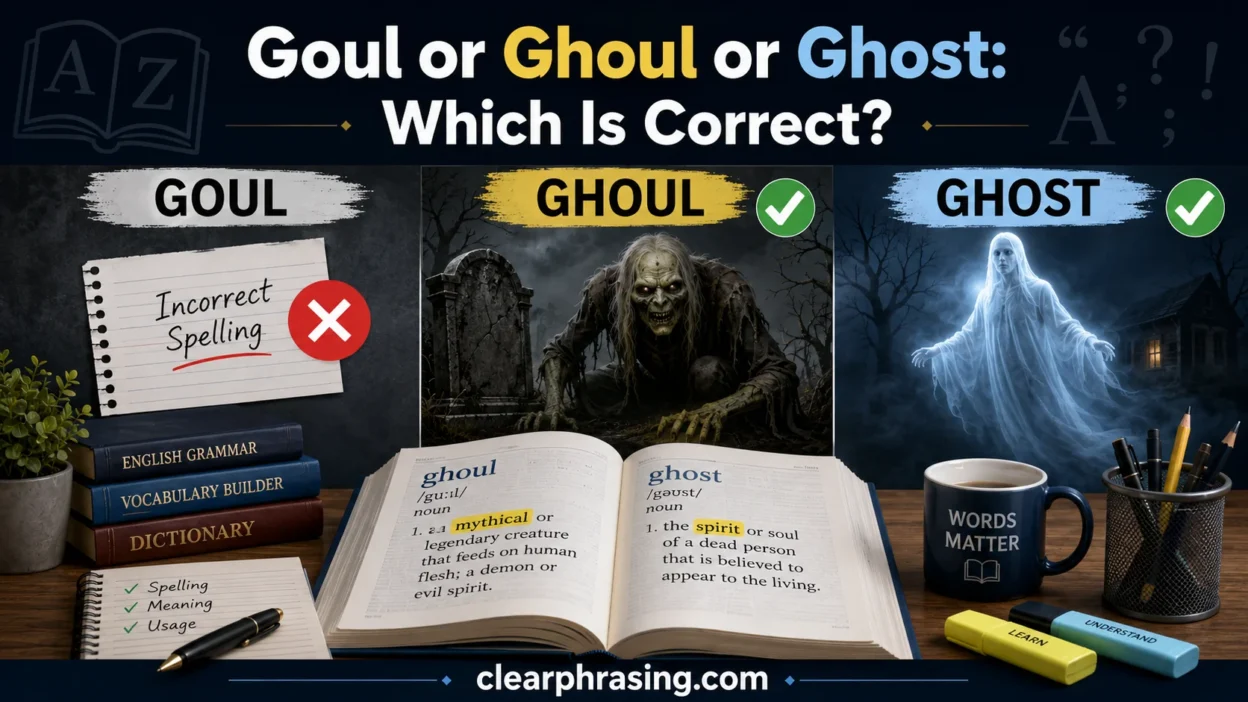
Goul or Ghoul or Ghost: Correct Spelling, Meaning, and Usage helps explain why these commonly confused words create confusion in English.
Ghost means an apparition, spectre, or phantom of a dead person, while ghoul describes an undead creature or evil spirit associated with graves and death. Goul is generally an incorrect spelling when you mean ghoul. Their meaning, spelling, word choice, and context clearly distinguish them.
The word ghost has roots in Old English, while ghoul comes from the Arabic word ġūl. A ghost may appear as a faint image, spirit, or presence, whereas a ghoul is traditionally a supernatural creature that eats the dead. In my English teaching experience, connecting each word with its meaning helps students remember the correct usage.
Quick Answer:
Here’s the simplest way to remember the difference:
| Word | Correct? | Meaning | Pronunciation | Example |
| Goul | ❌ Usually incorrect | Usually a misspelling of ghoul | — | Avoid it in standard English |
| Ghoul | ✅ Correct | A supernatural creature traditionally associated with dead bodies | /ɡuːl/ | A ghoul emerged from the grave. |
| Ghost | ✅ Correct | The spirit or apparition of a dead person | /ɡoʊst/ | A ghost appeared in the hallway. |
So, if you’re asking “Goul or ghoul?”, choose ghoul.
If you’re asking “Ghoul or ghost?”, the answer depends on what you mean.
A ghoul is a creature. A ghost is generally a spirit or apparition. Cambridge defines a ghost as the spirit of a dead person that may appear to living people, often as a pale or nearly transparent figure.
Quick rule: If you mean a corpse-eating supernatural creature, use ghoul. If you mean the spirit of a dead person, use ghost.
Is “Goul” a Correct Word?
The short answer is usually no.
When someone writes goul in a sentence about a frightening supernatural creature, they almost certainly mean ghoul. Standard English dictionaries use ghoul for this word.
The spelling can cause trouble because pronunciation gives you very little help. Ghoul is pronounced /ɡuːl/, which sounds roughly like “gool.” Cambridge gives this pronunciation in both its US and UK entries.
That creates a natural spelling trap. Someone hears the word and may reasonably assume that the spelling should be goul. English spelling, however, doesn’t always follow pronunciation in a neat one-to-one pattern.
Consider this example:
Incorrect:
A terrifying goul appeared beside the cemetery.
Correct:
A terrifying ghoul appeared beside the cemetery.
The second sentence uses the standard spelling.
Why Do People Spell Ghoul as “Goul”?
Several factors can make goul seem plausible:
- Ghoul has an unusual spelling.
- The gh doesn’t add a separate consonant sound here.
- The word sounds like “gool.”
- Many people encounter the word in speech before seeing it written.
- English contains many words whose spellings can’t be predicted perfectly from pronunciation.
It’s similar to hearing an unfamiliar name and trying to spell it from sound alone. You might get close. You might also miss one crucial letter.
For ghoul, that extra-looking h matters.
What Does “Ghoul” Mean?
A ghoul is a supernatural creature traditionally associated with death, graves, and dead bodies. Cambridge defines it as an evil spirit that eats dead bodies.
The word has deep roots in folklore rather than modern horror alone. Its traditional meaning gives it a more specific identity than the broad word ghost.
Imagine walking through a dark cemetery in a horror story. If a pale figure silently floats toward you, the writer may describe it as a ghost. If a monstrous creature crawls from a grave and feeds on corpses, ghoul is the more precise word.
That’s the key distinction.
The Traditional Meaning of Ghoul
The traditional ghoul belongs to folklore involving the dead and burial places. Modern books, movies, games, and other fictional works have expanded the idea considerably.
A modern ghoul might appear as:
- A graveyard creature
- A monster that consumes corpses
- A supernatural enemy in a fantasy game
- A frightening figure in a horror story
- A creature associated with cemeteries or abandoned places
Different fictional worlds can give ghouls different appearances and abilities. The basic association with death and corpses remains an important part of the word’s traditional meaning.
Ghoul Can Also Describe a Person
Ghoul has a figurative use as well.
Cambridge records an informal meaning for someone who takes an unusual interest in death and unpleasant subjects.
For example:
The journalist was criticized as a ghoul for focusing obsessively on the victims’ gruesome details.
Here, ghoul doesn’t mean an actual supernatural creature. It describes a person whose interest in disturbing subjects seems morbid or unhealthy.
The related adjective ghoulish can also describe something frightening, ugly, unpleasant, or connected with death and disturbing subjects.
Examples of “Ghoul” in Sentences
- The villagers believed a ghoul lived beyond the cemetery.
- The horror game sends ghouls into the town after midnight.
- The story describes a ghoul feeding near an old burial ground.
- A group of ghouls emerged from the abandoned crypt.
- The novel portrays the creature as a cunning and dangerous ghoul.
Notice how each sentence presents ghoul as a creature rather than simply a dead person’s spirit.
What Does “Ghost” Mean?
A ghost is generally understood as the spirit of a dead person, especially when that spirit is believed to appear to living people.
Cambridge defines the supernatural sense of ghost as the spirit of a dead person that may appear as a pale or almost transparent image.
That’s a much broader and more familiar concept than ghoul.
A ghost doesn’t have to be portrayed as a monster. In many stories, the ghost looks like the person who died. It might appear briefly, wander through a building, communicate with the living, or remain tied to a particular location.
For example:
A ghost appeared at the window just before midnight.
The sentence suggests an apparition or spirit. It doesn’t automatically suggest a creature that eats corpses.
Examples of “Ghost” in Sentences
- We heard footsteps in the hallway, but no one was there.
- The old mansion was supposedly haunted by a ghost.
- She claimed to have seen the ghost of a former resident.
- The movie follows a young woman who encounters a ghost.
- According to the legend, a ghost appears near the bridge every winter.
The word can also appear in many expressions and modern uses beyond the supernatural sense.
For instance, ghost can function as a verb meaning to suddenly stop communicating with someone. Cambridge lists this informal meaning as ending a relationship or interaction by abruptly stopping communication.
He stopped replying to every message and completely ghosted her.
That modern meaning has nothing to do with graveyards. Context does the heavy lifting.
Ghoul vs. Ghost: What’s the Difference?
The central difference is simple:
A ghoul is traditionally a supernatural creature associated with graves and dead bodies. A ghost is generally the spirit or apparition of a dead person.
Both words belong comfortably in horror and supernatural writing. However, they create different mental pictures.
Think of it this way:
Ghost = the dead person’s spirit
Ghoul = the supernatural creature associated with the dead
That distinction becomes especially useful when you’re writing fiction, reviewing a horror story, translating a sentence, or choosing the right word for an article.
Ghoul vs. Ghost Comparison
| Point | Ghoul | Ghost |
| Basic concept | Supernatural creature | Spirit or apparition |
| Connection with death | Strong | Strong |
| Traditional association | Graves and dead bodies | Dead people |
| Typical role | Monster or frightening creature | Apparition or spirit |
| Eats corpses? | Traditionally associated with this idea | Not part of the basic definition |
| Can look human? | Fiction often portrays it that way | Commonly portrayed as the dead person |
| Common in horror? | Yes | Yes |
| Pronunciation | /ɡuːl/ | /ɡoʊst/ |
Cambridge’s pronunciation entries make another difference clear: ghoul uses the /uː/ sound, while American English ghost uses /oʊ/.
Can a Ghoul Be Called a Ghost?
In casual fictional language, writers sometimes use broad supernatural terms loosely. However, that doesn’t mean the words are exact synonyms.
If a story specifically describes a creature that eats corpses, ghoul gives the reader a more precise picture.
If the story describes the spirit of someone who died years earlier, ghost is the natural choice.
Using the wrong word can change the scene.
Compare these two sentences:
A ghost crawled from the grave and began eating the corpse.
That sentence is possible in fiction, but it creates a strange combination because the action sounds more characteristic of a ghoul.
Now consider:
A ghoul crawled from the grave and began eating the corpse.
The second sentence immediately gives the reader a clearer horror image.
Word choice works like a camera lens. A broad word gives you a wider shot. A specific word brings the subject into focus.
Goul vs. Ghoul vs. Ghost Pronunciation
Pronunciation explains part of the confusion surrounding these words.
How to Pronounce “Ghoul”
Ghoul is pronounced:
/ɡuːl/
A simple approximation is:
“gool”
The word has one syllable. The gh spelling does not produce a separate “h” sound in modern pronunciation. Cambridge lists /ɡuːl/ for both US and UK English.
How to Pronounce “Ghost”
In American English, ghost is pronounced:
/ɡoʊst/
A simple approximation is:
“gohst”
Cambridge lists /ɡoʊst/ for US English and /ɡəʊst/ for UK English.
The vowel sound differs noticeably from ghoul.
| Word | US Pronunciation | Simple Sound |
| Ghoul | /ɡuːl/ | gool |
| Ghost | /ɡoʊst/ | gohst |
This difference matters when speaking. It also explains why writing goul can feel tempting. The sound itself doesn’t reveal the unusual spelling.
Why Is “Ghoul” Spelled With “Gh”?
English spelling carries traces of its long history. Some spellings preserve older forms even when modern pronunciation has changed.
The important practical point isn’t to memorize every historical change. It’s to recognize that gh doesn’t always have a predictable modern sound.
For example, compare:
- ghost
- ghoul
- laugh
- though
The letters gh behave differently across these words.
That’s one reason English learners shouldn’t rely entirely on pronunciation when spelling unfamiliar words. Listening helps you identify a word. Reading helps you learn its established spelling.
For ghoul, the safest approach is simply to remember the standard form:
G-H-O-U-L
Goul or Ghoul: Common Spelling Mistakes
The most common mistake is straightforward:
Goul ❌
Ghoul ✅
If you’re writing about a supernatural creature, cemetery monster, or corpse-eating spirit, ghoul is the standard choice.
Common Mistakes and Corrections
| Common mistake | Correct form | Explanation |
| The goul attacked the travelers. | The ghoul attacked the travelers. | Ghoul is the standard spelling. |
| A scary goul lived in the crypt. | A scary ghoul lived in the crypt. | Add the h. |
| The ghoul was the spirit of a dead woman. | The ghost was the spirit of a dead woman. | Ghost fits the intended meaning better. |
| The ghost ate corpses in the graveyard. | The ghoul ate corpses in the graveyard. | Ghoul better identifies the creature. |
These corrections aren’t merely about spelling. They also show why meaning matters.
Ghoul vs. Ghost in Horror Writing
Horror writers use both words because they create different kinds of fear.
A ghost often creates psychological tension. You can’t necessarily fight a ghost. You may not even know whether it’s present until something moves, whispers, or appears in a mirror.
A ghoul, by contrast, can feel more physical and predatory. The creature may lurk near graves, attack people, or feed on the dead.
Consider these two descriptions:
A ghost stood silently at the end of the corridor.
The fear comes from the unexplained presence.
Now:
A ghoul crouched beside the open grave.
The fear comes from the creature itself.
Neither word is automatically “scarier.” They simply build different kinds of imagery.
When Should You Use “Ghoul”?
Use ghoul when you mean:
- A supernatural creature
- A creature connected with graves
- A creature associated with corpses
- A monster in horror or fantasy fiction
- A person with a morbid interest in disturbing subjects
When Should You Use “Ghost”?
Use ghost when you mean:
- The spirit of a dead person
- A supernatural apparition
- A haunting presence
- A figure believed to appear after death
- A person who has supposedly returned as a spirit
That distinction keeps your writing sharp.
Ghoul, Ghost, Spirit, Phantom, and Specter
These words overlap, but each carries its own shade of meaning.
| Word | Main Idea |
| Ghoul | A supernatural creature associated with graves and dead bodies |
| Ghost | The spirit or apparition of a dead person |
| Spirit | A broad term for a nonphysical being or entity |
| Phantom | A ghostly figure or apparition |
| Specter | A frightening ghost or apparition |
Spirit is the broadest term in this group. Cambridge also defines it as something without a physical body, including a ghost, depending on context.
Phantom can work as another word for a ghost. Cambridge specifically defines it as a spirit of a dead person believed to visit the living and lists ghost as a synonym in that sense.
Ghoul, however, stands apart because it identifies a particular kind of supernatural creature rather than simply a dead person’s apparition.
Is a Ghoul the Same as a Ghost?
No.
Although both words belong to supernatural vocabulary, their core meanings differ.
A ghost is generally the spirit or apparition of someone who has died.
A ghoul is traditionally a supernatural creature associated with graves and dead bodies.
Fiction can bend these definitions. A modern fantasy universe might invent its own version of a ghoul. One story might make it intelligent. Another might make it nearly human. A third might treat it as an undead monster.
Still, when you’re choosing the ordinary English word, the traditional distinction remains useful.
Case Study: Choosing the Right Word
Imagine you’re writing this sentence:
“At midnight, a strange figure appeared beside the grave.”
Which word should you choose?
It depends on what happens next.
If the figure is the spirit of a dead person, write:
At midnight, a ghost appeared beside the grave.
If the figure is a monster associated with corpses, write:
At midnight, a ghoul appeared beside the grave.
If you write goul, the problem isn’t a subtle difference in meaning. It’s simply the spelling.
This small example shows why good word choice starts with meaning. Don’t pick a word because it merely sounds spooky. Decide what you’re actually describing.
Read More: All Bark and No Bite: Meaning, Origin, Examples, and Usage
FAQs
What is the correct spelling: goul, ghoul, or ghost?
Ghoul and ghost are both correct English words, but they have different meanings. Goul is generally an incorrect spelling when you mean ghoul. A ghost refers to the spirit or apparition of a dead person, while a ghoul traditionally refers to a supernatural creature associated with graves and the dead.
Is “goul” a correct English word?
No, goul isn’t the standard spelling of the supernatural creature commonly meant in English. The correct spelling is ghoul. If you’re writing about a creature that eats the dead or appears in horror stories and folklore, use ghoul rather than goul.
What does the word “ghoul” mean?
A ghoul is a supernatural creature traditionally described as an evil spirit that robs graves and eats the dead. The word can also describe someone who shows an unhealthy or excessive interest in death, horror, or unpleasant subjects.
What does “ghost” mean?
A ghost is commonly understood as the spirit or apparition of a dead person. It may appear in stories as an invisible presence, translucent figure, or visible shape. In modern English, ghost can also mean suddenly ending communication with someone without giving an explanation.
Are ghosts and ghouls the same thing?
No, ghosts and ghouls aren’t the same. A ghost is usually connected with the spirit or soul of a dead person, whereas a ghoul is a supernatural creature traditionally associated with graves and consuming the dead. Both belong to frightening folklore, but their roles are different.
What is the difference between a ghost and a ghoul?
The main difference is their nature. A ghost is an apparition or spirit, while a ghoul is a physical supernatural creature or monster in traditional stories. A ghost may haunt a person or place, whereas a ghoul is often portrayed as a creature that searches for graves and human flesh.
Where does the word “ghoul” come from?
The word ghoul comes from the Arabic word ġūl. The concept later became familiar in European literature and gained wider attention in the 1780s through Vathek, a novel by William Beckford. Its meaning has remained strongly connected with supernatural creatures and the dead.
Where does the word “ghost” come from?
Ghost comes from the Old English word gast. Historically, this word could refer to a spirit, breath, angel, or demon. Over time, its meaning developed into the modern sense of an apparition or spirit associated with a dead person.
Can “ghost” be used as a verb?
Yes, ghost can be used as a verb. In modern communication, to ghost someone means to suddenly stop responding or disappear from a relationship without explanation. The word also has another verb meaning: to secretly write work that receives someone else’s name as the author.
How can I remember the difference between ghoul and ghost?
A simple way to remember the difference is to think of a ghost as a spirit and a ghoul as a creature. A ghost is connected with a dead person’s soul or apparition, while a ghoul is traditionally a frightening monster associated with graves and the dead. This simple distinction can help you choose the correct word when writing.
Conclusion
The difference between goul, ghoul, and ghost becomes much clearer once you look beyond spelling and focus on meaning. Ghoul is the correct spelling for the supernatural creature traditionally associated with graves, the dead, and human flesh. Ghost refers to an apparition or spirit connected with a dead person. Goul, in contrast, is generally an incorrect spelling when the intended word is ghoul. These words may appear together in horror stories, folklore, fantasy, Halloween discussions, and scary movies, but they describe different ideas. Knowing this distinction helps you avoid an embarrassing spelling mistake and choose the right word for your sentence.
As an English teacher, I’ve noticed that students often remember confusing vocabulary more easily when they attach a clear mental picture to each word. Picture a ghost as a pale spirit appearing in a haunted house. Then picture a ghoul as a frightening creature lurking around a graveyard. That contrast makes the difference easier to remember. When you’re writing, don’t rely only on how a word sounds. Check its spelling, meaning, context, and usage. Once you understand those four points, choosing between ghost and ghoul becomes simple, and goul is easy to recognize as the incorrect spelling.

Ayesha Siddiqa is an English specialist and professional content writer at ClearPhrasing.com. She is passionate about making the English language easy to understand through clear, accurate, and engaging content. Her expertise includes English grammar, spelling, vocabulary, punctuation, word usage, and writing techniques.
At ClearPhrasing.com, Ayesha creates well-researched, reader-friendly articles designed to help students, professionals, writers, and English learners strengthen their language skills. She focuses on providing practical explanations, real-world examples, and up-to-date guidance that readers can confidently apply in everyday communication.
Committed to accuracy and clarity, Ayesha ensures that every article meets high editorial standards and delivers reliable, easy-to-follow information that empowers readers to write and communicate with confidence.