Wish You or Wishing You: Difference, Meaning, and Correct Usage helps you choose the right phrase and write natural English with confidence every time.
If you have ever paused mid-message, wondering about Wish You, Wishing You, or Wish You vs Wishing You, you are not alone. These English phrases often pop up in everyday English and confuse English learners, fluent English speakers, and native speakers. From my teaching experience, I have learned that small details make a big difference. When you understand the Difference, Meaning, Correct Usage, grammar, sentence structure, tone, context, proper usage, and the correct phrase, your writing becomes more natural and creates the right impact in written communication.
This in-depth guide uses practical examples, usage examples, and different scenarios to explain grammar rules, usage rules, correct grammar, correct form, and grammar accuracy. You will improve your communication skills through email writing, formal writing, informal writing, business communication, professional communication, business emails, professional email, greeting cards, birthday wishes, holiday wishes, social media captions, and message writing.
You will also strengthen your English grammar, English usage, writing style, and language skills, helping every message sound polite, formal, clear, and natural while avoiding common mistakes, grammar mistakes, awkward writing, or an incomplete sentence.
Quick Answer:
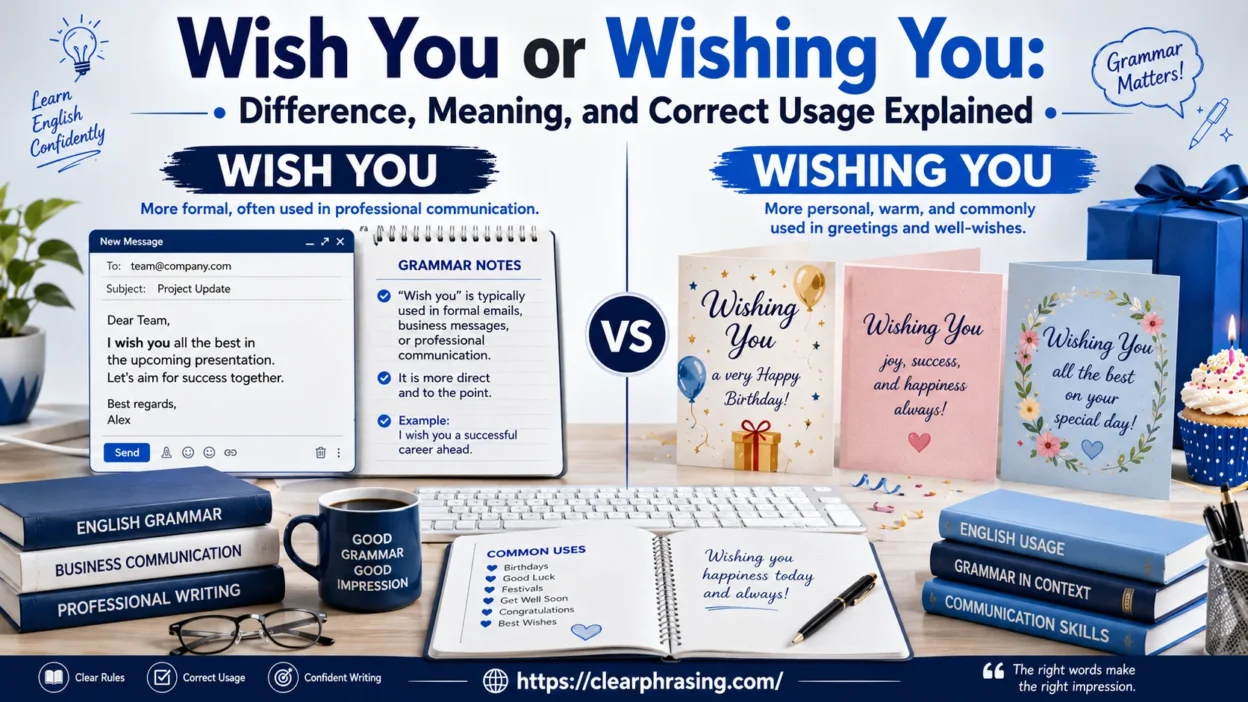
The difference between Wish You or Wishing You depends on how you use the phrase.
| Phrase | Meaning | Grammar Use | Example |
| Wish you | Expresses a hope or desire for someone | Usually part of a complete sentence | I wish you success in your career. |
| Wishing you | Sends warm greetings or good wishes | Commonly used as a greeting phrase | Wishing you a happy birthday. |
The easiest way to remember it:
- Use “wish you” when you want to say “I wish you something.”
- Use “wishing you” when you want to send a warm greeting or message.
Both are correct. The choice depends on the situation.
What Does “Wish You” Mean?
Meaning and Grammar Structure of “Wish You”
The phrase “wish you” comes from the verb wish, which means to want something good for someone or to express a desire.
The common structure is:
Subject + wish + person + something good
Examples:
- I wish you happiness.
- We wish you success.
- She wishes you good luck.
- They wish you a safe journey.
In these sentences, the speaker clearly shows who is making the wish.
The word “you” works as the person receiving the good wish.
For example:
I wish you success.
- I = person making the wish
- wish = action
- you = person receiving the wish
- success = the thing being wished
This structure makes the sentence complete and grammatically clear.
When to Use “Wish You”
You can use “wish you” in many situations where you want to express kindness, support, or encouragement.
Personal Messages
Examples:
- I wish you a happy birthday.
- I wish you a wonderful day.
- I wish you peace and happiness.
These sentences sound personal because they directly address another person.
Professional Communication
In workplaces, “wish you” often sounds respectful and professional.
Examples:
- We wish you continued success.
- I wish you the best in your future career.
- We wish you every success in your new position.
Businesses often use this phrase when writing farewell messages, announcements, or official greetings.
Special Occasions
Examples:
- We wish you a Merry Christmas.
- I wish you a happy anniversary.
- We wish you a joyful holiday season.
These expressions have become common because they clearly communicate positive feelings.
What Does “Wishing You” Mean?
Meaning and Grammar Structure of “Wishing You”
“Wishing you” uses the present participle form of the verb wish.
The phrase creates a softer and warmer feeling. It often sounds like the writer is sending positive thoughts rather than making a direct statement.
Examples:
- Wishing you a beautiful day.
- Wishing you success in everything you do.
- Wishing you happiness and good health.
In everyday communication, people often remove the subject and helping verb.
The complete sentence would be:
I am wishing you a beautiful day.
However, English speakers commonly shorten it to:
Wishing you a beautiful day.
This shortened style is normal in greetings and messages.
Why Is “Wishing You” Common in Messages?
You will often find “wishing you” in:
- Birthday cards
- Wedding invitations
- Holiday greetings
- Business emails
- Social media captions
- Thank-you messages
The phrase feels warm and friendly.
For example:
Wishing you a successful year ahead.
This sounds like a thoughtful message someone might write in a card.
Key Differences
Understanding the difference becomes easier when you compare their purpose.
| Feature | Wish You | Wishing You |
| Grammar form | Verb phrase | -ing phrase |
| Sentence style | Usually complete sentence | Often a shortened greeting |
| Tone | Direct and clear | Warm and friendly |
| Common location | Inside sentences | Beginning or ending of messages |
| Example | I wish you good luck. | Wishing you good luck. |
Neither phrase is better than the other. They simply create different impressions.
Think of it like this:
“Wish you” is a direct conversation.
You are clearly telling someone what you hope for them.
“Wishing you” is like writing a note on a gift card.
It feels warmer and more personal.
Wish You or Wishing You in Different Situations
Wish You or Wishing You in Emails
Email communication requires the right balance between professionalism and friendliness.
For formal emails, “wish you” often works well.
Example:
We wish you continued success in your professional journey.
This sounds polished and respectful.
For friendly email endings, “wishing you” feels more natural.
Example:
Wishing you a productive week ahead.
Both options work. The choice depends on your relationship with the reader.
Wish You or Wishing You for Birthday Messages
Birthday wishes are one of the most common places where people use these phrases.
Examples:
Formal:
I wish you a very happy birthday and a successful year ahead.
Friendly:
Wishing you a fantastic birthday filled with happiness.
The second version feels more like a greeting card message.
Wish You or Wishing You for Holidays
Holiday greetings commonly use both expressions.
Examples:
- We wish you a Merry Christmas.
- Wishing you a Merry Christmas and a Happy New Year.
The first one is traditional and complete.
The second one feels more personal and emotional.
Wish You or Wishing You in Professional Announcements
Companies often use these phrases when announcing promotions, retirements, or new opportunities.
Examples:
- We wish you success in your new role.
- Wishing you great achievements in your future endeavors.
The second option creates a warmer connection.
Common Mistakes
Using “Wish You” Without a Subject in Formal Writing
Many people write:
❌ Wish you success in your career.
In casual conversation, this may sound acceptable because people often remove words.
However, formal writing should include the subject:
✅ I wish you success in your career.
Using “Wishing You” Everywhere
Although “wishing you” is common, it does not replace every sentence.
Incorrect:
❌ Wishing you will complete the project soon.
Better:
✅ I wish you success with the project.
or
✅ I hope you complete the project soon.
“Wishing you” usually connects with a noun phrase, not a complete action.
Confusing Wish With Hope
Many learners mix up wish and hope.
| Word | Meaning | Example |
| Wish | A desire or good feeling toward someone | I wish you happiness. |
| Hope | A belief that something possible will happen | I hope you pass the exam. |
Compare:
- I wish you success.
- I hope you succeed.
Both sound positive, but the grammar and meaning differ.
Is “Wishing You” More Formal Than “Wish You”?
Many people assume that “wishing you” sounds more formal. However, formality depends on the complete sentence.
Compare:
Formal:
We wish you continued growth and success.
Warm professional style:
Wishing you continued growth and success.
The first sounds more official. The second sounds more personal.
The situation decides which one fits better.
Real-Life Examples of Choosing the Correct Phrase
| Situation | Better Choice | Example |
| Job interview message | Wish you | I wish you success in your interview. |
| Birthday card | Wishing you | Wishing you a wonderful birthday. |
| Company announcement | Both | We wish you success in your new role. |
| Social media caption | Wishing you | Wishing you love and happiness. |
| Formal letter | Wish you | We wish you a bright future. |
Common Learner Confusion About Wish You or Wishing You
Many English learners learn phrases by copying examples they see online. This creates confusion because they remember the expression but not the grammar behind it.
For example, a learner may see thousands of posts saying:
“Wishing you a happy birthday.”
Then they start using “wishing you” in every situation.
The better approach is to understand the pattern.
A complete sentence needs a subject:
- I wish you success.
A greeting message can use the shortened form:
- Wishing you success.
Once you recognize this difference, your writing becomes more natural.
Easy Tips to Remember Wish You or Wishing You
Use these simple reminders:
Remember “Wish You” as a Full Sentence
Think:
I wish you + something good
Examples:
- I wish you luck.
- I wish you happiness.
- I wish you success.
Remember “Wishing You” as a Greeting
Think:
Sending good wishes your way
Examples:
- Wishing you a great weekend.
- Wishing you a happy marriage.
- Wishing you a successful future.
Read More: Apple of My Eye: Meaning, Usage, Origin & Examples
FAQs
What is the difference between Wish You and Wishing You?
The main difference is that Wishing You is grammatically correct when it starts a greeting or message by itself. Wish You usually needs a subject, such as “I wish you,” to form a complete sentence.
Is Wish You grammatically correct?
On its own, Wish You is generally incomplete in standard English. It becomes correct when you include the subject, for example, “I wish you happiness.”
Why is Wishing You more common in greeting cards?
Wishing You sounds warm, polite, and natural. It works well as a shortened greeting in birthday cards, holiday messages, emails, and other written wishes.
Can I write Wish You a Happy Birthday?
In formal English, it is better to write Wishing you a happy birthday or I wish you a happy birthday. Both are complete and natural expressions.
When should I use Wishing You?
Use Wishing You when writing greeting cards, holiday messages, professional emails, social media captions, or any message where you want to send good wishes politely.
Is Wishing You formal or informal?
It works in both formal and informal situations. You can use it in business emails, personal messages, greeting cards, and professional communication.
Do native English speakers use Wish You?
Native English speakers usually say I wish you in complete sentences or use Wishing you as a greeting. They rarely use Wish You by itself.
Which phrase sounds more natural in everyday English?
Wishing You sounds more natural because it follows common English writing patterns and is widely used in greetings and well wishes.
Can I use Wishing You in business emails?
Yes. Wishing You is appropriate for professional emails when you want to end with a polite and positive message, such as “Wishing you continued success.”
How can I avoid confusing Wish You and Wishing You?
Remember one simple rule: if the sentence starts with the greeting alone, use Wishing You. If you choose Wish You, include the subject, such as I wish you, to make the sentence complete.
Conclusion
Understanding the difference between Wish You and Wishing You is a small step that makes a big improvement in your English writing. While both phrases express good intentions, Wishing You is the better choice when writing greeting cards, emails, holiday messages, or social media posts because it sounds natural and grammatically correct. If you prefer Wish You, remember to add a subject, such as I wish you, to complete the sentence. This simple rule will help your messages sound more fluent and professional.
As someone who has taught English for many years, I have noticed that learners often struggle with short expressions because they seem easy but follow important grammar rules. The best way to master them is to read authentic examples and practice using them in real situations. With regular practice, you wil confidently choose the correct phrase, avoid common mistakes, and write clear, polite, and natural messages every time.

Mehwish Imtiaz is an English specialist and professional blog writer at ClearPhrasing.com. She specializes in grammar, spelling, vocabulary, punctuation, and writing improvement. With a strong passion for clear communication and language education, she creates reader-friendly articles that help students, professionals, and English learners understand complex language topics with ease.
Her writing focuses on accuracy, simplicity, and practical usage, ensuring that every article provides clear explanations and real-world examples. At ClearPhrasing.com, Mehwish is committed to publishing well-researched, original content that helps readers write more confidently and communicate more effectively in everyday and professional English.