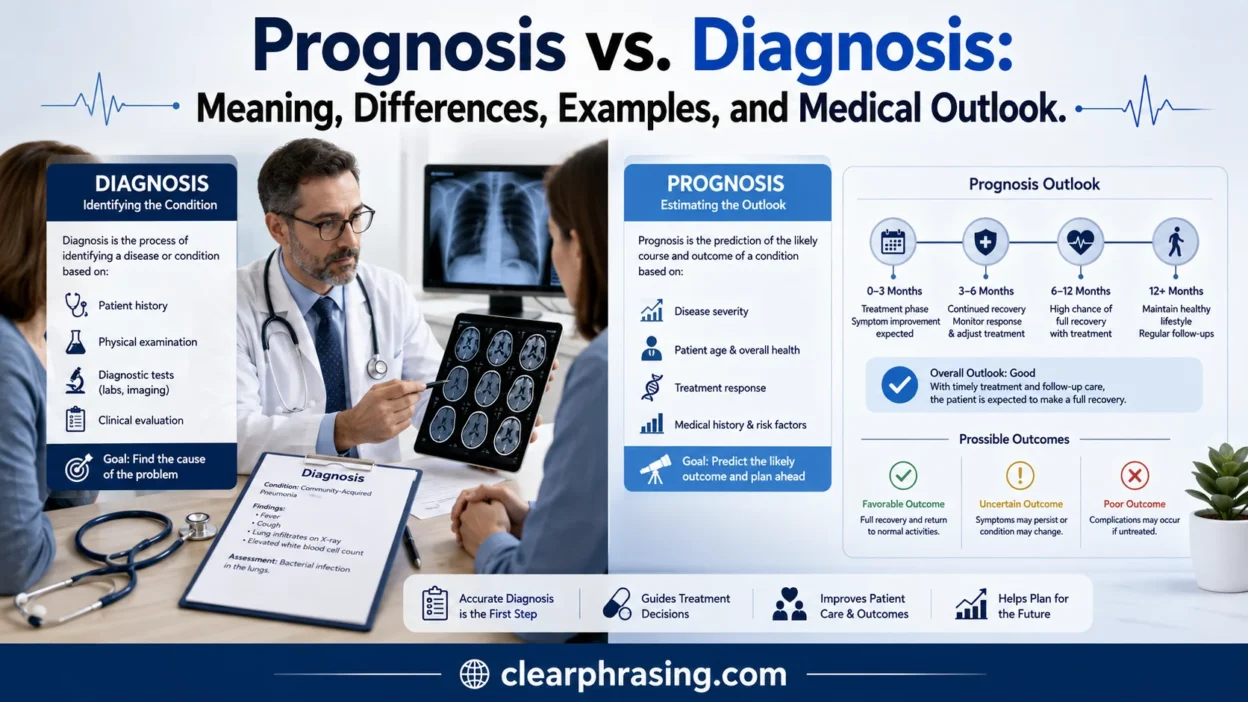
Prognosis vs. Diagnosis: Meaning, Differences & Usage explains two standard terms used in health and medicine.
A diagnosis identifies a condition or problem through examination, symptoms, and tests. A prognosis predicts the future course of an illness, including its probable result and possible recovery. These medical terms can cause confusion because they sound similar.
The difference matters in medical care. A medical practitioner may explain treatment, expectations, and future outcomes to a patient or caregiver. Understanding this distinction helps patients make informed decisions while healthcare professionals explain how a condition may change over time and what the future might hold.
Quick Answer:
The simplest way to understand prognosis vs. diagnosis is this:
| Term | Meaning | Main Question |
| Diagnosis | Identifies a disease or medical condition | What is wrong? |
| Prognosis | Estimates the likely course or outcome | What is likely to happen? |
| The difference becomes even clearer with serious or long-term conditions. A diagnosis might identify cancer, while the prognosis considers factors such as cancer type, stage, grade, overall health, and response to treatment. | ||
| Most importantly, a prognosis is an estimate rather than a guarantee. Even when doctors have strong evidence, individual outcomes can vary. |
What Is a Diagnosis?
A diagnosis is the identification of a disease, condition, or injury based on available medical evidence. Doctors don’t normally arrive at a diagnosis by looking at one symptom in isolation. They gather information and determine which condition best explains the findings.
The diagnostic process can involve several steps depending on the suspected condition.
How Doctors Make a Medical Diagnosis
Depending on the condition, a diagnostic evaluation may include:
- Medical history: Previous illnesses, medications, family history, and relevant health information.
- Symptoms: What the patient feels or notices.
- Physical examination: What the clinician can observe or detect.
- Laboratory tests: Blood, urine, tissue, or other samples.
- Imaging: X-rays, ultrasound, CT scans, MRI scans, or other imaging methods.
- Biopsy: Removing and examining tissue when necessary.
- Specialized testing: Additional tests designed for a particular disease or suspected condition.
No single diagnostic method works for every disease. A doctor may combine several sources of evidence before reaching a conclusion.
For instance, chest discomfort could have many possible causes. A physician might consider the patient’s history, examine the patient, order blood tests, and use imaging or other investigations. The goal isn’t simply to name a disease. It’s to identify the most accurate explanation supported by the evidence.
Diagnosis Examples
Here are several straightforward examples:
- “The patient has pneumonia.” → Diagnosis
- “The patient has type 2 diabetes.” → Diagnosis
- “The scan and biopsy confirmed breast cancer.” → Diagnosis
- “The patient has a fractured wrist.” → Diagnosis
These statements all identify what condition is present.
What a Diagnosis Doesn’t Automatically Tell You
A diagnosis doesn’t necessarily tell you:
- How severe the condition will become
- How quickly it will progress
- How well treatment will work
- Whether complications will develop
- How long recovery might take
- Whether the condition will return
Those questions move into the territory of prognosis.
What Is a Prognosis?
A prognosis is an estimate of the likely course or outcome of a disease or medical condition.
The word often appears in discussions about recovery, disease progression, complications, recurrence, survival, or long-term health. Its exact meaning depends on the condition being discussed.
If diagnosis answers “What do I have?”, prognosis moves toward “What can I reasonably expect?”
What Factors Affect Prognosis?
A prognosis can depend on many variables, including:
- Type of disease
- Severity of the condition
- Stage of disease
- Grade of disease where relevant
- Location and extent of the disease
- Age
- Overall health
- Other medical conditions
- Response to treatment
- Disease progression or recurrence
- Relevant biological or genetic characteristics
This explains why two people with the same diagnosis can have different prognoses.
Prognosis Is Not a Guaranteed Prediction
A prognosis isn’t a crystal ball. Doctors use medical evidence, statistics, experience, and individual patient information to estimate what may happen. However, no estimate can account perfectly for every biological difference between people.
For example, research may show that many patients with a particular disease respond well to a treatment. That information can help inform prognosis. It doesn’t guarantee that every individual will respond in exactly the same way.
That’s why doctors may use careful phrases such as:
- Favorable prognosis
- Good prognosis
- Guarded prognosis
- Poor prognosis
These phrases communicate an expected outlook without pretending that the future is completely certain.
Key Differences
The distinction becomes easier when the two terms sit side by side.
| Feature | Diagnosis | Prognosis |
| Purpose | Identifies the condition | Estimates the likely outcome |
| Main question | What is wrong? | What may happen? |
| Focus | Present condition | Future course |
| Evidence | Symptoms, history, examination, tests | Diagnosis plus disease and patient factors |
| Certainty | Can become highly established through evidence | Always contains some uncertainty |
| Examples | Pneumonia, diabetes, fracture | Expected recovery, progression, recurrence |
| Can change? | Yes, when new evidence changes the assessment | Yes, as the disease or treatment response changes |
| The central difference is simple: Diagnosis identifies the condition. Prognosis estimates its likely course. |
A Real-World Medical Example
Consider a patient who visits a doctor because of persistent symptoms.
After an examination and appropriate testing, doctors identify a particular disease. That’s the diagnosis.
The medical team then considers factors that may influence the patient’s future. Depending on the disease, these might include severity, stage, overall health, and treatment response. Those factors contribute to the prognosis.
Case Study: Cancer Diagnosis and Prognosis
Imagine a patient receives a biopsy after an abnormal imaging result.
The biopsy identifies a specific type of cancer. That finding establishes the diagnosis.
Doctors then evaluate additional information, such as:
- The type of cancer
- Its stage
- Its grade
- Whether it has spread
- Relevant biological characteristics
- The patient’s overall health
- How the cancer responds to treatment
That information helps doctors discuss the patient’s prognosis.
The distinction is straightforward:
Diagnosis: “This is the disease.”
Prognosis: “Given what we know about this disease and this patient, this is the likely outlook.”
How Diagnosis and Prognosis Work Together
Diagnosis and prognosis aren’t competing concepts. They work together.
A simplified medical reasoning process looks like this:
Symptoms → Medical evaluation → Testing → Diagnosis → Additional assessment → Prognosis → Treatment and monitoring
The diagnosis establishes what clinicians are dealing with. Prognosis then helps frame expectations about the future.
Diagnosis Provides the Starting Point
Doctors generally need to understand the condition before they can meaningfully discuss its expected course.
For example, saying someone has “a serious condition” isn’t enough to create a useful prognosis. Doctors need to know what the condition actually is and how it behaves.
Prognosis Adds a Future Perspective
Once clinicians understand the disease, they can consider what typically happens and how the individual’s circumstances might alter that expectation.
This becomes especially important when several possible outcomes exist.
Prognosis Can Support Treatment Discussions
Prognostic information can help patients and doctors discuss treatment choices, expectations, and future planning. However, prognosis doesn’t automatically dictate treatment. Decisions depend on the disease, available options, risks, benefits, patient preferences, and other clinical considerations.
Diagnosis vs. Prognosis vs. Treatment
A third term often gets mixed into this discussion: treatment.
These three concepts answer different questions.
| Term | Question It Answers |
| Diagnosis | What condition is present? |
| Prognosis | What is the likely course or outcome? |
| Treatment | What can be done to manage the condition? |
| Consider a simple example involving pneumonia: |
Diagnosis: The patient has pneumonia.- Prognosis: The patient is expected to recover with appropriate care.
- Treatment: The healthcare team provides appropriate treatment and follow-up.
These statements aren’t interchangeable.
A diagnosis names the problem. Prognosis describes the expected road ahead. Treatment concerns the actions taken to manage that problem.
What Does “Good Prognosis” Mean?
When a doctor says someone has a good prognosis, it generally means the expected outlook is favorable.
However, “good” doesn’t always mean exactly the same thing.
Depending on the disease, it could refer to:
- High likelihood of recovery
- Good disease control
- Lower risk of serious complications
- Longer expected survival
- Better expected quality of life
- Favorable response to treatment
A good prognosis still isn’t a promise. Medical outcomes involve uncertainty. Even a generally favorable condition can behave unexpectedly in an individual patient.
What Does “Poor Prognosis” Mean?
A poor prognosis means the expected outlook is less favorable.
That doesn’t automatically mean:
- Treatment cannot help
- Recovery is impossible
- The person will immediately become worse
- No treatment options exist
The phrase describes an expected outcome based on available information. It doesn’t eliminate uncertainty or determine an individual’s exact future.
Context matters. A doctor may describe a prognosis as poor because a disease is advanced, difficult to treat, highly aggressive, or associated with significant complications.
What Does “Guarded Prognosis” Mean?
A guarded prognosis generally indicates that the outcome remains uncertain.
Doctors may use this language when several factors make the future difficult to predict. The disease may be severe, available information may be limited, or the patient’s response to treatment may still be unclear.
A guarded prognosis shouldn’t automatically be interpreted as “the outcome will be bad.” Instead, it signals that uncertainty remains significant.
Why Can Two People With the Same Diagnosis Have Different Prognoses?
A diagnosis identifies the condition. It doesn’t make every patient identical.
Two people can receive the same diagnosis yet have different:
- Ages
- Overall health
- Disease severity
- Disease stages
- Treatment responses
- Other medical conditions
- Biological characteristics
- Risk factors
- Treatment options
Imagine two patients diagnosed with the same disease. One has an early-stage condition and responds strongly to treatment. The other has advanced disease with complications.
The diagnosis may be identical. The prognosis may not be.
That’s one of the most important ideas to understand about prognosis and diagnosis.
When Can a Prognosis Change?
A prognosis isn’t necessarily permanent.
Doctors may reassess the outlook when new information becomes available.
A prognosis can change because of:
- New test results
- A revised diagnosis
- Disease progression
- Treatment success
- Poor treatment response
- Recurrence
- New complications
- Changes in overall health
- New treatment options
For example, a patient may initially receive a cautious prognosis because doctors don’t yet know how the disease will respond to treatment. If treatment works better than expected, the outlook may improve.
The reverse can happen too. That’s why prognosis should be understood as an evidence-based assessment at a particular point in time, not an unchangeable verdict.
Common Misunderstandings About Prognosis vs. Diagnosis
“A diagnosis tells me what will happen.”
Not necessarily. A diagnosis identifies the condition. It doesn’t automatically predict its future course.
“A prognosis is a definite prediction.”
No. Prognosis involves uncertainty. It’s an informed estimate based on available evidence.
“A good prognosis guarantees recovery.”
It doesn’t. A favorable prognosis means the expected outlook is good. Individual outcomes can still differ.
“A poor prognosis means treatment won’t work.”
Not automatically. A poor prognosis describes a less favorable expected outcome. Treatment may still offer benefits.
“Diagnosis and prognosis mean the same thing.”
They don’t. Diagnosis identifies the condition. Prognosis estimates its likely course.
“Medical statistics tell me exactly what will happen.”
Statistics generally describe groups of patients. They can inform an individual’s prognosis, but they can’t predict every individual’s outcome with certainty.
Prognosis vs. Diagnosis in Medical Reports
You may encounter these terms in medical records, reports, or conversations with healthcare professionals.
A diagnosis section may identify:
- The disease
- Clinical findings
- Test results
- Pathology findings
- Relevant classifications
A prognosis discussion may address: - Expected disease progression
- Recovery prospects
- Treatment response
- Recurrence risk
- Potential complications
- Long-term outlook
- Survival expectations when appropriate
Medical reports vary by specialty. A cancer report won’t necessarily use the same structure as a report about a fracture or infection.
Still, the underlying distinction remains consistent: Diagnosis describes what has been identified. Prognosis describes what may happen next.
Diagnosis and Prognosis: Understanding the Word Forms
These words can also cause confusion because their related forms aren’t identical.
| Word | Part of Speech | Meaning |
| Diagnosis | Noun | Identification of a condition |
| Diagnose | Verb | To identify a condition |
| Diagnostic | Adjective | Related to identifying a condition |
| Prognosis | Noun | Expected course or outcome |
| Prognostic | Adjective | Related to predicting an outcome |
| For example: |
“The doctor diagnosed the infection.”- “The test helped establish the diagnosis.”
- “The scan provided useful diagnostic information.”
- “The patient has a favorable prognosis.”
- “The test has important prognostic value.”
Prognosis or Prognoses?
Here’s another useful distinction:
- Prognosis = singular
- Prognoses = plural
For example:
“The patient’s prognosis is favorable.”
But:
“The study examined the prognoses of several patient groups.”
That plural form surprises many English learners because prognoses doesn’t look like the plural of an English word.
Prognosis vs. Prediction: Are They the Same?
Not quite.
Prediction is a broad word that means an expectation about something that may happen.
Prognosis has a more specific medical meaning when discussing the expected course or outcome of a disease.
| Word | Meaning |
| Prediction | A general expectation about a future event |
| Prognosis | A medical estimate of the likely course or outcome |
| You might make a prediction about tomorrow’s weather. A doctor might discuss a prognosis for a patient’s medical condition. | |
| The ideas overlap because both involve the future. The context makes the distinction. |
Questions to Ask About Your Diagnosis and Prognosis
If you’re discussing a new medical condition with a healthcare professional, clear questions can help.
Questions About the Diagnosis
- What exactly is my diagnosis?
- What tests confirmed it?
- Are additional tests necessary?
- How certain is the diagnosis?
- How severe is the condition?
- Does the diagnosis need further classification?
Questions About the Prognosis
- What is the expected course of this condition?
- What factors affect my prognosis?
- What outcomes are most likely?
- How could treatment affect the outlook?
- What signs would suggest improvement?
- What changes could make the prognosis worse or better?
- How might my prognosis change over time?
Patients also differ in how much prognostic information they want. Some people want detailed statistics, while others prefer a broader explanation. Asking for the level of detail you find useful can make the conversation more productive.
Examples at a Glance
| Medical Situation | Diagnosis | Prognosis |
| Pneumonia | The patient has pneumonia | Expected recovery may be favorable with appropriate care |
| Broken wrist | The patient has a wrist fracture | The fracture is expected to heal with appropriate management |
| Cancer | Testing identifies a specific cancer | Outlook depends on factors such as type, stage, grade, and treatment response |
| Chronic disease | A specific long-term condition is identified | Outlook concerns likely disease control, progression, or complications |
| Infection | Testing identifies the infection | Prognosis considers expected response and possible complications |
| These examples are simplified. Actual medical decisions require an individual’s clinical information. |
A Simple Way to Remember Prognosis vs. Diagnosis
If medical terminology starts sounding confusing, use this shortcut:
Diagnosis = Identify
Prognosis = Outlook
Or remember two questions:
Diagnosis: “What do I have?”
Prognosis: “What might happen?”
That distinction works across many medical situations. A doctor first needs to understand the condition. Then, using the available evidence and relevant patient factors, the doctor can discuss the likely course.
Read More: Assistant Professor vs. Associate Professor: Difference
FAQs
What is the difference between diagnosis and prognosis?
A diagnosis identifies a disease, illness, or health condition based on symptoms, examinations, medical history, and tests. It tells you what condition a person has or what may be causing their symptoms.
A prognosis looks ahead. It describes the expected course, possible recovery, complications, or likely outcome of that condition. Simply put, diagnosis explains what is happening, while prognosis explains what may happen next.
Is a prognosis given after a diagnosis?
Usually, yes. Healthcare professionals generally need to understand a patient’s condition before they can estimate how it may progress. The diagnosis provides important information for making that assessment.
However, a prognosis isn’t always certain. A person’s age, overall health, response to treatment, severity of the illness, and other factors can influence the expected outcome.
Can a diagnosis change over time?
Yes, a diagnosis can change when new information becomes available. Additional tests, changing symptoms, or a patient’s response to treatment may give healthcare professionals a clearer picture of the condition.
That’s why an initial diagnosis isn’t necessarily the final answer. Medical professionals may reassess the situation as the patient’s health develops.
Can a prognosis change after treatment begins?
Yes, a prognosis can change. Treatment may work better or worse than expected, which can affect the expected course of an illness.
New symptoms, complications, test results, or improvements can also change the outlook. Therefore, a prognosis should generally be viewed as an informed medical estimate rather than a guaranteed prediction.
Does a serious diagnosis always mean a poor prognosis?
No. A serious diagnosis doesn’t automatically mean that the expected outcome will be poor. Many factors affect prognosis, including available treatments and how early the condition receives appropriate care.
Two people with the same diagnosis can also have different prognoses. Their overall health, treatment response, and individual circumstances may lead to different outcomes.
Who determines a patient’s prognosis?
A qualified healthcare professional typically assesses the prognosis using the patient’s diagnosis, medical history, test results, treatment options, and overall health.
Depending on the condition, several medical professionals may contribute to the assessment. They can explain what the available evidence suggests and discuss possible outcomes with the patient.
Why is understanding diagnosis and prognosis important?
Understanding these terms can make medical conversations much easier. When you know that diagnosis concerns the condition itself and prognosis concerns its expected course, confusing medical discussions become clearer.
This knowledge can also help patients ask better questions. You can discuss treatment options, expected recovery, possible complications, and other concerns more confidently with your healthcare professional.
Is prognosis the same as a prediction?
A prognosis is a type of medical prediction, but it isn’t a guarantee. Healthcare professionals use available evidence and clinical knowledge to estimate what might happen.
Because every patient responds differently, the actual outcome can differ from the initial prognosis. Think of it as a medically informed outlook rather than a fixed future.
What information helps doctors determine a prognosis?
Doctors may consider the diagnosis, severity of the condition, symptoms, test results, medical history, age, overall health, and response to treatment. The nature of the illness also matters.
Some conditions have a well-established expected course, while others can vary considerably. That’s why healthcare professionals may update a prognosis as new information becomes available.
How can I remember the difference between diagnosis and prognosis?
A simple memory trick can help: diagnosis = identify, while prognosis = predict. Diagnosis focuses on understanding the condition you’re dealing with.
Prognosis shifts the focus toward the future. When you hear diagnosis, think “What is it?” When you hear prognosis, think “What is likely to happen?”
Conclusion
Understanding prognosis vs. diagnosis makes medical language less intimidating. Although both terms relate to a person’s health, they answer different questions. Diagnosis focuses on identifying a condition through symptoms, examinations, medical history, and tests. Prognosis considers the likely future course of that condition, including recovery, complications, and possible outcomes. Once you understand this distinction, conversations with healthcare professionals can become much easier to follow.
From my experience working with language and explaining confusing terms, I’ve found that simple comparisons often make technical ideas stick. You don’t need to memorize complicated medical definitions. Remember the basic difference: diagnosis tells you what the condition is, while prognosis tells you what may happen afterward. This small distinction can help you understand treatment discussions, set realistic expectations, and communicate more confidently about your health.

Shamsa Kanwal is an English specialist and content writer at ClearPhrasing.com, where she helps readers navigate the English language with confidence. She enjoys breaking down grammar rules, spelling differences, vocabulary, and everyday writing challenges into simple, practical lessons that anyone can understand.
Her writing is focused on making learning approachable rather than overwhelming. Whether she’s explaining commonly confused words, punctuation rules, or grammar concepts, Shamsa believes that clear explanations and real-life examples are the key to effective learning.
Every article she writes is carefully researched, fact-checked, and edited to ensure it is accurate, easy to read, and genuinely helpful. Her goal is to create trustworthy resources that enable students, professionals, writers, and English learners to improve their communication skills and write with greater clarity.
Through her work at ClearPhrasing.com, Shamsa is committed to making English learning simpler, more practical, and accessible for readers around the world.