Fahrenheit vs Celsius: Differences, and Conversion starts with understanding two temperature scales used worldwide.
The invention of these scales gave us a standard way to quantify how hot or cold something feels. Celsius is common across much of the world, while Fahrenheit remains widely used in the US and United States. Both support temperature measurement in daily life, science, and medicine. As an English teacher, I find everyday examples make the differences and conversion between these systems easier to understand.
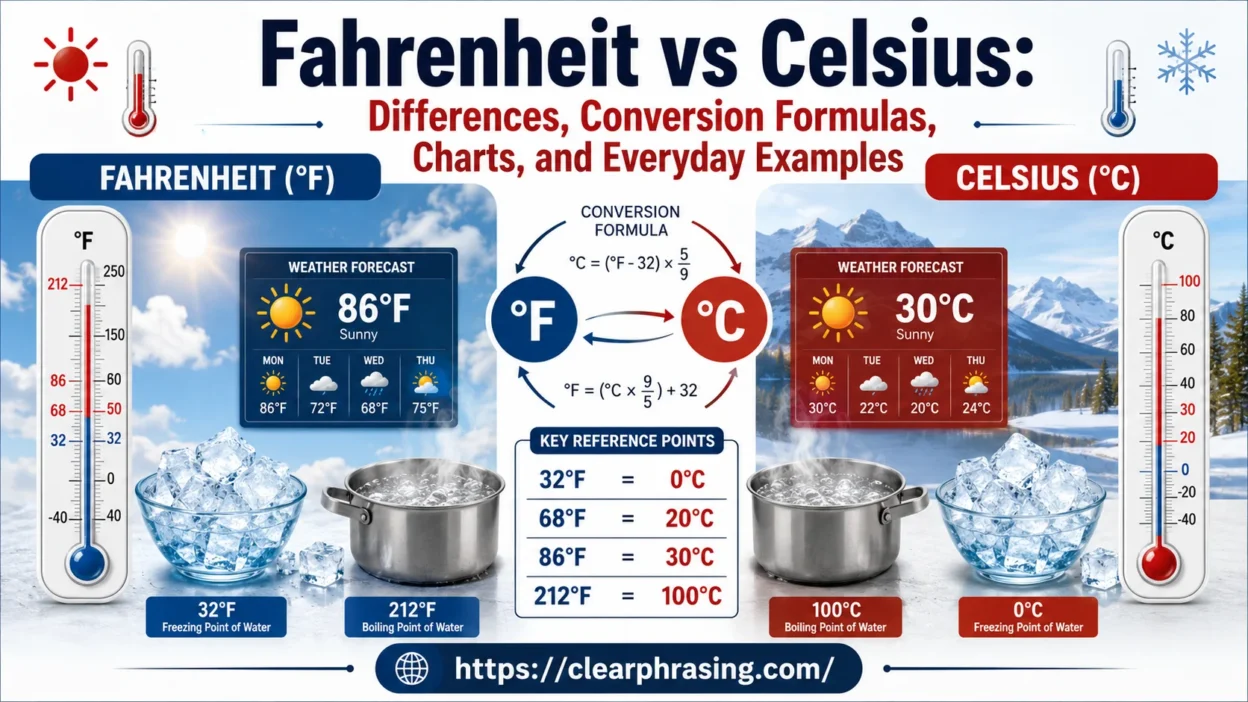
The difference is easy to see with water. Fahrenheit freezes at 32 degrees and boils at 212 degrees, while Celsius freezes at 0 degrees and boils at 100 degrees. These freezing and boiling points support scientific work and daily weather reports.
Your weather forecast may affect whether you carry an umbrella, while oven settings can change a dish. Understanding the correct scale is crucial when checking a thermostat, planning a trip overseas, or comparing temperatures by location and country.
Quick Answer:
Fahrenheit and Celsius are two different temperature scales used to express the same physical quantity. Celsius uses 0°C as the freezing point of water and 100°C as its boiling point under standard atmospheric conditions. Fahrenheit places those familiar points at 32°F and 212°F.
The exact conversion formulas are:
- Celsius to Fahrenheit: °F = (°C × 9/5) + 32
- Fahrenheit to Celsius: °C = (°F − 32) × 5/9
The two scales meet at −40 degrees, meaning −40°C = −40°F.
NIST provides these conversion equations as exact temperature conversions. It also notes that a temperature interval of 1°F equals 5/9 of a Celsius degree.
“The temperature interval of one kelvin equals exactly one degree Celsius.”
In simple terms, Fahrenheit and Celsius aren’t competing ways to measure different things. They’re two numerical languages for temperature.
What Is Celsius?
Celsius is a temperature scale widely used in science, weather reporting, education, cooking, and everyday life around much of the world.
The scale uses the symbol °C. Its familiar reference points are 0°C for water’s freezing point and 100°C for its boiling point under standard atmospheric pressure.
That 100-degree span gives Celsius a particularly intuitive structure. If you picture the interval between freezing and boiling as a ruler, Celsius divides that interval into 100 equal degrees.
However, temperature doesn’t stop at those reference points.
Water can exist below 0°C as ice. It can also exist above 100°C as liquid or vapor depending on pressure and conditions. The Celsius scale simply provides a numerical framework for describing those temperatures.
Common Celsius Temperatures
| Temperature | What it generally represents |
| −40°C | Extremely cold conditions |
| −20°C | Very cold weather |
| 0°C | Water’s freezing point under standard conditions |
| 10°C | Cool weather |
| 20°C | Mild, comfortable conditions |
| 25°C | Warm conditions |
| 30°C | Hot weather |
| 35°C | Very hot conditions |
| 40°C | Extremely hot weather |
| 100°C | Water’s boiling point under standard conditions |
These benchmarks make Celsius easier to interpret without calculating every value.
For example, if someone tells you it’s 30°C outside, you can immediately recognize that it’s hot. You don’t need to reach for a calculator.
What Is Fahrenheit?
Fahrenheit is another temperature scale. Its symbol is °F.
The scale is named after Daniel Gabriel Fahrenheit, whose work in temperature measurement helped establish the Fahrenheit system. Today, Fahrenheit remains especially familiar in everyday temperature reporting in the United States.
Its most recognizable reference points are:
- 32°F — water freezes under standard conditions
- 212°F — water boils under standard conditions
The difference between those points is 180°F.
That number is important because the Celsius scale divides the same freezing-to-boiling interval into 100 degrees. Fahrenheit divides it into 180 degrees.
As a result, Fahrenheit degrees are smaller than Celsius degrees.
Common Fahrenheit Temperatures
| Temperature | Approximate Celsius | Everyday description |
| −40°F | −40°C | Extremely cold |
| 0°F | −17.8°C | Very cold |
| 32°F | 0°C | Freezing point |
| 50°F | 10°C | Cool |
| 59°F | 15°C | Mild |
| 68°F | 20°C | Comfortable |
| 77°F | 25°C | Warm |
| 86°F | 30°C | Hot |
| 95°F | 35°C | Very hot |
| 104°F | 40°C | Extremely hot |
| 212°F | 100°C | Boiling point |
Fahrenheit vs Celsius: What Is the Difference?
The biggest difference between Fahrenheit and Celsius is how each scale assigns numerical values to temperature.
Both scales describe the same physical reality. The numbers simply use different starting points and different-sized intervals.
| Feature | Celsius | Fahrenheit |
| Symbol | °C | °F |
| Freezing point of water | 0°C | 32°F |
| Boiling point of water | 100°C | 212°F |
| Freezing-to-boiling interval | 100 degrees | 180 degrees |
| Size of one degree | Larger | Smaller |
| Common everyday use | Widely used internationally | Especially common in the U.S. |
| Scientific SI relationship | Degree Celsius is an SI-derived unit | Not an SI unit |
The numerical gap between the two scales isn’t random. It’s built into their mathematical relationship.
For every 1°C change in temperature, the corresponding Fahrenheit change is 1.8°F.
That’s why a temperature increase of 10°C represents an increase of 18°F.
NIST’s conversion tables confirm this 1.8-to-1 relationship between Fahrenheit and Celsius temperature intervals.
Quick Reference Table
| Question | Answer |
| What is 0°C in Fahrenheit? | 32°F |
| What is 100°C in Fahrenheit? | 212°F |
| What is 32°F in Celsius? | 0°C |
| What is 212°F in Celsius? | 100°C |
| What is 20°C in Fahrenheit? | 68°F |
| What is 30°C in Fahrenheit? | 86°F |
| What is 100°F in Celsius? | 37.8°C |
| What is 40°C in Fahrenheit? | 104°F |
| What temperature is equal on both scales? | −40° |
| How much is 1°C in Fahrenheit? | 1.8°F as a temperature interval |
| Celsius to Fahrenheit formula | (°C × 9/5) + 32 |
| Fahrenheit to Celsius formula | (°F − 32) × 5/9 |
Why Does Fahrenheit Have 32 Degrees at Freezing?
This question often makes Celsius users pause.
The answer lies in the different starting points used by the two scales.
Celsius assigns water’s freezing point a value of 0°C. Fahrenheit assigns that same point 32°F.
So when you convert Fahrenheit to Celsius, you first subtract 32. That removes the difference between the two scales’ zero points.
After that, you adjust for the different degree sizes.
Think of the two scales as two rulers. Both measure the same table. One ruler simply starts counting at a different point and uses different-sized markings.
That analogy explains why you can’t convert Fahrenheit to Celsius by simply subtracting 32.
Fahrenheit to Celsius Formula
The exact formula for converting Fahrenheit to Celsius is:
°C = (°F − 32) × 5/9
You can also write it as:
°C = (°F − 32) ÷ 1.8
Both versions produce the same result.
How to Convert Fahrenheit to Celsius
Follow these two steps:
- Subtract 32 from the Fahrenheit temperature.
- Multiply the result by 5/9.
Let’s walk through a few examples.
Example: Convert 68°F to Celsius
Start with:
68 − 32 = 36
Then:
36 × 5/9 = 20
Therefore:
68°F = 20°C
That’s a useful benchmark because 68°F often feels comfortable indoors.
Example: Convert 86°F to Celsius
Start with:
86 − 32 = 54
Then:
54 × 5/9 = 30
Therefore:
86°F = 30°C
So when a U.S. weather forecast says 86°F, a Celsius-based forecast would report 30°C.
Example: Convert 100°F to Celsius
Start with:
100 − 32 = 68
Then:
68 × 5/9 ≈ 37.8
Therefore:
100°F ≈ 37.8°C
This temperature is notably high for outdoor conditions.
Celsius to Fahrenheit Formula
The reverse conversion uses:
°F = (°C × 9/5) + 32
You can also use:
°F = (°C × 1.8) + 32
This time, multiply first. Then add 32.
Example: Convert 20°C to Fahrenheit
20 × 1.8 = 36
Then:
36 + 32 = 68
Therefore:
20°C = 68°F
Example: Convert 30°C to Fahrenheit
30 × 1.8 = 54
Then:
54 + 32 = 86
Therefore:
30°C = 86°F
Example: Convert 37°C to Fahrenheit
37 × 1.8 = 66.6
Then:
66.6 + 32 = 98.6
Therefore:
37°C = 98.6°F
This is why 98.6°F is commonly associated with a traditional reference value for human body temperature. Actual body temperature varies among individuals and circumstances.
NIST’s official conversion equations give the same mathematical relationship.
Fahrenheit vs Celsius Conversion Chart
A quick chart can be more useful than a formula when you need an answer immediately.
| Celsius | Fahrenheit | Practical reference |
| −40°C | −40°F | Same numerical value |
| −20°C | −4°F | Very cold |
| −10°C | 14°F | Freezing conditions |
| 0°C | 32°F | Water freezes |
| 5°C | 41°F | Chilly |
| 10°C | 50°F | Cool |
| 15°C | 59°F | Mild |
| 20°C | 68°F | Comfortable |
| 25°C | 77°F | Warm |
| 30°C | 86°F | Hot |
| 35°C | 95°F | Very hot |
| 40°C | 104°F | Extremely hot |
| 100°C | 212°F | Water boils |
This chart is particularly useful when reading weather reports or adjusting cooking temperatures.
Why Are Fahrenheit Degrees Smaller Than Celsius Degrees?
The difference becomes obvious when you compare the freezing and boiling points of water.
Celsius:
100°C − 0°C = 100 degrees
Fahrenheit:
212°F − 32°F = 180 degrees
Both scales describe the same temperature interval. Fahrenheit simply divides that interval into more units.
Therefore:
180 ÷ 100 = 1.8
That gives us the key relationship:
1°C = 1.8°F of temperature difference
The reverse relationship is:
1°F = 5/9°C of temperature difference
This distinction matters when discussing temperature changes rather than temperature readings.
For example, suppose a room warms from 20°C to 25°C.
That’s a 5°C increase.
In Fahrenheit, the same increase equals:
5 × 1.8 = 9°F
The room hasn’t become nine times hotter. The Fahrenheit scale simply uses smaller degree intervals.
What Temperature Is the Same in Fahrenheit and Celsius?
Here’s one of the best facts to remember:
−40°C = −40°F
It’s the only temperature where the numerical values match.
You can prove it with the Celsius-to-Fahrenheit formula:
1.°F = (−40 × 1.8) + 32
2.°F = −72 + 32
3.°F = −40
So:
−40°C = −40°F
It’s a handy conversion landmark. If you ever see −40°, you don’t need to ask which scale the speaker means.
The number works for both.
Fahrenheit vs Celsius for Weather
Weather forecasts are where most people encounter the two scales.
Someone accustomed to Celsius might see 30°C and immediately think, “That’s hot.”
Someone accustomed to Fahrenheit might see 86°F and reach exactly the same conclusion.
The numbers look unrelated. The weather isn’t.
Useful Weather Benchmarks
- 0°C = 32°F: freezing
- 10°C = 50°F: cool
- 15°C = 59°F: mild
- 20°C = 68°F: comfortable
- 25°C = 77°F: warm
- 30°C = 86°F: hot
- 35°C = 95°F: very hot
- 40°C = 104°F: extremely hot
These reference points help you develop temperature intuition.
Once you’ve memorized a few benchmarks, you can estimate unfamiliar temperatures without doing formal calculations.
A Quick Mental Trick for Fahrenheit to Celsius
You don’t always need the exact equation.
For a rough estimate, try this shortcut:
Subtract 30 from Fahrenheit, then divide by 2.
For example:
86°F
Subtract 30:
86 − 30 = 56
Divide by 2:
56 ÷ 2 = 28°C
The exact answer is 30°C.
So the shortcut isn’t mathematically exact. It’s simply a quick mental estimate.
For everyday conversations, that may be close enough.
When accuracy matters, use the official formula instead.
A Quick Mental Trick for Celsius to Fahrenheit
You can reverse the rough shortcut:
Multiply Celsius by 2, then add 30.
For example:
30°C × 2 = 60
Then:
60 + 30 = 90°F
The exact answer is 86°F.
Again, this method gives you an estimate rather than an exact conversion.
For cooking instructions, scientific calculations, medical information, or technical work, don’t rely on the shortcut.
Fahrenheit vs Celsius in Cooking
Temperature conversion becomes especially important in the kitchen.
A recipe from the United States might tell you to preheat an oven to 350°F. A recipe from a country using Celsius may give the oven temperature in degrees Celsius.
You shouldn’t assume that simply changing the number by 32 will work.
The scales have different intervals. That’s why the full conversion formula matters.
For example:
350°F = (350 − 32) × 5/9
350°F ≈ 176.7°C
In practical cooking, however, recipes and oven settings often use rounded temperatures. A cook may see a converted value around 175°C rather than the mathematically precise 176.7°C.
That distinction is useful. Mathematical conversion gives precision. Cooking instructions often prioritize practical oven settings.
Fahrenheit vs Celsius in Science
Celsius is closely connected to the international measurement system used throughout science.
The kelvin (K) is the SI base unit for thermodynamic temperature. The degree Celsius has the same size as a kelvin interval. NIST explains that a Celsius temperature relates to thermodynamic temperature through the 273.15 offset.
The relationship is:
K = °C + 273.15
For example:
25°C = 298.15 K
This doesn’t make Celsius obsolete. Instead, Celsius remains extremely useful for everyday temperature readings while Kelvin plays a central role in scientific work involving thermodynamic temperature.
Temperature Differences
Here’s a subtle point that often causes mistakes.
A temperature reading and a temperature difference aren’t the same mathematical operation.
Suppose water warms from 10°C to 20°C.
The temperature increases by:
10°C
The equivalent Fahrenheit increase is:
10 × 1.8 = 18°F
So the increase is 18°F.
However, 10°C as an actual temperature converts to 50°F.
That’s why the conversion formula for a temperature reading includes the 32-degree offset. A temperature difference doesn’t need that offset.
| Measurement | Result |
| 10°C as a temperature | 50°F |
| 10°C increase | 18°F increase |
| 20°C as a temperature | 68°F |
| 20°C increase | 36°F increase |
This distinction becomes important in science, engineering, weather analysis, and thermal calculations.
Does Celsius Measure Temperature More Accurately Than Fahrenheit?
No.
Neither scale is inherently more accurate.
Accuracy depends on the thermometer, calibration, measurement method, environmental conditions, and required precision.
A properly calibrated thermometer can provide a highly accurate reading in either Celsius or Fahrenheit.
The scales simply express that reading differently.
For example, the same physical temperature could appear as:
20°C
or:
68°F
Neither number is more “real.” They’re equivalent descriptions of the same temperature.
Is Fahrenheit or Celsius Better?
There isn’t a universal winner.
The better scale depends on what you’re doing.
Celsius may be more convenient when:
- You’re working with international scientific information.
- You’re traveling in countries that use Celsius.
- You’re reading metric-based technical material.
- You’re comparing temperatures using common 0°C and 100°C benchmarks.
- You’re studying chemistry, physics, or environmental science.
Fahrenheit may be more convenient when:
- You’re reading U.S. weather forecasts.
- You’re following a recipe written in Fahrenheit.
- You’re communicating with people who commonly use Fahrenheit.
- You’re working with equipment calibrated in Fahrenheit.
The important skill isn’t choosing a winner. It’s being able to move between the two without confusion.
Fahrenheit vs Celsius: Practical Case Study
Imagine you’re traveling from a country where weather forecasts use Celsius to the United States.
Your phone shows:
Today’s high: 86°F
At first glance, that number might seem unfamiliar.
Use a quick conversion:
(86 − 32) × 5/9 = 30°C
Now the forecast makes sense.
A 30°C day is hot. You’d probably choose lightweight clothing, drink enough water, and plan outdoor activities accordingly.
The same approach works in reverse.
Suppose you’re used to Fahrenheit and see a forecast of 35°C.
Convert it:
(35 × 1.8) + 32 = 95°F
Suddenly, the number has context.
That’s the real value of understanding Fahrenheit vs Celsius. You’re not merely converting numbers. You’re translating temperature into something meaningful.
Common Fahrenheit and Celsius Conversion Mistakes
Adding 32 without changing the scale
This is probably the most common mistake.
20°C + 32 = 52°F is incorrect.
The correct calculation is:
(20 × 1.8) + 32 = 68°F
Subtracting 32 but forgetting 5/9
This mistake also produces the wrong answer.
68°F − 32 = 36
But 36 isn’t the Celsius temperature.
You still need to multiply by 5/9:
36 × 5/9 = 20°C
Using the wrong formula direction
Remember:
Celsius → Fahrenheit: multiply by 1.8, then add 32.
Fahrenheit → Celsius: subtract 32, then multiply by 5/9.
The order matters.
Confusing degrees with temperature intervals
A 1°C temperature increase equals a 1.8°F increase.
However, 1°C as a temperature reading isn’t 1.8°F.
The zero-point difference changes the calculation.
Fahrenheit vs Celsius vs Kelvin
Celsius and Fahrenheit aren’t the only temperature scales you’ll encounter.
Kelvin is especially important in science.
| Scale | Symbol | Common role |
| Celsius | °C | Everyday and scientific temperature |
| Fahrenheit | °F | Everyday temperature, especially in the U.S. |
| Kelvin | K | Thermodynamic and scientific temperature |
Kelvin begins at absolute zero, the theoretical lower limit of thermodynamic temperature.
Absolute zero equals:
0 K = −273.15°C = −459.67°F
NIST identifies absolute zero as −273.15°C or −459.67°F.
Unlike Celsius and Fahrenheit, Kelvin doesn’t use the degree symbol. You write 300 K, not 300°K.
Read More: Can vs. Could: Difference, Rules, Uses, and Examples
FAQs
What is the main difference between Fahrenheit and Celsius?
The biggest difference is how each temperature scale measures heat and cold. Fahrenheit is mainly used in the United States, while Celsius is the standard in most other countries.
For example, water freezes at 32°F and boils at 212°F. In Celsius, the same points are 0°C and 100°C, making Celsius easier to use in many scientific calculations.
Which is colder, 0 degrees Celsius or 32 degrees Fahrenheit?
They’re actually the same temperature. 0°C equals 32°F, so neither one is colder.
This can feel confusing when you first switch between the two scales. Once you remember this matching point, comparing everyday temperatures becomes much easier.
Why does Fahrenheit freeze at 32 degrees?
The Fahrenheit scale uses 32°F as the freezing point of water under standard conditions. Its historical development used reference points that differ from the Celsius system.
That’s why Fahrenheit temperatures can seem unusual if you’re more familiar with Celsius. A temperature of 32°F simply means water reaches its freezing point.
Why does Celsius use 0 and 100 degrees?
The Celsius scale places water’s freezing point at 0°C and its boiling point at 100°C under standard atmospheric pressure.
This 100-degree difference gives Celsius a straightforward structure. It also makes the scale especially useful in science, education, weather reporting, and everyday temperature measurement.
How do you convert Celsius to Fahrenheit?
To convert Celsius to Fahrenheit, multiply the Celsius temperature by 9/5 and then add 32. The formula is °F = (°C × 9/5) + 32.
For instance, 20°C becomes 68°F. Once you practice a few examples, the conversion starts to feel less like math homework and more like a useful shortcut.
How do you convert Fahrenheit to Celsius?
To convert Fahrenheit to Celsius, subtract 32 from the Fahrenheit temperature and multiply the result by 5/9. The formula is °C = (°F − 32) × 5/9.
For example, 68°F equals 20°C. This conversion helps when you’re reading weather forecasts, traveling overseas, or working with information from countries that use different temperature systems.
Which countries use Fahrenheit?
The United States is the most prominent country that uses Fahrenheit for everyday temperatures. Celsius dominates weather reporting and general temperature measurement across most of the world.
You may still encounter Fahrenheit in some other places or specific contexts. However, if you travel internationally, Celsius is the scale you’ll encounter most often.
Which temperature scale is better, Fahrenheit or Celsius?
Neither scale is universally “better.” Each works well within the system where people commonly use it. Fahrenheit remains practical for everyday life in the United States, while Celsius has become the international standard for most scientific and everyday applications.
As an English teacher, I’ve noticed that the real challenge isn’t the scales themselves. It’s recognizing which scale you’re reading before you interpret the number.
Why is knowing Fahrenheit and Celsius important?
Knowing both scales can prevent simple misunderstandings. A weather forecast, thermostat, oven, or travel website might display temperatures differently depending on the country or device.
Understanding the difference and conversion helps you make better decisions. Whether you’re checking tomorrow’s weather or adjusting an oven temperature, knowing what the number means saves you from an unpleasant surprise.
What is the easiest way to remember Fahrenheit and Celsius?
Start with two important matching points: 0°C = 32°F and 100°C = 212°F. These give you the freezing and boiling points of water and provide useful reference points.
With regular practice, you’ll quickly recognize common temperatures. Think of it as learning two measuring tapes for the same thing: the numbers differ, but the temperature itself doesn’t.
Conclusion
Understanding Fahrenheit and Celsius doesn’t have to be complicated. The two systems simply measure the same thing—temperature—using different scales. Celsius places water’s freezing and boiling points at 0°C and 100°C, while Fahrenheit places them at 32°F and 212°F. Once these reference points become familiar, everyday comparisons become much easier. You can read a weather forecast, adjust your thermostat, understand an oven setting, or prepare for an overseas trip without wondering what the numbers actually mean.
The key is knowing when to use each scale and how to convert between them. Celsius dominates most of the world and scientific settings, while Fahrenheit remains deeply familiar in the United States. You don’t need to memorize dozens of temperatures. Learn the basic reference points, practice the two conversion formulas, and pay attention to the symbol beside the number. That small habit can save you plenty of confusion.

Shamsa Kanwal is an English specialist and content writer at ClearPhrasing.com, where she helps readers navigate the English language with confidence. She enjoys breaking down grammar rules, spelling differences, vocabulary, and everyday writing challenges into simple, practical lessons that anyone can understand.
Her writing is focused on making learning approachable rather than overwhelming. Whether she’s explaining commonly confused words, punctuation rules, or grammar concepts, Shamsa believes that clear explanations and real-life examples are the key to effective learning.
Every article she writes is carefully researched, fact-checked, and edited to ensure it is accurate, easy to read, and genuinely helpful. Her goal is to create trustworthy resources that enable students, professionals, writers, and English learners to improve their communication skills and write with greater clarity.
Through her work at ClearPhrasing.com, Shamsa is committed to making English learning simpler, more practical, and accessible for readers around the world.