Wholistic vs. Holistic: Correct Spelling, Meaning, and Usage can feel confusing because both spellings appear in books, websites, and conversations.
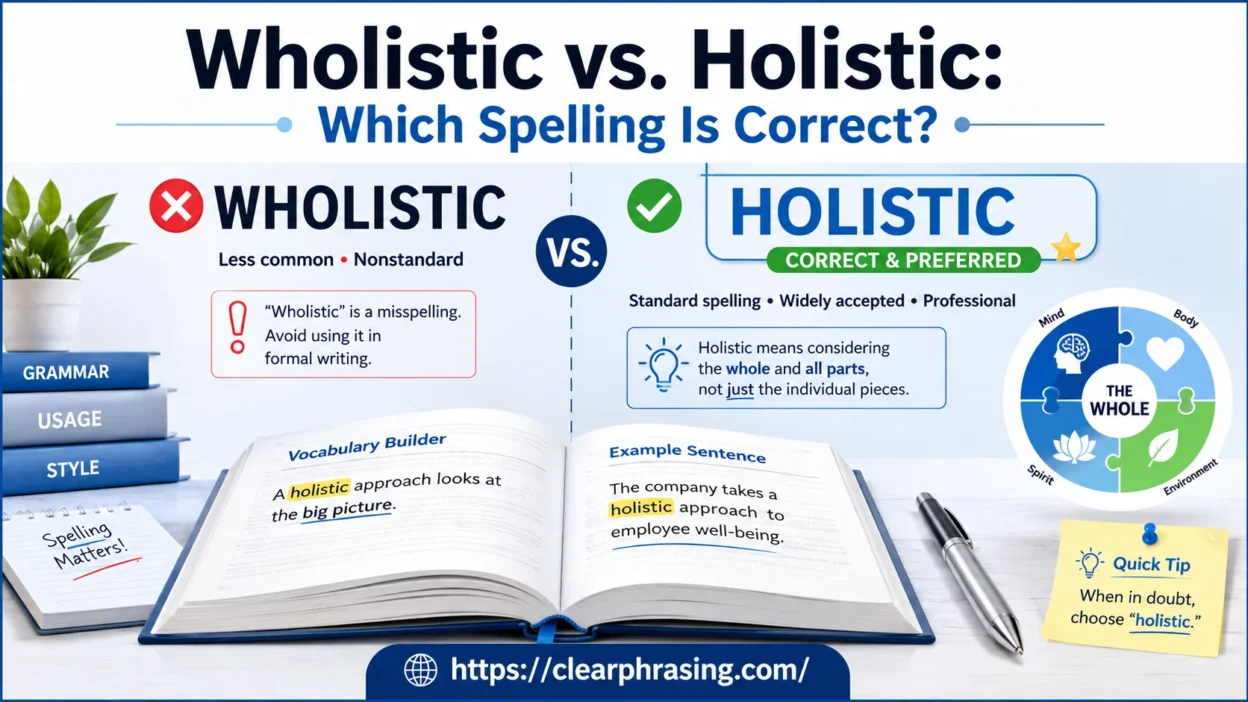
In modern English, holistic is the standard, preferred, and recommended choice. It’s widely used in professional writing, academic writing, medical writing, and business writing. Wholistic is a recognized variant spelling, but it remains less common. Both describe an approach that considers the whole, including its parts, mind, body, and social factors.
The origins also explain the difference. Wholistic appeared in 1941, while holistic was first seen in 1926. Holistic medicine appeared around 1960. Both terms can describe a philosophy of life, and their meanings are sometimes interchangeable.
However, holistic is used more often in modern language. In my experience as an English teacher, learners remember the correct form more easily when they connect holistic with health, education, and complete system thinking.
Quick Answer
Holistic is the standard and preferred spelling.
Wholistic is a recognized variant that means essentially the same thing, but it’s much less common and generally isn’t the best choice for formal writing.
| Word | Meaning | Usage | Best choice |
| Holistic | Considering a whole system, person, or situation | Standard and widely established | Yes |
| Wholistic | Same basic meaning as holistic | Less common variant | Usually avoid |
| Whole | Complete or entire | Ordinary adjective/noun | Depends on context |
| Holism | The idea that a whole can’t always be understood by examining parts separately | Specialized noun | Correct term |
A simple rule will save you from second-guessing yourself:
When you mean “considering the whole rather than separate parts,” use “holistic.”
If you encounter wholistic in someone else’s writing, though, don’t assume the writer has invented a word. It has a real history and appears in published English.
What Does Holistic Mean?
Holistic describes an approach that considers something as a complete system instead of focusing only on individual pieces.
Imagine looking at a puzzle. A narrow approach might examine one puzzle piece and describe its shape. A holistic approach looks at the entire picture and considers how that piece fits into it.
That distinction explains why holistic appears in so many different fields.
You’ll encounter the word in:
- Education
- Healthcare
- Business
- Psychology
- Environmental studies
- Project management
- Personal development
- Social sciences
- Systems thinking
- Organizational planning
For example:
- “The school takes a holistic approach to education.”
- “The company needs a holistic strategy for customer retention.”
- “The study examines the issue from a holistic perspective.”
- “The team developed a holistic solution to the problem.”
- “The program supports the student’s holistic development.”
In each sentence, the central idea remains the same: look at the larger picture rather than treating one element as if it exists alone.
Holistic Definition in Simple English
In simple terms, holistic means looking at the whole picture.
It often involves examining how different parts interact with one another.
For instance, suppose a company has declining sales. A narrow analysis might blame the sales team immediately. A holistic analysis would examine several connected factors:
- Product quality
- Pricing
- Customer expectations
- Marketing
- Competition
- Sales training
- Customer service
- Distribution
- Economic conditions
The goal isn’t simply to collect more information. It’s to understand how the different pieces work together.
What Does Wholistic Mean?
Wholistic carries essentially the same meaning as holistic.
The spelling probably feels natural because English already has the word whole. When people see whole, wholeness, and related words, adding a w to holistic can seem perfectly reasonable.
However, wholistic developed as an alternative form rather than becoming the dominant spelling.
That difference is important.
Calling wholistic nothing more than a spelling mistake misses part of the story. The form has appeared in actual English usage. It simply hasn’t become the preferred standard form.
Is Wholistic a Real Word?
Yes, wholistic is a real variant of holistic.
It isn’t the spelling you should normally choose for polished professional writing, but its existence is well established enough that completely dismissing it as nonsense would be inaccurate.
This creates an important distinction:
Recognized does not always mean preferred.
English has many words with alternative forms. One may be widely accepted while another remains uncommon or stylistically marked.
The same principle applies here.
Why Do People Spell Holistic as Wholistic?
The answer is largely visual and intuitive.
Consider these words:
- whole
- wholeness
- wholehearted
- wholesome
Now compare them with:
- holistic
- holism
The first group visibly connects to whole. The second group doesn’t look as obviously related.
As a result, wholistic seems to make immediate sense to many English speakers.
That doesn’t make it the standard spelling, though. English spelling follows history more often than pure logic.
What’s the Difference?
The most important point is that the meaning is nearly identical.
The main difference lies in spelling, frequency, and preferred usage.
Wholistic vs. Holistic Meaning
Both words describe an approach that considers something as a whole.
For example:
The organization takes a holistic approach to employee development.
The same sentence could appear with wholistic, and most readers would understand exactly what it means.
The difference isn’t like affect vs. effect, where changing the word can alter the grammatical function or meaning.
Instead, the distinction is closer to a standard form versus a less common variant.
Holistic Is the Safer Choice
When you’re unsure, choose holistic.
It works naturally in:
- Academic writing
- Professional reports
- Business communication
- Healthcare writing
- Educational content
- News writing
- General nonfiction
- Formal correspondence
- SEO content
- Workplace documents
If your goal is clarity and conventional usage, holistic wins easily.
Wholistic Has a Narrower Practical Role
There are situations where wholistic might remain appropriate.
For example, an organization may intentionally use Wholistic as part of its branding or name. In that case, changing the spelling could create a different proper name.
Likewise, if you’re quoting someone directly, you shouldn’t silently change their spelling.
Otherwise, holistic is usually the better choice.
Why Is Holistic Spelled Without a W?
This question gets to the heart of the confusion.
The word holistic didn’t develop simply by taking the English word whole and adding a suffix. Its history runs through the concept of holism.
The root traces back to the Greek holos, meaning whole or entire.
The term holism was developed in the twentieth century, particularly through the work of South African statesman and philosopher Jan Christian Smuts. His 1926 book Holism and Evolution helped establish the term in modern philosophical and scientific discussion.
From holism came holistic.
So the spelling makes more sense once you see the family tree:
Greek holos → holism → holistic
The English word whole has a different spelling history even though the meanings are closely related.
That’s why adding a w isn’t necessary.
The History Behind Wholistic vs. Holistic
The history also explains why holistic became the dominant form.
The Origin of Holism
The concept of holism emphasizes the importance of the whole.
It challenges the idea that you can always understand a complex system simply by breaking it into isolated components.
For example, a human body contains individual organs. Studying those organs separately can reveal valuable information. Yet understanding how the body functions requires attention to the relationships between those organs.
The same principle applies to many systems.
A business isn’t simply a collection of employees. A forest isn’t merely a collection of individual trees. A classroom isn’t merely a group of students.
Relationships matter.
The Development of Holistic
The adjective holistic emerged from the noun holism.
That gives holistic a direct linguistic connection to the established term holism rather than the spelling of the English word whole.
The later spelling wholistic reflects an understandable attempt to make that relationship visible.
In other words, people saw the meaning and adjusted the spelling.
Language does this all the time.
Why Wholistic Looks So Logical
There’s a funny little trap here.
If someone asked you to invent a word meaning “related to the whole,” you might reasonably write wholistic.
After all:
whole → wholistic
looks more obvious than:
whole → holistic
Yet word formation doesn’t always work from the spelling of the nearest English word.
That’s why holistic can look unusual while still being the standard form.
Holistic vs. Wholistic in Everyday Writing
You can use holistic in many situations without making your writing sound overly technical.
Holistic Approach
Holistic approach is one of the most common combinations.
Examples:
- “The teacher uses a holistic approach to student development.”
- “The company needs a holistic approach to customer experience.”
- “The project requires a holistic approach to risk management.”
The phrase works because it signals that multiple connected factors deserve consideration.
Holistic View
Holistic view emphasizes the broader picture.
“Before making a decision, the committee should take a holistic view of the situation.”
This phrase works especially well when individual details might otherwise distract from the overall issue.
Holistic Perspective
A holistic perspective means examining an issue within its wider context.
For example:
“A holistic perspective reveals how housing, transportation, and employment influence one another.”
Here, the word doesn’t simply mean “complete.” It highlights connections between parts of a larger system.
Holistic Solution
A holistic solution addresses a problem from several connected angles.
Suppose an office struggles with low productivity. Buying new software might solve one problem while ignoring workload, communication, training, and unclear responsibilities.
A holistic solution considers those factors together.
Holistic vs. Comprehensive: Are They the Same?
Not quite.
These two words overlap, but they emphasize different ideas.
Comprehensive generally means covering a broad range of things or including many important details.
Holistic emphasizes the whole and the relationships among its parts.
Consider these examples:
“The researcher prepared a comprehensive report.”
This suggests that the report covers the subject thoroughly.
Now compare:
“The researcher prepared a holistic report.”
This suggests that the report considers the subject as an interconnected whole.
The distinction is subtle but useful.
| Word | Main emphasis |
| Holistic | The whole and relationships among its parts |
| Comprehensive | Broad coverage and completeness |
| Complete | Nothing important is missing |
| Integrated | Different parts work together |
| Broad | Covers a wide range |
| Overall | Considers the general picture |
So don’t automatically replace holistic with comprehensive. The best word depends on what you want to emphasize.
Examples
Seeing the two forms side by side makes the difference easier to remember.
| Standard form | Variant form |
| She takes a holistic approach to education. | She takes a wholistic approach to education. |
| We need a holistic view of the problem. | We need a wholistic view of the problem. |
| The program supports holistic development. | The program supports wholistic development. |
| The company adopted a holistic strategy. | The company adopted a wholistic strategy. |
| They developed a holistic solution. | They developed a wholistic solution. |
The sentences on the right aren’t suddenly incomprehensible.
However, the sentences on the left use the preferred standard spelling.
Correcting a Common Writing Mistake
Consider this sentence:
“The university follows a wholistic approach to education.”
A polished version would normally be:
“The university follows a holistic approach to education.”
The meaning hasn’t changed. Only the preferred spelling has.
That makes this a particularly easy correction to remember.
Holistic vs. Wholistic in Formal Writing
When your audience expects polished standard English, holistic is the safer choice.
Academic Writing
Use holistic in:
- Research papers
- Essays
- Theses
- Academic reports
- Literature reviews
- Educational materials
For example:
“The study adopts a holistic framework for evaluating student outcomes.”
The conventional spelling keeps the sentence clean and familiar.
Business Writing
Business professionals frequently discuss holistic strategies, holistic planning, and holistic customer experiences.
For example:
“The company needs a holistic strategy that connects marketing, sales, and customer support.”
The word works particularly well when several departments or processes influence the same outcome.
Healthcare Writing
You’ll also encounter expressions such as:
- Holistic health
- Holistic care
- Holistic approach
- Holistic treatment
- Holistic wellness
However, the word itself doesn’t automatically prove that a particular treatment works. In healthcare writing, claims about effectiveness should always rest on appropriate scientific evidence.
That’s an important distinction between language meaning and medical evidence.
Professional Websites
For websites, articles, reports, and marketing material, holistic is generally the stronger choice.
Why?
Because readers recognize it immediately.
Unusual spelling can create friction. Even a tiny moment of hesitation can interrupt the reading experience.
A Practical Case Study: Choosing the Right Spelling
Imagine you’re writing a university report about student success.
You have three possible sentences:
1.“The university needs a wholistic strategy.”
2.“The university needs a holistic strategy.”
3.“The university needs a comprehensive strategy.”
Which one works best?
Holistic strategy is the strongest choice if you’re emphasizing the relationship among academic support, mental well-being, teaching quality, financial pressures, and campus resources.
Comprehensive strategy works if you’re emphasizing broad coverage.
Wholistic strategy communicates the intended meaning but uses the less common spelling.
The choice therefore depends on both meaning and standard usage.
Common Mistakes
Several mistakes appear again and again.
Assuming Wholistic Is Completely Wrong
This is too simplistic.
Wholistic exists as a variant and appears in actual English usage.
The more accurate advice is:
Wholistic is a recognized variant, but holistic is the preferred standard form.
That distinction gives readers better information than simply labeling one spelling “wrong.”
Assuming the Two Words Have Different Meanings
They generally don’t.
The core idea remains considering the whole rather than isolated parts.
The primary difference is the spelling and how commonly each form is used.
Choosing Wholistic Because It Looks More Logical
This is understandable, but English isn’t a logic puzzle.
The spelling wholistic looks connected to whole, yet holistic follows the historical development of the word through holism.
Changing an Official Name
If a company, organization, program, or product deliberately uses Wholistic in its official name, preserve that spelling.
Proper names don’t follow ordinary editing rules in the same way.
Replacing Holistic With Comprehensive Everywhere
These words overlap, but they’re not identical.
If your sentence emphasizes relationships among interconnected parts, holistic often carries the more precise meaning.
Holistic Synonyms You Can Use
Sometimes repeating holistic throughout an article can make the prose feel monotonous.
Depending on the context, consider:
- Comprehensive
- Integrated
- All-encompassing
- Broad
- Complete
- Overall
- System-wide
- Whole-system
- Multifaceted
- Wide-ranging
Be careful, though. These aren’t perfect substitutes.
For example, multifaceted emphasizes many aspects. Integrated emphasizes connected parts. Comprehensive emphasizes broad coverage.
Holistic specifically points readers toward the whole system and its interconnected elements.
A Simple Test for Holistic vs. Wholistic
When you’re unsure which spelling to use, ask yourself one question:
Am I describing an approach that considers something as a whole?
If the answer is yes, write:
holistic
For example:
- A holistic approach
- A holistic assessment
- A holistic strategy
- A holistic perspective
- A holistic solution
- Holistic development
- Holistic planning
That single spelling rule handles most everyday situations.
Read More: Fahrenheit vs Celsius: Differences, and Conversion
FAQs
Is “wholistic” or “holistic” the correct spelling?
Holistic is the standard and more widely accepted spelling in modern English. Wholistic is recognized as a variant, but it appears much less often in formal writing.
What does “holistic” mean?
Holistic means considering something as a whole rather than looking only at separate parts. For example, a holistic approach to health considers physical, mental, and social factors together.
Is “wholistic” a real word?
Yes. Wholistic is a recognized word and variant spelling of holistic. However, it isn’t the preferred choice in most modern English contexts.
Why do people spell “holistic” as “wholistic”?
The spelling wholistic likely connects the word more directly with whole. Since holistic thinking focuses on the whole rather than individual parts, some writers naturally use this alternative spelling.
Is “holistic” better for formal writing?
Yes. Holistic is generally the safer choice for academic, professional, medical, and business writing. Using the standard spelling makes your writing look more polished and familiar to most readers.
Can “wholistic” and “holistic” be used interchangeably?
In many situations, yes. Both words generally express the idea of considering something as a whole. However, holistic is far more common, so it usually works better when you want clear, conventional English.
Which spelling should I use in medical writing?
Use holistic. You’ll commonly see phrases such as holistic medicine, holistic treatment, and holistic health. These forms are well established and immediately recognizable to readers.
What is the difference between holistic and wholistic?
The main difference is usage and spelling, not meaning. Holistic is the standard form, while wholistic is a less common variant that emphasizes the connection with the word whole.
Is “holistic” commonly used in education?
Yes. Holistic education focuses on the learner as a whole rather than concentrating only on academic performance. It may consider emotional, social, intellectual, and personal development.
Should I choose “holistic” or “wholistic” in everyday writing?
Choose holistic in most cases. It’s more familiar, more widely used, and less likely to distract your reader. Wholistic isn’t necessarily wrong, but holistic is usually the better choice.
Conclusion
Choosing between wholistic and holistic doesn’t have to be a headache. Both spellings communicate the idea of looking at something as a whole, but holistic has become the clear standard in modern English. You’ll see it far more often in dictionaries, professional writing, medicine, education, and everyday communication. Wholistic still exists as a recognized variant, yet its limited use makes it a less practical choice when you’re aiming for conventional English.
As an English teacher, I’ve found that the easiest way to remember the difference is to focus on usage rather than appearance. When you’re writing about holistic health, holistic medicine, holistic education, or a broader approach that considers connected parts together, holistic is the spelling you should reach for. It’s familiar, precise, and unlikely to make your reader stop and wonder whether you meant something else.

Mehwish Imtiaz is an English specialist and professional blog writer at ClearPhrasing.com. She specializes in grammar, spelling, vocabulary, punctuation, and writing improvement. With a strong passion for clear communication and language education, she creates reader-friendly articles that help students, professionals, and English learners understand complex language topics with ease.
Her writing focuses on accuracy, simplicity, and practical usage, ensuring that every article provides clear explanations and real-world examples. At ClearPhrasing.com, Mehwish is committed to publishing well-researched, original content that helps readers write more confidently and communicate more effectively in everyday and professional English.