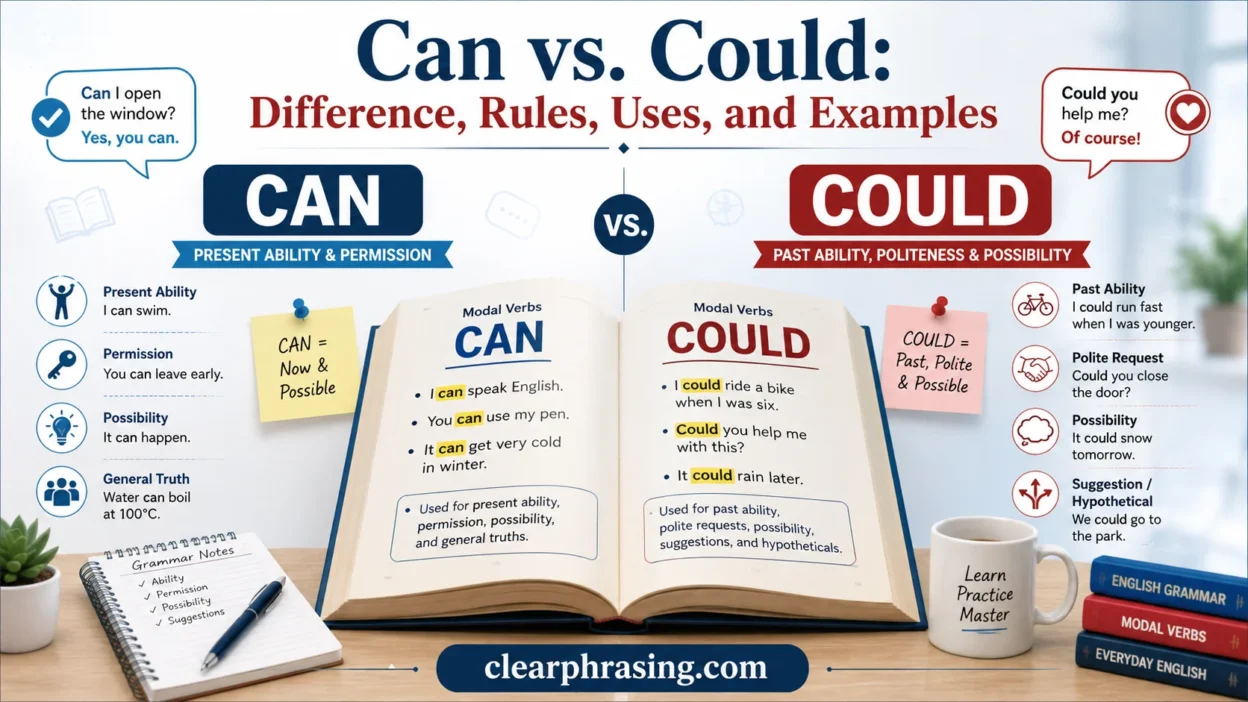
Can vs. Could: Difference, Rules, Uses, and Examples explains how these modal verbs work in everyday English. Can shows present ability, present possibility, or casual permission. For example, I can swim shows ability, while Can I leave early asks for permission.
Could often expresses past ability, past possibility, or polite requests. I could swim when I was younger describes a past ability, while Could you help me is a polite way to ask for help. As an English teacher, I’ve found that comparing real examples helps learners understand the distinction, usage, and nuances between these words.
The distinction between can and could becomes easier when you focus on context. Although they aren’t always interchangeable, both help you express possibility, ability, and permission clearly.
Quick Answer
Can commonly expresses present ability, permission, direct requests, offers, and general possibility. Could commonly expresses past ability, polite requests, uncertain possibility, suggestions, hypothetical situations, and past possibilities.
| Use | Can | Could |
| Present ability | I can drive. | — |
| Past ability | — | I could drive at seventeen. |
| Permission | Can I leave? | Could I leave? |
| Direct request | Can you help? | — |
| Polite request | Possible | Could you help? |
| General possibility | It can happen. | Sometimes |
| Specific possibility | Less common | It could happen tonight. |
| Offer | Can I help? | Possible |
| Suggestion | Less common | You could try again. |
| Hypothetical situation | Limited | I could help if I had time. |
| Past possibility | — | She could have missed the bus. |
| The key point is simple: could doesn’t always mean past can. Its meaning depends on the sentence and context. |
What Does Can Mean?
Can is one of the most useful modal verbs in English. It commonly expresses ability, permission, possibility, requests, and offers. Although its basic meaning often relates to ability, context determines what it actually communicates.
Can for Present Ability
Use can when someone has the ability to do something now.
- I can swim.
- She can speak Spanish.
- He can drive.
- They can solve difficult problems.
In “I can swim,” the speaker tells us about a current ability. The sentence doesn’t say when the ability developed. It simply confirms that the ability exists now.
Can for Permission
In everyday English, can commonly asks for or gives permission.
- Can I use your phone?
- Can I sit here?
- You can leave now.
- You can borrow my notebook.
When you ask “Can I…?”, you’re asking whether something is allowed. When someone says “You can…”, they’re granting permission.
Traditional grammar books sometimes recommend may for formal permission. Modern everyday English uses can very widely, especially in conversation.
Can for General Possibility
Can can describe something that is generally possible or sometimes happens.
- Accidents can happen.
- Winters can be extremely cold here.
- Driving at night can be dangerous.
- Learning a language can take years.
These statements describe possibilities that exist generally. They don’t necessarily predict one specific event.
Compare:
It can get very cold here.
This describes a general condition.
It could get very cold tonight.
This describes a particular possibility.
Can for Requests
You can use can to make ordinary, direct requests.
- Can you help me?
- Can you close the window?
- Can you send the report?
- Can you explain this?
These requests aren’t automatically rude. In casual conversation, “Can you help me?” sounds completely natural. The overall wording and relationship between speakers also influence politeness.
Can for Offers
Can frequently appears when someone offers help.
- Can I help you?
- Can I carry that for you?
- Can I get you some water?
Here, the speaker is offering an action that they are able and willing to perform.
What Does Could Mean?
Could has several important functions. It can describe past ability, but it also expresses possibility, politeness, suggestions, and hypothetical outcomes.
1.Could for Past Ability
Use could to describe a general ability someone had in the past.
- I could swim when I was five.
- She could read before starting school.
- He could run very quickly when he was younger.
- We could speak some French when we lived abroad.
Here, could connects an ability with an earlier period.
Compare:
I can swim.
The ability exists now.
I could swim when I was six.
The ability existed in the past.
However, English makes an important distinction between general past ability and one successful event. For example:
I could swim when I was six.
This describes general ability.
I was able to swim across the river yesterday.
This emphasizes successfully completing one particular action.
2.Could for Polite Requests
One of the most common uses of could has nothing to do with the past.
Compare:
Can you open the window?
Could you open the window?
Both sentences request the same action. However, could usually makes the request sound softer or more tentative.
The difference isn’t about physical ability. You’re not suggesting that the listener might lack the ability to open the window. Instead, could changes the tone of the request.
3.Could for Permission
Could can also politely ask for permission.
- Could I borrow your pen?
- Could I leave early today?
- Could we use this room?
Compared with “Can I…?”, “Could I…?” often sounds more courteous or less direct.
However, could isn’t normally used to give straightforward permission.
Natural:
You can use my laptop.
Depending on context, “You could use my laptop” usually sounds more like a suggestion or possible option than a direct grant of permission.
4.Could for Possibility
Could often expresses something that might happen or might be true.
- It could rain tonight.
- She could be at home.
- We could miss the train.
- This could cause serious problems.
The speaker doesn’t present the outcome as certain. Instead, they identify it as one possible outcome.
5.Could for Suggestions
Use could when presenting an option or possible course of action.
- You could ask your teacher.
- We could take the train.
- You could try again.
- She could apply for another position.
A suggestion gives the listener room to decide. Compare:
You should call your manager.
This sounds like stronger advice.
You could call your manager.
This presents calling the manager as one possible choice.
6.Could for Hypothetical Situations
Could can describe what would be possible under an imagined condition.
- I could help if I had more time.
- We could travel more if flights were cheaper.
- If you studied regularly, you could improve quickly.
Here, could doesn’t describe ordinary past ability. It describes a possibility that depends on a condition.
Can vs. Could for Ability
Ability provides one of the clearest comparisons between these two modal verbs.
Can for Present Ability
Use can for an ability that exists now.
- I can cook.
- She can type quickly.
- They can speak three languages.
- He can repair computers.
Could for General Past Ability
Use could for general abilities that existed in the past.
- I could run five miles when I was younger.
- She could read at age four.
- They could play chess as children.
A useful pattern is:
Present ability → can
General past ability → could
Could Doesn’t Always Mean Past
This rule has an important exception. Could can refer to the present or future when it expresses possibility.
We could meet tomorrow.
This clearly refers to the future.
She could be waiting outside.
This describes a present possibility.
So don’t memorize could = past as an absolute rule. Learn the function of the modal instead.
Can vs. Could for Permission
Both can and could can appear when asking for permission, but they create slightly different tones.
Can I…?
Can I…? sounds direct, natural, and conversational.
- Can I use your computer?
- Can I leave now?
- Can I sit here?
- Can I borrow your notes?
Could I…?
Could I…? usually sounds softer and more polite.
- Could I ask you something?
- Could I borrow your notes?
- Could I leave early?
- Could I use your computer?
The difference concerns tone rather than basic permission.
| Sentence | Meaning and tone |
|—|—|
| Can I leave? | Direct and natural |
| Could I leave? | Softer and more polite |
| You can leave. | Gives permission |
| You may leave. | More formal |
Can vs. Could for Requests
Requests show the difference particularly well.
Can tends to sound direct and conversational.
Could often creates a softer request.
| Can | Could |
| Can you help me? | Could you help me? |
| Can you wait? | Could you wait? |
| Can you send the file? | Could you send the file? |
| Can you explain that? | Could you explain that? |
| Neither form is automatically rude. Consider: |
Can you send me the report?
This is perfectly normal.
Could you please send me the report when you have a chance?
This sounds softer because of could, please, and the additional wording.
Can vs. Could for Possibility
The distinction between general and specific possibility causes many mistakes.
Can for General Possibility
Use can when something is generally possible.
- Accidents can happen.
- This machine can overheat.
- Prices can change quickly.
- Roads can become dangerous in winter.
These statements describe possibilities that occur under certain circumstances.
Could for Specific Possibility
Use could when discussing a particular situation that may happen.
- The machine could overheat tonight.
- She could arrive late.
- We could miss the flight.
- It could snow tomorrow.
Consider the difference:
This road can be dangerous in winter.
General possibility.
This road could be dangerous tonight.
Specific possibility.
Why “It Can Rain Tomorrow” Often Sounds Wrong
Learners sometimes use can because rain is possible tomorrow. However, standard English generally prefers could, may, or might for a particular uncertain prediction.
Better:
- It could rain tomorrow.
- It may rain tomorrow.
- It might rain tomorrow.
Can works better for general statements:
It can rain heavily during this season.
Can vs. Could for Offers and Suggestions
The speaker’s intention determines the better modal.
Can for Offers
Use can when offering help.
- Can I help you?
- Can I carry your bag?
- Can I make some coffee?
- Can I pick you up?
Could for Suggestions
Use could when presenting an option.
- You could call her.
- We could leave earlier.
- You could try another approach.
- We could meet on Friday.
A simple distinction can help:
Can I…? often offers an action.
You could… often suggests an option.
Can vs. Could in Conditional Sentences
Conditional sentences reveal another useful difference.
Can for Realistic Possibilities
Can can describe an outcome that remains realistically available.
If you hurry, you can catch the bus.
The speaker sees catching the bus as a realistic possibility.
Could for Hypothetical Possibilities
Could often appears when the situation is more hypothetical.
If you left earlier, you could catch the bus.
Another example:
If I had more time, I could help you.
The speaker doesn’t currently have enough time. The ability becomes possible under a different condition.
Can vs. Could in Negative Sentences
The negative forms are can’t and couldn’t.
Can’t
Can’t can express inability, lack of permission, or impossibility.
- I can’t swim.
- You can’t park here.
- That can’t be true.
Context determines the exact meaning.
Couldn’t
Couldn’t can describe past inability.
- I couldn’t swim when I was young.
- She couldn’t read at that age.
- We couldn’t find the address.
It can also express impossibility:
That couldn’t be the correct answer.
Here, couldn’t doesn’t necessarily refer to past time. It expresses the speaker’s judgment that something is impossible.
Can vs. Could With Have
The structure could have + past participle adds another layer of meaning.
Could Have for Past Possibility
Use could have when considering something that may have happened in the past.
- She could have missed the train.
- They could have taken the wrong road.
- He could have forgotten the appointment.
The speaker doesn’t know whether the event happened. They’re considering it as a possible explanation.
Could Have for an Unused Opportunity
Sometimes could have indicates that an opportunity existed but wasn’t taken.
You could have called me.
Depending on context, this can imply that calling was possible but didn’t happen.
Another example:
We could have won the game.
This normally means winning was possible, but the team didn’t win.
Could Have Been
This structure often describes an unrealized or possible past situation.
- It could have been worse.
- She could have been injured.
- That could have been a serious mistake.
The surrounding context determines the precise meaning.
Grammar Rules
The grammar rules for these modal verbs are straightforward once you know the basic structure.
Use the Base Verb After Can and Could
Correct:
- She can swim.
- He could drive.
- We can help.
- They could leave.
Incorrect: - She can swims.
- He could drives.
- We can to help.
- They could to leave.
Don’t Add “To” After Can or Could
Modal verbs take the base verb directly.
I can go.
Not:
I can to go.
Likewise:
She could help.
Not:
She could to help.
Can and Could Don’t Change With the Subject
These modals remain unchanged regardless of the subject.
- I can
- You can
- He can
- She can
- We can
- They can
The same applies to could.
Questions With Can and Could
Put the modal before the subject.
- Can you help me?
- Could you help me?
- Can she drive?
- Could they arrive earlier?
The basic pattern is:
Modal + subject + base verb
Common Mistakes
Thinking Could Always Means Past
This is the most common mistake. Could can express:
- Past ability
- Present possibility
- Future possibility
- Polite requests
- Suggestions
- Hypothetical situations
- Past possibility
So don’t automatically translate could as “was able to.”
Using Can for Every Possibility
For a specific uncertain prediction, could often sounds more natural.
Less natural:
It can rain tomorrow.
More natural:
It could rain tomorrow.
However, can works well for general possibilities:
It can rain heavily here during summer.
Adding To After Can or Could
Incorrect:
I can to drive.
Correct:
I can drive.
Incorrect:
She could to help.
Correct:
She could help.
Adding -s to the Main Verb
Incorrect:
He can speaks English.
Correct:
He can speak English.
After a modal verb, use the base form.
Assuming Could Means Less Ability
In “Could you open the door?”, could doesn’t suggest that the listener has limited ability. It makes the request softer.
Can vs. Could in Everyday Conversations
Real conversations make these differences easier to remember.
Asking for Permission
A: Can I borrow your charger?
B: Sure. You can use it.
Making a Polite Request
A: Could you send me the report?
B: Sure. I’ll send it this afternoon.
Discussing Possibility
A: Where’s Sara?
B: She could be in her office.
Talking About Past Ability
A: Could you swim when you were a child?
B: Yes, I could.
Making a Suggestion
A: I don’t know what to do.
B: You could talk to your teacher.
These conversations demonstrate an important lesson: context determines meaning.
Can vs. Could in Formal and Informal English
The choice between can and could can influence how a request sounds in professional communication.
In everyday speech:
Can you send me the file?
This sounds natural and direct.
In a workplace setting:
Could you send me the file when you have a moment?
This may sound more considerate.
However, don’t assume could is always formal. Native speakers use it constantly in ordinary conversation. Likewise, can isn’t automatically rude or informal.
The relationship between speakers, the purpose of the request, and the surrounding words all influence tone.
: Side-by-Side Comparison
| Function | Can | Could |
| Present ability | Yes | Not usually |
| General past ability | No | Yes |
| Asking permission | Yes | Yes |
| Giving permission | Yes | Usually not |
| Direct requests | Yes | Yes |
| Softer requests | Possible | Common |
| General possibility | Yes | Sometimes |
| Specific uncertain possibility | Less common | Yes |
| Offers | Common | Possible |
| Suggestions | Less common | Common |
| Hypothetical situations | Limited | Common |
| Past possibility | No | Yes, especially could have |
This comparison shows why could can’t simply be labeled the past version of can.
Examples
Ability
- I can drive.
- She can speak Japanese.
- I could ride a bicycle when I was four.
- He could run much faster when he was younger.
Permission
- Can I use your computer?
- Could I ask a question?
- You can leave now.
- You can borrow my notes.
Requests
- Can you help me?
- Could you help me?
- Can you close the window?
- Could you explain that again?
Possibility
- Mistakes can happen.
- It could rain tonight.
- This machine can overheat.
- The machine could overheat if we leave it running.
Suggestions
- You could try again.
- We could take the train.
- You could ask your manager.
Hypothetical Situations
- I could help if I had more time.
- We could travel more if tickets were cheaper.
Past Possibility
- She could have missed the bus.
- They could have taken the wrong road.
- It could have been a serious problem.
Practical Case Study
Imagine an employee needs a report from a colleague. The first message says:
Can you send me the report?
This sounds direct and perfectly acceptable.
Now consider:
Could you send me the report when you have a chance?
The second version softens the request.
Now change the context:
The report could contain an error.
Here, could doesn’t make a request more polite. It expresses possibility.
Finally:
I could finish the report if I had another hour.
Here, could expresses a conditional possibility or ability.
The same modal therefore performs different functions in different sentences. That’s exactly why context matters.
Practice Questions
Choose can or could in each sentence.
- I ___ swim when I was six.
- ___ you please close the door?
- It ___ rain tonight.
- ___ I borrow your pen?
- You ___ try restarting the computer.
- She ___ speak three languages now.
- Mistakes ___ happen in large projects.
- If I had more time, I ___ help you.
- He ___ have forgotten the appointment.
- ___ you help me carry this box?
Answer Key
- could — past ability
- could — polite request
- could — specific possibility
- can/could — both can ask permission, with could generally softer
- could — suggestion
- can — present ability
- can — general possibility
- could — hypothetical possibility
- could — past possibility
- can/could — both work, with could generally softer
How to Remember Can vs. Could
Think of can as the modal of present capability, permission, direct requests, and general possibility.
Think of could as the modal of past ability, softer requests, uncertain possibilities, suggestions, and hypothetical outcomes.
When you’re unsure, ask yourself what the sentence is doing.
- Present ability? → can
- General past ability? → could
- Direct request? → can
- Softer request? → could
- General possibility? → can
- Specific uncertain possibility? → could
- Suggestion? → could
- Hypothetical situation? → could
- Past possibility? → could have
The goal isn’t to memorize can and could as opposites. Instead, learn what each modal communicates in context.
Read More: Sustain or Substain: Correct Spelling, Meaning and Usage
FAQs
Can and Could mean the same thing?
No. Can and could are both modal verbs, but they have different uses. Can usually refers to present ability, possibility, or casual permission.
Could often refers to past ability, less certain possibilities, or more polite requests. Context determines which word sounds correct.
Is “can” used for present ability?
Yes. Can commonly expresses an ability someone has now. For example, “I can drive” means the person has the ability to drive.
It can also describe a general possibility. “This road can become crowded” means that situation is possible.
Is “could” always the past form of “can”?
Not always. Could can describe past ability, such as “I could run faster when I was younger.” However, it also has other uses.
For example, “Could you open the window?” is a polite request about the present, not the past.
Can I use “can” to ask for permission?
Yes. Can is commonly used for casual permission, especially in everyday conversation. For example, “Can I leave early?” sounds natural and direct.
In more formal situations, you may prefer could because it sounds more polite. The choice depends on the situation and relationship between speakers.
Is “could” more polite than “can”?
Generally, yes. Could often makes a request sound softer and more courteous. “Could you help me?” sounds more polite than “Can you help me?”
However, can isn’t rude. It’s perfectly normal for casual conversations with friends, coworkers, or people you know well.
Can “could” express possibility?
Yes. Could can describe something that may happen or may be possible. For example, “It could rain tonight” presents rain as a possible outcome.
The important point is that could often suggests uncertainty. It doesn’t guarantee that the event will happen.
Can “can” express future possibility?
Yes, but its meaning depends on the sentence. Can may describe something that is generally possible in the future, such as “We can meet tomorrow.”
For a specific uncertain prediction, could may sound more natural: “We could meet tomorrow if everyone is available.”
Which is correct: “Can you help me?” or “Could you help me?”
Both are grammatically correct. Can you help me? is direct and common in everyday English.
Could you help me? sounds slightly more polite or considerate. Neither sentence is wrong, so choose according to the tone you want.
How can I remember the difference between can and could?
Think of can as the more direct choice for present ability, general possibility, and casual permission. Think of could as useful for past ability, uncertainty, and polite requests.
Instead of memorizing dozens of rules, compare examples in real situations. This makes the difference easier to remember and use naturally.
What is the easiest way to practice can and could?
Start with three simple categories: present ability, past ability, and requests. Write sentences such as “I can swim,” “I could swim when I was younger,” and “Could you help me?”
Then create your own examples from daily life. This practice helps you understand context, improve accuracy, and choose the right modal verb without second-guessing every sentence.
Conclusion
Understanding can and could doesn’t have to feel complicated. Once you connect each word with its main purpose, the difference becomes much easier to recognize. Can commonly expresses present ability, general possibility, or casual permission, while could often expresses past ability, uncertainty, or polite requests. The surrounding context usually gives you the best clue.
The key is to practice these words in realistic sentences instead of learning rules in isolation. Pay attention to how people use them in conversations, emails, and everyday situations. With regular practice, you’ll become more confident about choosing between can and could, and your English will sound clearer, more natural, and more precise.

Mariam Asghar is an English specialist and professional content writer at ClearPhrasing.com. She is dedicated to helping readers improve their English through clear, practical, and easy-to-understand content. Her areas of expertise include grammar, spelling, vocabulary, punctuation, sentence structure, and effective writing.
At ClearPhrasing.com, Mariam writes comprehensive, well-researched articles that simplify complex language concepts for students, professionals, writers, and English learners. She believes that strong communication begins with a solid understanding of the English language and strives to make every lesson accessible and engaging.
With a strong commitment to quality, accuracy, and continuous learning, Mariam ensures that each article is carefully researched, thoroughly reviewed, and written to help readers communicate with greater confidence and clarity.