Passed vs. Past: Difference and Correct Usage can confuse native users and non-native users because these commonly confused words have an identical sound but different spelling, meaning, and functions.
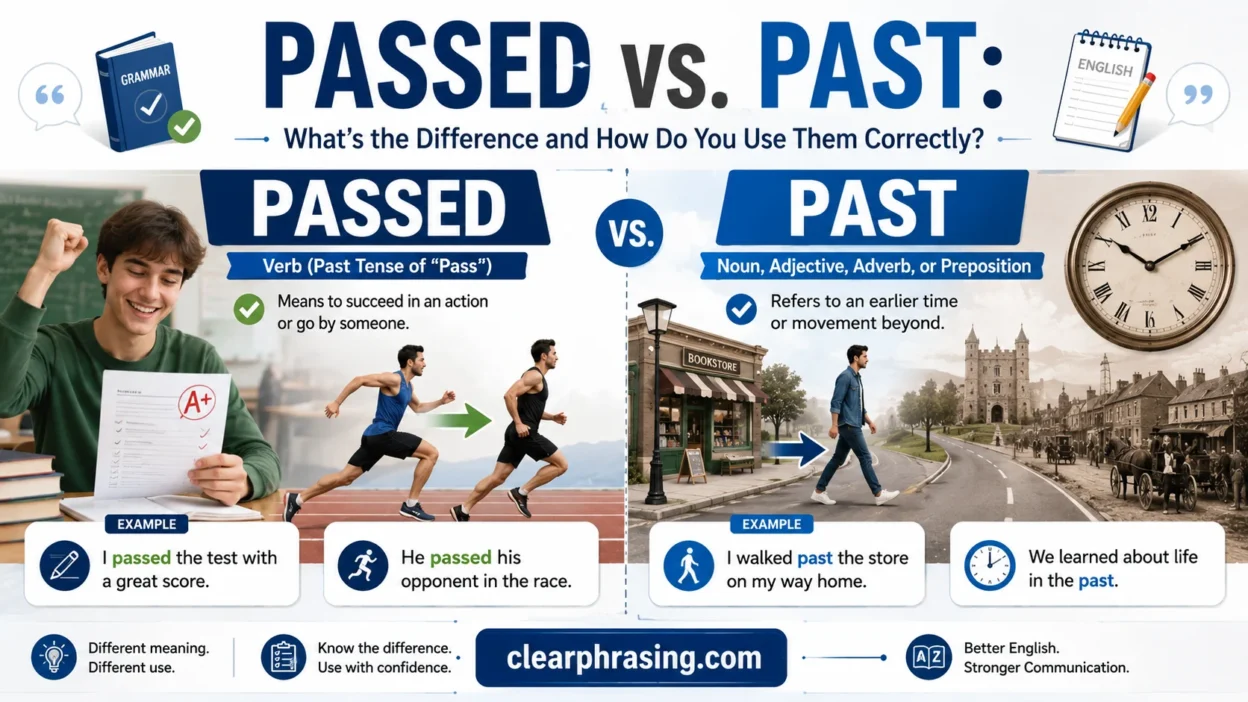
Passed is a verb, while past can serve as a noun, adjective, adverb, or preposition. In English, this distinction matters for grammar, usage, and word choice.In academic writing, using them correctly helps keep your writing accurate, clear, and effective.
In my experience as an English teacher, students often confuse these words because they sound alike when they say aloud them. I encourage you to focus on context and the role each word plays in a sentence.
This simple habit improves communication, strengthens your writing, and helps you comprehend the difference. With regular practice, you can choose the correct word confidently and avoid common mistakes.
Quick Answer
Passed is usually the correct choice when you need the past tense or past participle of the verb “pass.”
She passed the exam.
Here, passed describes an action. The present-tense version is:
She passes the exam.
More naturally, you might say:
She passes the exam when she takes it.
By contrast, past doesn’t function as the past-tense form of pass. It can describe earlier time, a position beyond something, or movement beyond a point, depending on the sentence.
We walked past the library.
I don’t like thinking about the past.
It’s half past six.
A useful memory rule is:
Passed = an action involving “pass.”
Past = earlier time, a position beyond something, or something previous.
| Word | Main grammatical role | Basic idea | Example |
| Passed | Verb | An action occurred | She passed the test. |
| Past | Preposition | Beyond a point | We walked past the bank. |
| Past | Noun | Earlier time | He regrets the past. |
| Past | Adjective | Earlier or previous | Her past mistakes mattered. |
| Past | Adverb | Beyond a point | The car drove past. |
The important thing is not simply whether the sentence talks about the past. Both words can appear in sentences about past events. The real question is what grammatical role the word plays.
What Does “Passed” Mean?
Passed is the past-tense and past-participle form of pass. Because it comes from a verb, it normally expresses something that happened, changed, moved, transferred, succeeded, or came to an end.
Cambridge Dictionary lists meanings of pass that include moving beyond someone or something and going beyond a point in time. The verb also has meanings related to succeeding in an examination, transferring something, and allowing time to elapse.
Passed as the Past Tense of “Pass”
The most straightforward use occurs when passed describes an action completed in the past.
I passed the grocery store on my way home.
She passed the driving test.
The bus passed our house.
He passed the message to his manager.
In each example, you can identify an action. Someone did something.
The base verb is pass, while the past form is passed:
| Present | Past |
| pass | passed |
| passes | passed |
| passing | passed |
So if you can naturally change the sentence to use pass in the present tense, you’re probably dealing with passed.
I passed the store yesterday.
I pass the store every morning.
That verb relationship is the key.
Passed When Someone Succeeds
One especially common use appears with exams, tests, courses, and requirements.
Maria passed the final exam.
He passed his driving test.
They passed the safety inspection.
Here, passed means that someone successfully met a required standard.
Using past would be incorrect:
❌ She past the exam.
✅ She passed the exam.
The reason is simple. The sentence needs a verb. Passed supplies that verb.
Passed When Something Moves
Itcan also describe movement beyond a person or place.
The runner passed me near the finish line.
A truck passed our car.
We passed the old church on the way downtown.
Notice something interesting here. These sentences can look similar to sentences containing past, but the grammar changes.
Compare:
The car passed the house.
The car went past the house.
The meanings overlap. The grammatical structures don’t.
In the first sentence, passed is the main verb.
In the second, went is the main verb and past functions as a preposition.
Passed When Time Elapses
You can also use passed when time moves forward or a period ends.
Three hours passed before she called.
Several months passed without any news.
As the years passed, the town changed.
Here, passed means something like elapsed or went by.
This creates one of the most useful comparisons in the entire topic:
Time passed.
The past cannot be changed.
The first sentence describes an action involving time. The second refers to an earlier period.
Passed as a Past Participle
Passed also works as the past participle of pass. It can appear with auxiliary verbs such as has, have, and had.
She has passed the exam.
They had passed the building before they noticed the sign.
The deadline has passed.
This is another reliable clue. When passed appears as part of a verb phrase, it retains its connection to pass.
What Does “Past” Mean?
Unlike passed, the word past can perform several grammatical jobs. Merriam-Webster lists past as an adjective and preposition and also gives noun and adverb uses.
That flexibility explains why past appears in so many different sentence patterns.
Past as a Preposition
Use past as a preposition when it shows that someone or something moves beyond a particular person, place, object, or point.
We drove past the museum.
She walked past me without saying anything.
The dog ran past the gate.
He looked past the obvious answer.
In these examples, past establishes a relationship between the action and another element.
A useful structure is:
verb + past + person/place/thing
For example:
walked past the house
drove past the school
ran past the finish line
looked past the problem
This is why the common phrase walked past uses past, not passed.
❌ She walked passed me.
✅ She walked past me.
The verb is already walked. Adding passed would create the wrong structure.
Past as a Noun
Past can also function as a noun when it means an earlier period or previous experiences.
We can’t change the past.
He doesn’t like talking about his past.
The past still influences many decisions.
She left her past behind.
In these sentences, past names a period of time or a collection of previous experiences.
Past as an Adjective
As an adjective, past describes something connected with an earlier time.
1.past experiences
2.past mistakes
3.past presidents
4.past generations
5.past relationships
For example:
Her past experiences shaped the way she approached the project.
Here, past modifies experiences. It tells you that those experiences happened earlier.
Merriam-Webster includes meanings such as “having existed or taken place in a period before the present” and gives examples involving previous periods.
Past as an Adverb
Past can also function as an adverb when it indicates movement beyond a point.
The train went past.
The runner sped past.
I watched the car drive past.
In these cases, past doesn’t directly introduce a noun.
Compare:
The car drove past the house.
The car drove past.
The first example uses past before a noun phrase. The second uses it independently.
Past in Time Expressions
Another familiar use appears when telling time.
It’s five past three.
It’s half past seven.
The meeting starts at a quarter past nine.
Here, past means that the specified number of minutes has elapsed after the hour.
So:
❌ It’s half passed six.
✅ It’s half past six.
The spelling doesn’t change simply because you’re talking about time. The sentence requires the preposition past.
Passed vs. Past: Why the Words Cause So Much Confusion
The problem isn’t just spelling. Passed and past overlap in meaning because both connect with the idea of moving beyond something or moving through time.
Consider these sentences:
The car passed the house.
The car went past the house.
Both describe a car moving beyond a house. Yet the first sentence uses passed as a verb. The second uses went as the verb and past as a preposition.
That’s the subtle point many quick grammar guides miss.
The question isn’t:
“Am I talking about something that happened before now?”
That test isn’t enough.
Instead, ask:
“What grammatical job does this word perform?”
If it supplies the action of pass, use passed.
If it describes an earlier period or indicates movement beyond something, past may be the right choice.
Passed vs. Past: Side-by-Side Examples
The fastest way to see the difference is to compare sentences with similar meanings.
| Passed | Past |
| She passed the test. | We walked past the school. |
| The bus passed us. | The bus went past us. |
| Three hours passed. | We talked about the past. |
| He passed the building. | He drove past the building. |
| She has passed the deadline. | The deadline is in the past. |
Look closely at the first pair.
She passed the test.
Here, passed tells us what she did.
We walked past the school.
Here, walked tells us what she did. Past tells us where she moved in relation to the school.
That distinction is more reliable than trying to memorize dozens of isolated examples.
Passed vs. Past in Movement
Movement creates some of the trickiest examples.
Consider:
The cyclist passed the truck.
The verb is passed. The cyclist moved beyond the truck.
Now change the structure:
The cyclist rode past the truck.
The verb is rode. Past tells us the cyclist’s direction or position relative to the truck.
Both sentences can describe almost the same event.
A Useful Grammar Pattern
Subject + passed + object
The runner passed the other athlete.
Subject + movement verb + past + object
The runner ran past the other athlete.
That small structural difference solves many spelling problems.
Passed vs. Past in Time Expressions
Time creates another important contrast.
Time Passed
Use passed when time itself performs the action.
Five minutes passed.
The afternoon passed quickly.
Several years passed before they met again.
Here, passed is a verb.
Time in the Past
Use past when you refer to an earlier period.
We lived there in the past.
She has learned from her past.
The past few months have been difficult.
Here, past doesn’t mean that time is performing an action. It identifies an earlier period.
Past Time
You may also see past time in specific contexts.
The discussion concerns past time rather than future plans.
However, everyday English usually prefers more natural phrases such as earlier time, previous years, or the past.
Passed Away vs. Past Away
One spelling mistake deserves special attention because it appears frequently in informal writing.
The standard expression is:
passed away
It means died.
Examples:
Her grandfather passed away peacefully.
His longtime friend passed away last year.
The actor passed away at the age of 82.
The expression past away is incorrect.
Why? Because passed is the verb form required in this expression. Past cannot replace it.
This is a case where memorizing the established phrase helps:
passed away, not past away.
Passed By vs. Past
It can also confuse writers because they can describe similar movement.
The years passed by quickly.
The years went past quickly.
In the first sentence, passed is the verb and by forms part of the phrase.
In the second, went is the verb and past indicates movement beyond a point.
Another comparison:
She passed by my office.
She walked past my office.
Both can describe movement near or beyond the office. The grammatical construction determines the spelling.
Common Mistakes With Passed and Past
“I Past the Test”
Incorrect:
❌ I past the test.
Correct:
✅ I passed the test.
Why? Passed is the past-tense verb meaning that you succeeded.
“I Walked Passed the Store”
Incorrect:
❌ I walked passed the store.
Correct:
✅ I walked past the store.
Why? Walked is already the verb. Past shows the location or direction of movement.
“In the Passed”
Incorrect:
❌ In the passed, people communicated differently.
Correct:
✅ In the past, people communicated differently.
Why? Past is the noun referring to an earlier period.
“Two Years Past”
This one depends on the intended meaning.
If you mean that two years elapsed, use:
Two years passed before she returned.
If you’re describing a point beyond two years, a phrase such as two years past can occur in specific contexts, though it isn’t the usual replacement for passed.
The sentence’s structure and intended meaning matter.
“Half Passed Six”
Incorrect:
❌ It’s half passed six.
Correct:
✅ It’s half past six.
Why? Time expressions use past to indicate minutes after the hour.
A Simple Test for Passed vs. Past
When you’re unsure, try these three checks.
Check Whether It Is a Verb
Ask:
Is the word describing the action of passing?
If yes, passed may be correct.
She passed the ball.
He passed the exam.
The storm passed.
Check for Earlier Time
Ask:
Does the word refer to an earlier period?
If yes, use past.
in the past
past mistakes
past generations
the past
Check for Movement Beyond Something
Ask:
Does the word mean beyond a particular place, person, or point?
If yes, past often works.
walk past the house
drive past the sign
move past the obstacle
This test isn’t a substitute for understanding the whole sentence. However, it works well for most everyday cases.
A Practical Memory Trick for Passed vs. Past
Here’s a compact rule worth remembering:
Passed does the passing. Past describes what is beyond or what came before.
Think of two scenes.
In the first, a runner moves ahead of another runner:
The runner passed me.
The word passed performs the action.
In the second, you describe the runner’s route:
The runner went past me.
The word past identifies the point the runner moved beyond.
That tiny shift in sentence structure explains a surprisingly large number of mistakes.
Passed vs. Past in Formal Writing
This distinction matters in professional and academic writing because a single spelling error can make an otherwise polished sentence look careless.
Consider a business report:
The deadline passed without a response.
That sentence clearly identifies passed as the verb.
Now consider:
The deadline is now in the past.
Here, past refers to an earlier period.
In academic writing:
Researchers passed the samples through several filters.
But:
Researchers compared the findings with past studies.
The words may appear close together in the same paragraph, yet their grammatical roles remain different.
Accuracy comes from understanding the sentence rather than relying on how the words sound.
Passed vs. Past: Common Expressions
Expressions With “Passed”
- passed the test
- passed the exam
- passed by
- passed away
- passed through
- passed down
- passed on
- passed out
- passed the deadline
- time passed
Examples:
The tradition was passed down through generations.
The storm passed through the region.
She passed out after standing too long.
Expressions With “Past”
- in the past
- the past few years
- past experience
- past mistakes
- past midnight
- half past six
- walk past
- drive past
- look past
- move past
Examples:
We’ve learned from past mistakes.
The discussion continued past midnight.
Try to look past the obvious answer.
Passed vs. Past: A Case Study
Imagine that Alex drives home after work. He goes beyond the local supermarket and arrives home twenty minutes later.
You could describe the trip in several ways:
Alex passed the supermarket on his way home.
Here, passed is the main verb.
You could also write:
Alex drove past the supermarket on his way home.
Now drove is the main verb. Past describes Alex’s movement relative to the supermarket.
Later, Alex says:
Twenty minutes passed before he started cooking.
Again, passed functions as the verb.
Then he remembers an earlier event:
He thought about the past.
Now past functions as a noun.
One short situation can therefore contain both words correctly.
Passed vs. Past: Grammar Comparison
| Sentence | Word | Function | Explanation |
| She passed the exam. | Passed | Verb | She succeeded. |
| The bus passed us. | Passed | Verb | The bus moved beyond us. |
| Two hours passed. | Passed | Verb | Two hours elapsed. |
| We walked past the store. | Past | Preposition | It shows movement beyond the store. |
| He remembers the past. | Past | Noun | It refers to earlier time. |
| They discussed past events. | Past | Adjective | It describes earlier events. |
| The car drove past. | Past | Adverb | It indicates movement beyond. |
| It’s ten past four. | Past | Preposition | It indicates time after the hour. |
The table reveals the central pattern: passed has a much narrower grammatical job than past.
Merriam-Webster specifically notes that past can serve as a noun, adjective, preposition, and adverb, while passed is the past-tense form of pass.
Passed vs. Past Practice Quiz
Choose passed or past in each sentence.
- She ______ the final exam.
- We drove ______ the old theater.
- Three hours ______ before the meeting ended.
- He often thinks about his ______.
- The train went ______ the station.
- They have ______ the deadline.
- It’s half ______ eight.
- She walked ______ me without speaking.
- Several years ______ before they met again.
- He learned from his ______ mistakes.
- The storm ______ through the area.
- We lived there in the ______.
Answers
- passed — It is the past-tense verb pass.
- past — It indicates movement beyond the theater.
- passed — The verb means that three hours elapsed.
- past — It refers to an earlier period.
- past — It describes movement beyond the station.
- passed — The verb refers to moving beyond a deadline in time.
- past — This is a time expression.
- past — Walked is the verb, while past indicates position or direction.
- passed — The years elapsed.
- past — It describes mistakes from an earlier period.
- passed — It is the past-tense form of pass.
- past — It refers to an earlier period.
Read More: Beware vs. Be Aware: Difference, Meaning, and Usage
FAQs
What is the main difference between passed and past?
Passed and past sound the same, but they have different meanings and grammatical functions. Passed is usually the past tense or past participle of the verb pass. For example, “She passed the exam” describes an action she completed.
Past, on the other hand, commonly refers to an earlier time or something beyond a particular point. It can also work as a noun, adjective, adverb, or preposition. For example, “We walked past the library.”
Is passed always a verb?
In standard English usage, passed is the past tense and past participle form of the verb pass. It describes an action that happened previously or has been completed.
For example, “The car passed me on the highway” describes an action. Remembering this connection can make the difference easier to recognize when you’re choosing between passed and past.
Is past always related to time?
Not always. Past often relates to an earlier time, as in “my past experiences,” but it can also describe movement beyond a person, place, or point.
For example, “She walked past the store.” Here, past doesn’t mean an earlier time. It shows movement beyond a specific location.
How can I remember when to use passed?
A useful trick is to check whether you’re describing an action. If someone or something completed the action of passing, passed is usually the right choice.
For example, “He passed the ball,” “She passed her test,” and “The train passed the station.” In each sentence, passed describes something that happened.
How can I remember when to use past?
Try replacing past with an expression such as “beyond” or “earlier time.” If the sentence still makes sense, past may be the correct choice.
For example, “We drove past the school” can be understood as driving beyond the school. Similarly, “In the past, people communicated differently” clearly refers to an earlier time.
Can passed and past appear in the same sentence?
Yes. In fact, using both words in one sentence can make their difference easier to understand.
For example, “The runner passed me and continued past the finish line.” Passed describes the runner’s action, while past shows movement beyond the finish line.
Why do people confuse passed and past?
The main reason is pronunciation. Passed and past sound alike in standard English, so you can’t always identify the correct word simply by hearing it.
The confusion becomes more noticeable in writing because their spellings reveal the difference. Looking at the sentence’s meaning and grammatical structure will usually help you select the right word.
Which is correct: passed the store or past the store?
Both can be correct, but they mean different things depending on the sentence. “We passed the store” means we went by or went beyond the store as an action.
“We walked past the store” also describes movement beyond the store, but past functions differently. The choice depends on the grammatical structure of the sentence.
Is past a preposition?
Yes. Past can function as a preposition when it shows movement or position beyond something.
For example, “The children walked past the house.” Here, past connects the action of walking with the house and indicates that they moved beyond it.
Is passed used for time?
No, not when you’re referring directly to an earlier period. For time expressions, past is generally the appropriate word.
For example, “We discussed the past,” “She has learned from her past,” and “In the past, this was common.” Use passed when you need the verb pass to describe an action.
Conclusion
Understanding passed vs. past becomes much easier when you stop relying on pronunciation alone. Although the two words sound identical, they don’t perform the same job in a sentence. Passed comes from the verb pass and normally describes an action that has already happened. Past has a much wider range of uses. It can refer to an earlier period, show movement beyond something, or function as a noun, adjective, adverb, or preposition. Once you recognize these grammatical roles, the difference starts to feel much more natural.
As an English teacher, I’ve found that learners often know the definitions but still hesitate when they have to choose the correct word in real writing. That’s understandable. When two words sound exactly alike, your ear can’t always guide you. Your best tool is context. Ask yourself what the sentence is trying to express. Are you describing someone who passed an exam, passed another person, or passed something along? Or are you talking about the past, moving past a location, or referring to something that happened earlier? That quick question can prevent many common mistakes.
This distinction matters beyond grammar exercises. In academic writing, professional communication, emails, essays, and everyday conversations, accurate word choice makes your meaning easier to understand. A small spelling difference can change the grammatical role of a word and, in some cases, the meaning of the entire sentence. The good news is that you don’t need to memorize complicated rules. Learn to connect passed with the action pass, and connect past with earlier time or movement beyond a point. Then practice the words in complete sentences. With regular use, you’ll begin to recognize the correct form almost automatically.

Shamsa Kanwal is an English specialist and content writer at ClearPhrasing.com, where she helps readers navigate the English language with confidence. She enjoys breaking down grammar rules, spelling differences, vocabulary, and everyday writing challenges into simple, practical lessons that anyone can understand.
Her writing is focused on making learning approachable rather than overwhelming. Whether she’s explaining commonly confused words, punctuation rules, or grammar concepts, Shamsa believes that clear explanations and real-life examples are the key to effective learning.
Every article she writes is carefully researched, fact-checked, and edited to ensure it is accurate, easy to read, and genuinely helpful. Her goal is to create trustworthy resources that enable students, professionals, writers, and English learners to improve their communication skills and write with greater clarity.
Through her work at ClearPhrasing.com, Shamsa is committed to making English learning simpler, more practical, and accessible for readers around the world.