If you’re confused about probably and propably, you’re not alone. Propably or Probably: Correct Spelling, Meaning, and Usage explains this common spelling issue clearly.
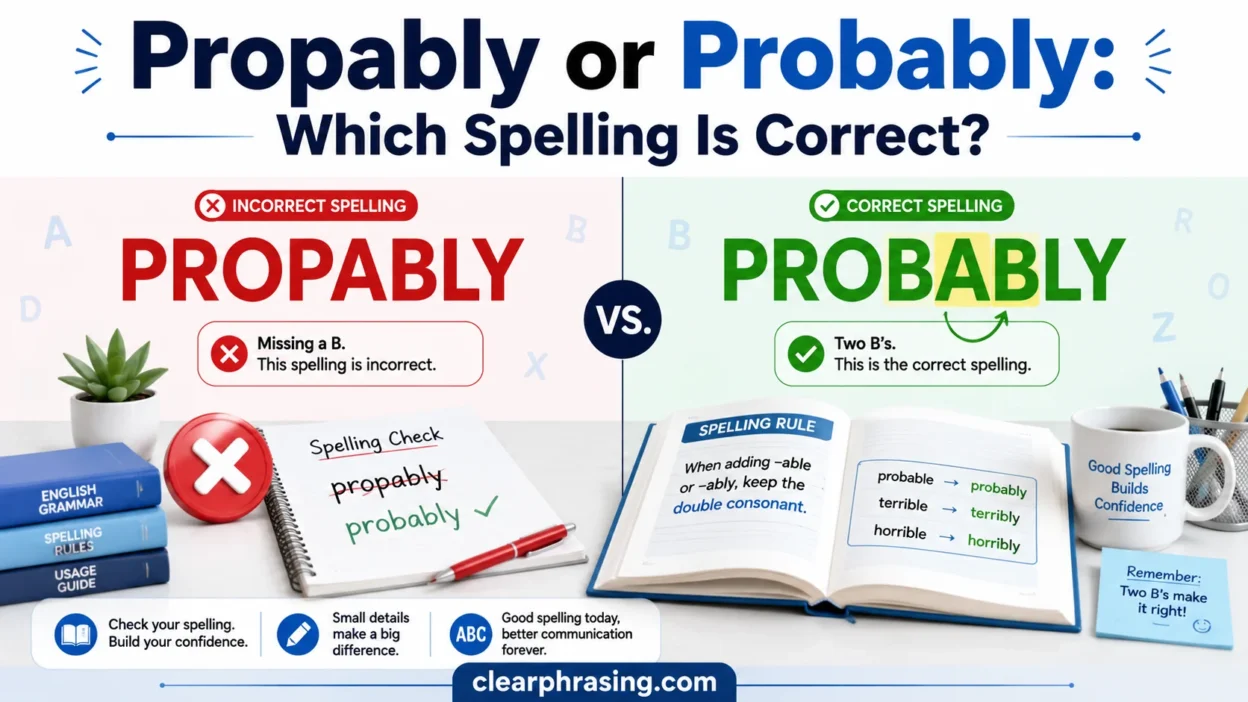
Probably is the correct word, while propably is a common misspelling and incorrect spelling. In English, probably is an adverb that shows likelihood, probability, or expectation. It means something is likely to happen or be true, but not completely certain. For example, “It will probably rain today.” As an English teacher, I often see students make this common error because the words sound similar.
Think of probably as a middle ground between certainty and possibility. Definitely, almost certainly, and most likely suggest stronger certainty, while maybe and possibly show more uncertainty. This nuance creates different shades of meaning in spoken English and written English. When choosing the correct word, double-check the spelling and ensure proper usage.
Correct grammar, word choice, and sentence construction improve communication clarity and language accuracy. Using probably correctly helps you communicate clearly and effectively, while avoiding confusion for readers in both formal writing and informal writing.
Quick Answer:
Probably is the correct spelling.
Propably is incorrect.
The word probably means “very likely” or “in all likelihood.” It expresses a strong possibility without saying that something is absolutely certain.
| Word | Correct? | Meaning | Example |
| Probably | ✅ Yes | Very likely | “She’ll probably arrive soon.” |
| Propably | ❌ No | Misspelling | “She’ll propably arrive soon.” |
A simple way to remember it is this:
Probably has two B’s.
If you remember the related word probable, the spelling becomes easier:
probable → probably
Propably or Probably: Which One Is Correct?
Probably Is the Correct Spelling
Probably is the standard English spelling. It functions as an adverb and tells the reader or listener that something has a strong chance of being true or happening.
For example:
- “It will probably rain tonight.”
- “She’ll probably call after work.”
- “They’re probably already home.”
- “He probably knows the answer.”
- “We’ll probably finish before noon.”
Cambridge defines probably as an adverb used when something is very likely. Oxford gives a similar explanation, describing it as a word used to say that something is likely to happen or be true.
So when you want to express likelihood, use probably.
Propably Is a Misspelling
Propably isn’t the standard English spelling of this word. It usually appears because someone leaves out the second b while typing or writing.
Consider these examples:
❌ “I’ll propably go tomorrow.”
✅ “I’ll probably go tomorrow.”
❌ “She propably forgot.”
✅ “She probably forgot.”
The difference looks small. However, one missing letter turns the correct word into a spelling error.
What Does Probably Mean?
Probably Means “Very Likely”
When you use probably, you’re saying that something has a high likelihood of being true or happening.
For example:
“The package will probably arrive tomorrow.”
This sentence doesn’t guarantee that the package will arrive tomorrow. Instead, it tells the reader that tomorrow is the most likely outcome based on the available information.
You can think of probably as sitting between uncertainty and certainty.
- Maybe → uncertain
- Possibly → possible
- Probably → very likely
- Definitely → certain
This distinction matters because these words don’t carry the same level of confidence.
Probably Does Not Mean Definitely
One of the most important points about probably is that it doesn’t mean certainly.
Compare these sentences:
“She’ll probably come.”
This means you expect her to come, but something could still change.
“She’ll definitely come.”
This means the speaker has no meaningful doubt about her coming.
Oxford defines definitely as expressing something that is certain or considered true without doubt.
That small difference can matter in professional communication, plans, predictions, and everyday conversations.
Why Do People Spell Probably as Propably?
Pronunciation Makes Probably Difficult to Spell
The spelling problem becomes easier to understand when you look at pronunciation.
Cambridge gives the American pronunciation as /ˈprɑː.bə.bli/ and the British pronunciation as /ˈprɒb.ə.bli/. Oxford gives corresponding pronunciations for American and British English.
When people speak quickly, though, the word may sound less distinct than its written form suggests.
You might hear something closer to:
prob-uh-blee
or, in very casual speech:
prob-ly
That reduced sound can make the middle b easy to overlook.
The Missing “B” Problem
The spelling becomes much easier when you slow the word down:
pro + ba + bly = probably
The two b’s are easy to miss because they don’t always stand out clearly in rapid speech.
Think of it like a road with two signs that look similar. If you drive past quickly, you may remember only one. Writing propably works the same way. Your ear remembers the shortened sound while your hand reproduces the wrong spelling.
That’s why this mistake often comes from pronunciation rather than a lack of understanding.
How to Spell Probably Correctly
Connect Probably With Probable
One of the easiest spelling strategies is to connect probably with probable.
Probable means likely to happen or be true. Oxford defines it as something likely to happen, exist, or be true.
Then:
probable → probably
Notice the shared beginning:
prob-
This connection gives you a reliable spelling anchor.
Related words include:
- probable
- probably
- probability
- improbable
- improbably
Once you recognize the prob- family, probably becomes much less mysterious.
Remember the Two B’s
Here’s a simple memory trick:
Probably = two B’s
You can even visualize it as:
PRO + B + A + B + LY
The second b is the letter people often drop.
If you’re unsure while writing, pause for one second and ask:
“Does probably have two B’s?”
Yes. It does.
How to Pronounce Probably
American English Pronunciation
In American English, dictionaries commonly represent the pronunciation as:
/ˈprɑː.bə.bli/
The first syllable receives the main stress.
A simple learner-friendly approximation is:
PRAH-buh-blee
However, natural speech can reduce the middle sounds.
Why Pronunciation Doesn’t Always Match Spelling
English spelling often preserves a word’s established form even when everyday pronunciation changes slightly.
This happens with many English words. People naturally reduce sounds when they speak quickly because smooth speech requires less effort.
The important lesson is simple:
Don’t use casual pronunciation as your spelling guide.
You may hear a shortened version of probably, but standard writing still uses probably.
How to Use Probably in a Sentence
Probably Before the Main Verb
A common position for probably is before the main verb.
Examples:
- “She probably knows the answer.”
- “They probably need more time.”
- “He probably forgot the appointment.”
- “You probably remember this story.”
Here, probably modifies the verb phrase and signals that the speaker considers the action likely.
Probably After the Verb “Be”
When the main verb is a form of be, probably commonly appears after it.
Examples:
- “She is probably tired.”
- “They are probably busy.”
- “He was probably nervous.”
- “The store is probably closed.”
Notice the pattern:
subject + be + probably + complement
This placement sounds natural in ordinary English.
Probably With Will
Probably frequently appears with will when you make predictions.
Examples:
- “It will probably snow tonight.”
- “She’ll probably arrive around six.”
- “The price will probably increase.”
- “They’ll probably agree.”
The word softens the prediction. You’re making a reasonable expectation rather than presenting your prediction as an absolute fact.
Probably at the Beginning of a Sentence
You can also place probably at the beginning of a sentence when you want to frame the whole statement.
For example:
“Probably, the best choice is to wait.”
However, in everyday American English, many speakers would naturally say:
“The best choice is probably to wait.”
Both structures can work. The second often sounds smoother in ordinary conversation.
Probably vs. Similar Words
Probably vs. Maybe
Maybe means something is possible but uncertain. Cambridge describes maybe as a word used when something might be true or might happen.
Compare:
- “Maybe she’ll come.”
- “She’ll probably come.”
The first sentence leaves the outcome more open. The second suggests that her arrival is more likely.
Probably vs. Possibly
Possibly also expresses uncertainty. Oxford describes it as saying that something might happen or be true without certainty.
For example:
- “He could possibly join us.”
- “He’ll probably join us.”
The first statement simply allows for the possibility. The second expresses a stronger expectation.
Probably vs. Likely
Likely and probably are closely related, but their grammar differs.
Compare:
- “She’ll probably win.”
- “She’s likely to win.”
Oxford defines likely as having a good chance of happening or being true.
Both sentences communicate a similar idea. However, their sentence structures aren’t identical.
Probably vs. Definitely
These words sit at very different points on the certainty scale.
| Word | Basic meaning | Example |
| Maybe | Possible | “Maybe he’ll call.” |
| Possibly | Possible | “He could possibly call.” |
| Probably | Very likely | “He’ll probably call.” |
| Definitely | Certain | “He’ll definitely call.” |
Choosing the right word helps your reader understand exactly how confident you are.
Common Spelling Mistakes With Probably
Mistake: Writing “Propably”
❌ “She will propably arrive late.”
✅ “She will probably arrive late.”
The problem is the missing second b.
Mistake: Writing “Probally”
Another common variation is probally.
❌ “They will probally agree.”
✅ “They will probably agree.”
Here, the ending changes incorrectly from -ably to -ally.
Mistake: Writing “Probebly”
Some writers also replace the a with e.
❌ “He will probebly come.”
✅ “He will probably come.”
Again, connecting the word to probable can prevent this error.
Mistake: Letting Pronunciation Control Spelling
English learners sometimes spell words according to the sounds they hear.
That strategy can work with a few simple words. It becomes risky with words such as probably, where natural speech may reduce sounds.
The written form remains:
probably
Not:
propably
Not:
probally
Not:
prolly in formal writing.
In Formal and Informal Writing
Probably in Formal Writing
Probably is perfectly acceptable in professional and academic writing when the meaning calls for it.
You might see sentences such as:
- “The results will probably change after further testing.”
- “This approach will probably reduce costs.”
- “The delay was probably caused by a technical issue.”
- “The policy will probably require additional review.”
The word allows writers to communicate uncertainty without sounding vague.
Probably in Informal Communication
In casual texting, you may encounter shortened forms such as prolly.
For example:
“I’ll prolly be there later.”
This is an informal shortening, not the standard spelling used in polished writing.
For emails, essays, reports, applications, articles, and professional messages, stick with:
probably
A Practical Case Study: Why the Error Happens
Imagine a student writing this sentence:
“The teacher will propably explain it tomorrow.”
The student understands the meaning perfectly. The problem isn’t vocabulary. It isn’t grammar either. The problem comes from spelling the word as it sounds during quick speech.
Now compare the correction:
“The teacher will probably explain it tomorrow.”
A useful learning strategy is to connect probably with probable instead of trying to memorize every letter separately.
Probable → probably
That small connection gives the learner a pattern rather than a one-time correction.
This approach can also help with other word families. When a difficult word shares a recognizable base with another familiar word, use that relationship as a spelling clue.
Probably: Correct and Incorrect Examples
| Incorrect | Correct |
| “I’ll propably go tomorrow.” | “I’ll probably go tomorrow.” |
| “She propably knows him.” | “She probably knows him.” |
| “It’s propably too late.” | “It’s probably too late.” |
| “They are propably busy.” | “They are probably busy.” |
| “He probally forgot.” | “He probably forgot.” |
| “We’ll probebly finish soon.” | “We’ll probably finish soon.” |
The pattern is clear: probably keeps the a and both b’s.
How to Remember Probably
Use the Word “Probable”
This is probably the most useful memory trick:
probable → probably
The two words belong to the same word family.
If you know how to spell probable, you already have most of probably in place.
Remember the Two B’s
Say this to yourself:
“Probably has two B’s.”
It’s short. It’s memorable. It works.
When you type quickly, those two letters can disappear from your attention. A deliberate spelling check brings them back.
Think About the Word Family
You can build a small mental chain:
probable → probably → probability
These words share the probab- spelling pattern.
That connection is more useful than memorizing probably as an isolated collection of letters.
Quick Test: Probably or Propably?
Choose the correct spelling in each sentence.
She will ___ arrive after lunch.
- Propably
- Probably
Answer: Probably
It will ___ take longer than expected.
- Propably
- Probably
Answer: Probably
He is ___ already at home.
- Propably
- Probably
Answer: Probably
They’ll ___ need another meeting.
- Propably
- Probably
Answer: Probably
The rule stays the same in every example: probably is spelled with two b’s.
Read More: Nickel and Dime: Idiom Meaning, Examples, and Usage
FAQs
Is “probably” the correct spelling?
Yes. Probably is the correct spelling in standard English. Propably is a common spelling mistake and shouldn’t be used in formal or informal writing.
What does “probably” mean?
Probably means that something is likely to happen or be true. It shows a high level of likelihood without expressing complete certainty.
Why do people spell “probably” as “propably”?
People often write propably because the word can sound like it contains fewer syllables when spoken quickly. This makes the incorrect spelling easy to remember.
Is “propably” a real English word?
No. Propably isn’t a standard English word. It’s generally considered a misspelling of probably.
What part of speech is “probably”?
Probably is an adverb. It modifies a verb or an entire statement to show how likely something is.
What is an example of “probably” in a sentence?
A simple example is: “I will probably finish the work today.” Here, probably shows that finishing the work is likely but not guaranteed.
Is “probably” stronger than “possibly”?
Yes. Probably usually suggests a greater likelihood than possibly. For example, “It will probably rain” suggests rain is more likely than “It will possibly rain.”
Can I use “probably” in formal writing?
Yes. Probably is perfectly acceptable in formal, academic, professional, and everyday English. It’s a standard adverb with no informal restriction.
How can I remember the spelling of “probably”?
Try breaking it into parts: prob-able-ly → probably. You can also remember that the correct spelling contains “prob” followed by “ably,” not “propably.”
Is “probably” commonly confused with another word?
Yes. Probably is frequently confused with propably, especially in casual writing. Checking the spelling before submitting an email, assignment, or article can help you avoid this common error.
Conclusion
Choosing probably instead of propably may seem like a small spelling detail, but it can make your English much clearer and more polished. Probably is the correct word, and it works as an adverb to show that something is likely to happen or be true without saying that it is completely certain. On the other hand, propably is simply a common misspelling and has no standard meaning in English. This confusion often happens because both forms look and sound similar, especially when you hear the word in fast conversation. However, remembering the correct spelling becomes easier when you connect probably with words such as probability, probable, and probably. Once you recognize this pattern, you’re less likely to leave out the second “b” when writing. Whether you’re preparing an assignment, sending a professional email, writing an article, or having a casual conversation, using the correct spelling helps you communicate your meaning without unnecessary distractions.
The best approach is to use probably regularly in your own sentences and pay attention to how it functions in different contexts. You might write, “I’ll probably finish this later,” “She will probably arrive soon,” or “It will probably rain tomorrow.” These simple examples reinforce both the spelling and the meaning naturally. So, the next time you find yourself questioning probably or propably, don’t let the similar sound confuse you. Remember that probably is the correct spelling, check it when necessary, and keep using it confidently. Small improvements like this can strengthen your grammar, vocabulary, writing accuracy, and overall communication skills.

Mehwish Imtiaz is an English specialist and professional blog writer at ClearPhrasing.com. She specializes in grammar, spelling, vocabulary, punctuation, and writing improvement. With a strong passion for clear communication and language education, she creates reader-friendly articles that help students, professionals, and English learners understand complex language topics with ease.
Her writing focuses on accuracy, simplicity, and practical usage, ensuring that every article provides clear explanations and real-world examples. At ClearPhrasing.com, Mehwish is committed to publishing well-researched, original content that helps readers write more confidently and communicate more effectively in everyday and professional English.