Criteria Is or Criteria Are: Which Is Correct? Difference & Usage becomes easier when you know the difference between criterion and criteria.
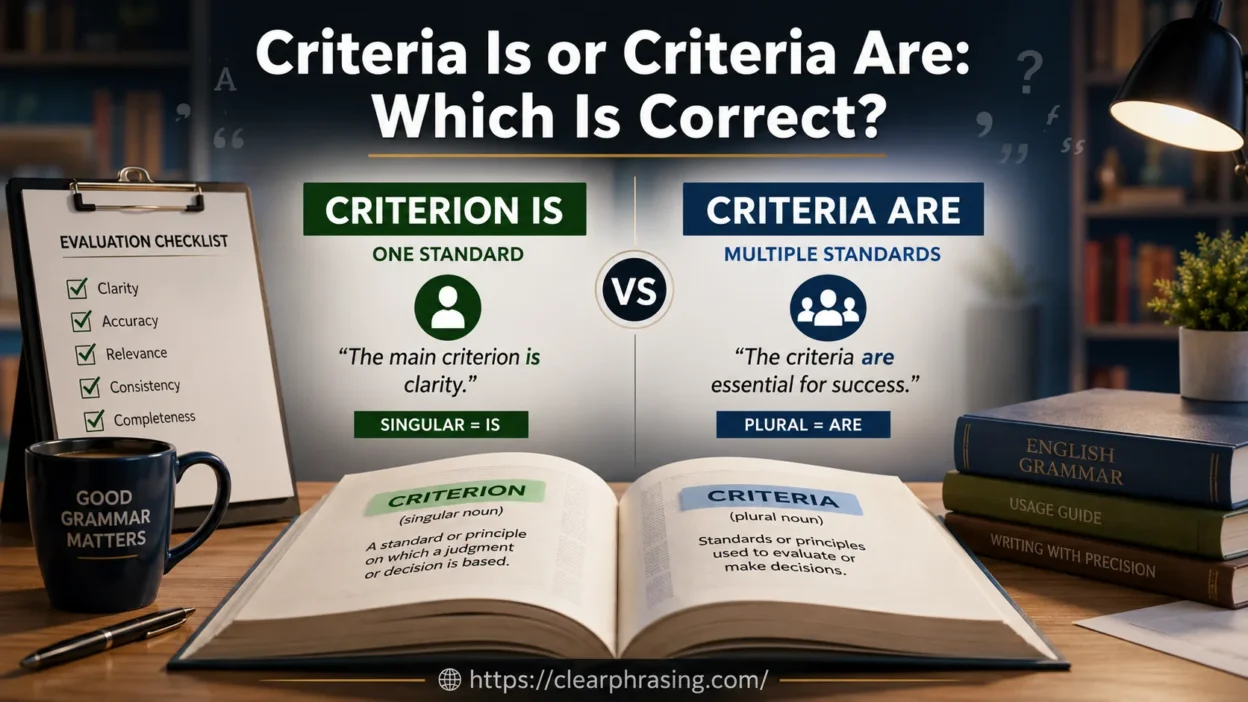
Criterion is the singular form, meaning one standard or factor, so criterion is is correct. Criteria is the plural form, meaning several standards, requirements, or factors, so use criteria are. This grammar rule helps English learners avoid confusion and choose accurate usage.
The history of this word comes from a borrowed language, which gives its forms unusual baggage. Traditionally, careful standard English uses a plural verb with criteria, making “The criteria are strict” grammatically correct. However, English changes, and modern informal English sometimes treats criteria as one general set of requirements.
You may encounter this form in real-world writing and professional conversations.In my teaching experience, this common mistake appears in academic writing, business communication, applications, reports, and exams. A simple trick helps you remember the rule: use criterion for one, and criteria for several.
This choice keeps your sentences clear, improves correct usage, and makes this tricky grammar point less challenging.
Quick Answer
The traditional rule is straightforward:
- Criterion is → one standard
- Criteria are → two or more standards
- Criteria is → used as a singular construction in modern English
- Criterias → generally avoid in standard formal writing
Compare these examples:
The main criterion is affordability.
There is one standard: affordability.
The main criteria are affordability, quality, and reliability.
There are several standards.
A useful rule to remember is:
One criterion. Several criteria.
For formal writing, academic work, business documents, reports, and professional communication, criterion is and criteria are provide the clearest distinction.
The Basic Rule
The choice between is and are depends on whether you’re referring to one standard or several.
| Number | Noun | Verb | Example |
| Singular | criterion | is | The criterion is important. |
| Plural | criteria | are | The criteria are important. |
A criterion is a standard used to judge, evaluate, or make a decision about something.
Criteria, traditionally, refers to multiple standards.
For example:
Experience is the main criterion for the position.
Only one standard appears in the sentence.
Now consider:
Experience, education, and communication skills are the main criteria for the position.
The sentence identifies several standards. Therefore, criteria are follows the traditional agreement pattern.
Use “Criterion Is” for One Standard
Use criterion when you mean one standard, requirement, or basis for judgment.
Examples include:
- The main criterion is accuracy.
- The primary criterion is cost.
- One criterion is previous experience.
- The only criterion is academic performance.
- The most important criterion is reliability.
Consider this sentence:
Safety is the primary criterion when selecting the equipment.
The sentence identifies safety as one deciding standard.
A simple way to picture the difference is to imagine a measuring stick. If you’re judging something with one measuring stick, you have one criterion.
Use “Criteria Are” for Multiple Standards
Use criteria when you mean two or more standards.
Examples:
- The criteria are clearly defined.
- The selection criteria are strict.
- These criteria are difficult to meet.
- The eligibility criteria are listed below.
- Several criteria are used to evaluate applicants.
For example:
The hiring criteria are education, experience, technical skills, and communication ability.
That’s four standards. The traditional plural form criteria therefore takes are.
What Does Criterion Mean?
Criterion means a standard used to evaluate, judge, compare, or make a decision about something.
In simpler terms, a criterion is a yardstick for making a judgment.
Imagine that you’re choosing a new laptop. You might consider battery life, price, storage, weight, and performance.
If you care about only battery life, then battery life is your criterion.
Battery life is my main criterion when choosing a laptop.
If you consider battery life, price, storage, weight, and performance, you have several criteria.
This word commonly appears in situations involving evaluation, selection, comparison, testing, and decision-making.
Common Uses of “Criterion”
You may encounter criterion in phrases such as:
- selection criterion
- admission criterion
- eligibility criterion
- grading criterion
- performance criterion
- research criterion
- quality criterion
- evaluation criterion
For example:
Previous teaching experience is one important criterion for the position.
The phrase one important criterion makes the singular meaning obvious.
What Does Criteria Mean?
Criteria is traditionally the plural form of criterion.
It refers to multiple standards used to evaluate, compare, select, or judge something.
For example:
The committee established five criteria for selecting the winner.
Those five criteria might include:
- Originality
- Quality
- Accuracy
- Creativity
- Presentation
Each individual standard is a criterion. Together, they are criteria.
Think of the relationship this way:
One standard → criterion
Multiple standards → criteria
That’s the foundation for deciding whether is or are belongs in the sentence.
Criterion vs. Criteria at a Glance
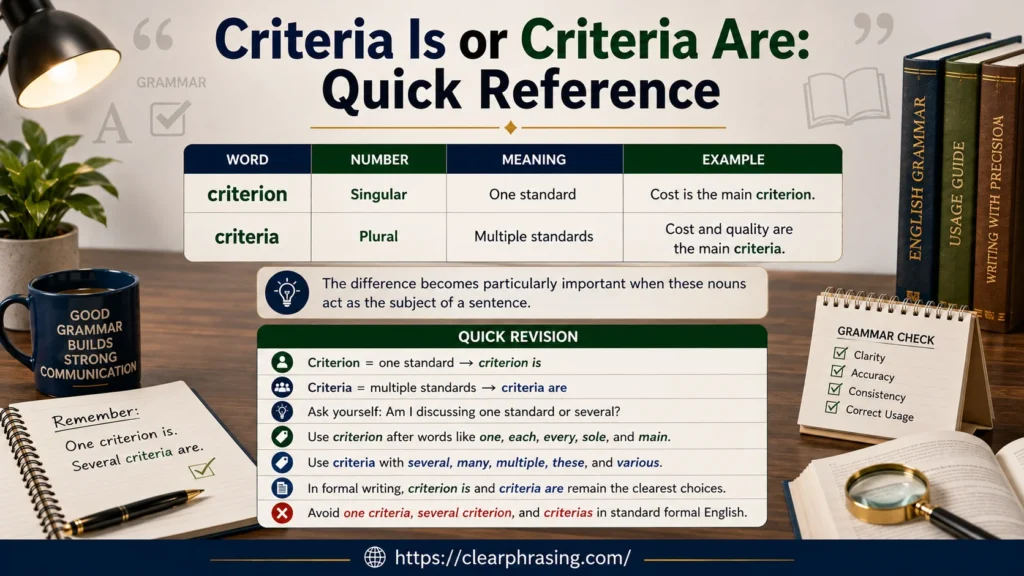
| Word | Number | Meaning | Example |
| criterion | Singular | One standard | Cost is the main criterion. |
| criteria | Plural | Multiple standards | Cost and quality are the main criteria. |
The difference becomes particularly important when these nouns act as the subject of a sentence.
Why Is “Criteria” Plural?
The unusual spelling has a linguistic explanation.
Most English plurals follow familiar patterns:
- standard → standards
- rule → rules
- requirement → requirements
- condition → conditions
Criterion, however, comes from Greek. Its traditional plural form criteria reflects that older linguistic origin.
English contains several other words with similar classical plural forms.
| Singular | Traditional plural |
| criterion | criteria |
| phenomenon | phenomena |
| analysis | analyses |
| thesis | theses |
| basis | bases |
This is why criteria can feel strange to English learners. It doesn’t behave like an ordinary English plural.
There’s another reason for the confusion. Speakers frequently use criteria to refer to an entire set of requirements. That collective meaning has helped encourage singular use in modern English.
Is “Criteria Is” Grammatically Correct?
The answer requires some nuance.
Under the traditional grammatical rule, criteria is plural. Therefore:
The criteria are important.
is the standard construction.
However, modern English increasingly uses criteria as a singular noun. Major dictionaries recognize this development, particularly in spoken and informal English.
As a result, you may encounter:
The criteria is unclear.
or:
The criteria is different for each department.
These examples reflect actual contemporary usage.
That doesn’t mean the traditional distinction has disappeared. Instead, English now has competing patterns.
For formal writing, the clearest approach remains:
The criterion is unclear.
when referring to one standard.
Or:
The criteria are unclear.
when referring to multiple standards.
Why Does “Criteria Is” Appear?
Language changes through everyday use.
When people repeatedly hear criteria used as the name of an entire set of requirements, they may begin treating it as one collective unit.
For example:
The criteria is difficult to understand.
The speaker may be thinking of the whole set of requirements as one framework.
This kind of grammatical shift isn’t unusual. English has absorbed thousands of words from other languages, and some have gradually changed their grammatical behavior.
Words such as data and agenda have also developed usage patterns that differ from their original classical forms.
So, rather than treating every modern use as a simple mistake, it’s more accurate to recognize the difference between traditional grammar and evolving usage.
Should You Use “Criteria Is” in Formal Writing?
If your goal is clear and conventional formal writing, criterion is is usually the better choice when you mean one standard.
Consider:
The criteria is difficult to understand.
The reader may wonder whether criteria refers to one standard, several standards, or an entire set treated as a single unit.
Now compare:
The criterion is difficult to understand.
The meaning is immediately clear.
Or:
The criteria are difficult to understand.
Again, the number is obvious.
This clarity matters in:
- Academic papers
- Research reports
- Business documents
- Job descriptions
- Application guidelines
- Government documents
- Technical writing
- Educational materials
There’s little benefit in choosing an ambiguous construction when a clearer alternative takes only one word.
Common Mistakes
The word criteria produces several predictable errors. Most disappear once you understand its number.
“The Criteria Is”
This is probably the sentence that causes the most debate.
Traditional formal usage prefers:
❌ The criteria is too strict.
If you’re referring to one standard:
✅ The criterion is too strict.
If you’re referring to multiple standards:
✅ The criteria are too strict.
Don’t start by choosing between is and are. First decide how many standards you’re discussing.
“One Criteria”
Some writers mistakenly use criteria after one.
❌ One criteria must be satisfied.
The traditional form is:
✅ One criterion must be satisfied.
The word one clearly signals a singular noun.
“Several Criterion”
This mistake reverses the problem.
❌ Several criterion must be met.
The correct traditional construction is:
✅ Several criteria must be met.
The word several indicates more than one.
“Criterias”
Writers sometimes add -s because they assume criteria is singular.
❌ The company uses several criterias.
Use:
✅ The company uses several criteria.
For standard formal writing, criteria is the usual plural form.
Real-World Examples
The distinction becomes much easier when you see it in practical situations.
Academic Example
Suppose a professor evaluates essays according to grammar, organization, evidence, and originality.
Those are four standards.
The grading criteria are grammar, organization, evidence, and originality.
Now imagine that the professor evaluates the essays using only grammar.
Grammar is the main criterion.
The number of standards changes the noun.
Hiring Example
A company might evaluate candidates based on education, experience, communication skills, and technical ability.
The hiring criteria are education, experience, communication skills, and technical ability.
Now imagine that the company has one essential requirement:
Relevant experience is the primary criterion.
The difference is easy to see.
Product Selection Example
Imagine you’re choosing a smartphone based on price, battery life, camera quality, and storage.
Price, battery life, camera quality, and storage are the main criteria.
But if price alone determines your decision:
Price is the deciding criterion.
One factor becomes a criterion. Several factors become criteria.
A Practical Case Study
Imagine a scholarship committee selecting one recipient.
The committee evaluates every applicant using three standards:
- Academic performance
- Financial need
- Community involvement
The committee could write:
The selection criteria are academic performance, financial need, and community involvement.
Why are?
Because the committee has three separate standards.
Now imagine that the scholarship rules change. Financial need becomes the only deciding factor.
The wording changes:
Financial need is the sole criterion.
Why is?
Because only one standard remains.
This example captures the central rule:
One standard = criterion is.
Multiple standards = criteria are.
Quick Comparison
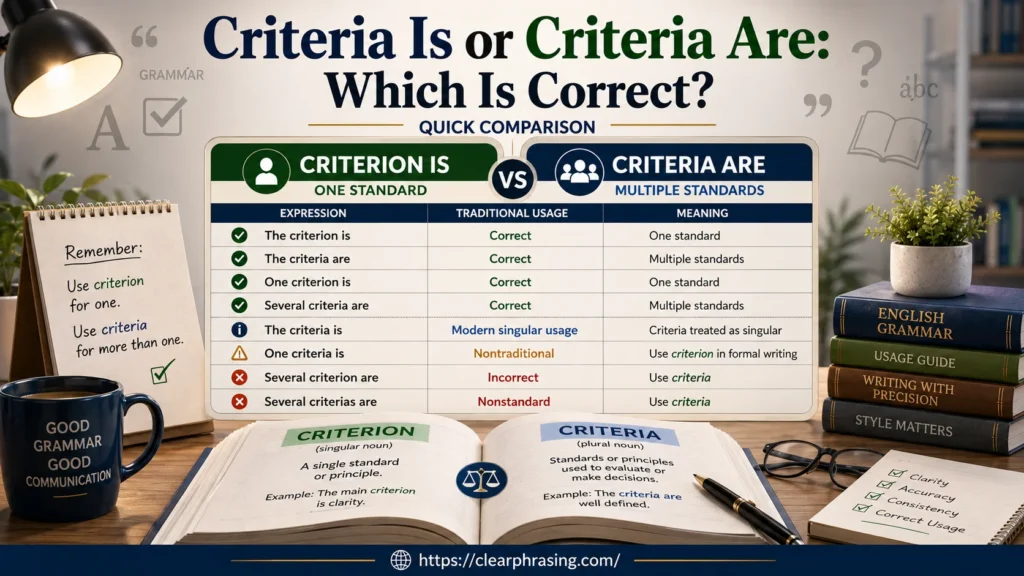
| Expression | Traditional usage | Meaning |
| The criterion is | Correct | One standard |
| The criteria are | Correct | Multiple standards |
| One criterion is | Correct | One standard |
| Several criteria are | Correct | Multiple standards |
| The criteria is | Modern singular usage | Criteria treated as singular |
| One criteria is | Nontraditional | Use criterion in formal writing |
| Several criterion are | Incorrect | Use criteria |
| Several criterias are | Nonstandard | Use criteria |
This table also highlights an important point: “criteria is” isn’t simply a typo in every modern context.
It reflects a genuine shift in English usage. However, traditional forms remain the safer option when precision matters.
When “Criteria Is” May Make Sense
Modern usage deserves recognition because readers will encounter it.
A sentence such as:
The criteria is different for each department.
may treat criteria as one overall framework.
This singular use has become common enough to receive dictionary recognition.
Still, formal writers have an easy way to avoid the ambiguity.
If there’s one standard, write:
The criterion is different for each department.
If there are several standards, write:
The criteria are different for each department.
The goal isn’t to win a grammar argument. It’s to make the sentence easy to understand.
How to Choose Between Criteria Is and Criteria Are
When you’re unsure, use this three-step approach.
Ask What You Mean
First, determine the number of standards.
One standard?
Use criterion.
Multiple standards?
Use criteria.
Match the Verb
After identifying the noun, choose the traditional matching verb:
- criterion → is
- criteria → are
For example:
The main criterion is cost.
The main criteria are cost, quality, and durability.
Check the Context
Certain words can reveal whether the sentence refers to one or multiple standards.
Singular clues:
- one
- a
- an
- each
- every
- sole
- only
- primary
- main
Plural clues:
- several
- many
- multiple
- various
- these
- those
- all
- two
- three
- five
For example:
The sole criterion is accuracy.
The word sole tells you there’s only one standard.
Compare:
The various criteria are accuracy, speed, and reliability.
The word various clearly signals multiple standards.
Formal and Informal English
Context affects which construction works best.
In formal writing, the traditional distinction provides a reliable way to make your meaning clear.
Use:
The criterion is…
for one standard.
Use:
The criteria are…
for multiple standards.
In informal conversation, you may hear:
The criteria is…
because singular criteria has become established in modern usage.
That doesn’t mean every speaker consciously knows the historical distinction. In fact, many people simply use the form that sounds natural to them.
For readers and writers, the practical lesson is more useful than a rigid rule:
Recognize “criteria is” as an established modern usage, but prefer “criterion is” when you mean one standard in careful formal writing.
My Personal Experience
As an English language specialist and teacher, I’ve seen how easily learners can become uncertain when two closely related grammatical forms appear in the same sentence.
Criterion and criteria are a good example because students often recognize the words but hesitate when deciding how to use them correctly. Over the years, I’ve found that explaining the meaning first makes the grammar much easier to understand. When learners know whether they are talking about one standard or several, the correct structure becomes much more natural.
My teaching experience has also shown me that memorizing grammar rules alone doesn’t always build confidence. Students learn better when they see how a rule works in practical writing, from classroom assignments to professional communication.
I encourage learners to examine the meaning, notice the number of things being discussed, and then make their grammatical choice. This approach helps turn a confusing language point into a clear and useful skill that students can apply with greater confidence.
Key Insights
- Criterion refers to one standard, while criteria refers to multiple standards.
- Understanding the meaning first makes choosing the correct grammatical form easier.
- Many learners struggle because they memorize rules without understanding the logic behind them.
- Practical examples help students apply grammar confidently in real writing situations.
- Checking whether you mean one or several things can prevent common mistakes.
- Learning grammar through meaning and context builds stronger, long-term confidence.
Practice Section
Test your understanding of criterion and criteria with these quick exercises.
Choose the Correct Word
Fill in each blank with criterion or criteria.
- The most important ______ for this job is experience.
- The selection ______ are clearly explained.
- Price is the main ______ when choosing a new laptop.
- The judges considered several ______ before selecting the winner.
- One important ______ is good communication.
Choose “Is” or “Are”
- The main criterion ______ accuracy.
- The admission criteria ______ listed on the website.
- Cost and quality ______ important criteria.
- The only criterion ______ reliability.
- These criteria ______ difficult to meet.
Answers
- criterion
- criteria
- criterion
- criteria
- criterion
- is
- are
- are
- is
- are
Quick reminder: One criterion is. Several criteria are.
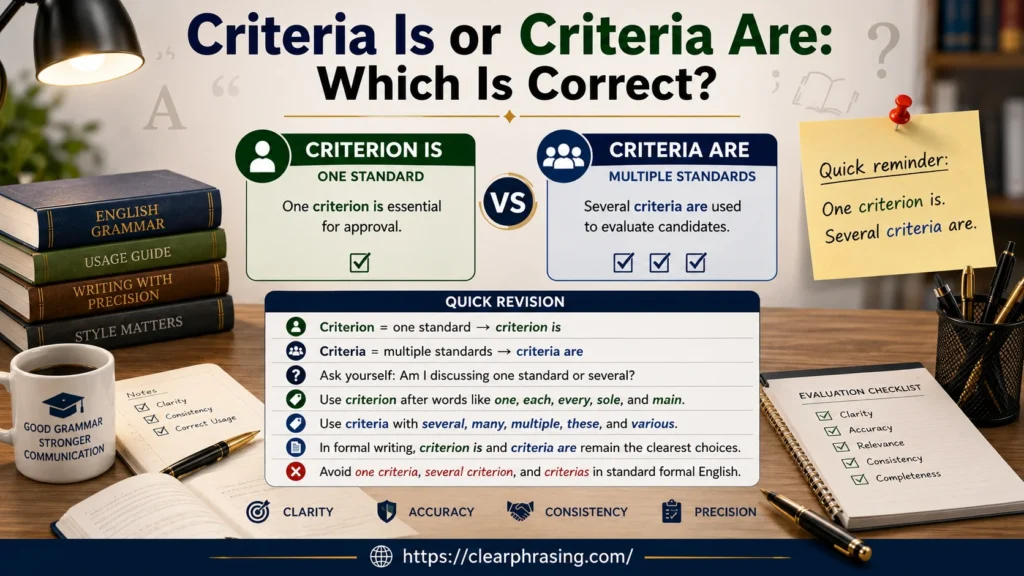
Quick Revision
- Criterion = one standard → criterion is
- Criteria = multiple standards → criteria are
- Ask yourself: Am I discussing one standard or several?
- Use criterion after words like one, each, every, sole, and main.
- Use criteria with several, many, multiple, these, and various.
- In formal writing, criterion is and criteria are remain the clearest choices.
- Avoid one criteria, several criterion, and criterias in standard formal English.
Read More: Racket or Racquet: Correct Spelling, Meaning, and Usage
FAQs
1. Is “criteria is” grammatically correct?
In standard English, criteria is is generally considered incorrect when criteria refers to multiple standards or requirements. The plural form criteria normally takes the plural verb are.
For example, you would write, “The criteria are clearly defined.” If you mean only one standard, use the singular noun criterion with is: “The main criterion is experience.”
2. Should I always use “criteria are”?
Not necessarily. Use criteria are when criteria refers to two or more individual standards, conditions, or requirements. That is the traditional and preferred construction in formal English.
If you’re talking about one standard, switch to criterion is. The easiest way to remember the distinction is simple: one criterion, two or more criteria.
3. What is the singular form of “criteria”?
The singular form of criteria is criterion. Both words refer to a standard used to judge, evaluate, or make a decision, but their grammatical numbers differ.
For instance, “Cost is an important criterion” discusses one standard. “Cost and quality are important criteria” discusses multiple standards.
4. Can “criteria is” appear in everyday English?
Yes, you may encounter criteria is in informal speech or real-world writing. Some speakers treat criteria as a collective idea, such as one overall set of requirements.
However, its appearance doesn’t make it the preferred choice in careful standard English. For formal writing, criteria are remains the safer construction when multiple standards are intended.
5. Why do people confuse “criteria” and “criterion”?
The confusion partly comes from the unusual plural pattern. Many English nouns form plurals by adding -s, but criterion changes to criteria.
Because both words look unfamiliar to many learners, it’s easy to mix up their grammatical roles. Learning them as a pair makes the difference much easier to remember.
6. Is “the criteria are” correct?
Yes. The criteria are is correct when criteria refers to multiple standards or requirements.
For example, “The selection criteria are strict” means that several conditions must be satisfied. If only one condition matters, you would instead write, “The selection criterion is strict.”
7. Can “criteria” refer to one set of requirements?
Yes, criteria can describe a collection or set containing multiple requirements. Even when those requirements work together as one overall system, standard English generally treats criteria as plural.
Therefore, you can say, “The criteria are listed below,” even though all the requirements belong to one application, test, or evaluation process.
8. Which form should I use in academic writing?
In academic writing, criteria are is normally the best choice when you mean multiple standards. Academic work benefits from precise grammatical agreement, especially when discussing research methods, evaluations, or selection standards.
Use criterion is when referring to a single standard. This distinction keeps your writing precise and prevents an otherwise small grammar issue from distracting readers.
9. Is “criterion are” ever correct?
No, not when criterion functions as the singular noun. Since criterion is singular, it normally takes is, not are.
For example, “The main criterion is reliability” is correct. When you change the noun to plural criteria, the verb changes as well: “The main criteria are reliability and cost.”
10. What is the easiest way to remember the difference?
Think of criterion as one measuring stick and criteria as several measuring sticks. The singular word takes is, while the plural word takes are.
So, remember this quick pattern: one criterion is, but several criteria are. Once you connect the noun with its matching verb, choosing between the two forms becomes much more automatic.
Conclusion
Understanding criteria and criterion doesn’t require memorizing a complicated grammar rule. The essential distinction is grammatical number. Criterion is singular, while criteria is plural, so the matching verbs are usually is and are, respectively. This simple pattern solves most questions about their usage.
You may still see criteria is in informal conversations and modern writing, particularly when speakers view criteria as one collective set of requirements. Even so, formal and careful English generally favors criteria are when multiple standards are involved. Keeping this convention in mind can help you write with greater consistency.
The quickest memory trick is to pair each noun with its verb: criterion is and criteria are. Whether you’re preparing an academic paper, writing a report, completing an application, or communicating professionally, this small distinction can make your sentences sound clearer and more polished.

Mariam Asghar is an English specialist and professional content writer at ClearPhrasing.com. She is dedicated to helping readers improve their English through clear, practical, and easy-to-understand content. Her areas of expertise include grammar, spelling, vocabulary, punctuation, sentence structure, and effective writing.
At ClearPhrasing.com, Mariam writes comprehensive, well-researched articles that simplify complex language concepts for students, professionals, writers, and English learners. She believes that strong communication begins with a solid understanding of the English language and strives to make every lesson accessible and engaging.
With a strong commitment to quality, accuracy, and continuous learning, Mariam ensures that each article is carefully researched, thoroughly reviewed, and written to help readers communicate with greater confidence and clarity.