Wriggle Room vs. Wiggle Room: Difference and Usage can confuse people because both expressions sound similar.
When negotiating, wiggle room means flexibility, space, or extra leeway to change plans. It fits a deal, price, schedule, or other situations where you need freedom to adjust. Wriggle room has a different meaning and suggests physically moving in a tight space, like a worm that wriggles through soil.
The two terms may look like twins, but their usage isn’t completely interchangeable. In everyday language, native speakers generally use wiggle room when discussing flexibility. You might leave some room in a trip schedule for unexpected events or keep options open during negotiating. If you dig deeper and learn the rules, this subtle difference becomes easier to understand.
Understanding the essence of each term is a game-changer for mastering the English language and improving your vocabulary. Although speaker’s preference can affect unusual uses, choosing your words wisely helps your conversations sound more natural and communicate your intended meaning effortlessly.
Understanding the difference can help you choose the expression that fits your audience. So, let’s clear up the confusion between wriggle room vs. wiggle room once and for all.
Quick Answer:
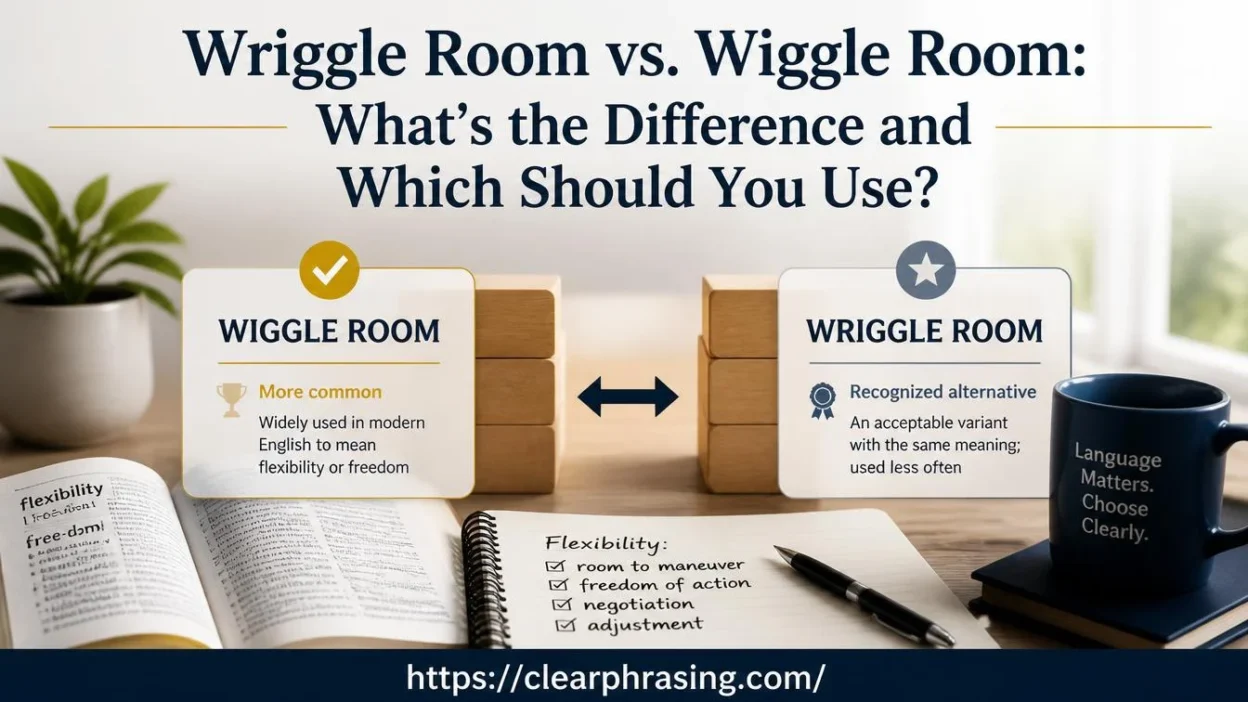
Wiggle room and wriggle room generally have the same meaning. Both refer to flexibility, freedom, or an opportunity to make changes.
The main difference is usage. Wiggle room is the more common form, while wriggle room is a recognized alternative, particularly in British usage.
| Expression | Correct? | Meaning | General Usage |
| Wiggle room | Yes | Flexibility or freedom to adjust | More common and widely used |
| Wriggle room | Yes | Essentially the same meaning | Less common; mainly associated with UK usage |
The Simple Rule
If you’re unsure which expression to use, choose wiggle room.
It works naturally in American English, international English, business communication, and everyday conversation.
When in doubt, use “wiggle room.”
That doesn’t mean wriggle room is wrong. It simply means that wiggle room will usually sound more familiar to a wider audience.
What Does Wiggle Room Mean?
Wiggle room means flexibility or freedom to make changes, negotiate, adjust a plan, or interpret something differently.
The expression creates a simple mental picture. Imagine standing in a tight space. If you have enough space to move slightly, you have room to wiggle.
That physical image eventually developed into a figurative expression.
Today, people use wiggle room when talking about flexibility in situations involving:
- Budgets
- Schedules
- Negotiations
- Contracts
- Deadlines
- Rules
- Prices
- Business decisions
The expression is informal and uncountable. In business contexts, it can specifically describe how much details such as prices, costs, or times can change.
Examples of Wiggle Room
Here are some natural examples:
- We need some wiggle room in the budget.
- The deadline doesn’t leave us much wiggle room.
- Is there any wiggle room on the price?
- Leave yourself some wiggle room in your schedule.
- The agreement gives both sides some wiggle room.
The central idea remains the same.
If something has wiggle room, it isn’t completely fixed. You can still make adjustments.
If something has no wiggle room, the limits are firm.
What Does Wriggle Room Mean?
Wriggle room generally means the same thing as wiggle room.
It refers to flexibility, freedom to act, or an opportunity to change something.
The expression may appear less frequently, but it isn’t automatically incorrect. It is a recognized variation of the more common phrase. Cambridge directly cross-references wriggle room to wiggle room, while Oxford records the two forms as variants.
Does Wriggle Room Have a Different Meaning?
Not in the ordinary idiomatic sense.
This is where many explanations become unnecessarily complicated. People sometimes assume that because wiggle and wriggle have slightly different literal meanings, wiggle room and wriggle room must describe completely different things.
They don’t.
Both expressions generally describe room for flexibility.
Wriggle Room vs. Wiggle Room: The Main Difference
The biggest difference between wriggle room and wiggle room is usually frequency and regional preference, not meaning.
| Feature | Wiggle Room | Wriggle Room |
| Meaning | Flexibility or freedom to adjust | Essentially the same |
| Correctness | Correct | Correct |
| Frequency | More common | Less common |
| General Recommendation | Best choice for most writers | Recognized alternative |
| Regional Association | Widely used | More often linked with UK usage |
| Tone | Informal | Informal |
Oxford describes wiggle room as the more frequent form and wriggle room as less frequent.
The Real Difference Is Usage
Many grammar questions have a clear right-or-wrong answer.
This isn’t really one of them.
The important question isn’t:
“Which one is grammatically correct?”
A better question is:
“Which one will sound most natural to my readers?”
For most audiences, the answer is wiggle room.
Why Are Wiggle and Wriggle Different?
Although the expressions wiggle room and wriggle room have essentially the same idiomatic meaning, the verbs wiggle and wriggle have slightly different literal meanings.
| Word | Basic Literal Meaning | Example |
| Wiggle | Move slightly from side to side or back and forth | The child wiggled her fingers. |
| Wriggle | Twist and turn with short, twisting movements | The snake wriggled across the path. |
Wiggle
Wiggle usually describes small movements from side to side or back and forth.
For example:
- The baby wiggled her toes.
- He wiggled his fingers.
- The dog wiggled its tail excitedly.
Wriggle
Wriggle often suggests twisting and turning movements.
For example:
- The worm wriggled through the soil.
- The snake wriggled across the ground.
- The child tried to wriggle out of the tight space.
Merriam-Webster describes wriggle as movement involving short twisting or writhing motions and movement by twisting and turning.
The literal difference is real.
However, once the words become part of the idiomatic expressions wiggle room and wriggle room, that difference doesn’t create two separate meanings.
That’s an important point to remember.
Which Is More Common: Wiggle Room or Wriggle Room?
Wiggle room is more common.
That’s why it is generally the best choice when you’re writing for a broad audience.
Language works a little like clothing. Two outfits may both be perfectly acceptable, but one may feel more familiar in a particular setting.
The same principle applies here.
Wriggle room is recognized, but wiggle room is the form most readers are likely to expect. Oxford explicitly identifies wriggle room as the less frequent form.
Why Does Common Usage Matter?
Dictionary correctness matters, of course. However, natural communication involves more than correctness.
You also want your writing to feel familiar and smooth.
Imagine reading these two sentences:
- We need some wiggle room in the budget.
- We need some wriggle room in the budget.
Both communicate the same basic idea.
However, the first sentence will usually feel more familiar to a wider audience.
That familiarity makes wiggle room the safer choice.
Wiggle Room in American English
In American English, wiggle room is the natural and widely recognized expression.
You’ll often hear it in conversations about:
- Business deals
- Salaries
- Prices
- Deadlines
- Budgets
- Travel plans
- Contracts
For example:
The company has very little wiggle room in its budget.
That sentence sounds completely natural in American English.
You might also hear:
Is there any wiggle room on the price?
This question often appears during negotiations. The speaker wants to know whether the price is fixed or whether some flexibility exists.
Wriggle Room in British English
Wriggle room is a recognized alternative that appears mainly in British usage.
That means you shouldn’t automatically mark it as a mistake when you encounter it.
It is simply a less common variation.
However, wiggle room remains widely understood and recognized. Cambridge specifically notes wriggle room as a mainly UK alternative.
Which One Should International Writers Use?
For an international audience, wiggle room is usually the strongest choice.
It is:
- Widely understood
- Familiar to American readers
- Recognizable internationally
- Common in everyday communication
When you want the safest option, choose wiggle room.
What Does “No Wiggle Room” Mean?
One of the most common uses of the expression appears in the phrase no wiggle room.
This means there is no flexibility whatsoever.
The rules are fixed. The deadline is firm. The decision cannot change.
Examples
- The contract leaves no wiggle room for negotiation.
- We have no wiggle room in the deadline.
- The budget gives us no wiggle room for extra expenses.
- The new policy leaves no wiggle room for exceptions.
Imagine trying to move inside a space so tight that you can’t shift even slightly.
That’s the image behind no wiggle room.
You’re working within strict limits.
How to Use Wiggle Room Correctly
One of the best ways to learn an English expression is to understand the words that naturally appear around it.
Wiggle room commonly works with words that describe the amount of flexibility available.
Common Expressions With Wiggle Room
| Expression | Meaning |
| Some wiggle room | A certain amount of flexibility |
| A little wiggle room | A small amount of flexibility |
| Plenty of wiggle room | A large amount of flexibility |
| Enough wiggle room | A sufficient amount of flexibility |
| More wiggle room | Additional flexibility |
| Less wiggle room | Reduced flexibility |
| Very little wiggle room | Almost no flexibility |
| No wiggle room | No flexibility at all |
Common Verbs With Wiggle Room
| Verb or Phrase | Example |
| Have wiggle room | We still have wiggle room in the budget. |
| Leave wiggle room | Leave some wiggle room in your schedule. |
| Give wiggle room | The agreement gives both sides wiggle room. |
| Allow wiggle room | The rules allow some wiggle room. |
| Create wiggle room | The changes created more wiggle room. |
| Need wiggle room | We need more wiggle room before the deadline. |
Examples in Everyday English
Wiggle Room in a Budget
We should leave some wiggle room in the budget for unexpected expenses.
Wiggle Room in a Schedule
Try to build some wiggle room into your schedule.
Wiggle Room in a Negotiation
The seller may have some wiggle room on the final price.
Wiggle Room in a Contract
The wording gives both sides some wiggle room.
Wiggle Room Before a Deadline
We have very little wiggle room before the project deadline.
These combinations help you use the phrase naturally instead of forcing it into a sentence.
Can You Say “More Wiggle Room”?
Yes, you can.
Wiggle room works naturally with comparative expressions.
| Expression | Example |
| More wiggle room | We need more wiggle room in the schedule. |
| Less wiggle room | The new rules give us less wiggle room. |
| Enough wiggle room | Do we have enough wiggle room to negotiate? |
| Little wiggle room | There is little wiggle room in the budget. |
| No wiggle room | The deadline leaves no wiggle room. |
Consider this example:
If we extend the deadline by two days, we’ll have more wiggle room.
Or:
The new budget gives us less wiggle room than last year’s budget.
These expressions are especially common when people compare different plans or situations.
Can You Say “Wiggle Rooms”?
Usually, no.
Wiggle room is generally treated as an uncountable noun when it means flexibility.
That means these expressions sound natural:
- We need more wiggle room.
- There isn’t much wiggle room.
- Do we have enough wiggle room?
- The project needs more wiggle room.
This sounds unnatural in the usual idiomatic sense:
- We need more wiggle rooms.
Think about the word flexibility.
You normally say:
We need more flexibility.
You don’t usually say:
We need more flexibilities.
The same basic pattern applies to wiggle room.
Wiggle Room vs. Leeway
Leeway is one of the closest alternatives to wiggle room.
Both words describe freedom within limits. Merriam-Webster lists leeway and latitude as synonyms of wiggle room.
Wiggle Room
This sounds conversational and informal.
We need some wiggle room in the schedule.
Leeway
This sounds slightly more neutral and can fit comfortably into professional writing.
The manager gave the team some leeway.
Both sentences describe flexibility.
Still, wiggle room creates a more vivid mental image. Leeway sounds more straightforward.
Wiggle Room vs. Latitude
Latitude can also mean freedom to act or make decisions.
However, it generally sounds more formal.
Compare these sentences:
- The team needs more wiggle room.
- The team needs more latitude.
The meaning overlaps.
Yet the tone changes.
Wiggle room feels conversational.
Latitude feels more formal and professional.
| Expression | Tone | Main Meaning |
| Wiggle room | Informal and conversational | Flexibility to adjust |
| Leeway | Neutral | Freedom within limits |
| Latitude | More formal | Freedom to act or decide |
Choose the expression that fits your audience and situation.
Wiggle Room vs. Room to Maneuver
These expressions have similar meanings, but they emphasize different ideas.
Wiggle Room
Wiggle room usually focuses on flexibility within existing limits.
We have some wiggle room in the budget.
Room to Maneuver
Room to maneuver often suggests strategic freedom.
The company needs room to maneuver during negotiations.
The difference is subtle.
Wiggle room often involves adjustments.
Room to maneuver often involves strategy.
A company might have wiggle room to change its budget. At the same time, it may need room to maneuver during a difficult business situation.
Wiggle Room vs. Margin for Error
These expressions can also confuse English learners.
They are related, but they aren’t interchangeable.
Wiggle Room Means Flexibility
You can change something.
The schedule has some wiggle room.
Margin for Error Means Tolerance for Mistakes
You can make a small mistake without causing serious failure.
The calculation has very little margin for error.
| Expression | What It Allows |
| Wiggle room | Changes and adjustments |
| Margin for error | Mistakes within acceptable limits |
This difference becomes particularly important in technical, financial, and professional writing.
Where Did the Expression “Wiggle Room” Come From?
The phrase creates a very clear physical image.
Imagine being inside a tight space.
If you have enough space to move slightly, you have wiggle room.
Over time, English speakers began using that physical idea figuratively.
The meaning developed like this:
Physical space
↓
Ability to move
↓
Freedom to maneuver
↓
Flexibility in a situation
That’s why the phrase feels so natural.
The first known use of wiggle room in this figurative sense dates to 1965, according to Merriam-Webster.
A Practical Case Study: Wiggle Room in a Budget
Let’s see how the expression works in a realistic situation.
Imagine a small business preparing for a new project.
The company estimates the following expenses:
| Expense | Planned Cost |
| Materials | $8,000 |
| Marketing | $3,000 |
| Labor | $12,000 |
| Software | $2,000 |
| Total | $25,000 |
Now imagine the company has exactly $25,000 available.
Everything looks fine on paper.
Then the software company increases its price.
Suddenly, the budget has a problem.
Why?
Because there is no wiggle room.
Now imagine the company sets aside an additional $3,000 for unexpected costs.
| Budget Situation | Available Amount |
| Planned Project Costs | $25,000 |
| Emergency Reserve | $3,000 |
| Total Available Budget | $28,000 |
| Wiggle Room | $3,000 |
The project now has flexibility.
That extra money creates wiggle room.
The Practical Lesson
Good planning doesn’t mean spending every available dollar.
Sometimes, the smartest plan leaves space for unexpected problems.
That’s wiggle room in action.
A Practical Case Study: Wiggle Room in a Schedule
Now consider a common travel situation.
Your flight leaves at 3:00 p.m.
You decide to arrive at the airport at 2:50 p.m.
Technically, you have a plan.
Realistically, you’ve left yourself almost no wiggle room.
Traffic could slow you down.
Security could take longer.
Parking could become a problem.
A small delay could ruin the entire plan.
Now imagine arriving at 12:30 p.m.
You have created flexibility.
Unexpected problems can happen without immediately destroying your schedule.
That’s wiggle room.
| Arrival Plan | Wiggle Room | Risk Level |
| Arrive at 2:50 p.m. | Almost none | Very high |
| Arrive at 12:30 p.m. | Significant | Lower |
The Lesson
A good schedule doesn’t fill every minute.
Sometimes, leaving empty space is the smartest decision you can make.
Common Mistakes
Thinking Wriggle Room Is Always Wrong
This is incorrect.
Wriggle room is a recognized variation.
It may be less common, but less common doesn’t mean wrong.
Thinking the Expressions Have Completely Different Meanings
They don’t.
Both generally describe flexibility or freedom to make changes.
The difference mainly involves usage frequency and regional preference.
Assuming Wiggle Room Is Formal Language
It isn’t.
Wiggle room is generally an informal expression.
However, informal doesn’t mean unprofessional.
People frequently use it in:
- Business meetings
- Workplace conversations
- Emails
- Negotiations
- Everyday professional communication
For highly formal writing, you might choose:
- Flexibility
- Discretion
- Latitude
- Leeway
- Scope for adjustment
Using the Plural Unnecessarily
Remember that wiggle room is usually uncountable.
Use:
- More wiggle room
- Less wiggle room
- Some wiggle room
Avoid using wiggle rooms when you mean flexibility.
When Should You Use Wiggle Room Instead of Wriggle Room?
Here’s the easiest practical guide.
Use “Wiggle Room” When:
- You’re writing in American English.
- You’re writing for an international audience.
- You want the most familiar version.
- You’re writing business content.
- You’re unsure which form to choose.
Use “Wriggle Room” When:
- You’re following British English usage.
- A publication uses that variation.
- You’re quoting someone directly.
- Consistency requires that spelling.
The Best General Recommendation
For most writers, wiggle room is the safest choice.
It is familiar, natural, and widely understood.
A Simple Memory Trick for Wriggle Room vs. Wiggle Room
You don’t need a complicated rule.
Just remember this:
Wiggle room is the common choice. Wriggle room is the recognized alternative.
That’s enough to solve the problem in most situations.
If you’re writing for a broad audience, choose wiggle room and move on.
No need to tie yourself in knots.
Read More: Ins and Outs or In’s and Out’s: Which Is Correct?
FAQs
Is “wiggle room” the correct expression for flexibility?
Yes. Wiggle room is the standard and natural expression when you mean having extra space, freedom, or flexibility to change something. You can use it when discussing prices, schedules, plans, deadlines, or negotiations.
What does “wriggle room” mean?
Wriggle room literally suggests enough physical space to move or twist around. It connects with the verb wriggle, which describes making small movements, especially when you’re in a narrow or uncomfortable space.
Are “wriggle room” and “wiggle room” interchangeable?
Not usually. Although the expressions look and sound similar, wiggle room is the established choice for flexibility or freedom to adjust. Wriggle has a stronger connection with physical movement.
Can I use “wiggle room” during a negotiation?
Absolutely. Wiggle room works especially well when you still have some freedom to change your offer, price, deadline, or conditions during a negotiation.
Is “wriggle room” always incorrect?
No. Wriggle room can make sense when the intended idea involves physical movement within a limited space. However, using it to mean flexibility in a negotiation may sound unusual to many readers.
Why do people confuse these two expressions?
The confusion comes mainly from their similar spelling, pronunciation, and general association with movement. Both words suggest movement, but wiggle room developed the broader figurative meaning of flexibility.
Which phrase sounds more natural in everyday English?
Wiggle room sounds much more natural when you’re talking about choices, plans, agreements, or negotiations. It’s the expression most readers and listeners will expect in these contexts.
Can “wiggle room” describe a flexible schedule?
Yes. You can say that you’ve left some wiggle room in your schedule when you have extra time available for delays, changes, or unexpected events.
Does “wiggle room” work in formal writing?
Yes, but consider your audience and tone. It’s widely understood, although a more formal alternative such as flexibility, leeway, or margin for adjustment may suit highly formal documents better.
What is the easiest way to remember the difference?
Think of wiggle room as room for flexibility and wriggle room as room for physical movement. This simple association can help you choose the right expression quickly.
Conclusion
Choosing between wriggle room and wiggle room becomes much easier once you connect each expression with its main idea. Wiggle room is the phrase you’ll normally want when discussing flexibility, negotiations, schedules, prices, plans, or changing conditions.
Wriggle room has a more physical feel because wriggle describes twisting or moving through a restricted area. That distinction gives the two expressions their own identities, even though their spelling and sounds can make them easy to mix up.
Once you recognize that difference, your word choice becomes more confident and natural. When you need to describe flexibility, especially in everyday English or negotiation, wiggle room is the safer and more familiar choice.

Mariam Asghar is an English specialist and professional content writer at ClearPhrasing.com. She is dedicated to helping readers improve their English through clear, practical, and easy-to-understand content. Her areas of expertise include grammar, spelling, vocabulary, punctuation, sentence structure, and effective writing.
At ClearPhrasing.com, Mariam writes comprehensive, well-researched articles that simplify complex language concepts for students, professionals, writers, and English learners. She believes that strong communication begins with a solid understanding of the English language and strives to make every lesson accessible and engaging.
With a strong commitment to quality, accuracy, and continuous learning, Mariam ensures that each article is carefully researched, thoroughly reviewed, and written to help readers communicate with greater confidence and clarity.