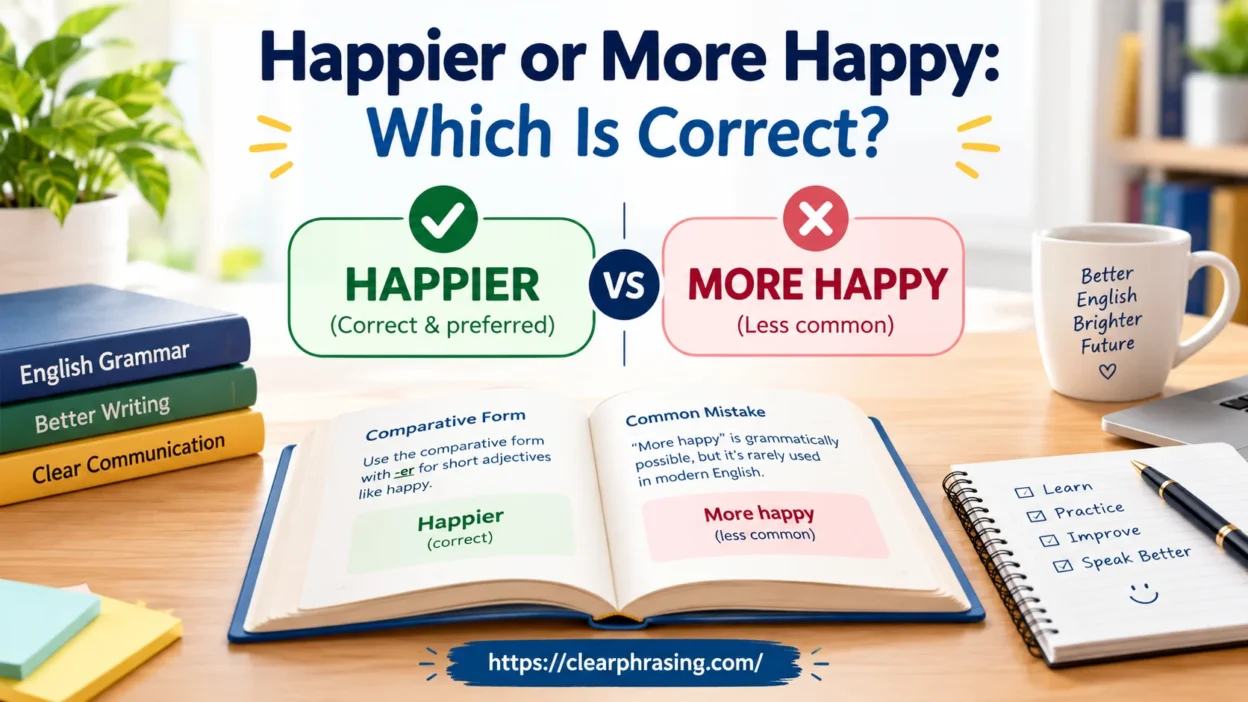
Happier or More Happy: Which Is Correct? Both forms are correct, but happier sounds more natural in most situations. Happy is an adjective, while happier is its comparative form. We use it when comparing two things, such as when she feels happier today than yesterday. More happy is also acceptable, but it’s less common.
As an English language specialist and teacher, I’ve noticed that students often understand grammar rules but hesitate when choosing an expression. I explain this grammar point through simple sentences because English can sometimes feel like a tricky beast of unspoken rules. In everyday conversation, happier is shorter, flows better, and feels natural.
On the other hand, more happy can add emphasis, especially in formal writing. When expressing joy, choosing happier usually gives you the neat answer. The usual comparative word helps show that someone feels more joyful than another person. Although both forms create a similar picture, the choice can make your language sparkle and may come as a surprise.
Quick Answer:
Happier is the standard comparative form of happy. Use it when you compare someone’s level of happiness with another person, time, situation, or experience.
The basic forms are:
| Form | Grammar Role | Example |
| happy | Base adjective | She feels happy. |
| happier | Comparative adjective | She feels happier today. |
| happiest | Superlative adjective | She feels happiest at home. |
| more happy | Less common comparative form | It may appear in particular contexts. |
For most everyday writing and conversation, choose happier. For example, “I feel happier now” sounds natural and complete even though the sentence doesn’t explicitly state what the speaker is comparing.
What Does Happier Mean?
Happier describes a greater degree of happiness. It is the comparative form of happy, so you use it when one emotional state exceeds another.
You might compare two people:
- Maria is happier than her sister.
- The children seem happier than their parents.
You might compare two periods: - I’m happier now than I was last year.
- She feels happier than she did before.
You can also compare situations: - He is happier working from home.
- They were happier in their old neighborhood.
The comparison doesn’t always need to be stated. If someone says, “I’m happier now,” the listener can usually infer a comparison with an earlier period.
Why Is Happier the Correct Comparative Form?
English has two major ways to form comparative adjectives. Short adjectives often take -er, while longer adjectives generally use more.
Adjectives That Commonly Take -er
Examples include:
- tall → taller
- short → shorter
- fast → faster
- kind → kinder
- young → younger
Adjectives That Commonly Use More
Longer adjectives generally use more:
- interesting → more interesting
- expensive → more expensive
- comfortable → more comfortable
- complicated → more complicated
Happy follows the -er pattern because it ends in a consonant plus y. The comparative form changes the final y to i and adds -er.
happy → happier
The superlative follows the same spelling pattern:
happy → happiest
This pattern is also found in adjectives such as easy, busy, and funny.
| Base Adjective | Comparative | Superlative |
| happy | happier | happiest |
| easy | easier | easiest |
| busy | busier | busiest |
| funny | funnier | funniest |
| pretty | prettier | prettiest |
| lazy | lazier | laziest |
Why Does Happy Become Happier?
The spelling rule is straightforward. When an adjective ends in a consonant followed by y, English normally changes the y to i before adding -er or -est.
The process looks like this:
happy → happi → happier
The same principle gives us:
happy → happiest
This explains why happyer is incorrect.
| Correct Form | Incorrect Form | Reason |
| happier | happyer | Change y to i before adding -er. |
| happiest | happyest | Change y to i before adding -est. |
A useful rule to remember is simple: consonant + y → change y to i before -er or -est.
Can You Say More Happy?
You may encounter more happy, but it isn’t the usual choice for a basic comparison. In everyday English, happier generally sounds more natural.
Compare these sentences:
- I feel happier today. ✅
- I feel more happy today. Less natural in ordinary usage.
The second sentence is understandable. However, most speakers would normally choose happier.
That doesn’t mean more happy can never appear. English sometimes allows variation with two-syllable adjectives, especially when a writer wants a particular emphasis, contrast, or rhythm. The important distinction is between possible English and the most natural everyday choice.
If you’re writing an essay, email, article, school assignment, or ordinary conversation, happier is usually the better option.
Happier vs. More Happy: What Is the Difference?
The two forms can communicate a greater degree of happiness, but they don’t have equal status in normal usage.
| Feature | Happier | More Happy |
| Standard comparative form | Yes | Less common |
| Common in everyday English | Very common | Uncommon |
| Best for straightforward comparisons | Yes | Usually not |
| Natural choice for learners | Yes | Usually no |
| Can occur in special stylistic contexts | Yes | Yes |
The practical rule is easy to remember: use happier unless you have a specific reason to choose more happy.
When Should You Use Happier?
There are several common situations where happier fits naturally.
Comparing Present and Past Feelings
Use happier when someone’s emotional state has changed over time.
- I’m happier now than I was before.
- She is happier since moving closer to her family.
- He seems happier than he did last month.
- We’re happier in our new home.
These sentences clearly show a change in emotional state.
Comparing Two People
You can compare the happiness of two people.
- Sarah is happier than her brother.
- The younger children seem happier than the older ones.
- He looks happier than his coworkers.
The comparison can describe an observed emotional difference rather than a measurable quantity.
Comparing Two Situations
Sometimes the comparison involves circumstances rather than people.
- I’m happier working remotely.
- She is happier with her new schedule.
- They were happier living in the countryside.
Here, happier shows which situation produces a greater sense of satisfaction or emotional well-being.
Showing Emotional Change
Happier can also describe gradual improvement.
- She became happier after changing careers.
- He grew happier as he became more confident.
- The children looked happier after the rain stopped.
This use doesn’t require a direct comparison because the change itself creates the comparison.
Happier Than vs. Happier With
These two expressions are easy to confuse because both commonly appear after happier. However, than and with serve different purposes.
Happier Than
Use than when you compare one person, thing, period, or situation with another.
- I’m happier than I was last year.
- She is happier than her sister.
- He seems happier than before.
The word than introduces the other side of the comparison.
Happier With
Use with when you identify something that makes a person more satisfied or content.
- I’m happier with my new job.
- She is happier with this arrangement.
- Are you happier with the second option?
Compare the meanings
| Sentence | Meaning |
| I’m happier than before. | My current emotional state is better than my earlier state. |
| I’m happier with my new job. | My new job gives me greater satisfaction. |
The preposition changes the relationship between the ideas.
Do You Always Need Than After Happier?
No. Happier can appear without than when the comparison is obvious from context.
With an Explicit Comparison
I’m happier than I was five years ago.
Here, the sentence clearly identifies both points in the comparison.
With an Implied Comparison
I’m happier now.
The speaker doesn’t need to explain the earlier situation because the listener can infer it.
This structure is common in conversation. If someone asks, “How are things at your new job?”, you could simply answer, “I’m much happier now.”
The comparison remains clear even without than.
Can You Say Much Happier, Far Happier, or Slightly Happier?
Yes. Adverbs and phrases can modify happier to show the size of the difference.
| Expression | Meaning | Example |
| much happier | Noticeably happier | I’m much happier now. |
| far happier | Significantly happier | She is far happier in her new role. |
| a lot happier | Considerably happier | They seem a lot happier together. |
| slightly happier | A little happier | He feels slightly happier today. |
| a little happier | Somewhat happier | I’m a little happier than before. |
| somewhat happier | Moderately happier | She seems somewhat happier lately. |
These modifiers make comparisons more precise. Much happier suggests a clear difference, while slightly happier suggests only a small change.
Common Mistakes With Happier
Several errors appear repeatedly when people form the comparative of happy.
Writing Happyer Instead of Happier
❌ She feels happyer today.
✅ She feels happier today.
The final y changes to i before -er.
Using More Happier
❌ She is more happier now.
✅ She is happier now.
Happier already contains the comparative ending -er. Adding more creates a double comparative in standard English.
The same principle applies to other comparative forms:
- ❌ more faster
- ✅ faster
- ❌ more easier
- ✅ easier
- ❌ more smaller
- ✅ smaller
Confusing Than and Then
❌ I’m happier then before.
✅ I’m happier than before.
Than introduces a comparison. Then generally refers to time, sequence, or what happened next.
For example:
- I was younger then.
- I’m happier than before.
Using Most Happiest
❌ This is the most happiest day of my life.
✅ This is the happiest day of my life.
Happiest already expresses the superlative degree, so adding most isn’t necessary.
What’s the Difference?
The difference between happier and happiest comes down to the type of comparison.
Happier
Use happier when comparing two people, situations, periods, or levels.
She is happier than her sister.
Happiest
Use happiest when describing the highest degree of happiness within a group or range.
She is happiest when she spends time with her family.
The complete pattern is:
| Degree | Form | Example |
| Positive | happy | She is happy. |
| Comparative | happier | She is happier now. |
| Superlative | happiest | She is happiest at home. |
A simple way to remember it is happy → happier → happiest.
How to Choose Between -Er and More
The happier question connects to a broader rule in English grammar.
Short Adjectives Often Take -Er
Examples include:
- cold → colder
- bright → brighter
- quick → quicker
- strong → stronger
Longer Adjectives Usually Use More
Examples include:
- useful → more useful
- attractive → more attractive
- important → more important
- complicated → more complicated
Two-Syllable Adjectives Need More Attention
Two-syllable adjectives don’t all follow one rigid pattern. Some commonly take -er, some strongly favor more, and some allow variation.
Words ending in -y often use -er:
- happy → happier
- easy → easier
- busy → busier
- noisy → noisier
This is why happy doesn’t follow the same pattern as a word such as careful.
Real-Life Examples of Happier
Seeing the word in different settings makes the pattern easier to recognize.
Workplace Examples
- I’m happier in my new position.
- She seems happier since changing teams.
- He is much happier with his current schedule.
Family and Relationships
- The children are happier when both parents are home.
- She feels happier around her friends.
- They seem happier together now.
Everyday Situations
- I’m happier when I get enough sleep.
- He feels happier after exercising.
- You might be happier with the second option.
Looking Back
- I’m happier now than I was five years ago.
- She was happier before she moved away.
These examples show that happier works naturally across casual, professional, and personal contexts.
Happier or More Happy in Formal Writing
For formal writing, happier is generally the clearer choice when you need the ordinary comparative form of happy.
Consider an academic sentence:
Participants reported feeling happier after the program.
The sentence is direct and natural.
Replacing happier with more happy would draw unnecessary attention to the wording:
Participants reported feeling more happy after the program.
The reader can understand the meaning, but the first version follows the conventional comparative pattern more smoothly.
In formal writing, familiar grammatical structures usually help your ideas stand out instead of the wording itself.
Happier or More Happy in Everyday Conversation
In casual speech, happier is the natural choice for ordinary comparisons.
You might hear:
- “I’m happier now.”
- “She looks happier.”
- “He seems much happier.”
- “Are you happier there?”
These expressions are short, natural, and easy to understand.
More happy may appear in particular contexts, but it isn’t normally the form you need when speaking naturally.
A Simple Decision Guide
When you’re unsure, use this quick process:
Are you comparing a level of happiness?
→ Use happier.
Are you describing the greatest level within a group or range?
→ Use happiest.
Are you considering more happy because the sentence has a special contrast or stylistic purpose?
→ Check the context carefully.
For ordinary English, the safest pattern remains:
happy → happier → happiest
Practice:
Choose the form that sounds correct in each sentence.
- I feel ______ now than I did last month.
- She became ______ after moving closer to her family.
- Are you ______ with your new schedule?
- He looks ______ than he did yesterday.
- They seem much ______ in their new home.
- I’m ______ now that the project is finished.
Answers
- I feel happier now than I did last month.
- She became happier after moving closer to her family.
- Are you happier with your new schedule?
- He looks happier than he did yesterday.
- They seem much happier in their new home.
- I’m happier now that the project is finished.
The practice sentences reinforce the most important point: happier is the normal comparative form.
Quick Mistake Check
| Incorrect | Correct |
| happyer | happier |
| more happier | happier |
| happier then before | happier than before |
| most happiest | happiest |
| more happy in an ordinary comparison | happier |
A quick review like this can help you catch errors before submitting an assignment or publishing your writing.
Read More: Wriggle Room vs. Wiggle Room: Difference and Usage
FAQs
Is “happier” grammatically correct?
Yes. Happier is the standard comparative form of happy and is widely used when you compare a person, situation, or experience with another.
Is “more happy” also correct?
Yes, more happy can be grammatically correct. However, native speakers generally prefer happier because it sounds smoother and more natural in most contexts.
Should I use “happier” in everyday English?
Yes. Happier is usually the better choice for everyday conversation, casual writing, and ordinary comparisons. It’s concise and easy to understand.
When might “more happy” sound better?
More happy can work when you want to give special emphasis to the word happy or when the sentence has a particular rhythm or structure. Context matters.
Is “happier” a comparative adjective?
Yes. Happier is the comparative form of the adjective happy. You can use it to show that someone or something has a greater degree of happiness.
Can I say “happier than”?
Absolutely. Happier than is a common structure for making comparisons, such as saying that one person feels happier than another.
Is “more happier” correct?
No. Avoid more happier in standard English. Since happier already expresses the comparative form, adding more creates an unnecessary double comparative.
Does “happier” work in formal writing?
Yes. Happier is completely appropriate for formal writing. You don’t need to replace it with more happy simply because your writing is formal.
Why do people sometimes use “more happy”?
Writers may choose more happy for emphasis, style, or sentence rhythm. It’s less common than happier, but the construction can still appear in certain contexts.
What is the safest choice: “happier” or “more happy”?
In most cases, choose happier. It’s the familiar comparative form, works naturally in conversation and writing, and clearly communicates the intended comparison.
Conclusion
Choosing between happier and more happy becomes much easier once you understand how comparative adjectives work. Happier is the normal comparative form of happy, so it’s the choice you’ll most often want when comparing people, experiences, or situations. It sounds natural without making the sentence feel forced.
That doesn’t mean more happy is automatically wrong. You may encounter it when a writer wants particular emphasis or a certain style. Still, if you’re learning English and simply want the form that will sound natural to most readers and listeners, happier is the practical choice. Think of it as the straightforward option that usually fits without any extra adjustment.
As an English language specialist and teacher, I’ve found that learners often improve faster when they focus on how a word actually works in a sentence rather than memorizing isolated rules. Once you practice happier in real comparisons, the choice becomes almost automatic. Keep the comparison clear, avoid more happier, and use more happy only when the context genuinely calls for it.

Shamsa Kanwal is an English specialist and content writer at ClearPhrasing.com, where she helps readers navigate the English language with confidence. She enjoys breaking down grammar rules, spelling differences, vocabulary, and everyday writing challenges into simple, practical lessons that anyone can understand.
Her writing is focused on making learning approachable rather than overwhelming. Whether she’s explaining commonly confused words, punctuation rules, or grammar concepts, Shamsa believes that clear explanations and real-life examples are the key to effective learning.
Every article she writes is carefully researched, fact-checked, and edited to ensure it is accurate, easy to read, and genuinely helpful. Her goal is to create trustworthy resources that enable students, professionals, writers, and English learners to improve their communication skills and write with greater clarity.
Through her work at ClearPhrasing.com, Shamsa is committed to making English learning simpler, more practical, and accessible for readers around the world.