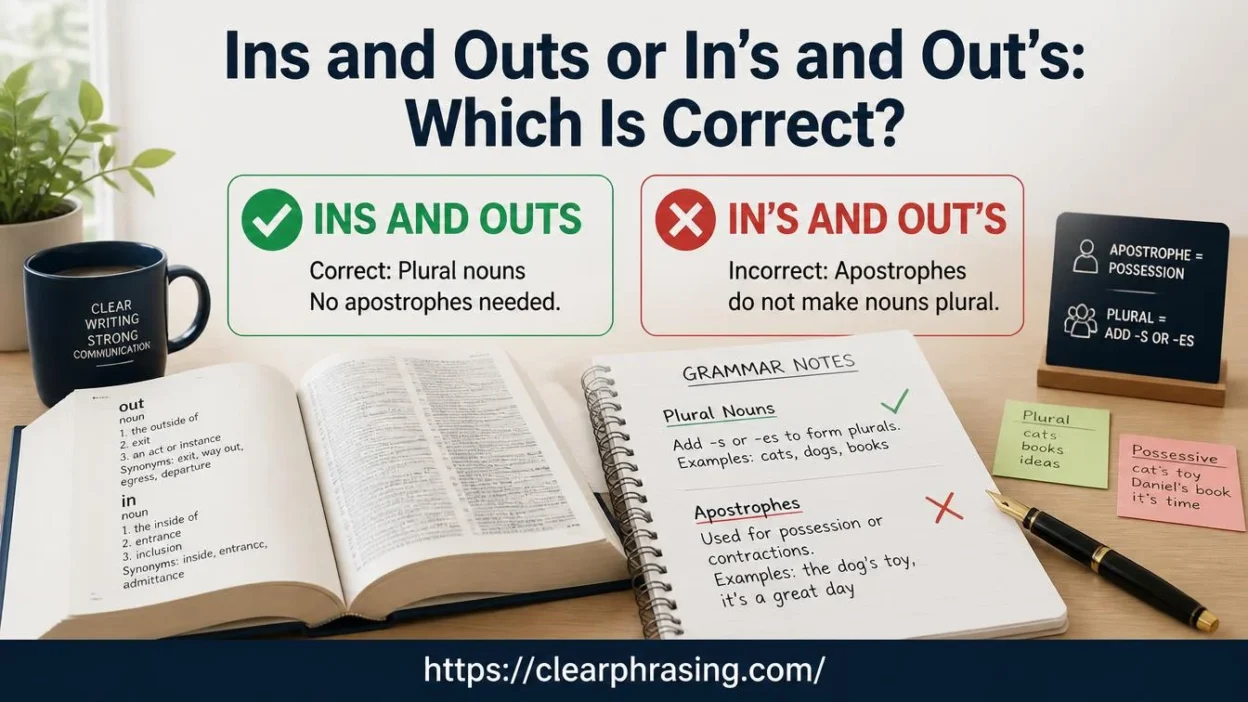
When you ask Ins and Outs or In’s and Out’s: Which Is Correct?, the correct way is ins and outs.
In my English language and English writing experience, I’ve seen experienced writers pause over this tiny detail in familiar expressions. This tricky topic can leave you scratching your head, but ins and outs is the clear winner.
The phrase refers to thorough details, meaning knowing every part of a topic. Whether you’re using a pen and paper or your fingers on a keyboard, these language details can improve clarity and correctness. Learning them helps you master English throughout your writing journey.
The issue involves apostrophes, possession, and contractions. Apostrophes show ownership or a missing letter, such as dog’s bone, can’t, and cannot. Since ins and outs shows neither possessive words nor omitted letters, no apostrophe belongs there. English may be a quirky beast, but this correct expression follows a straightforward rule.
Quick Answer:
The correct spelling is ins and outs.
Correct: The ins and outs of the business
Incorrect: The in’s and out’s of the business
The phrase “ins and outs” refers to the detailed, complicated, or less obvious parts of something.
For example:
She knows all the ins and outs of running a successful online business.
The words ins and outs are plural forms here. They aren’t possessive words, so they don’t need apostrophes.
A simple rule can save you from trouble:
Plural = usually no apostrophe.
Possession = apostrophe may be needed.
That’s the whole ball game.
What Does “Ins and Outs” Mean?
The expression “ins and outs” means the important details, complicated aspects, procedures, or hidden workings of something.
When someone understands the ins and outs of a subject, they know much more than the basics. They’ve learned how things actually work.
For example:
- A mechanic may know the ins and outs of car engines.
- An accountant may understand the ins and outs of tax regulations.
- A teacher may know the ins and outs of classroom management.
- A software developer may understand the ins and outs of a complicated system.
Consider this sentence:
It took me several months to learn the ins and outs of the new software.
The speaker didn’t merely learn how to open the software. They learned its features, settings, shortcuts, problems, and practical details.
That’s why the phrase often suggests deep knowledge gained through experience.
The Main Meaning: Details and Intricacies
At its core, ins and outs describes the many parts of a subject that you need to understand.
Imagine learning to drive. Knowing how to start the car is only the beginning. Eventually, you learn about traffic rules, parking, mirrors, blind spots, road signs, weather conditions, and defensive driving.
Those additional details are the ins and outs.
The phrase works especially well when something has many moving parts.
For example:
Before starting the job, Maria wanted to understand the ins and outs of the company.
This suggests that Maria wanted more than a simple introduction. She wanted a complete understanding.
Can “Ins and Outs” Have a Literal Meaning?
Yes, in and out can have literal meanings in other contexts. However, the established expression “the ins and outs” usually refers figuratively to details and complexities.
Context does the heavy lifting.
Compare these examples:
The building has separate entrances and exits.
This discusses physical movement.
He understands the ins and outs of the building’s security system.
This refers to detailed knowledge.
Same basic words. Completely different job.
Why Is “In’s and Out’s” Incorrect?
The biggest problem with “in’s and out’s” is simple: apostrophes don’t normally make ordinary words plural.
To make most nouns plural, English adds -s or -es.
For example:
- book → books
- car → cars
- idea → ideas
- ins → plural
- outs → plural
You don’t write:
- book’s when you mean books
- car’s when you mean cars
- idea’s when you mean ideas
The same principle applies to ins and outs.
Apostrophes Usually Show Possession
An apostrophe often shows that something belongs to someone or something.
For example:
- the teacher’s desk = the desk belongs to one teacher
- the teachers’ lounge = the lounge belongs to multiple teachers
- the company’s policy = the policy belongs to the company
Now look at this phrase:
the ins and outs of the job
Nothing belongs to an in or an out. The words simply function as plurals.
Therefore, no apostrophes are needed.
Why Does “In’s and Out’s” Look Tempting?
This mistake happens because in and out don’t look like ordinary nouns.
Most people first learn them as prepositions, adverbs, or parts of common expressions. Seeing them become ins and outs can feel unusual.
That unusual appearance sometimes makes writers think punctuation is required.
It isn’t.
English often turns words into different grammatical forms. A word can change jobs depending on how you use it.
For example:
He is in the office.
Here, in helps describe location.
However:
The politician discussed the ins and outs of the agreement.
Here, the word functions as a noun.
English is flexible like that.
Understanding the Grammar Behind “Ins and Outs”
To understand the correct spelling fully, it helps to look at what happens grammatically.
How Can “In” Become “Ins”?
English allows words to shift from one grammatical category to another.
This process is often called conversion or functional shift. A word may act as one part of speech in one sentence and another part of speech elsewhere.
In the expression “ins and outs,” the words function as nouns.
The plural forms are:
in → ins
out → outs
That’s why the phrase takes ordinary plural spelling.
How Can “Out” Become “Outs”?
The same principle applies to out.
English speakers can use out as a noun in several contexts. For instance, sports may use the word out as a noun.
You might hear:
The pitcher recorded three outs.
Again, outs is simply a plural noun.
No apostrophe is necessary.
The Grammar at a Glance
| Form | Meaning or Function | Correct in Standard Usage? |
| in | Singular word in various grammatical roles | Yes |
| ins | Plural noun form | Yes |
| in’s | Possessive form in a specific context | Not correct for this expression |
| out | Singular word in various grammatical roles | Yes |
| outs | Plural noun form | Yes |
| out’s | Possessive form in a specific context | Not correct for this expression |
| ins and outs | Established expression | Yes |
| in’s and out’s | Incorrect spelling of the expression | No |
The key takeaway is straightforward: the phrase needs plural forms, not possessive forms.
“The Ins and Outs” vs. “Ins and Outs”
You’ll often see the expression written as “the ins and outs.”
For example:
She knows the ins and outs of the publishing industry.
This is probably the most common sentence structure.
When Should You Use “The Ins and Outs”?
Use the when you’re referring to the specific collection of details connected to something.
Examples:
We need to understand the ins and outs of the new policy.
The trainer explained the ins and outs of the equipment.
He learned the ins and outs of the business from his father.
The word the makes the phrase sound complete and natural in most sentences.
Can You Say “All the Ins and Outs”?
Absolutely.
Adding all emphasizes complete knowledge.
For example:
After ten years in the industry, she knows all the ins and outs.
This suggests extensive experience.
Can You Use “Ins and Outs” Without “The”?
Yes. The phrase can appear without the, depending on sentence structure.
For example:
This guide covers ins and outs that beginners often miss.
However, the ins and outs of something remains the most familiar and natural construction.
How to Use “Ins and Outs” Correctly in a Sentence
The expression works in casual conversation and professional writing.
Examples in Everyday Conversation
Tell me the ins and outs of your new job.
My brother knows the ins and outs of fixing old computers.
You’ll understand the ins and outs once you’ve spent some time there.
These sentences sound natural because the phrase adds personality. Instead of repeatedly saying details, you can use a more colorful expression.
Examples in Professional Writing
The phrase can also work in workplace communication.
The training program teaches employees the ins and outs of customer service.
New managers should understand the ins and outs of the company’s reporting system.
She has extensive knowledge of the ins and outs of project management.
However, consider your audience. Very formal documents may sound better with more direct alternatives.
Examples in Academic or Formal Contexts
Instead of ins and outs, you might choose:
- details
- specifics
- procedural requirements
- technical aspects
- particulars
- intricacies
For example:
Conversational:
The article explains the ins and outs of the process.
More formal:
The article explains the procedural details of the process.
Neither sentence is automatically better. The right choice depends on your audience.
Common Mistakes
Even experienced writers occasionally trip over this expression.
Mistake: Writing “In’s and Out’s”
This is the most common error.
❌ She understands the in’s and out’s of the job.
✅ She understands the ins and outs of the job.
Remember: you’re making the words plural. You aren’t showing possession.
Mistake: Confusing “Ins and Outs” With “Pros and Cons”
These phrases have different meanings.
Ins and outs means details and complexities.
Pros and cons means advantages and disadvantages.
Compare:
Let’s discuss the pros and cons of buying the house.
This means discussing the good and bad points.
Let’s understand the ins and outs of buying the house.
This means learning about the complete process and its details.
The difference matters.
Mistake: Confusing “Ins and Outs” With “Ups and Downs”
Ups and downs refers to positive and negative experiences.
For example:
Every relationship has its ups and downs.
That sentence discusses good times and difficult times.
Meanwhile:
Understanding the ins and outs of a relationship takes time.
This sentence focuses on the details and complexities.
They’re not interchangeable.
Mistake: Using “&” in Standard Prose
You may see “Ins & Outs” in titles, advertisements, or headings.
That’s often acceptable for design purposes.
However, standard sentences usually look better with and.
For example:
Heading: The Ins & Outs of Freelancing
Standard prose: This article explains the ins and outs of freelancing.
Ins and Outs vs. Similar Expressions
Several English expressions may seem similar. Still, each carries its own meaning.
| Expression | Meaning | Example |
| Ins and outs | Details and complexities | She knows the ins and outs of the system. |
| Pros and cons | Advantages and disadvantages | We discussed the pros and cons. |
| Ups and downs | Good and bad experiences | Every career has its ups and downs. |
| Nitty-gritty | Important practical details | Let’s get to the nitty-gritty. |
| Details | Specific information | Please provide the details. |
Ins and Outs vs. Nitty-Gritty
These expressions sometimes overlap.
Both can refer to important details. However, nitty-gritty often focuses on the practical or essential details.
For example:
Let’s get down to the nitty-gritty.
This means it’s time to discuss the important facts.
Meanwhile:
Let’s learn the ins and outs of the process.
This suggests developing a broad and detailed understanding.
Think of nitty-gritty as getting to the meat of the matter. Think of ins and outs as learning how the whole machine works.
Ins and Outs vs. Details
Details is more neutral.
You can use it almost anywhere:
Please send me the details.
However, ins and outs feels more conversational and often suggests complexity.
I’ll explain the ins and outs tomorrow.
That sentence sounds warmer and more idiomatic.
Is “Ins and Outs” an Idiom?
Yes. Ins and outs is an established English idiomatic expression.
Its meaning isn’t limited to literal movement inward and outward. Instead, it commonly refers to the detailed workings of something.
The phrase becomes especially clear when followed by of.
For example:
- the ins and outs of the job
- the ins and outs of the business
- the ins and outs of the system
- the ins and outs of the process
- the ins and outs of investing
This structure tells the reader exactly what complicated subject you’re discussing.
Where Did “Ins and Outs” Come From?
The phrase developed from the ordinary ideas of things being in and out. Over time, English speakers used the paired words to suggest the many different sides, movements, details, or aspects of something.
That’s a common pattern in English.
Paired expressions often create a broader meaning than either word carries alone.
Consider:
- ups and downs
- odds and ends
- ifs and buts
- comings and goings
These expressions use contrasting or paired ideas to describe a wider situation.
Ins and outs follows the same general pattern. It captures the many different details that make up a complicated subject.
Is “Ins and Outs” Appropriate for Formal Writing?
Yes, but context matters.
The expression works well in:
- Blog posts
- Educational articles
- Business communication
- Training materials
- Workplace conversations
- Interviews
- Informal professional writing
For example:
Our onboarding program explains the ins and outs of company procedures.
That sounds professional while remaining approachable.
When Should You Choose a More Formal Alternative?
Some documents require a more technical tone.
You might choose another phrase when writing:
- Legal documents
- Academic research papers
- Scientific reports
- Government policies
- Highly formal business documents
Instead of:
The report explains the ins and outs of the procedure.
You could write:
The report explains the procedural requirements and technical details.
Again, there’s no universal winner. Match your language to your audience.
How to Remember the Correct Spelling
Here’s the easiest memory trick:
Think: Plural, Not Possessive
IN + S = INS
OUT + S = OUTS
No apostrophes needed.
You can also compare the phrase with other paired plurals:
- ups and downs
- ifs and buts
- odds and ends
You wouldn’t normally write:
❌ up’s and down’s
❌ if’s and but’s
The same logic applies to:
✅ ins and outs
A Simple Question to Ask Yourself
Before adding an apostrophe, ask:
“Am I showing possession?”
If the answer is no, you probably don’t need one.
For this expression, nothing belongs to the ins or outs.
They’re simply plural nouns.
Case closed.
A Practical Case Study: Why the Apostrophe Changes the Look of Professional Writing
Imagine a company publishes this sentence:
Our experts know the in’s and out’s of digital marketing.
The meaning remains understandable. However, the punctuation mistake can weaken the writing.
A careful reader may immediately notice the unnecessary apostrophes.
Now compare it with:
Our experts know the ins and outs of digital marketing.
The corrected version looks cleaner and follows standard English grammar.
This small difference shows why punctuation matters. Apostrophes may be tiny, but they can carry a lot of grammatical weight.
Good writing often comes down to these small details.
Practice Section:
Test your understanding.
Choose the Correct Answer
She knows all the _____ of running a small business.
A. in’s and out’s
B. ins and outs
It took several weeks to learn the _____ of the new software.
A. ins and outs
B. in’s and out’s
The manager explained the _____ of the new system.
A. in’s and out’s
B. ins and outs
Answers
The correct answer in every sentence is:
B. ins and outs
Why?
Because ins and outs are plural forms. The phrase doesn’t show possession.
Quick Revision:
Here’s everything you need to remember:
- Ins and outs is the correct standard spelling.
- In’s and out’s is incorrect when referring to this expression.
- Apostrophes don’t normally create ordinary plurals.
- The phrase means the details, intricacies, and complicated aspects of something.
- The common structure is “the ins and outs of something.”
- Don’t confuse ins and outs with pros and cons.
- Don’t confuse it with ups and downs, either.
- In highly formal writing, alternatives such as details or specifics may work better.
Read More: Purposely or Purposefully: What’s the Difference and Usage
FAQs
Is “ins and outs” the correct spelling?
Yes. “Ins and outs” is the standard and correct spelling. It refers to all the details, facts, or practical aspects of something.
Is “in’s and out’s” ever correct?
No, not when you mean the details of something. “In’s and out’s” incorrectly adds apostrophes where they aren’t needed.
Why doesn’t “ins and outs” need apostrophes?
The words ins and outs aren’t showing possession or omitted letters. Therefore, there’s no grammatical reason to add apostrophes.
What does “ins and outs” mean?
“Ins and outs” means the complete details of a subject, activity, system, or situation. For example, you might learn the ins and outs of a new job.
Does “ins and outs” mean knowing everything?
It generally means understanding the important details and practical aspects of something. It doesn’t necessarily mean knowing absolutely everything.
Can I use “ins and outs” in formal writing?
Yes. “Ins and outs” is an established English expression and can appear in both everyday and formal writing when the context suits it.
Is “ins and outs” singular or plural?
The expression is normally treated as plural because it contains two plural nouns, ins and outs. However, its meaning refers collectively to the details of something.
What is the difference between “ins and outs” and “in’s and out’s”?
The main difference is punctuation. “Ins and outs” is correct because the expression doesn’t indicate possession or contractions, while “in’s and out’s” uses unnecessary apostrophes.
Can “ins and outs” describe a skill?
Yes. You can use it when discussing the details of a skill, process, system, or activity. For example, someone may learn the ins and outs of photography.
How can I remember the correct spelling?
A simple trick is to remember that “ins and outs” names details rather than ownership or missing letters. Since neither requires an apostrophe here, leave the apostrophes out.
Conclusion
Choosing between “ins and outs” and “in’s and out’s” becomes much easier once you understand what the apostrophe actually does. The correct expression is “ins and outs,” with no apostrophes. It describes the details or practical aspects of something.
The apostrophe often causes confusion because English uses it for several purposes. It can show possession, as in “dog’s bone,” or indicate omitted letters in contractions such as “can’t.” Neither function applies to “ins and outs.”
In my experience teaching English, I’ve found that learners often add punctuation when a word looks unusual or unfamiliar. However, unusual-looking words don’t automatically need apostrophes. Understanding the purpose behind the punctuation makes these choices far easier.
So, whenever you want to describe the complete details of a subject, remember “ins and outs.” It’s clear, grammatically correct, and widely understood. Once you recognize the simple rule, this commonly confused expression becomes one less spelling problem to worry about.

Mehwish Imtiaz is an English specialist and professional blog writer at ClearPhrasing.com. She specializes in grammar, spelling, vocabulary, punctuation, and writing improvement. With a strong passion for clear communication and language education, she creates reader-friendly articles that help students, professionals, and English learners understand complex language topics with ease.
Her writing focuses on accuracy, simplicity, and practical usage, ensuring that every article provides clear explanations and real-world examples. At ClearPhrasing.com, Mehwish is committed to publishing well-researched, original content that helps readers write more confidently and communicate more effectively in everyday and professional English.