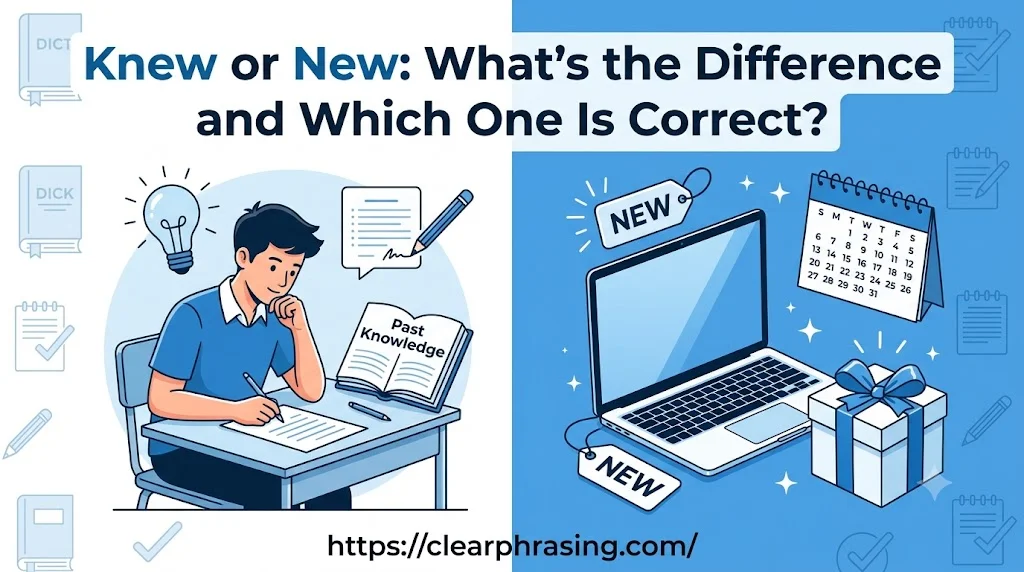
Knew or New: What’s the Difference and Which One Is Correct? helps learners understand homophones that sound the same but have different meanings.
These terms are spelled differently and create confusion because their usage is different. Knew is the past tense of the verb know and refers to something you were aware of in the past. For example, “I knew the answer to the question” shows awareness and familiarity with information that existed before.
New refers to something recent, recently made, discovered, unused, or different from something that existed before. It works as an adjective that describes things, such as “I bought a new car.” Their pronunciation sounds identical, but their meanings and applications are distinct.
As an English teacher, I explain that correct usage, grammar, spelling, and English usage help improve language skills and vocabulary. Using either word correctly in a sentence makes communication clear and prevents confusion.
Quick Answer
Knew is the past tense of the verb “know.” It means someone had knowledge or understanding in the past.
New is an adjective that describes something recent, fresh, different, or unused.
Correct examples:
- ✅ I knew the answer before the test.
- ✅ She bought a new laptop yesterday.
- ❌ I new the answer.
- ❌ He knew bicycle looks expensive.
If you’re talking about knowledge in the past, use knew. If you’re describing a person, place, thing, or idea, use new.
Knew vs. New at a Glance
| Feature | Knew | New |
| Part of Speech | Verb (past tense of know) | Adjective |
| Meaning | Had knowledge or understanding | Recent, fresh, unused, or different |
| Pronunciation | /nuː/ | /nuː/ |
| Grammar Function | Action word | Describes a noun |
| Time Reference | Past | Present or future description |
| Example | I knew her name. | I bought a new phone. |
Why Do People Confuse Knew and New?
The main reason people confuse knew and new is that they are homophones. Homophones are words that have the same pronunciation but different meanings and spellings.
When you hear someone say these words, they sound identical. The sentence itself tells you which spelling is correct.
Compare these examples:
- I knew the answer.
- I bought a new dictionary.
The pronunciation never changes. Only the meaning does.
Spell check also contributes to the problem. Since knew and new are both correctly spelled English words, many grammar tools won’t detect the mistake if you choose the wrong one.
People often make this error in:
- School assignments
- Business emails
- Social media posts
- Text messages
- Blog articles
- Online discussions
What Does “Knew” Mean?
It is the simple past tense of the verb know. It tells the reader that someone had knowledge, understanding, awareness, or familiarity before the present time.
Definition
Knew means had knowledge of, understood, recognized, or was familiar with something in the past.
Unlike know, which describes the present, it always refers to a completed time.
| Present | Past |
| I know the answer. | I knew the answer. |
| She knows my brother. | She knew my brother. |
| We know the rules. | We knew the rules. |
Grammar Rule for Knew
Use knew whenever you’re talking about knowledge or understanding that existed in the past.
The basic pattern is simple:
Subject + knew + object
Examples:
- I knew his phone number.
- She knew the truth.
- They knew the schedule.
- We knew the project would succeed.
- Nobody knew the final result.
You can also use knew before clauses.
Examples:
- I knew that you would call.
- She knew where the keys were.
- They knew why the meeting ended early.
Correct Usage
Talking About Facts
Use it when someone already had information.
Examples:
- He knew the capital of Australia.
- Everyone knew the answer.
- I knew the deadline was Friday.
Talking About People
Use knew to show familiarity with someone.
Examples:
- I knew her in college.
- They knew the coach well.
- My grandfather knew the author personally.
Talking About Places
Examples:
- She knew every street in the city.
- We knew the neighborhood well.
- They knew the hiking trail by heart.
Talking About Skills
Examples:
- He knew how to repair computers.
- I knew how to swim at an early age.
- She knew how to solve difficult equations.
Examples in Everyday Sentences
Daily Conversation
- I knew you’d arrive early.
- She knew it would rain.
- We knew something was wrong.
School
- The student knew every answer.
- Nobody knew the homework had changed.
- The teacher knew the lesson would be challenging.
Workplace
- Our manager knew the client well.
- Everyone knew the meeting would run late.
- I knew the report needed revision.
Storytelling
- The detective knew the clue mattered.
- She knew she had found the missing document.
- They knew danger was getting closer.
Common Expressions with “Knew”
| Expression | Meaning |
| Knew better | Should have acted more wisely |
| Never knew | Had no previous knowledge |
| Knew by heart | Memorized completely |
| Knew all along | Had knowledge from the beginning |
| Knew for a fact | Was completely certain |
Examples:
- You should have known better.
- I never knew you liked painting.
- She knew by heart every line of the poem.
- We knew all along that he was honest.
- He knew for a fact the information was correct.
What Does “New” Mean?
New is an adjective, not a verb. It describes a noun by showing that something is recent, fresh, different, or unused.
Definition of New
New means:
- Recently made
- Recently bought
- Different from before
- Recently introduced
- Not used before
Examples include:
- a new computer
- a new employee
- a new restaurant
- a new idea
- a new opportunity
Different Meanings of “New”
Recently Made
Something that has just been created or produced.
Examples:
- They released a new smartphone.
- The company introduced a new logo.
Recently Purchased
Something you have just bought.
Examples:
- My new shoes are comfortable.
- She loves her new bicycle.
Different From Before
Something has changed from an earlier version.
Examples:
- We developed a new strategy.
- The school adopted a new policy.
New to Someone
A person has recently started something.
Examples:
- I’m new to photography.
- She’s new at this company.
- He’s new to the neighborhood.
Fresh or Unused
Something has never been used before.
Examples:
- Please open a new notebook.
- They installed new windows.
- He bought a new suitcase.
Examples of “New” in Everyday Sentences
Shopping
- I bought a new phone.
- She ordered a new dress.
- They purchased new furniture.
Business
- The company hired new employees.
- We launched a new product.
- Our office moved to a new building.
Technology
- Have you installed the new software update?
- The new version works much faster.
- The app includes several new features.
Daily Life
- We met our new neighbors.
- She started a new hobby.
- They found a new coffee shop.
Common Expressions with “New”
| Expression | Meaning |
| Brand-new | Completely unused |
| New beginning | A fresh start |
| New arrival | Someone or something that recently arrived |
| New customer | A first-time buyer |
| New version | An updated edition |
| New opportunity | A fresh chance for success |
Examples:
- They bought a brand-new car.
- Graduation marked a new beginning.
- We welcomed several new arrivals this month.
- Every new customer receives a discount.
- The new version improves performance.
- She accepted a new opportunity in another city.
Knew vs. New: Side-by-Side Comparison
Although knew and new sound identical, they belong to different parts of speech and serve different purposes in a sentence. Learning this comparison will help you choose the correct word every time.
| Feature | Knew | New |
| Part of Speech | Verb | Adjective |
| Meaning | Had knowledge or understanding | Recent, fresh, different, or unused |
| Tense | Past tense of know | No tense |
| Function | Shows an action or state of knowing | Describes a noun |
| Example | I knew the answer. | I bought a new laptop. |
A simple rule can save you from this common mistake:
- If you can replace the word with understood or was aware of, use knew.
- If you can replace it with recent, fresh, or different, use new.
Knew vs. New in Grammar
Is “Knew” a Verb?
Yes. Knew is the past tense of know, so it functions as a verb.
Examples:
- She knew the truth.
- They knew the rules.
- I knew what you meant.
Is “New” an Adjective?
Yes. New describes a noun by giving more information about it.
Examples:
- A new teacher joined the school.
- We moved into a new house.
- He bought a new computer.
Can They Replace Each Other?
No. They never have the same meaning.
Compare these sentences:
- ❌ I new the answer.
- ✅ I knew the answer.
- ❌ She bought a knew car.
- ✅ She bought a new car.
Replacing one with the other creates a grammar mistake and changes the meaning completely.
Pronunciation: Why Do They Sound the Same?
Both knew and new are pronounced /nuː/. Since they share the same pronunciation, they are called homophones.
Many English words are homophones, including:
- There, Their, They’re
- To, Too, Two
- Know, No
- Right, Write
- Sea, See
Because pronunciation doesn’t help, always look at the sentence’s meaning before choosing the correct spelling.
Easy Trick to Remember the Difference
A simple memory trick makes these words much easier to remember.
Remember “Know”
The word knew comes from know.
If the sentence talks about knowing something in the past, choose knew.
Example:
- I know the answer today.
- Yesterday I knew the answer.
Remember “New”
Think about buying something new.
1.A new phone.
2.A new book.
3.A new opportunity.
If you’re describing something, the correct word is new.
Quick Memory Chart
| If the sentence is about… | Use |
| Knowledge in the past | Knew |
| Something recent or fresh | New |
Real-Life Examples
Everyday Conversation
- I knew you would call.
- We bought a new dining table.
- She knew the restaurant was closed.
- My brother started a new job.
School
- The student knew every formula.
- Our school introduced a new science lab.
Workplace
- The manager knew the project deadline.
- The company released a new product line.
Travel
- She knew the city very well.
- They stayed at a new hotel.
Knew and New in Common Phrases
| Sentence | Correct Word |
| I _____ the answer. | knew |
| She bought a _____ laptop. | new |
| We _____ the truth. | knew |
| They moved into a _____ house. | new |
| He _____ my grandfather. | knew |
| The company launched a _____ service. | new |
Common Mistakes Writers Make
Many writers confuse these words because they rely on pronunciation instead of grammar.
Here are the most common mistakes.
Using “New” Instead of “Knew”
Incorrect:
- I new the answer.
Correct:
- I knew the answer.
Using “Knew” Instead of “New”
Incorrect:
- She bought a knew phone.
Correct:
- She bought a new phone.
Forgetting That “Knew” Is Always Past Tense
Incorrect:
- I knew the answer now.
Correct:
- I know the answer now.
Proofreading Too Quickly
Reading your work aloud won’t always catch this mistake because both words sound the same. Instead, ask yourself:
- Am I talking about knowledge?
- Or am I describing a noun?
The answer will tell you which spelling is correct.
Knew or New Quiz
Choose the correct word.
- I _____ the meeting started at noon.
- She bought a _____ backpack.
- Nobody _____ the final score.
- We visited a _____ museum.
- They _____ exactly what happened.
Answers
- knew
- new
- knew
- new
- knew
Knew vs. New Practice Worksheet
Fill in the blanks.
- I _____ you would win.
- He purchased a _____ bicycle.
- We _____ the weather would change.
- They opened a _____ restaurant.
- She _____ my parents years ago.
- My sister has a _____ apartment.
- Nobody _____ the secret.
- We installed a _____ security system.
Answer Key
- knew
- new
- knew
- new
- knew
- new
- knew
- new
Similar Confusing Word Pairs
If you struggle with knew and new, you may also confuse these words.
- Know vs. No
- There vs. Their vs. They’re
- Your vs. You’re
- To vs. Too vs. Two
- Than vs. Then
- Accept vs. Except
- Affect vs. Effect
- Its vs. It’s
- Principal vs. Principle
- Compliment vs. Complement
Learning these pairs will improve your spelling and make your writing more accurate.
Read More: Alter vs. Altar: Difference, Meaning, and Usage
FAQs
Q1. What is the main difference between knew and new?
Answer: Knew is the past tense of the verb know and refers to something you were aware of before. New is an adjective used for something recent, unused, or recently created.
Q2. Why do knew and new sound the same but have different meanings?
Answer: Knew and new are homophones, which means they have the same pronunciation but different spellings and meanings.
Q3. Is knew the past tense form of the word know?
Answer: Yes, knew is the past tense of know. It shows that someone had knowledge or awareness of something in the past.
Q4. When should I use the word new in a sentence?
Answer: Use new when describing something recent, unused, or different from what existed before, such as “She bought a new phone.”
Q5. Can knew and new be used interchangeably in English?
Answer: No, knew and new cannot be used interchangeably because they have different meanings and grammatical roles.
Q6. What type of word is new in English grammar?
Answer: New is an adjective because it describes a noun, such as a new book, new idea, or new car.
Q7. How can I remember the correct use of knew and new?
Answer: Remember that knew contains know, so it relates to knowledge from the past. New relates to something fresh, recent, or unused.
Q8. Why do learners often confuse knew and new?
Answer: Learners often confuse these words because they sound identical, but their spelling, meaning, and usage are different.
Q9. What are some common examples of sentences using knew and new?
Answer: Examples include: “I knew the answer yesterday” and “I bought a new laptop.” The first shows past knowledge, while the second describes something recent.
Q10. How does correct usage of knew and new improve English communication?
Answer: Using knew and new correctly makes your writing and speaking clearer, prevents confusion, and improves overall English communication skills.
Conclusion
Understanding the difference between knew and new helps you avoid common English mistakes and communicate more clearly. Although both words sound the same, their meanings, spelling, and grammar roles are different. Knew connects to past knowledge, while new describes something recent, fresh, or unused. Learning these small differences can improve your vocabulary and confidence in English usage.
As an English teacher, I believe that mastering homophones like knew and new builds a stronger foundation for accurate communication. When you understand how these words work in different sentences, you can write and speak with fewer errors. Regular practice with examples will make choosing the correct word easier and more natural.

Ayesha Siddiqa is an English specialist and professional content writer at ClearPhrasing.com. She is passionate about making the English language easy to understand through clear, accurate, and engaging content. Her expertise includes English grammar, spelling, vocabulary, punctuation, word usage, and writing techniques.
At ClearPhrasing.com, Ayesha creates well-researched, reader-friendly articles designed to help students, professionals, writers, and English learners strengthen their language skills. She focuses on providing practical explanations, real-world examples, and up-to-date guidance that readers can confidently apply in everyday communication.
Committed to accuracy and clarity, Ayesha ensures that every article meets high editorial standards and delivers reliable, easy-to-follow information that empowers readers to write and communicate with confidence.