Mid Next Week vs. Midweek: Meaning, Differences, and Usage explains the Meaning, Difference, and Usage of these Terms in simple English.
Many People think they are Interchangeable, but Midweek usually Means the Middle Part of the Current Week, Specifically Wednesday, Thursday, or the Surrounding Days. Mid Next Week refers to the Middle of the Next Week, part of the Future Week. This Concept reduces Confusion and improves Planning, Schedules, Appointments, Events, and everyday Communication.
From my teaching experience, a Clear Understanding helps you Understand Timing, Timeframe, and Sentence Construction. The Word Midweek is a Compound Word made by Combining the Prefix Mid-. You can Use it as an Adjective or Adverb to Convey ideas Effectively. This Article uses Examples to Illustrate the Basics, helping you Plan More Accurately, Avoid being Double-booked, stop Missing Important Events, and know what Sets Apart Current and Future references.
This guide explains mid next week vs. midweek in simple English. You’ll learn their meanings, differences, grammar, examples, business usage, and common mistakes so you can use each phrase with confidence.
Quick Answer
The difference is simple.
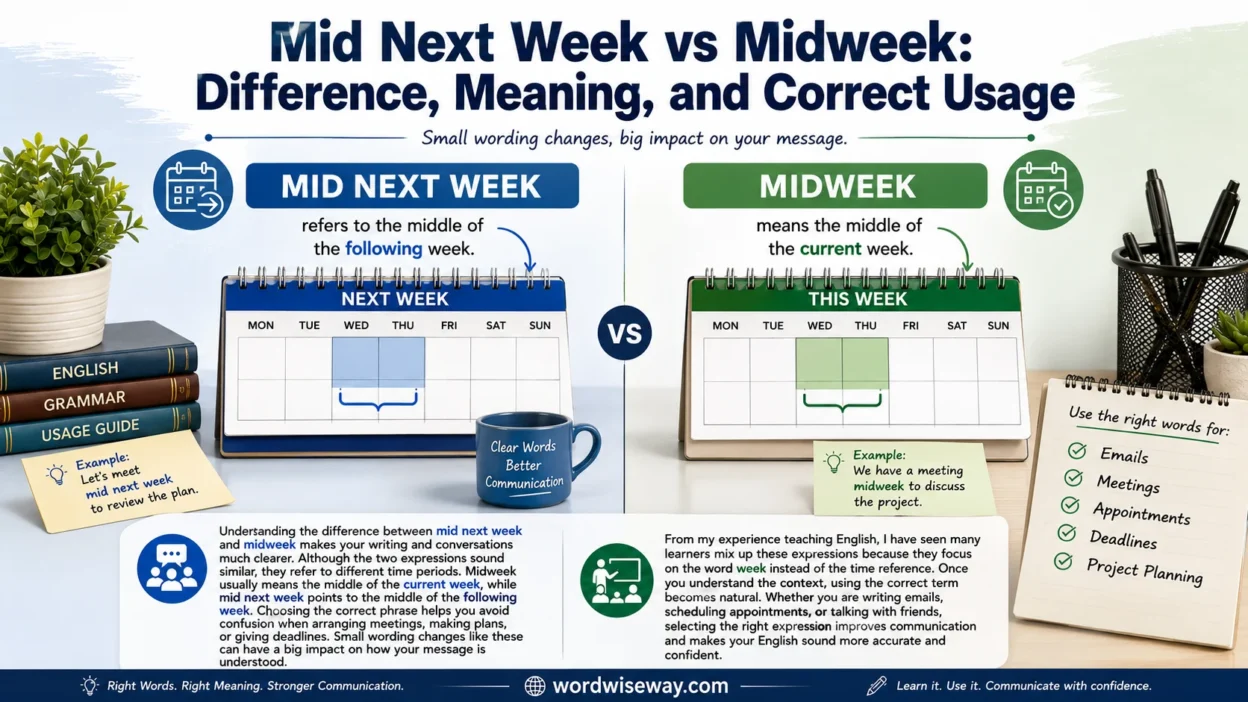
Mid next week refers to the middle of the following week, which most people interpret as Wednesday, although some may include Tuesday afternoon or Thursday depending on the situation.
Midweek simply means the middle of a week. Unless another week is mentioned, people usually understand it as Wednesday or the period from Tuesday through Thursday.
Quick Comparison Table
| Expression | Meaning | Usually Refers To |
| Mid next week | Middle of the following week | Next Wednesday or around Wednesday |
| Midweek | Middle of any week | Wednesday or the middle days of a week |
Quick Examples
- We’ll finish the report mid next week.
- The sale begins midweek.
- Snow is expected midweek.
- Let’s schedule the meeting for mid next week.
What Does “Mid Next Week” Mean?
Mid next week means the middle portion of the upcoming week after the current one.
Unlike a fixed calendar date, it is a relative time expression. Its meaning depends on when the speaker says it.
For example, if today is Monday, July 6, and someone says they’ll finish a project mid next week, they usually mean Wednesday, July 15, not this Wednesday.
Although there is no official rule defining the exact day, most native English speakers naturally interpret it as Wednesday because Wednesday sits at the center of a standard Monday-to-Friday workweek.
Typical Time Range
People commonly use mid next week to refer to:
- Wednesday
- Tuesday afternoon through Thursday
- Around the middle of the upcoming workweek
Context determines the exact meaning.
When People Use “Mid Next Week”
You’ll hear this phrase frequently in professional settings.
Common situations include:
- Project deadlines
- Shipping estimates
- Client updates
- Medical appointments
- Job interviews
- Team meetings
- Construction schedules
Examples
- The software update should be available mid next week.
- We’ll review your application mid next week.
- The contractor expects to finish mid next week.
- Customer support will contact you mid next week.
Notice that each sentence refers specifically to the following week, not the current one.
What Does “Midweek” Mean?
Midweek means the middle of a week.
Unlike mid next week, this expression does not identify which week unless additional context makes it clear.
If someone simply says:
The event takes place midweek.
Most people understand that the event happens around Wednesday.
Which Days Count as Midweek?
There isn’t one universal definition.
Most speakers think of:
- Wednesday
- Tuesday through Thursday
- The central portion of the week
Different industries sometimes define it differently.
For example:
- Weather forecasters often say midweek when discussing Wednesday conditions.
- Retail businesses may advertise midweek sales beginning Tuesday or Wednesday.
- Event organizers may use it for activities held on Wednesday evenings.
Common Uses
You’ll often see midweek in:
- News articles
- Weather reports
- Travel updates
- Marketing campaigns
- Sports schedules
- Entertainment listings
Examples
- Rain is expected midweek.
- The restaurant offers midweek specials.
- Hotel prices often drop midweek.
- Traffic becomes lighter midweek.
Mid Next Week vs. Midweek: The Main Difference
Although these expressions sound similar, they answer different questions.
| Feature | Mid Next Week | Midweek |
| Time reference | Following week | Any week |
| Specificity | More specific | More general |
| Usually means | Around next Wednesday | Around Wednesday |
| Depends on current date | Yes | Usually no |
| Common in business | Very common | Common |
The easiest way to remember the difference is this:
- Mid next week tells which week.
- Midweek tells which part of a week.
Why People Confuse These Two Expressions
The confusion isn’t surprising because both phrases share the word mid.
Several factors contribute to misunderstandings.
Both Often Mean Wednesday
Many speakers immediately think of Wednesday when they hear either expression.
That similarity makes the phrases seem interchangeable even though they are not.
Both Describe the Middle of a Week
Each expression points toward the center of a week.
However, one identifies the following week, while the other simply identifies the middle portion.
Context Does Most of the Work
English relies heavily on context.
If someone says:
I’ll finish the report midweek.
You might ask:
Which week?
If they instead say:
I’ll finish the report mid next week.
The intended week becomes much clearer.
Is “Mid Next Week” Grammatically Correct?
Yes.
Mid next week is grammatically correct and widely used in modern English.
Although you won’t usually find it listed as a fixed dictionary entry, it follows normal English word order.
Native speakers regularly use expressions such as:
- Mid next week
- Late next week
- Early next week
- Later this week
These expressions are common in speech, emails, customer service, and business writing.
Is “Midweek” One Word or Two?
Today, midweek is generally written as one word.
You may occasionally see mid-week, especially in older publications or style guides, but the single-word spelling has become the preferred modern form.
Which Version Should You Use?
| Form | Recommendation |
| Midweek | Preferred |
| Mid-week | Acceptable but less common |
For consistency, use midweek unless you’re following a publication style guide that requires otherwise.
Which Expression Is More Precise?
The answer depends on your goal.
Use “Mid Next Week” When
- Discussing future deadlines
- Scheduling appointments
- Giving project updates
- Planning deliveries
- Confirming meetings
Example:
We expect your order to arrive mid next week.
Use “Midweek” When
- Talking generally
- Discussing weekly routines
- Describing recurring events
- Reporting weather
- Advertising promotions
Example:
New discounts become available midweek.
Mid Next Week vs. Midweek in Professional Communication
Business communication values clarity.
While mid next week is useful, it may still leave room for interpretation.
Instead of writing:
We’ll respond mid next week.
Consider writing:
We’ll respond by Wednesday next week.
Including the actual day reduces confusion.
Better Business Examples
Less precise:
- We’ll meet mid next week.
More precise:
- We’ll meet on Wednesday next week.
Less precise:
- The shipment should arrive midweek.
More precise:
- The shipment should arrive on Wednesday.
Whenever deadlines matter, exact dates are usually better than relative expressions.
Mid Next Week vs. Midweek in Everyday English
Outside the workplace, people rarely need perfect precision.
Friends and family naturally understand flexible time expressions.
Examples include:
- Let’s grab lunch midweek.
- We’ll visit Grandma mid next week.
- I’ll call you midweek.
- The repair should be done mid next week.
Conversation usually provides enough context.
Real-Life Examples
Office Deadline
Manager:
Please submit the revised proposal mid next week.
The employee understands the deadline falls around next Wednesday.
Shipping Update
Customer support says:
Your replacement package should arrive mid next week.
This gives the customer a reasonable delivery window.
School Assignment
Teacher:
I’ll return your essays midweek.
Students expect feedback around Wednesday.
Weather Forecast
Meteorologist:
Temperatures will cool significantly midweek.
Viewers understand the change should occur around Wednesday.
Family Planning
Parent:
We’ll decorate the house mid next week before guests arrive.
Everyone knows preparations will happen during the following week’s middle days.
Common Mistakes to Avoid
Many learners make the same mistakes.
Using “Midweek” When You Mean Next Week
Incorrect:
We’ll finish the project midweek.
If several weeks are being discussed, readers may not know which week you mean.
Better:
We’ll finish the project mid next week.
Assuming Everyone Defines Midweek the Same Way
Some people think Tuesday qualifies.
Others mean only Wednesday.
When accuracy matters, specify the exact day.
Forgetting the Audience
Internal team members may understand company schedules.
Clients often need more precise wording.
Overusing Relative Dates
Expressions like:
- Later
- Soon
- Midweek
- Early next week
work well in conversation but can create confusion in contracts or formal schedules.
Better Alternatives
Sometimes a more direct expression works better.
| Instead of | Use |
| Mid next week | Wednesday next week |
| Mid next week | Around Wednesday |
| Midweek | Wednesday |
| Midweek | During the middle of the week |
| Midweek | Tuesday through Thursday |
Specific dates almost always improve clarity.
Synonyms and Similar Time Expressions
English offers several related expressions.
- Early next week
- Later next week
- End of the week
- Beginning of the week
- Middle of the week
- Around Wednesday
- By Wednesday
- During the week
- Late this week
- Early this week
Each phrase highlights a different point on the weekly timeline.
Mid Next Week vs. Midweek in American and British English
Both American and British English use these expressions in much the same way.
The biggest difference isn’t regional. It’s contextual.
In both varieties of English:
- Midweek usually refers to Wednesday.
- Mid next week points to the middle of the following week.
Some organizations define these periods differently for scheduling purposes, but everyday usage remains remarkably consistent.
Key Takeaways
Here are the most important points to remember.
- Mid next week refers to the middle of the following week.
- Midweek refers to the middle of a week in general.
- Wednesday is the most common interpretation for both expressions.
- Context determines the exact meaning.
- Business communication benefits from specific dates instead of relative expressions.
- When clarity matters, write the actual day rather than relying on broad time phrases.
Read More: Worth It vs Worthy: Difference, Meaning, and Correct Usage
FAQs
1. What does mid next week mean?
It usually refers to the middle of the following week, most commonly Wednesday or Thursday of next week.
2. What does midweek mean?
Midweek generally means the middle of the current week, often Wednesday or the days around it.
3. Are mid next week and midweek the same?
No. They refer to different weeks. Midweek is about the current week, while mid next week refers to the following week.
4. Which expression is better for business communication?
Use the phrase that matches your intended timeline. If there is any chance of confusion, mention the exact date.
5. Is midweek one word or two?
Midweek is commonly written as one word in modern English, although mid-week may appear in some publications.
6. Does mid next week always mean Wednesday?
Not always. Depending on the speaker and context, it can refer to Wednesday or Thursday of the next week.
7. Can I use midweek in formal writing?
Yes. It is widely accepted in formal emails, reports, and professional communication.
8. Why do people confuse these terms?
They both describe the middle of a week, but the reference point changes. One refers to the current week and the other to the following week.
9. Should I use an exact date instead of these phrases?
If timing is important, using a specific date is the clearest option and avoids misunderstandings.
10. How can I remember the difference?
Think about the reference word next. If it is included, the phrase points to the following week. Without it, midweek usually refers to the current week.
Conclusion
Understanding the difference between mid next week and midweek makes your writing and conversations much clearer. Although the two expressions sound similar, they refer to different time periods. Midweek usually means the middle of the current week, while mid next week points to the middle of the following week. Choosing the correct phrase helps you avoid confusion when arranging meetings, making plans, or giving deadlines. Small wording changes like these can have a big impact on how your message is understood.
From my experience teaching English, I have seen many learners mix up these expressions because they focus on the word week instead of the time reference. Once you understand the context, using the correct term becomes natural. Whether you are writing emails, scheduling appointments, or talking with friends, selecting the right expression improves communication and makes your English sound more accurate and confident.

Mariam Asghar is an English specialist and professional content writer at ClearPhrasing.com. She is dedicated to helping readers improve their English through clear, practical, and easy-to-understand content. Her areas of expertise include grammar, spelling, vocabulary, punctuation, sentence structure, and effective writing.
At ClearPhrasing.com, Mariam writes comprehensive, well-researched articles that simplify complex language concepts for students, professionals, writers, and English learners. She believes that strong communication begins with a solid understanding of the English language and strives to make every lesson accessible and engaging.
With a strong commitment to quality, accuracy, and continuous learning, Mariam ensures that each article is carefully researched, thoroughly reviewed, and written to help readers communicate with greater confidence and clarity.