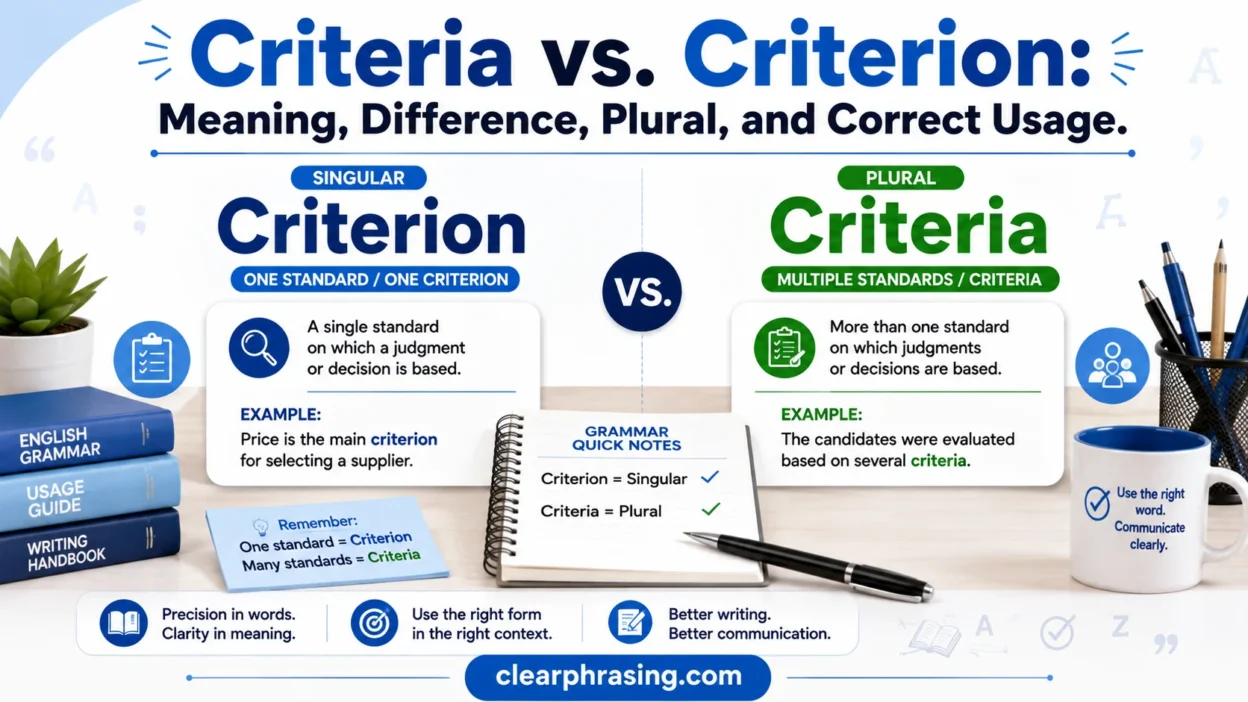
Criteria vs. Criterion: Meaning, Difference, and Correct Usage becomes easier when you remember that criterion means one standard, while criteria means two or more standards.
These grammar terms are often confused in sentences, reports, and professional communication. The key difference is number: criterion is a singular noun, while criteria is the plural form. In my experience teaching English, students, writers, and professionals commonly make the mistake of saying one criteria. The correct singular is always criterion, which keeps your writing clear and polished.
A quick way to remember their correct usage is to notice their endings. Criterion ends in -on, reminding you of one standard, while criteria ends in -a, suggesting many standards. These words appear in academic writing, formal writing, evaluation methods, assessment standards, selection requirements, and grading rubrics.
For example, taste can be one criterion in a baking contest, while taste, presentation, and creativity can form several criteria. This simple rule makes choosing the right word more effortless.
Quick Answer:
Criterion is the singular form. It means one standard, requirement, principle, or condition used to judge something.
Criteria is the plural form. It means two or more standards, requirements, principles, or conditions used for evaluation.
| Word | Number | Meaning | Example |
| Criterion | Singular | One standard used for judgment | “Experience is an important criterion.” |
| Criteria | Plural | Multiple standards used for judgment | “Experience and education are important criteria.” |
The easiest rule to remember is:
One criterion → two or more criteria
For example:
- “Price is one criterion for choosing a laptop.”
- “Price, battery life, and performance are three criteria for choosing a laptop.”
The verbs should also match the number:
- “The main criterion is reliability.”
- “The main criteria are reliability and cost.”
A useful substitution trick can help, too. If you can replace the word with standard, use criterion. If you can replace it with standards, use criteria.
Quick Reference:
| Question | Answer |
| What is singular? | Criterion |
| What is plural? | Criteria |
| What does criterion mean? | One standard for judgment |
| What does criteria mean? | Multiple standards for judgment |
| Is “criteria is” normally correct? | No. Use criteria are in formal English. |
| Is “criterion are” correct? | No. Use criterion is. |
| What is the plural of criterion? | Criteria |
| Can you normally use “criterions”? | No. Criteria is the standard plural. |
| One standard? | Criterion |
| Multiple standards? | Criteria |
What Does Criterion Mean?
Criterion means one particular standard or rule used to evaluate something. It gives you a specific basis for making a judgment, comparison, classification, or decision.
For example:
“Accuracy is the most important criterion for this test.”
The sentence identifies only one standard: accuracy. Therefore, criterion is the correct choice.
You’ll find criterion in many areas, including:
- Academic assessment
- Hiring decisions
- Scientific research
- Product evaluation
- Business planning
- Award selection
- University admissions
- Quality control
- Performance reviews
The context can change completely, but the grammatical rule stays the same. If you mean one standard, criterion works.
Criterion in a Sentence
Here are several examples:
- “Cost is an important criterion when buying a car.”
- “Safety became the deciding criterion.”
- “The applicant meets every required criterion.”
- “Accuracy is one criterion used to evaluate the software.”
- “The scholarship has one strict eligibility criterion.”
- “Customer satisfaction serves as a key criterion for success.”
Each example focuses on one standard.
You can also recognize the singular form through words that commonly appear before it:
- one criterion
- a criterion
- this criterion
- the criterion
- each criterion
- the main criterion
These combinations make the singular meaning clear.
What Does Criteria Mean?
Criteria is the plural form of criterion. It refers to two or more standards used to evaluate, classify, compare, or judge something.
For example:
“The committee established several criteria for selecting the winner.”
The committee isn’t relying on one standard. It has several standards. Therefore, criteria is correct.
Imagine a company selecting a new employee. The hiring team might consider experience, education, communication skills, technical knowledge, and leadership ability. Together, these factors represent several criteria.
Criteria in a Sentence
Consider these examples:
- “The selection criteria are clearly stated.”
- “Price and quality are important criteria.”
- “Applicants must meet all the eligibility criteria.”
- “The researchers established strict inclusion criteria.”
- “Several criteria determine whether a product qualifies.”
- “The award committee used five criteria to evaluate each entry.”
Because criteria is plural, it normally takes plural verbs in formal English.
A useful pattern is:
Criteria + are/were/have
For example:
- “The criteria are difficult to meet.”
- “The criteria were changed last year.”
- “These criteria have become standard.”
Criteria vs. Criterion: The Main Difference
The central difference between criteria vs. criterion comes down to number. Both words describe standards used for evaluation. The difference is whether you’re talking about one standard or several standards.
Criterion Is Singular
Use criterion when you mean one standard.
“Reliability is the main criterion.”
Only one standard appears in the sentence: reliability.
More examples include:
- “Attendance is one important criterion.”
- “The final criterion is originality.”
- “This criterion applies to every applicant.”
- “Meeting the deadline is a necessary criterion.”
Criteria Is Plural
Use criteria when you mean multiple standards.
“Reliability, price, and durability are important criteria.”
Here, three standards appear. Therefore, criteria is correct.
More examples include:
- “The criteria are listed on the application.”
- “Several criteria influence the final decision.”
- “The committee reviewed all the selection criteria.”
- “These criteria help researchers classify the results.”
Criterion vs. Criteria Comparison
| Singular | Plural |
| criterion | criteria |
| one standard | multiple standards |
| a criterion | several criteria |
| this criterion | these criteria |
| criterion is | criteria are |
| criterion was | criteria were |
This distinction handles most questions about criteria vs. criterion.
Criteria vs. Criterion Grammar Rules
Knowing the definitions is useful, but you also need to know how these nouns behave in sentences. Number affects not only the noun but also the words around it.
Which Is Singular: Criterion or Criteria?
Criterion is singular.
Use it when you’re discussing one standard, measure, or basis for evaluation.
Correct:
“Experience is an important criterion.”
Also correct:
“The main criterion is accuracy.”
The singular verb is agrees with the singular noun criterion.
Which Is Plural: Criterion or Criteria?
Criteria is plural.
Use it when you’re discussing more than one standard.
Correct:
“Experience and education are important criteria.”
The plural verb are agrees with the plural noun criteria.
Think of the pattern this way:
Criterion → one
Criteria → more than one
Once you connect the noun with the correct verb, many common errors disappear.
Is “Criteria Is” Correct?
In formal standard English, criteria is is generally incorrect when criteria functions as the plural of criterion.
Incorrect:
“The criteria is too strict.”
Correct:
“The criteria are too strict.”
The reason is straightforward. Criteria refers to multiple standards, so it normally requires a plural verb.
Compare these sentences:
- “The criterion is too strict.” → one standard
- “The criteria are too strict.” → multiple standards
You may occasionally see criteria treated as singular in informal or modern usage. English changes over time, and some speakers regularize unfamiliar classical plurals. However, if you’re writing an academic paper, professional report, business document, or formal article, the clearest choice is to maintain the traditional distinction:
criterion is
criteria are
Is “Criterion Are” Correct?
No. When criterion refers to one standard, it takes a singular verb.
Incorrect:
“The criterion are difficult to satisfy.”
Correct:
“The criterion is difficult to satisfy.”
The same pattern applies to other verbs:
- “The criterion was changed.”
- “This criterion has become important.”
- “The criterion does not apply here.”
The unusual spelling shouldn’t distract you from the basic rule. Criterion is singular.
What Is the Plural of Criterion?
The standard plural of criterion is criteria.
The pattern is:
- One → criterion
- Two → criteria
- Several → criteria
For example:
“The university uses one main criterion.”
But:
“The university uses several admission criteria.”
The plural doesn’t normally become criterions in standard formal English.
Can You Say “Criterions”?
You may occasionally encounter criterions, particularly in older or specialized writing. However, criteria is the established plural form and the one readers will expect in normal formal English.
For everyday, academic, and professional writing, use:
criterion → criteria
There’s no need to complicate the choice.
Common Mistakes
Several mistakes appear repeatedly because writers recognize the meaning but overlook the number.
Using Criteria as a Singular Noun
Incorrect:
“The main criteria is experience.”
If you mean one standard, use criterion.
Correct:
“The main criterion is experience.”
If you mean several standards, change both the noun and the verb:
“The main criteria are experience and education.”
Using Criterion for Multiple Standards
Incorrect:
“The criterion for admission are strict.”
If several standards or requirements exist, use criteria.
Correct:
“The criteria for admission are strict.”
Using a Singular Determiner With Criteria
Incorrect:
“This criteria is important.”
Correct:
“This criterion is important.”
Or, if you mean multiple standards:
“These criteria are important.”
The surrounding words provide another useful clue.
| Incorrect | Correct |
| this criteria | this criterion |
| these criterion | these criteria |
| criteria is | criteria are |
| criterion are | criterion is |
| one criteria | one criterion |
| several criterion | several criteria |
Criterion vs. Criteria in Different Contexts
The difference becomes much easier to understand when you see these words working in real situations.
Academic Writing
Schools and universities frequently use criteria to describe several standards.
For example:
“The instructor evaluated each essay using three criteria: organization, evidence, and clarity.”
Each individual factor is a criterion.
Together, they are criteria.
You could therefore write:
- “Clarity is one criterion.”
- “Clarity and organization are two criteria.”
This distinction matters in grading rubrics, admissions policies, scholarship applications, and academic research.
Business and Hiring
Hiring managers often evaluate candidates according to several criteria.
A company might consider:
- Relevant experience
- Education
- Communication skills
- Technical knowledge
- Leadership ability
Together, these are multiple criteria.
However, if a hiring manager says:
“Leadership ability is our most important criterion.”
The singular form is correct because the sentence identifies one standard as the most important.
Scientific Research
Researchers frequently use expressions such as inclusion criteria and exclusion criteria.
For example:
“Participants had to meet all inclusion criteria.”
The phrase refers to multiple conditions.
If a study has one specific requirement, you could instead say:
“Age was one eligibility criterion.”
This distinction helps technical writing remain precise.
Product Evaluation
Imagine you’re comparing three laptops.
You might judge them according to:
- Battery life
- Price
- Weight
- Processing speed
- Screen quality
These are your criteria.
However, perhaps battery life matters most.
You could say:
“Battery life is my most important criterion.”
The subject remains the same. Only the number of standards changes.
Selection Criterion vs. Selection Criteria
These phrases differ by only one letter, but their grammatical roles are different.
Selection criterion means one standard used for selection.
“Experience is an important selection criterion.”
Selection criteria means several standards used for selection.
“Experience, education, and communication skills are selection criteria.”
The same pattern applies to many common expressions.
| Singular | Plural |
| evaluation criterion | evaluation criteria |
| selection criterion | selection criteria |
| eligibility criterion | eligibility criteria |
| assessment criterion | assessment criteria |
| admission criterion | admission criteria |
| quality criterion | quality criteria |
If several standards follow the phrase, criteria will usually be the appropriate choice.
Criterion vs. Criteria vs. Standard
The word standard can often replace either term when you want simpler everyday English.
For example:
“Accuracy is one criterion.”
You could also say:
“Accuracy is one standard.”
Likewise:
“Accuracy and clarity are two criteria.”
Could become:
“Accuracy and clarity are two standards.”
The meanings aren’t always identical. Criterion often refers specifically to a basis for judging something, while standard can have a wider meaning.
Still, the substitution makes a useful grammar test.
Try the Standard Test
Ask yourself:
Am I talking about one standard?
Use criterion.
Am I talking about multiple standards?
Use criteria.
For example:
“Price is an important ___.”
Only one standard appears.
Answer: criterion
Now consider:
“Price, quality, and durability are important ___.”
Several standards appear.
Answer: criteria
It’s a simple test, but it works in most situations.
A Practical Case Study: Choosing a Job Candidate
Imagine a company needs to hire a marketing manager.
The hiring team considers five factors:
- Relevant experience
- Communication skills
- Leadership ability
- Industry knowledge
- Technical skills
Together, these factors represent the company’s selection criteria.
Now imagine the hiring manager says:
“Leadership ability is our most important criterion.”
That sentence is also correct because the manager has singled out one standard.
The distinction is easy to see:
Five factors = criteria
One factor = criterion
This same pattern works for university admissions, product testing, employee evaluations, research studies, and almost any process involving multiple standards.
How to Remember Criteria vs. Criterion
If these two words keep getting mixed up, picture a checklist.
With one box, you have one criterion.
With several boxes, you have multiple criteria.
The memory formula is simple:
1 → criterion
2+ → criteria
Then check the verb:
criterion is
criteria are
For example:
“The criterion is clear.”
“The criteria are clear.”
Using these noun-and-verb pairs together makes the distinction easier to remember.
Read More: Propably or Probably: Correct Spelling, Meaning, and Usage
FAQS
1. Is “criterion” singular or plural?
Criterion is singular. It refers to one standard, rule, or condition used to judge or evaluate something. For example, “Price is the main criterion.” The plural form is criteria, which refers to two or more standards.
2. Is “criteria” the plural of “criterion”?
Yes. Criteria is the plural form of criterion. You use it when talking about multiple standards. For example, “The committee considered several criteria before making its decision.”
3. Can I say “one criteria”?
No. One criteria is grammatically incorrect in standard English. Because one refers to a single item, the correct expression is one criterion. You can say “one criterion” or “several criteria.”
4. What is an easy way to remember criterion and criteria?
Think of criterion as one standard and criteria as many standards. The ending can also help: criterion ends in -on, while criteria ends in -a. This small memory trick can make the distinction easier to recall.
5. Can “criterion” refer to a requirement?
Yes. A criterion can be a requirement, condition, or standard that something must meet. For example, “Previous experience is an important criterion for the position.” When several requirements are involved, you can call them criteria.
6. How do you use “criteria” in a sentence?
Use criteria when referring to multiple standards or conditions. For example, “The hiring manager used several criteria to evaluate the applicants.” Here, more than one factor influenced the evaluation.
7. Is “criteria” commonly misused as a singular noun?
Yes. Many people use criteria as though it were singular, especially in everyday speech and informal writing. Phrases such as “this criteria” or “one criteria” are common mistakes. In careful English, use criterion for a single standard.
8. What is the difference between a criterion and a standard?
A criterion is a specific standard used to judge or evaluate something. Standard is a broader word that can describe an expected level of quality or performance. In many contexts, however, the two words can have very similar meanings.
9. Where are the words criterion and criteria commonly used?
You’ll often find these words in academic writing, business reports, research, hiring processes, grading systems, competitions, and formal evaluations. For example, a teacher may use several criteria to assess an essay, while one particular requirement is a criterion.
10. Which is correct: “criteria is” or “criteria are”?
In standard English, criteria are is correct when criteria means multiple standards. For example, “The criteria are clearly explained.” When referring to one standard, use criterion is, as in “The main criterion is accuracy.”
Conclusion
Understanding criterion vs. criteria doesn’t have to feel like a complicated grammar lesson. The central rule is simple: criterion means one standard, while criteria means two or more standards. Once you connect each word with its number, choosing the correct form becomes much easier. Whether you’re writing an essay, preparing a report, evaluating candidates, or discussing requirements, this distinction can help your sentences sound more precise and professional.
As an English teacher, I’ve found that learners usually remember this difference better when they see it in real situations rather than memorize a definition alone. Think of criterion as one box to check and criteria as a whole checklist. That mental picture makes the rule practical. With regular use, you’ll naturally recognize when criterion or criteria belongs in your sentence, and you’ll avoid one of the most common mistakes involving these two easily confused words.

Mariam Asghar is an English specialist and professional content writer at ClearPhrasing.com. She is dedicated to helping readers improve their English through clear, practical, and easy-to-understand content. Her areas of expertise include grammar, spelling, vocabulary, punctuation, sentence structure, and effective writing.
At ClearPhrasing.com, Mariam writes comprehensive, well-researched articles that simplify complex language concepts for students, professionals, writers, and English learners. She believes that strong communication begins with a solid understanding of the English language and strives to make every lesson accessible and engaging.
With a strong commitment to quality, accuracy, and continuous learning, Mariam ensures that each article is carefully researched, thoroughly reviewed, and written to help readers communicate with greater confidence and clarity.