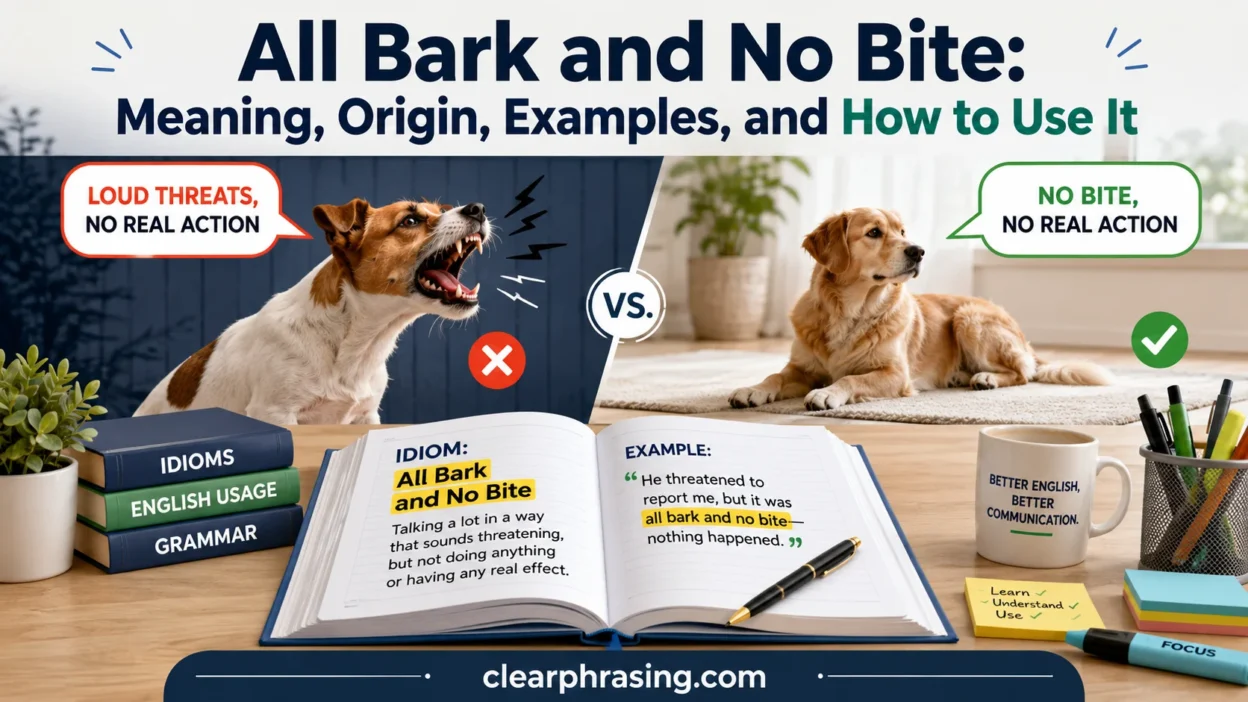
The All Bark and No Bite: Meaning, Origin, Examples, and Usage describes someone whose words sound threatening but whose actions create no real threat.
The phrase comes from the literal image of a dog that barks loudly but doesn’t bite. Its figurative meaning suggests tough talk, empty threats, or grand promises without real action. This expression appears in the workplace, sports, and friendships, helping your audience understand the difference between appearance and reality.
For example, a coworker who threatens to quit over small issues may use talk tough language but never follow through. Their words seem stronger than their actions, making the threat less serious.
In my experience teaching English language, I’ve found that learners understand this idiom quickly when they compare barking with biting. The expression can add clarity to speech, writing, and everyday communication.
Quick Answer:
“All bark and no bite” means someone talks aggressively, makes threats, or boasts about what they will do but doesn’t follow through with action.
For example:
He keeps threatening to complain to the boss, but he’s all bark and no bite.
Here, bark represents the person’s loud or threatening words. Bite represents the action that never follows.
The phrase is an idiom, so you shouldn’t interpret it literally. It describes the gap between what someone says and what they actually do.
The expression can also describe someone who talks about ambitious plans but repeatedly fails to act on them. Still, its strongest sense involves threatening or intimidating behavior.
What Does “All Bark and No Bite” Mean?
The easiest way to understand the expression is to split it into two parts.
| Word | Figurative meaning |
| Bark | Loud, aggressive, threatening, or boastful words |
| Bite | Real action, consequences, or follow-through |
Imagine someone saying, “I’ll make sure you regret this,” every time they get angry. Yet they never do anything afterward.
That person may be described as all bark and no bite.
The expression points to a mismatch. Their language creates an impression of power, but their behavior doesn’t support it.
What Does “Bark” Represent?
In this idiom, bark isn’t ordinary conversation. It suggests words that make someone sound tougher, stronger, or more dangerous than their actions reveal.
The “bark” might include:
- Threats
- Aggressive warnings
- Tough talk
- Boasting
- Intimidation
- Grand promises
- Strong claims without evidence
For example, a person might repeatedly say they’ll report a coworker, sue a business, quit their job, or confront someone. If they never act on those statements, their words become the “bark.”
What Does “Bite” Represent?
Bite represents the action that gives words real force.
It can mean:
- Following through
- Taking action
- Enforcing a threat
- Producing consequences
- Delivering promised results
- Backing up a claim
That’s why the phrase works so well. Barking creates noise. Biting creates consequences.
Why Is “All Bark and No Bite” an Idiom?
Yes, “all bark and no bite” is an idiom.
An idiom is an expression whose intended meaning differs from the literal meaning of its individual words. You don’t need an actual dog for someone to be “all bark and no bite.”
The expression creates a mental picture, then uses that picture to describe human behavior.
Consider this sentence:
The new manager is all bark and no bite.
The manager obviously isn’t being compared to a dog in a literal sense. Instead, the sentence says that the manager sounds intimidating but doesn’t follow through.
That figurative quality makes the phrase memorable. Rather than saying “the manager frequently makes threats without acting,” you can use five familiar words to communicate the same basic idea.
Where Did “All Bark and No Bite” Come From?
The expression draws on the familiar image of a dog barking without biting. Its exact development isn’t as straightforward as some popular explanations suggest, so it’s better to avoid claiming a single inventor or precise origin without evidence.
The related expression “his bark is worse than his bite” has documented roots in early 19th-century English. Phrase Finder identifies “all bark and no bite” as a variant of that older expression and notes that the phrase came into common use around the beginning of the 19th century.
The broader idea is older, though. English has long used barking dogs as a metaphor for people who make a great deal of noise but don’t necessarily act.
One historical example appears in John Heywood’s collection of proverbs from around 1550. The proverb contrasts dogs that bark loudly with the idea that those same dogs don’t necessarily bite.
So the history is best understood as a family of related expressions, rather than a single phrase appearing out of nowhere.
“All Bark and No Bite” vs. “His Bark Is Worse Than His Bite”
These expressions overlap, but they’re not identical.
“All bark and no bite” focuses strongly on a person’s lack of action after aggressive talk.
He threatens everyone, but he’s all bark and no bite.
“His bark is worse than his bite” emphasizes that someone’s manner or words appear more frightening than their actual behavior.
Don’t take his shouting too seriously. His bark is worse than his bite.
The distinction is subtle, but useful.
How to Use “All Bark and No Bite” in a Sentence
The expression usually describes a person, although the person can represent a wider pattern of behavior.
A common structure is:
Subject + be + all bark and no bite
For example:
- He’s all bark and no bite.
- She’s all bark and no bite.
- They’re all bark and no bite.
- That manager is all bark and no bite.
You can also put the phrase after a description of someone’s behavior.
He talks tough, but he’s all bark and no bite.
The contrast between talking and acting makes the meaning especially clear.
“All Bark and No Bite” Example Sentences
Seeing the phrase in different contexts makes its meaning easier to recognize.
Examples About Threats
He keeps threatening to sue, but he’s all bark and no bite.
The speaker believes the threats won’t lead to legal action.
She sounds intimidating, but she’s all bark and no bite.
Her manner is aggressive, but she doesn’t actually act aggressively.
The coach warned the players that he’d bench anyone who arrived late. After several violations, though, everyone realized he was all bark and no bite.
The repeated warning loses credibility because the coach never enforces it.
Examples About Big Claims
He talks about starting three companies, but he’s all bark and no bite.
Here, the phrase moves beyond direct threats. It describes someone whose ambitious words aren’t followed by action.
The executive promised major changes, yet employees began calling the plan all bark and no bite.
The criticism focuses on promises that haven’t produced results.
Examples in Everyday Conversation
My brother says he’ll challenge anyone who disagrees with him, but he’s all bark and no bite.
She keeps saying she’ll quit, but after six months, she’s still there. She’s all bark and no bite.
Don’t worry about his angry comments. He’s all bark and no bite.
These examples show why context matters. The expression usually needs a clear connection between strong words and weak follow-through.
When Does “All Bark and No Bite” Fit Best?
A useful test involves three questions:
- Is the person making strong, aggressive, or impressive claims?
- Do those words suggest action or consequences?
- Does the person fail to follow through?
If the answer is yes across the board, “all bark and no bite” is probably a good choice.
For example, imagine a supervisor who repeatedly says, “One more late arrival and you’re fired.”
The employee arrives late five more times. Nothing happens.
That situation provides the missing piece: the threat doesn’t translate into action.
When Doesn’t “All Bark and No Bite” Fit?
The phrase isn’t a universal synonym for “talkative.”
Someone can talk constantly without being threatening or boastful. That alone doesn’t make them all bark and no bite.
For example:
She talks about her favorite movies all day.
This person isn’t “all bark and no bite.” There’s no threat, bravado, or promised action.
Likewise, if someone makes a promise and then fulfills it, the idiom doesn’t fit.
He warned the contractor about the deadline and canceled the contract when the deadline was missed.
That’s not “all bark and no bite.” His words had consequences.
Avoid Using It When Someone May Actually Be Dangerous
There’s also a practical reason to use this idiom carefully.
Calling a genuinely threatening person “all bark and no bite” assumes that the person won’t act. That assumption could be wrong.
The idiom describes your assessment of someone’s behavior. It isn’t proof that a threat is harmless.
Is “All Bark and No Bite” Always Negative?
Usually, yes.
The expression often sounds critical, dismissive, sarcastic, or mocking. You’re suggesting that someone lacks the substance behind their words.
Still, the tone can vary.
| Context | Likely tone |
| Friends joking about a harmless argument | Playful |
| Describing an aggressive coworker | Critical |
| Discussing empty political promises | Skeptical |
| Describing repeated threats | Dismissive |
| Warning someone about a dangerous person | Potentially inappropriate |
In casual conversation, the phrase can even sound humorous.
Dad talks tough about fixing everything around the house, but he’s all bark and no bite when the toolbox comes out.
The sentence isn’t necessarily accusing Dad of making serious threats. Instead, it pokes fun at his repeated claims.
“All Bark and No Bite” vs. Similar Expressions
Several English expressions describe a gap between words and actions. However, their shades of meaning differ.
| Expression | Meaning | Best use |
| All bark and no bite | Talks tough but doesn’t act | Threats or intimidating talk |
| His bark is worse than his bite | Seems harsher than he really is | Someone intimidating but less harmful than they appear |
| All talk and no action | Talks without doing | General lack of follow-through |
| Talks a big game | Makes impressive claims | Boasting about ability or plans |
| Talk is cheap | Words matter less than actions | Emphasizing the importance of results |
| All show and no substance | Looks impressive but lacks real value | Presentations, claims, or appearances |
These expressions overlap, but they aren’t interchangeable in every sentence.
“All Bark and No Bite” vs. “All Talk and No Action”
This is probably the closest comparison.
All talk and no action is broader. It can describe almost any situation in which someone talks about doing something but doesn’t do it.
She says she’ll organize the event, but she’s all talk and no action.
All bark and no bite carries more force. It often suggests aggressive language, threats, or intimidation.
He keeps threatening to challenge his opponents, but he’s all bark and no bite.
So, if there’s a threatening edge, “all bark and no bite” usually communicates the idea more precisely.
“All Bark and No Bite” vs. “Talks a Big Game”
Talks a big game often describes someone who boasts about their abilities.
He talks a big game about basketball, but he rarely scores.
The person may not threaten anyone. They’re simply making themselves sound impressive.
By contrast:
He keeps challenging everyone to a fight, but he’s all bark and no bite.
The second sentence carries a much stronger sense of intimidation.
Is “All Bark and No Bite” Formal or Informal?
“All bark and no bite” is mainly conversational and informal.
It works naturally in:
- Everyday conversations
- Dialogue
- Blogs
- Opinion pieces
- Informal articles
- Social media
- Casual workplace conversations
It can also appear in journalism and commentary, especially when the writer wants a vivid or conversational tone.
However, formal reports may benefit from more precise wording.
Instead of:
The company is all bark and no bite.
A formal report could say:
The company has repeatedly announced enforcement measures without implementing them.
The second version sounds less colorful, but it provides a more precise description.
Grammar of “All Bark and No Bite”
The expression normally works as a subject complement after a form of be.
Common patterns include:
- He is all bark and no bite.
- She is all bark and no bite.
- The manager is all bark and no bite.
- They are all bark and no bite.
You can also use a shortened form:
He’s all bark, no bite.
The shortened version is especially common in casual speech, headlines, captions, and punchy writing.
Is “All Bark, No Bite” Correct?
Yes. “All bark, no bite” is a common shortened form of “all bark and no bite.”
The full expression is the more complete form:
He’s all bark and no bite.
The compressed version sounds sharper:
He’s all bark, no bite.
Neither version requires you to interpret “bark” or “bite” literally.
Common Mistakes
Mistake: Using It for Any Talkative Person
Talking a lot isn’t enough.
The phrase needs some element of empty threat, bravado, intimidation, or failed follow-through.
Mistake: Using It When Someone Actually Acts
If someone threatens a consequence and then carries it out, describing them as “all bark and no bite” contradicts the situation.
Mistake: Treating It as an Exact Synonym for “Talks a Big Game”
The expressions overlap, but talks a big game often focuses on boasting.
All bark and no bite more strongly suggests aggressive talk that lacks action.
Mistake: Assuming It Always Means Physical Violence
The “bite” doesn’t have to mean physically attacking someone.
It can represent any meaningful action or consequence.
A business executive can be all bark and no bite. So can a manager, politician, competitor, friend, or neighbor.
Can “All Bark and No Bite” Describe Someone Who Isn’t Dangerous?
Absolutely.
The expression doesn’t require a real physical threat.
For example:
He constantly says he’ll launch a competing business, but he’s all bark and no bite.
There’s no physical danger here. The “bite” represents the promised business action.
Similarly:
The company keeps promising sweeping reforms, but critics say its announcements are all bark and no bite.
The phrase now describes a gap between rhetoric and results.
That broader use explains why the idiom remains useful beyond confrontational situations.
What Is the Opposite of “All Bark and No Bite”?
English doesn’t have one perfect fixed antonym for the expression.
Instead, you can describe the opposite idea with phrases such as:
- Backs up their words
- Follows through
- Means what they say
- Puts words into action
- Delivers on promises
- Walks the talk
For example:
He doesn’t make many threats, but he always follows through.
That describes someone whose actions support their words.
Real-Life Contexts
The idiom appears in many situations because the underlying idea is universal: words create expectations, while actions prove them.
Workplace
A manager repeatedly threatens disciplinary action but never enforces the rules.
Business
A company announces major improvements every quarter without delivering measurable changes.
Competition
An athlete or competitor boasts about winning but performs poorly when the contest begins.
Personal Relationships
Someone repeatedly threatens to end a relationship or confront another person but never follows through.
Public Debate
A public figure makes strong promises or threats without taking the action they announced.
In each case, the same pattern appears:
Strong language → expectation of action → no meaningful follow-through.
A Simple Way to Remember “All Bark and No Bite”
Think of the idiom as a three-step equation:
Bark = words
Bite = action
All bark and no bite = strong words without matching action
That makes the expression easy to remember.
If someone keeps making noise about what they’ll do but never does it, the idiom may be exactly what you’re looking for.
Read More: Ware vs. Wear: Difference, Meaning, Examples
FAQs
What does “all bark and no bite” mean?
It describes someone who sounds threatening or aggressive but rarely takes action. Their words may seem strong, yet their behavior shows little real danger.
Is “all bark and no bite” an idiom?
Yes, “all bark and no bite” is a common English idiom. It uses the image of a barking dog to describe a person whose threats are stronger than their actions.
What is the origin of “all bark and no bite”?
The expression comes from the familiar idea that a dog may bark loudly without actually biting. Over time, this image became a figurative way to describe empty threats.
What is an example of “all bark and no bite”?
A manager might repeatedly threaten to fire an employee over minor mistakes but never take action. In that situation, you could say the manager is all bark and no bite.
Can you use this idiom for a friend?
Yes. You might use it when a friend talks confidently about confronting someone but never actually does anything. The phrase usually suggests that the person’s tough words don’t match their behavior.
Is “all bark and no bite” positive or negative?
It usually has a negative or teasing tone because it suggests that someone makes threats without following through. However, friends may also use it playfully.
What is the difference between “all bark and no bite” and “bark is worse than the bite”?
Both expressions describe a person who seems more threatening than they really are. “All bark and no bite” focuses more on empty threats, while “bark is worse than the bite” emphasizes that someone appears more dangerous than they actually are.
Can “all bark and no bite” describe a situation?
Yes. Although it commonly describes people, you can also use it for situations where there is plenty of noise, pressure, or apparent danger but little actual consequence.
Can I use “all bark and no bite” in formal writing?
You can, but it works best when the context allows idiomatic or conversational language. In highly formal writing, a phrase such as “empty threats” or “a lack of follow-through” may sound more appropriate.
What does “bark” represent in this idiom?
Bark represents loud words, threats, warnings, or aggressive talk. Bite represents real action or consequences, so someone with plenty of bark but no bite talks tough without acting.
Conclusion
All bark and no bite is a useful idiom because it turns a simple picture of a barking dog into a clear lesson about human behavior. It describes the gap between what someone says and what they actually do. When a person makes bold threats, talks tough, or promises serious action but never follows through, this expression captures the situation neatly.
Understanding this idiom also helps you recognize how English uses everyday images to express deeper ideas. Whether you hear it at work, in a conversation with friends, or while reading English, the meaning becomes easier to grasp when you remember the basic contrast: lots of barking, but no biting.

Shamsa Kanwal is an English specialist and content writer at ClearPhrasing.com, where she helps readers navigate the English language with confidence. She enjoys breaking down grammar rules, spelling differences, vocabulary, and everyday writing challenges into simple, practical lessons that anyone can understand.
Her writing is focused on making learning approachable rather than overwhelming. Whether she’s explaining commonly confused words, punctuation rules, or grammar concepts, Shamsa believes that clear explanations and real-life examples are the key to effective learning.
Every article she writes is carefully researched, fact-checked, and edited to ensure it is accurate, easy to read, and genuinely helpful. Her goal is to create trustworthy resources that enable students, professionals, writers, and English learners to improve their communication skills and write with greater clarity.
Through her work at ClearPhrasing.com, Shamsa is committed to making English learning simpler, more practical, and accessible for readers around the world.