However or How Ever: Meaning, Difference, and Usage becomes easier when you understand the role of each form.
However is an adverb that usually shows contrast or contradiction and often means nevertheless or in spite of that. In my experience as an English teacher, I’ve seen many writers and speakers get confused because the words can sound similar. The proper use depends on the context, and learning this difference can improve your grammar, writing clearly, and overall language proficiency.
How ever is a phrase used when how needs emphasis. Depending on the context, it can mean whatever way, whatever degree, or whatever extent. For example, “However you convince Mom to buy the car, make it happen.” Similarly, “However certain you feel Mr. Plum is the murderer, wait for evidence before accusing him.”
Understanding this common conundrum helps writers make the correct choice and communicate their ideas more clearly.
Quick Answer:
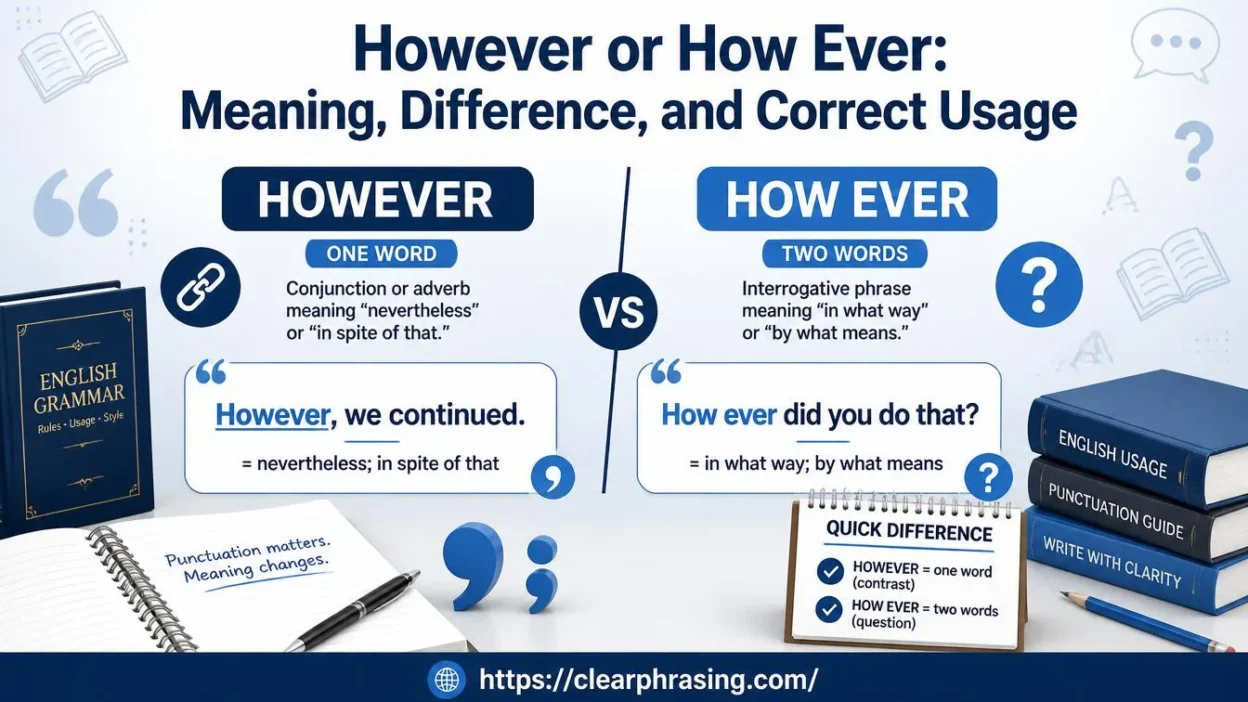
However is the standard one-word form in most situations. It can mean “nevertheless,” “in whatever way,” or “to whatever degree.” For example, you might write, “However, we decided to continue,” or “You can solve the problem however you like.”
How ever is written as two words when ever separately emphasizes how, especially in an emphatic question. For example, “How ever did you manage that?” adds surprise or strong emphasis to the basic question “How did you manage that?” Oxford specifically notes this separate-word construction.
| Form | Main meaning | Example |
| however | Nevertheless / in contrast | However, we continued. |
| however | In whatever way | Do it however you prefer. |
| however | To whatever degree | However difficult it gets, continue. |
| how ever | Emphatic “how” | How ever did you do that? |
So, if you mean “nevertheless,” use however. If ever intensifies a separate question word how, how ever may be appropriate.
What Does “However” Mean?
The word however has several established uses. Treating it as nothing more than a fancy version of but can lead to awkward grammar and punctuation.
Modern dictionaries recognize three major patterns: contrast, manner, and degree.
However Means “Nevertheless” or “In Contrast”
The most familiar use of however introduces an idea that contrasts with something stated earlier.
Consider:
The restaurant looked crowded. However, we found a table quickly.
The second sentence doesn’t completely reject the first. Instead, it introduces an unexpected result.
You could replace however with nevertheless in this example:
The restaurant looked crowded. Nevertheless, we found a table quickly.
That substitution gives you a useful memory test. If nevertheless fits naturally, however is probably the correct form.
More examples include:
- The forecast predicted rain. However, the afternoon stayed sunny.
- She had little experience. However, she performed extremely well.
- The apartment was small. However, its location was excellent.
- The proposal seemed expensive. However, the long-term savings were significant.
In this use, however acts as a contrastive adverb. It doesn’t simply connect two independent clauses in the same way that but does.
However Means “In Whatever Way”
Here’s where things get more interesting.
However can also mean “in whatever way” or “no matter how.” Cambridge explains this use as expressing that the particular way something happens doesn’t matter.
For example:
You can arrange the furniture however you like.
This means:
You can arrange the furniture in whatever way you like.
Another example:
However you approach the problem, check your calculations carefully.
Here, however doesn’t mean nevertheless. It describes the method or manner of approaching the problem.
More examples:
- Organize the files however you think is easiest.
- However you explain the process, keep the instructions clear.
- Travel however you prefer.
- However you look at the situation, the deadline remains unchanged.
Notice the difference:
However, the deadline remains unchanged.
Here, however means nevertheless.
But:
However you look at the situation, the deadline remains unchanged.
Here, however means in whatever way.
The spelling stays the same because both uses belong to the established word however.
However Means “To Whatever Degree”
Another important pattern is however + adjective or adverb.
In this construction, however means “to whatever degree” or “no matter how.” Oxford lists this as a distinct use.
Examples include:
- However difficult the exam becomes, stay focused.
- However carefully you plan, unexpected problems can arise.
- However expensive the repair is, the machine needs attention.
- However small the error seems, correct it.
- However quickly she worked, she couldn’t finish everything.
Consider this sentence:
However difficult the task seems, don’t give up.
You could paraphrase it as:
No matter how difficult the task seems, don’t give up.
That makes the meaning easier to recognize.
What Does “How Ever” Mean?
Now we reach the less common construction.
How ever consists of two separate words when ever emphasizes the question word how. Oxford gives the example “How ever did you get here so quickly?” and explains that this separate spelling is used when ever emphasizes how.
Compare these questions:
How did you solve the puzzle?
and:
How ever did you solve the puzzle?
The first question simply asks about the method.
The second carries extra emotion. Depending on the context, it can express surprise, disbelief, amazement, frustration, or strong curiosity.
It’s similar to saying:
How on earth did you solve the puzzle?
That doesn’t mean how ever is always dramatic. Context controls the tone.
Examples of “How Ever”
- How ever did you find that tiny mistake?
- How ever could they have known?
- How ever will we finish this project by Friday?
- How ever did you get there so quickly?
- How ever could she remember all those details?
In each example, ever adds emphasis to how.
That’s the key.
The words aren’t functioning as the single adverb however in the contrastive sense.
However vs How Ever: The Key Difference
The easiest way to understand however vs how ever is to focus on meaning rather than pronunciation.
| Feature | However | How ever |
| Spelling | One word | Two words |
| Common role | Adverb or conjunction-like use | How + emphatic ever |
| Contrast | Yes | No |
| “In whatever way” | Yes | Not normally |
| “To whatever degree” | Yes | Not normally |
| Emphatic question | Can occur in some styles | Yes, when ever emphasizes how |
| Frequency | Very common | Less common |
| Example | However, I agreed. | How ever did you know? |
The biggest mistake is assuming that how ever is always wrong. It isn’t.
The real question is whether ever functions separately to emphasize how.
How to Use “However” Correctly
Knowing the meaning is only half the battle. Punctuation matters too.
“However” at the Beginning of a Sentence
You can start a sentence with however.
For example:
However, the final results were different.
This use is widely found in modern English. Merriam-Webster specifically notes that the supposed ban on beginning sentences with however isn’t an absolute rule. It points out that many established writers have used it this way.
So this isn’t automatically wrong:
However, we decided to stay.
The comma works because however introduces a contrastive statement.
“However” in the Middle of a Sentence
When however interrupts a sentence, commas often set it off as a parenthetical element.
For example:
The results, however, were unexpected.
Another example:
The proposal was, however, rejected.
Here, removing however leaves a grammatically complete sentence:
The results were unexpected.
That helps explain why commas surround the interrupting word.
“However” Between Two Independent Clauses
This is where many writers stumble.
Consider:
❌ The plan failed, however we continued.
The comma doesn’t properly join the two independent clauses.
Better choices include:
The plan failed. However, we continued.
Or:
The plan failed; however, we continued.
Or:
The plan failed, but we continued.
The distinction matters because however doesn’t function like the coordinating conjunction but in this structure.
A useful rule is simple:
Don’t use a comma alone to join two independent clauses with however.
When “However” Doesn’t Need a Comma
Not every however needs a comma.
Consider:
However you organize the schedule, make sure everyone receives the final version.
Here, however means in whatever way. It forms part of the clause rather than acting as a parenthetical contrastive transition.
Another example:
However carefully she checked the document, one typo remained.
Again, a comma doesn’t belong immediately after however.
Compare these sentences:
However, she checked the document again.
However carefully she checked the document, one typo remained.
The first however means nevertheless.
The second means to whatever degree / no matter how carefully.
That difference explains the punctuation.
However or How Ever Examples
Seeing the forms side by side makes the distinction much easier.
Examples With “However”
Contrast:
The store was closing. However, we still had enough time to shop.
Manner:
You can complete the assignment however you prefer.
Degree:
However challenging the course becomes, keep practicing.
Contrast inside a sentence:
The course was difficult; however, the lessons were useful.
Manner at the beginning of a clause:
However you approach the topic, support your claims with evidence.
Examples With “How Ever”
Surprise:
How ever did you manage to finish so quickly?
Disbelief:
How ever could he have forgotten such an important detail?
Strong curiosity:
How ever did you discover that shortcut?
Amazement:
How ever did they build something so complicated?
In each question, ever adds force to how.
Common Mistakes
The confusion usually comes from treating the two forms as interchangeable. They aren’t.
Writing “How Ever” When You Mean “Nevertheless”
Incorrect:
❌ How ever, we decided to continue.
Correct:
✅ However, we decided to continue.
The intended meaning is nevertheless. Therefore, use the one-word form.
Writing “However” for an Emphatic “How”
When ever separately emphasizes how, two words can be appropriate:
How ever did you manage that?
The sentence isn’t saying nevertheless. It’s expressing an emphatic question.
Adding a Comma Automatically After Every “However”
This rule is too broad:
❌ However, you solve the problem, check the answer.
Better:
✅ However you solve the problem, check the answer.
Here, however means in whatever way.
But compare:
✅ However, you should check the answer.
This version uses however as a contrastive transition.
Assuming “However” Always Means “But”
However often introduces contrast, but that isn’t its only job.
Compare:
However, the results changed.
with:
Solve the problem however you like.
The first expresses contrast.
The second expresses manner.
Then consider:
However difficult the problem looks, start with the first step.
This one expresses degree.
Understanding these three patterns makes however much easier to use accurately.
A Simple Test
When you’re stuck, don’t stare at the spelling. Test the meaning.
Test One: Can You Replace It With “Nevertheless”?
Try:
However, I decided to stay.
Replace however:
Nevertheless, I decided to stay.
The meaning still works. Use however.
Test Two: Can You Replace It With “In Whatever Way”?
Try:
Do it however you prefer.
Replace it:
Do it in whatever way you prefer.
The meaning remains intact. Use however.
Test Three: Does “Ever” Emphasize “How”?
Try:
How ever did you discover that?
The basic question is:
How did you discover that?
Adding ever strengthens the question. Use how ever when that separate emphasis is intended.
This three-step test handles most everyday cases.
However or How Ever in Formal Writing
However is especially useful in academic and professional writing because it can signal a clear shift in an argument.
For example:
The initial findings appeared promising. However, later testing revealed several weaknesses.
The transition tells readers that the next point qualifies or challenges the previous one.
Still, good writing doesn’t depend on however every other sentence. Repetition can flatten your prose.
Depending on the relationship between ideas, alternatives include:
- nevertheless
- nonetheless
- even so
- in contrast
- by contrast
- still
- despite this
- on the other hand
Choose the alternative that accurately describes the relationship. Don’t swap transition words simply to avoid repetition.
For example:
The evidence was limited. Nevertheless, the researchers continued.
works naturally.
But:
The evidence was limited. In contrast, the researchers continued.
doesn’t express the same relationship as clearly. In contrast usually sets two things against each other rather than simply acknowledging an unexpected continuation.
Precision beats variety when the two goals conflict.
However or How Ever in American English
In modern US English, however is the standard one-word spelling for its established meanings.
It commonly means:
- nevertheless
- in whatever way
- to whatever degree
Oxford’s American dictionary lists all three uses and separately notes the how ever construction when ever emphasizes how.
So American English doesn’t require you to choose between the two forms based simply on pronunciation.
Instead, look at the grammatical structure.
However, the meeting continued.
Here, use one word.
However carefully you prepare, surprises can happen.
Again, one word.
How ever did you finish before everyone else?
Here, two words can emphasize how.
A Closer Look at “However” and “How Ever”
The distinction becomes clearer when you think of ever as having two possible jobs.
In however, the word has become an established lexical unit. Cambridge groups however with other -ever words such as whatever, whenever, wherever, and whoever. These forms can express meanings such as “any way at all” or “it doesn’t matter how.”
In how ever, by contrast, how remains a separate question word and ever adds emphasis.
Think of the difference as a small grammatical fork in the road:
However
→ one established word
→ contrast, manner, or degree
How ever
→ two separate words
→ ever emphasizes how
Once you see that structure, the spelling becomes much less mysterious.
Case Study: One Space Changes the Meaning
Consider this sentence:
However did she solve the problem?
A reader may interpret this as a question about how she solved it, with however functioning in an emphatic question construction. Merriam-Webster includes this “how in the world” sense under however.
Oxford, however, specifically notes that when ever emphasizes how, it is usually written separately:
How ever did you get here so quickly?
This is a useful reminder that dictionaries can describe overlapping usage differently. In careful modern writing, how ever makes the separate emphasis particularly clear.
That distinction is more useful than declaring one form universally right and the other universally wrong.
Quick Practice
Fill in each blank with however or how ever.
- _____, the final decision remained unchanged.
- _____ did you finish the entire report overnight?
- You can arrange the chairs _____ you like.
- _____ difficult the assignment seems, keep working.
- The road was longer than expected. _____, we arrived on time.
- _____ carefully you check the figures, small errors can happen.
- _____ could they have predicted the outcome?
- We can solve the issue _____ the team thinks best.
Answers
- However — it means nevertheless.
- How ever — ever emphasizes the question how.
- however — it means in whatever way.
- However — it means to whatever degree.
- However — it introduces a contrast.
- However — it modifies carefully and means no matter how carefully.
- How ever — it emphasizes the question.
- however — it means in whatever way.
Facts to Remember
Keep these points handy when editing your writing:
- However is normally written as one word.
- However can express contrast.
- However can mean “in whatever way.”
- However can mean “to whatever degree.”
- How ever can be correct when ever emphasizes how.
- However can begin a sentence.
- A contrastive however can take commas when it functions as an interrupting element.
- A comma shouldn’t automatically follow however when it introduces a clause meaning “in whatever way” or “to whatever degree.”
- Don’t join two independent clauses with a comma alone before however.
- Meaning matters more than pronunciation.
Read More: Assumedly vs. Assumably: Meaning, Difference, and Usage
FAQs
1. What is the main difference between however and how ever?
However is usually an adverb that introduces contrast, while how ever consists of two separate words. The correct choice depends on the meaning and context of your sentence.
2. Is however one word or two words?
However is normally written as one word. When how and ever work separately to emphasize how something happens, you may write how ever as two words.
3. What does however mean in a sentence?
However commonly means “nevertheless” or “in spite of that.” It can connect two contrasting ideas, such as: “I was tired; however, I finished the assignment.”
4. When should I use how ever?
Use how ever when you want to emphasize the word how, particularly in questions or expressions showing surprise. For example: “How ever did you solve that problem?”
5. Can however and how ever be used interchangeably?
No. Although they look and sound similar, they serve different purposes. However generally expresses contrast or means “in whatever way,” while how ever emphasizes the manner or degree described by how.
6. Does however always show contrast?
Not always. However can also mean “in whatever way” or “to whatever degree.” Its exact meaning depends on how it functions within the sentence.
7. Is however formal English?
Yes. However works well in formal and informal writing. You’ll often see it in essays, reports, professional communication, academic writing, and everyday sentences.
8. Why do people confuse however with how ever?
The confusion comes mainly from their similar spelling and pronunciation. However, their grammatical roles differ, so looking at the sentence’s meaning usually reveals which form you need.
9. Can however appear at the beginning of a sentence?
Yes. For example: “However, we decided to continue.” When it introduces a contrasting statement this way, punctuation helps separate it from the rest of the sentence.
10. How can I remember when to use however?
Think about what you’re trying to express. If you mean “nevertheless,” choose however. If you’re emphasizing how something happened or was done, how ever may be appropriate.
Conclusion
The difference between however and how ever may look tiny on the page, but it can change the meaning and structure of a sentence. Once you identify whether you’re expressing contrast, manner, or degree, the correct form becomes much easier to choose.
With regular practice, this distinction stops feeling like a grammar trap. Pay attention to context, read examples aloud, and check what you actually mean before choosing the word. That small habit can make your writing clearer, smoother, and more confident.

Shamsa Kanwal is an English specialist and content writer at ClearPhrasing.com, where she helps readers navigate the English language with confidence. She enjoys breaking down grammar rules, spelling differences, vocabulary, and everyday writing challenges into simple, practical lessons that anyone can understand.
Her writing is focused on making learning approachable rather than overwhelming. Whether she’s explaining commonly confused words, punctuation rules, or grammar concepts, Shamsa believes that clear explanations and real-life examples are the key to effective learning.
Every article she writes is carefully researched, fact-checked, and edited to ensure it is accurate, easy to read, and genuinely helpful. Her goal is to create trustworthy resources that enable students, professionals, writers, and English learners to improve their communication skills and write with greater clarity.
Through her work at ClearPhrasing.com, Shamsa is committed to making English learning simpler, more practical, and accessible for readers around the world.