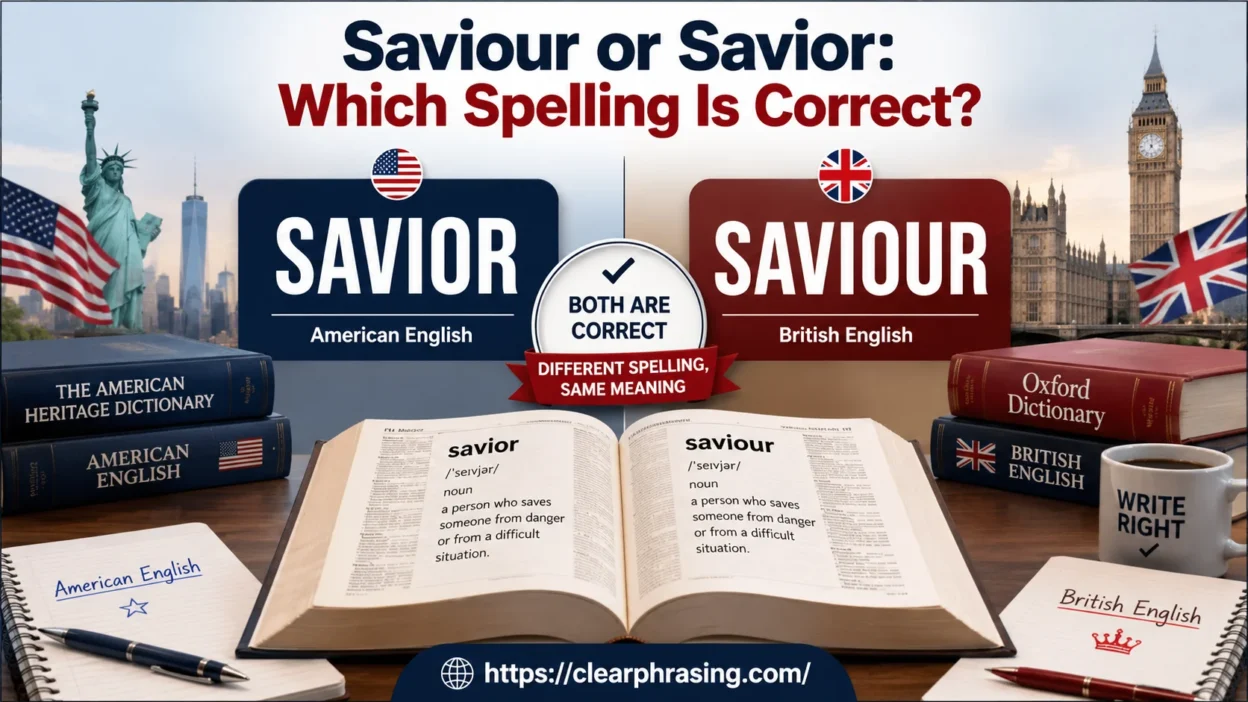
Saviour or Savior: Correct Spelling, Meaning, and Usage can seem confusing because English has regional variations and odd rules. In American English, savior is the preferred spelling, while British English uses saviour.
Both spellings have the same meaning. They describe a person who saves or rescues someone from danger, harm, or difficulty. The difference only reflects regional English usage, not a change in meaning.
As an English teacher, I’ve seen learners become puzzled by this common confusion. The simple rule is to choose the spelling that matches your audience. Use savior for a US audience and saviour for British writing.
Quick Answer
Savior and saviour are both correct spellings of the same noun.
- Savior = standard American English spelling
- Saviour = standard British English spelling
- Meaning = a person who saves or rescues someone
- Pronunciation = generally the same
- Part of speech = noun
- Plural = saviors in US English and saviours in British English
| Question | Answer |
| Is savior correct? | Yes. It is the standard US spelling. |
| Is saviour correct? | Yes. It is the standard UK spelling. |
| Do they mean different things? | No. They have the same basic meaning. |
| Which should Americans use? | Savior |
| Which should British writers use? | Saviour |
| Is the pronunciation different? | Generally, no. |
| Can both appear in English? | Yes, depending on regional spelling conventions. |
Merriam-Webster lists savior as the main US entry and gives saviour as a variant spelling.
In other words, the spelling changes, not the meaning.
What Does Savior or Saviour Mean?
At its most basic level, savior or saviour describes someone who saves another person from danger, harm, trouble, or destruction.
Cambridge Dictionary defines the word in terms of someone who saves another person from danger or harm.
The word can describe a real person who performs a rescue:
“a person who saves someone or something from harm”
For example:
- The firefighter became a savior after rescuing the family.
- The lifeguard was hailed as a saviour after pulling the swimmer from the water.
- Her quick decision made her the team’s savior.
The word also works figuratively. A person, organization, invention, or even an idea can become a savior when it provides much-needed relief.
For instance, someone might call a new financial plan a savior for a struggling business. A commuter might jokingly call a reliable ride-sharing service a savior after missing the last bus.
That figurative use gives the word a broader range than simply “rescuer.”
Savior or Saviour in Religious Contexts
The word takes on a specific meaning in Christianity. Savior in American English and Saviour in British English can refer to Jesus Christ, who Christians believe saves humanity from sin.
In this context, the word often appears with a capital S:
- Christians believe Jesus is the Savior.
- The hymn refers to Jesus as the Saviour.
Capitalization can depend on the religious context, denomination, publication style, and whether the word functions as a specific title or a general description. Therefore, it’s better to follow the style used by the particular religious organization or publication rather than assuming every occurrence must use a capital letter.
The important point is that the regional spelling remains the same. American religious writing generally uses Savior, while British religious writing commonly uses Saviour.
What Is the Difference?
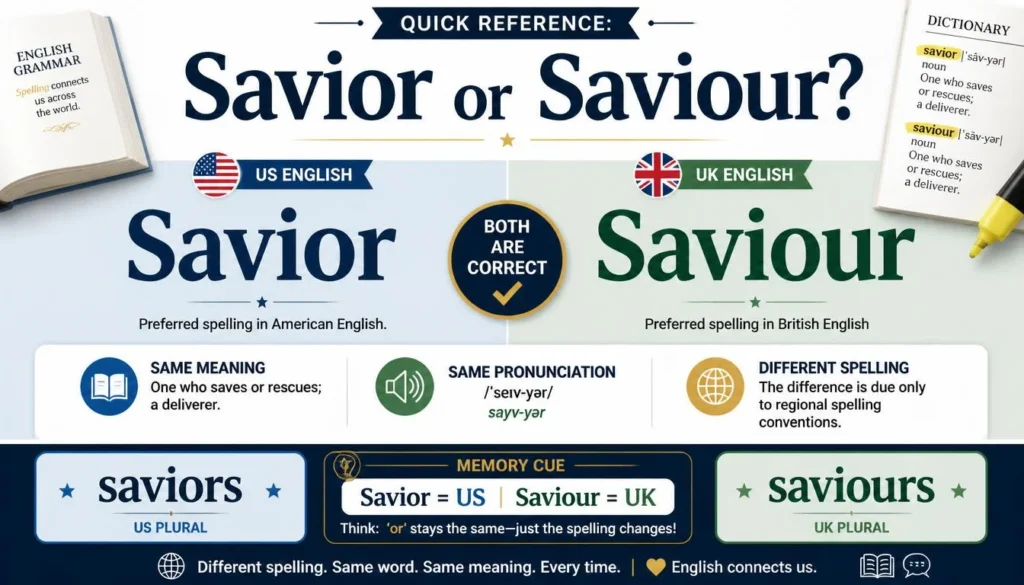
The difference between saviour and savior is primarily a matter of regional spelling.
American English tends to use -or in several words where British English traditionally uses -our.
| American English | British English |
| savior | saviour |
| favor | favour |
| honor | honour |
| color | colour |
| neighbor | neighbour |
| labor | labour |
| behavior | behaviour |
This pattern makes saviour/savior easier to remember.
Think of the u as part of a broader British spelling tradition. American English often removes that u in words ending in -our.
However, don’t treat the pattern as a universal rule that applies to every English word. English spelling contains plenty of historical exceptions and special cases.
Why Does Saviour Have a “U”?
The spelling difference reflects the historical development of English rather than a difference in pronunciation or meaning.
The word ultimately traces back through French and Middle English forms to Latin salvator, meaning someone who saves. Merriam-Webster traces savior through Middle English to Latin salvator.
Over time, English developed different spelling conventions on opposite sides of the Atlantic. British English retained many spellings with -our, while American English adopted or standardized shorter -or forms in numerous cases.
That’s why you see familiar pairs such as:
colour → color
favour → favor
honour → honor
saviour → savior
The extra letter doesn’t create a new word. It simply reflects a different spelling tradition.
Savior in American English
If you’re writing in US English, choose savior.
It’s the spelling American readers expect in ordinary contemporary writing. You’ll find it in general writing, journalism, educational material, religious texts, fiction, and everyday communication.
For example:
- The firefighter was hailed as a savior.
- The new technology became a savior for small businesses.
- Many Christians refer to Jesus as the Savior.
- She regarded her older brother as her savior during the crisis.
Notice that the meaning stays exactly the same when the word changes from savior to saviour.
Why American Writers Should Prefer Savior
Consistency matters in professional writing.
Imagine an article written entirely in American English:
The company announced its new behavior policy and praised its neighborhood volunteers as heroes and saviours.
The word saviours suddenly introduces a British-style spelling into an otherwise American spelling system.
That doesn’t make the sentence impossible to understand. It simply makes the style inconsistent.
A cleaner version would be:
The company announced its new behavior policy and praised its neighborhood volunteers as heroes and saviors.
The same principle applies to websites, academic papers, marketing content, schoolwork, and business documents.
Saviour in British English
If you’re writing in British English, use saviour.
British readers commonly expect the -our spelling, just as they expect colour rather than color and favour rather than favor.
Consider these examples:
- The firefighter was hailed as a saviour.
- The new policy became a saviour for struggling families.
- Many Christians refer to Jesus as the Saviour.
- She considered her friend a saviour during a difficult period.
Cambridge Dictionary distinguishes the forms by region, identifying saviour with UK usage and savior with US usage.
Is Saviour Correct in American English?
Saviour is a legitimate English spelling, but savior is the normal American form.
This distinction matters.
A word can be recognized as an English variant without being the preferred spelling in a particular regional variety. Merriam-Webster, for example, recognizes saviour as a variant of savior.
There are also situations where an American writer might deliberately retain saviour.
For example:
- A quotation may contain the original spelling.
- A book title may use Saviour.
- A proper name may contain the British spelling.
- A religious organization may have adopted that spelling.
- A writer may intentionally follow British English.
So, saviour isn’t meaningless or “wrong” in the United States. It simply isn’t the standard US spelling.
Is Savior Correct in British English?
Yes, savior is recognizable in British English, but saviour is the conventional British spelling.
A British publication that otherwise follows UK spelling would normally choose saviour. Using savior alongside colour, favour, and honour could create an uneven style.
That doesn’t mean British readers won’t understand savior. They certainly will. The issue is regional convention and consistency, not comprehension.
A useful rule is simple:
Use the spelling that matches the variety of English used throughout your writing.
That approach prevents most problems.
How Do You Pronounce Savior and Saviour?
Savior and saviour generally have the same pronunciation.
The extra u in saviour doesn’t normally create an additional spoken syllable. The pronunciation can vary slightly according to accent, as many English words do, but the spelling difference itself doesn’t create two separate words.
A simple pronunciation guide is approximately:
SAY-vee-er
Some accents may make the middle sounds slightly different. That’s normal. English pronunciation varies across regions, even when the spelling remains identical.
The important distinction is therefore visual rather than semantic.
You hear essentially the same word. You simply see two regional spellings.
Savior or Saviour in a Sentence
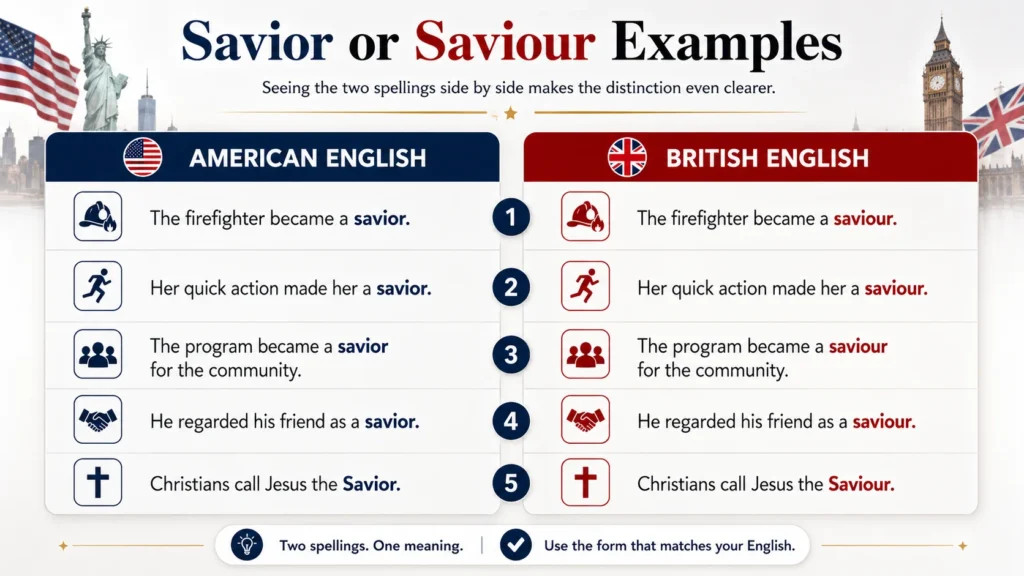
Seeing the two spellings side by side makes the distinction even clearer.
| American English | British English |
| The firefighter became a savior. | The firefighter became a saviour. |
| Her quick action made her a savior. | Her quick action made her a saviour. |
| The program became a savior for the community. | The program became a saviour for the community. |
| He regarded his friend as a savior. | He regarded his friend as a saviour. |
| Christians call Jesus the Savior. | Christians call Jesus the Saviour. |
Nothing else needs to change merely because the spelling changes.
The grammar stays the same. The meaning stays the same. The pronunciation remains essentially the same.
Only the regional spelling changes.
Savior or Saviour as a Noun
Savior/saviour is a noun.
It can refer to a person who rescues someone from danger or, in figurative language, someone or something that provides major relief.
Consider these grammatical forms:
- a savior
- the savior
- our savior
- their savior
- several saviors
The plural differs according to the regional spelling:
- American English: saviors
- British English: saviours
For example:
Several firefighters became unexpected saviors during the storm.
British English would write:
Several firefighters became unexpected saviours during the storm.
The noun can describe an individual or multiple people. It can also carry a figurative sense.
For example:
The emergency fund became a savior for the small company.
Here, the fund didn’t literally rescue anyone from physical danger. Instead, it provided financial relief that helped the company survive.
When Should You Capitalize Savior or Saviour?
Capitalization depends on how the word functions in context.
Lowercase Savior or Saviour
Use lowercase when the word describes an ordinary person or thing that saves someone.
Examples:
- The paramedic was a savior during the accident.
- The new loan became a saviour for the struggling business.
- Her friend proved to be a savior when she needed help.
Here, the noun functions as a general description.
Capitalized Savior or Saviour
The word may take a capital letter when it refers specifically to Jesus Christ as a religious title or designation.
Examples:
- Christians believe Jesus is the Savior.
- The church’s hymn celebrates the Saviour.
However, capitalization practices can differ between religious traditions and editorial styles. When preparing formal religious content, follow the relevant publication’s established style.
The spelling rule remains unchanged:
US English → Savior
British English → Saviour
Common Mistakes
These two forms create several predictable errors.
Treating One Spelling as Universally Correct
Calling saviour an outright spelling mistake ignores British English.
Likewise, calling savior incorrect ignores standard American English.
The better explanation is regional variation.
Mixing American and British Spellings
A document should normally follow one consistent spelling system.
For example, avoid writing:
The neighborhood honored the saviour for his courage.
If the document uses American English, this would be more consistent:
The neighborhood honored the savior for his courage.
A British version would use:
The neighbourhood honoured the saviour for his courage.
The spelling of savior/saviour should fit the surrounding vocabulary.
Assuming the Meanings Differ
They don’t.
Savior and saviour refer to the same concept. The difference is primarily geographical spelling.
Assuming the Extra U Changes Pronunciation
It generally doesn’t.
The u represents a spelling convention rather than an additional sound.
Capitalizing Every Use of Savior
Not every person who rescues someone is the Savior.
Compare:
- The firefighter became a savior.
- Christians refer to Jesus as the Savior.
The first describes a rescuer generally. The second uses the word in a specific religious context.
Which One Should You Use?
The easiest way to choose is to identify your audience and spelling system first.
| If you’re writing for… | Use… |
| United States readers | savior |
| United Kingdom readers | saviour |
| A US school or university | savior |
| A British publication | saviour |
| A US business website | savior |
| A British website | saviour |
| A quotation containing the word | Usually preserve the original wording |
| A specific title or proper name | Follow the established form |
For general US English writing, savior is the safest choice.
For British English, choose saviour.
The real goal isn’t to pick the spelling that looks more familiar. It’s to maintain a consistent variety of English throughout the piece.
American vs. British Writing
The distinction becomes easier when you compare several common spelling pairs.
| Meaning | American English | British English |
| A person who saves | savior | saviour |
| Preference or support | favor | favour |
| Respect or recognition | honor | honour |
| Appearance/color | color | colour |
| Person living nearby | neighbor | neighbour |
| Work or employment | labor | labour |
| Actions or conduct | behavior | behaviour |
This pattern explains why the spelling can look unusual to someone accustomed to the other variety.
An American reader may instinctively expect savior because they regularly see favor, honor, and color. A British reader may expect saviour because favour, honour, and colour follow the same broader convention.
A Practical Editing Test
When you’re unsure, scan the surrounding text.
If you’ve written:
- color
- favor
- honor
- neighbor
- behavior
then savior will probably fit your American English style.
If you’ve written:
- colour
- favour
- honour
- neighbour
- behaviour
then saviour will probably fit your British English style.
This quick comparison often solves the problem without consulting a dictionary.
Easy Trick to Remember
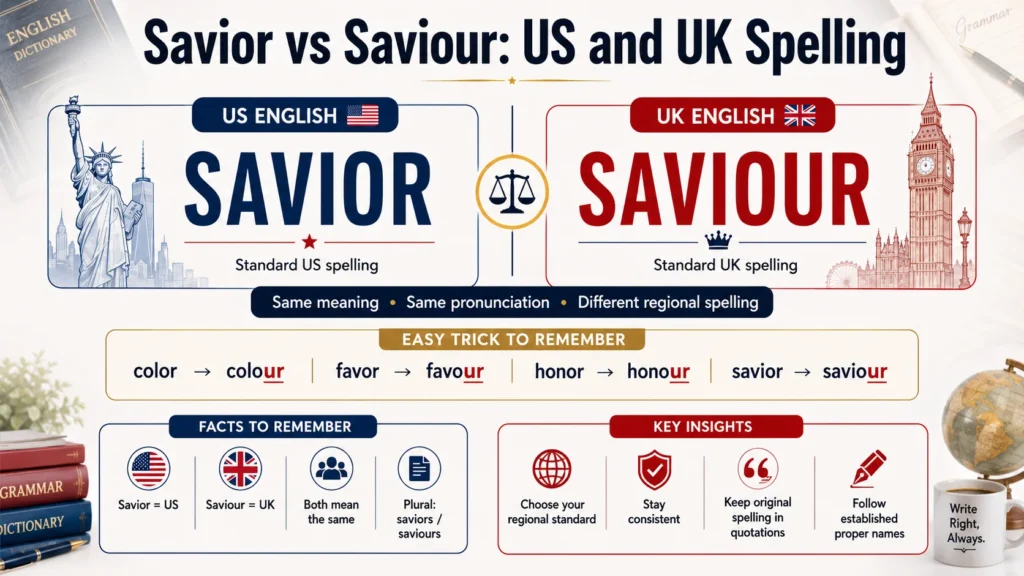
Here’s a simple memory trick:
Savior = US
Saviour = UK
Remember the u as part of the British -our spelling pattern.
You can reinforce it with familiar pairs:
- color → colour
- favor → favour
- honor → honour
- savior → saviour
If you write primarily in American English, think shorter spelling.
If you write primarily in British English, remember the traditional u.
It’s a small visual cue, but it makes the distinction much easier to remember.
Facts to Remember
Here are the essential facts in one place:
- Savior is the standard US spelling.
- Saviour is the standard UK spelling.
- Both are nouns.
- Both have the same basic meaning.
- Both can describe a literal rescuer.
- Both can describe a figurative source of relief.
- Both can refer to Jesus Christ in Christian contexts.
- Their pronunciation is generally the same.
- The plural forms are saviors and saviours.
- The spelling difference reflects regional English conventions.
- Consistency matters when choosing between them.
- Merriam-Webster recognizes saviour as a variant of savior.
- Cambridge distinguishes savior as US and saviour as UK usage.
Key Insights
- Choose the appropriate regional standard.
- Maintain consistency across your content.
- The additional letter doesn’t alter the definition.
- US publications generally prefer the shorter form.
- UK publications commonly use the traditional form.
- Preserve the original spelling in quotations.
- Follow established forms in proper names.
- Consider reader expectations when making your choice.
My Personal Experience
Over the years, I’ve learned that many learners struggle not because they lack vocabulary, but because they haven’t yet developed confidence in recognizing subtle differences in written English. In my classroom, I often guide students to examine how words function within a sentence rather than relying on what simply looks familiar. This approach has helped many of my students become more careful and confident writers.
One thing I’ve consistently noticed is that learners improve faster when they understand the reasoning behind a language choice. I encourage them to pay attention to their intended readers, the style of their writing, and the conventions they’re following. From my experience, this practical approach works far better than asking students to memorize long lists of isolated rules.
Test Yourself
1. Which spelling is standard in American English?
A) Saviour
B) Savior
C) Saveour
D) Savour
2. Which spelling is standard in British English?
A) Savior
B) Saveor
C) Saviour
D) Savour
3. What is the basic meaning of both forms?
A) A teacher
B) A person who saves or rescues
C) A traveler
D) A leader
4. What is the main difference between “savior” and “saviour”?
A) Their meanings
B) Their pronunciation
C) Their grammatical function
D) Their regional spelling
5. Which plural form is used in US English?
A) Saviours
B) Saviors
C) Saviouries
D) Savorers
Answer Key:
- B
- C
- B
- D
- B
Quick Revision
- Savior → standard US English spelling.
- Saviour → standard UK English spelling.
- Both have the same meaning and pronunciation.
- Both function as a noun.
- US plural: saviors.
- UK plural: saviours.
- The difference comes from regional spelling conventions.
- In religious contexts, capitalization may vary by style and usage.
- Keep your spelling consistent throughout the same piece.
- Easy reminder: Savior = US, Saviour = UK.
Read More: Regardless of Whether or Regardless Whether: Which Is Correct?
FAQs
Is Saviour or Savior the correct spelling?
Both saviour and savior are correct spellings. The difference depends on the variety of English you’re using. Savior is standard in American English, while saviour is standard in British English.
What does savior or saviour mean?
Both words describe a person who saves, rescues, or protects someone from danger, harm, difficulty, or another serious problem. Their meaning doesn’t change with the spelling.
Is Savior American or British English?
Savior is the preferred form in American English. If you’re writing for a US audience, this is generally the spelling you should choose.
Is Saviour used in British English?
Yes. Saviour is the standard British English spelling. It’s also common in countries that generally follow British spelling conventions.
Why do Savior and Saviour have different spellings?
The difference comes from regional spelling conventions that developed within English. American and British English often use different spellings for the same words, while keeping their meanings unchanged.
Can I use Saviour in American English?
You can, but savior is normally the expected spelling in American English. Using saviour may make your writing look more British or reflect a specific name, quotation, or religious usage.
Can I use Savior in British English?
Readers in Britain will understand savior, but saviour is the conventional British spelling. For polished British writing, it’s better to follow the local spelling standard.
Does Saviour mean something different from Savior?
No. Saviour and savior have the same meaning. Both can refer to someone who saves or rescues another person, and neither spelling changes the basic definition.
How can I remember the difference between Savior and Saviour?
A simple way to remember it is to associate savior with US English and saviour with British English. When writing for a particular audience, check which regional spelling your readers expect.
Which spelling should I use in formal writing?
Use the spelling that matches your chosen variety of English. For American formal writing, choose savior; for British formal writing, choose saviour. Consistency matters more than treating one form as universally correct.
Conclusion
The choice between savior and saviour isn’t really a question of right versus wrong. Both spellings belong to standard English, but they reflect different regional conventions. Savior is the usual American English form, whereas saviour is the established British English form. Both words describe someone who saves, rescues, or protects another person, so their meaning remains exactly the same despite the extra u in the British spelling.
When I teach spelling and usage, I encourage learners to focus less on memorizing isolated differences and more on recognizing the English variety they’re using. If your audience is primarily American, savior will usually be the natural choice.
If you’re following British English conventions, choose saviour. The most important point is to stay consistent throughout your writing. Once you connect each spelling with its regional form, this commonly confusing pair becomes much easier to remember and use confidently.

Mariam Asghar is an English specialist and professional content writer at ClearPhrasing.com. She is dedicated to helping readers improve their English through clear, practical, and easy-to-understand content. Her areas of expertise include grammar, spelling, vocabulary, punctuation, sentence structure, and effective writing.
At ClearPhrasing.com, Mariam writes comprehensive, well-researched articles that simplify complex language concepts for students, professionals, writers, and English learners. She believes that strong communication begins with a solid understanding of the English language and strives to make every lesson accessible and engaging.
With a strong commitment to quality, accuracy, and continuous learning, Mariam ensures that each article is carefully researched, thoroughly reviewed, and written to help readers communicate with greater confidence and clarity.