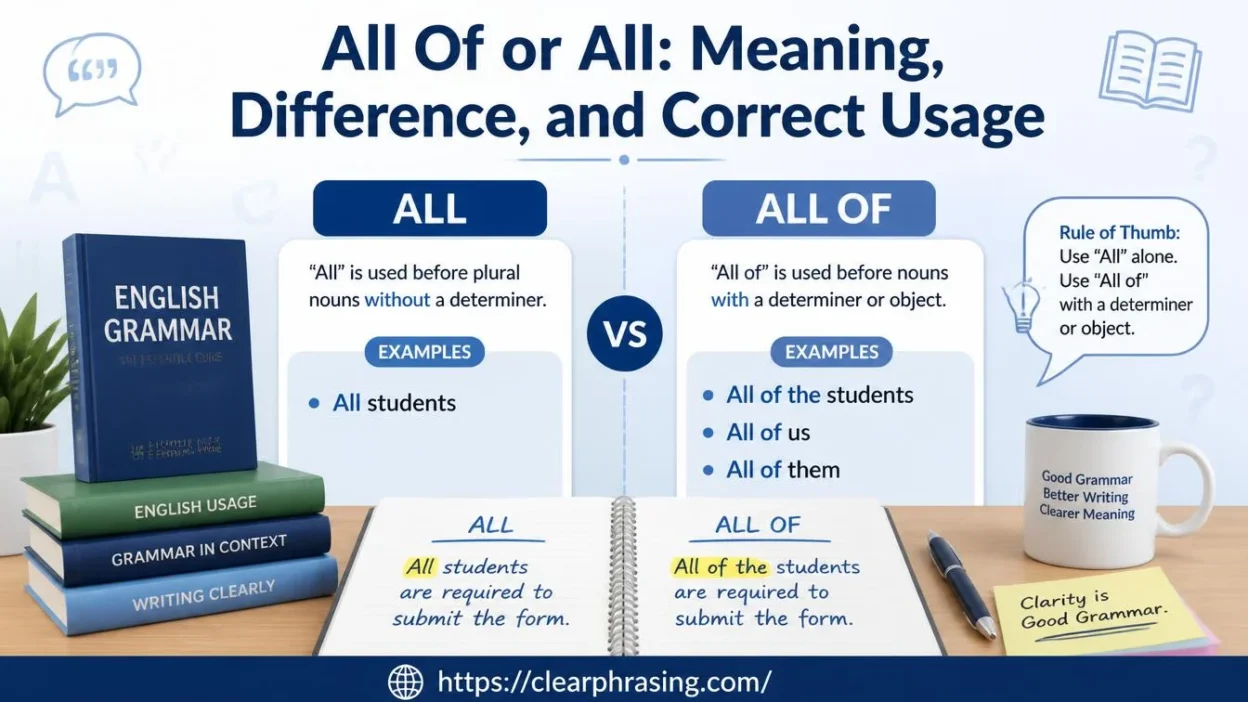
In English, All Of or All: Meaning, Difference, and Correct Usage can seem confusing, but the difference is simple.
All of usually comes before pronouns like us and them or determiners like the and my. For example, “I ate all of the cookies.” All can stand alone when discussing things in a general way, such as “All are welcome.” These rules improve clarity, correctness, and natural English writing.
In my teaching experience, this small difference often causes a grammar question or a brief hitch in the flow of a sentence. Whether you’re writing an email, report, or practicing English speaking, understanding these grammar nuances builds confidence.
It also helps you create clear sentences and communicate more effectively when speaking.
Quick Answer:
“All” and “all of” can both be correct, but they don’t appear in exactly the same grammatical structures.
- Use all before a plural noun when you mean a whole class or group:
- All students need practice.
- All employees must follow the policy.
- All dogs need proper care.
2. Use all before an uncountable noun when you mean the complete amount:
- All information was verified.
- All equipment is ready.
- All money must be accounted for.
3. Use all or all of before a specific noun phrase containing words such as the, my, your, these, or those:
- All the students passed.
- All of the students passed.
- All my friends agreed.
- All of my friends agreed.
- All these books are useful.
- All of these books are useful.
However, when a personal pronoun follows, all of is normally required:
- All of us agreed.
- All of them arrived.
- All of you are welcome.
- All of it was useful.
Cambridge Dictionary confirms these core patterns, including the use of all of with personal, demonstrative, and relative pronouns and the use of all without of before indefinite plural nouns and uncountable nouns.
What Does “All” Mean?
All means the complete number, amount, or group of something. It commonly works as a determiner, which means it comes before a noun phrase and tells you how much or how many you mean.
For example:
- All students should complete the assignment.
- All water contains some minerals.
- All employees received the announcement.
- All information must remain confidential.
Notice something important in these examples. All doesn’t mean a few selected members. It covers the entire group or amount.
If you say “All students need feedback,” you’re making a general statement about students as a class. You aren’t necessarily talking about a particular group sitting in one classroom.
That’s one of the most useful distinctions to remember.
All students = students in general
All the students = a specific group of students
The British Council also distinguishes between general and specific reference. General plural nouns can appear without a determiner, while specific noun phrases commonly use determiners such as the or possessives.
What Does “All Of” Mean?
All of expresses the idea of a complete group or amount, but of connects all to the following noun phrase or pronoun.
For example:
- All of the students passed.
- All of my money was spent.
- All of them agreed.
- All of us were ready.
In many cases, all of and all have essentially the same meaning:
- All the students passed.
- All of the students passed.
Both sentences tell us that every student in the particular group passed.
The difference isn’t usually about the amount. It’s mainly about sentence structure and usage.
That’s why treating “all of” as wrong would be misleading. Major grammar references recognize it as a standard construction. Chicago Manual of Style notes that all the and all of the are both grammatical, although its editorial style generally removes of when doing so makes the sentence more concise.
The Main Difference
The easiest way to understand all vs. all of is to look at the word that follows.
| Structure | Example | Correct? |
| all + plural noun | All students passed. | Yes |
| all + uncountable noun | All information was checked. | Yes |
| all + the + noun | All the students passed. | Yes |
| all of + the + noun | All of the students passed. | Yes |
| all + possessive + noun | All my friends came. | Yes |
| all of + possessive + noun | All of my friends came. | Yes |
| all of + personal pronoun | All of them came. | Yes |
| all + personal pronoun | All them came. | No |
| pronoun + all | I invited them all. | Yes |
The pattern becomes much easier once you stop thinking of of as an optional decoration. Sometimes it is optional. Sometimes the grammar requires it.
When to Use “All” Without “Of”
All + Plural Noun
Use all directly before a plural noun when you are making a general statement about an entire class.
For example:
- All children need support.
- All teachers make mistakes sometimes.
- All cars require maintenance.
- All employees must complete training.
Here, you aren’t identifying a particular group. You’re talking about children, teachers, cars, or employees as a category.
So this sentence works:
All students should learn basic grammar.
But this sentence doesn’t work in standard English:
All of students should learn basic grammar.
Why? The plural noun students appears without a determiner. In this general structure, English uses all, not all of. Cambridge specifically identifies this as a standard usage pattern.
All + Uncountable Noun
You can also use all directly before an uncountable noun.
Examples include:
- All information should be checked.
- All equipment is available.
- All money was recovered.
- All furniture was removed.
- All research takes time.
Again, don’t automatically insert of.
For example:
❌ All of information is accurate.
✅ All information is accurate.
However, once you make the noun phrase specific, all of can become possible:
✅ All of the information is accurate.
The difference is subtle but important. Information in the first sentence refers to information generally. The information identifies a particular body of information.
All + Possessive Determiner
English also allows all directly before possessives such as my, your, his, her, our, and their.
For example:
- All my friends live nearby.
- All your questions are important.
- All her books are on the shelf.
- All their employees received training.
You can also use all of:
- All of my friends live nearby.
- All of your questions are important.
- All of her books are on the shelf.
- All of their employees received training.
Both patterns are grammatical. Cambridge explicitly recognizes both forms before possessives.
When to Use “All Of”
All Of + Personal Pronoun
This is one of the most important rules.
Use all of before personal pronouns such as:
- us
- you
- them
- him
- her
- it
Examples:
- All of us were excited.
- All of you are invited.
- All of them agreed.
- I used all of it.
- She contacted all of them.
Don’t write:
1. ❌ All us were excited.
2. ❌ All them agreed.
3. ❌ I used all it.
Instead, use:
1.✅ All of us were excited.
2.✅ All of them agreed.
3.✅ I used all of it.
Cambridge identifies all of as the standard structure before personal pronouns.
All Of + Relative Pronoun
All of also appears before relative pronouns such as which and whom.
For example:
- She interviewed five candidates, all of whom had relevant experience.
- I read three reports, all of which contained useful information.
- They visited several cities, all of which had different attractions.
Here, all of whom refers to all the people mentioned earlier. All of which refers to all the things or situations mentioned earlier.
These constructions are especially common in formal and academic writing.
All Of + It
All of it deserves special attention because writers sometimes try to remove of simply to make the sentence shorter.
That doesn’t work.
Correct:
- I read all of it.
- We used all of it.
- She remembered all of it.
Incorrect:
- ❌ I read all it.
- ❌ We used all it.
- ❌ She remembered all it.
Chicago Manual of Style specifically notes all of it as an exception to the tendency to omit of.
In other words, concise writing doesn’t mean deleting words mechanically. Natural grammar comes first.
All Of the vs. All the
This is probably the most common all of or all question.
Consider these sentences:
All the students passed.
All of the students passed.
Both are correct.
The meaning is essentially the same. Both sentences refer to the complete group of specific students.
Which One Should You Choose?
In many contexts, all the is shorter and more direct.
For example:
All the employees received an email.
That’s perfectly natural.
You could also write:
All of the employees received an email.
That’s also correct.
Chicago style generally prefers dropping of when possible because it favors concise wording. However, Chicago also acknowledges that all of remains grammatical and can sound natural in context.
So don’t turn a style preference into a grammar rule.
| Sentence | Grammar | Style |
| All the employees attended. | Correct | Concise |
| All of the employees attended. | Correct | Slightly longer |
| All employees attended. | Correct | General statement |
The key difference lies in specificity, not correctness.
All My vs. All of My
The same principle applies to possessives.
Both are correct:
- All my friends came.
- All of my friends came.
Both mean that every friend in the relevant group came.
You might choose all my when you want a compact sentence:
All my friends live nearby.
You might naturally use all of my in another sentence:
All of my friends from college attended the reunion.
Neither version automatically sounds more grammatical.
The best choice often depends on rhythm, emphasis, and the surrounding sentence.
All These vs. All of These
Demonstratives create another common point of confusion.
You can say:
- All these books are expensive.
- All of these books are expensive.
- All those houses look similar.
- All of those houses look similar.
Both forms work.
The same applies to this and that:
- All this work was necessary.
- All of this work was necessary.
- All that effort paid off.
- All of that effort paid off.
Cambridge confirms that of can appear or disappear before demonstratives such as this, that, these, and those.
So if a grammar checker suggests removing of from all of these, don’t assume the original sentence was wrong. It may simply be recommending a more concise style.
All of Us vs. We All
English gives you another useful option with personal pronouns.
Compare:
All of us agreed.
We all agreed.
Both are correct.
The difference comes from word order.
With all of, the phrase appears before the verb:
All of us agreed with the decision.
With we all, all works inside the clause:
We all agreed with the decision.
The same pattern works with other pronouns:
- All of them left early.
- They all left early.
- All of you should listen.
- You should all listen.
This flexibility makes English more expressive. You don’t always need to choose between a “correct” and “incorrect” form. Sometimes you simply have two correct structures.
All of Them vs. Them All
You can also place all after an object pronoun.
Compare:
- I invited all of them.
- I invited them all.
Both are correct.
Similarly:
- She called all of us.
- She called us all.
And:
- We helped all of them.
- We helped them all.
Cambridge recognizes both pronoun + all and all of + pronoun when the pronoun functions as an object.
One important exception appears in short responses. If someone asks:
“How many of these boxes do you need?”
A natural answer is:
All of them.
Not:
❌ Them all.
That distinction can feel surprising at first, but context determines which structure works naturally.
All Of or All in Formal Writing
Formal writing doesn’t require you to avoid all of.
Instead, focus on whether the construction is grammatically correct, clear, and useful.
For example:
All participants completed the survey.
This version is compact and professional.
You could also write:
All of the participants completed the survey.
Both work. The second version emphasizes the specific group a little more clearly because the participants identifies a particular set.
In editing, shorter isn’t automatically better. Every word should earn its place, but of isn’t useless simply because you can sometimes remove it.
As Chicago Manual of Style explains, all of is grammatically sound even though editors may omit of when concision is the goal.
Common Mistakes
Mistake: “All of Students”
❌ All of students need access to books.
✅ All students need access to books.
If students refers to students generally, don’t add of.
Mistake: “All Them”
❌ I invited all them.
✅ I invited all of them.
Or:
✅ I invited them all.
Mistake: Assuming “All Of” Is Wrong
❌ “You should never use all of.”
That’s too broad.
All of is completely grammatical in many structures:
- all of us
- all of them
- all of it
- all of the students
- all of my friends
- all of these books
Mistake: Assuming “All” Always Replaces “All Of”
You can’t simply delete of from every sentence.
For example:
All of us were ready.
You can’t turn that into:
❌ All us were ready.
Instead, change the structure:
We were all ready.
This is an important lesson: English grammar depends on structure, not just word count.
A Simple Rule for Remembering
Use this quick guide:
| What follows “all”? | Best pattern |
| General plural noun | all + noun |
| Uncountable noun | all + noun |
| The + noun | all the / all of the + noun |
| Possessive + noun | all my / all of my + noun |
| Demonstrative + noun | all these / all of these + noun |
| Personal pronoun | all of us / all of them |
| Relative pronoun | all of which / all of whom |
| Object pronoun after a verb | them all / all of them |
The shortest practical rule is this:
Use “all” for general plural or uncountable nouns. Use “all of” with personal pronouns. Before a specific noun phrase, both forms may work.
That single distinction will solve most all of or all questions you encounter.
Practical Examples
Here are several examples from common writing situations:
General statement
All customers deserve respectful service.
Specific group
All the customers in the waiting area received updates.
Alternative specific form
All of the customers in the waiting area received updates.
Possessive
All my colleagues supported the project.
Alternative possessive
All of my colleagues supported the project.
Personal pronoun
All of us supported the project.
Object pronoun
The manager thanked us all.
Alternative object structure
The manager thanked all of us.
Uncountable noun
All information must remain confidential.
Specific uncountable noun
All of the information in the report was verified.
Notice how the structure changes according to the noun phrase. That’s the real key.
A Short Case Study: Why the Difference Matters
Imagine a teacher writes this instruction on a classroom worksheet:
All students must complete the exercise.
The sentence describes students as a general group.
Now imagine the teacher is speaking to a particular class:
All the students must complete the exercise.
The meaning has become more specific. The sentence now points toward a known group.
The teacher could also write:
All of the students must complete the exercise.
That sentence is equally grammatical.
Finally, if the teacher addresses the students directly, the structure changes:
All of you must complete the exercise.
Not:
❌ All you must complete the exercise.
This small example shows why all, all of, the, and pronouns cannot be treated as interchangeable pieces. Their relationship matters.
Practice Section:
Complete each sentence with the most appropriate form.
- ___ students need regular practice.
- ___ the students passed the test.
- ___ of them arrived early.
- ___ my books are on the desk.
- ___ of us agreed with the decision.
- ___ information must be checked.
- ___ of the information was accurate.
- She invited ___ of her friends.
- We used ___ of it.
- ___ these examples show the same pattern.
Answers
- All students need regular practice.
- All the students passed the test.
- All of them arrived early.
- All my books are on the desk.
- All of us agreed with the decision.
- All information must be checked.
- All of the information was accurate.
- She invited all of her friends.
- We used all of it.
- All these examples show the same pattern.
The exercise highlights the three major patterns: general nouns, specific noun phrases, and pronouns.
Read More: Assumedly vs. Assumably: Meaning, Difference, and Usage
Final Comparison
| Phrase | Correct? | Why |
| All students | ✅ | General plural noun |
| All of students | ❌ | No determiner before the plural noun |
| All the students | ✅ | Specific noun phrase |
| All of the students | ✅ | Specific noun phrase |
| All my friends | ✅ | Possessive noun phrase |
| All of my friends | ✅ | Possessive noun phrase |
| All of us | ✅ | Personal pronoun |
| All us | ❌ | Standard English requires of here |
| All of them | ✅ | Personal pronoun |
| Them all | ✅ | Alternative object construction |
| All information | ✅ | Uncountable noun used generally |
| All of the information | ✅ | Specific information |
| All these books | ✅ | Demonstrative noun phrase |
| All of these books | ✅ | Demonstrative noun phrase |
| All of it | ✅ | Pronoun construction |
| All it | ❌ | Not the standard construction |
FAQs
Is “All of” grammatically correct?
Yes, “all of” is grammatically correct when it appears before certain pronouns and determiners. For example, you can say, “All of the students arrived early” or “All of them agreed.” It helps identify the complete group or amount being discussed.
Is “all” correct without “of”?
Yes, “all” can be used without “of.” For example, “All students passed the test” and “All are welcome” are both correct. The choice depends on what follows all and whether you need a determiner or pronoun.
Should I say “all of the” or “all the”?
Both “all of the” and “all the” are correct. “All the students” is often more concise, while “all of the students” can sound slightly more deliberate or emphatic. Neither form is grammatically wrong.
Can “all of” come before a pronoun?
Yes. “All of” commonly comes before object pronouns such as us, them, and you. For example, “All of us enjoyed the trip” and “All of them completed the assignment” are natural and correct.
Can I use “all” before a specific noun?
Yes, you can use “all” directly before a noun, especially when a determiner is not required. For example, “All students need practice” is correct. However, with a specific group, you may say “all the students.”
What is the difference between “all” and “all of”?
The main difference involves what comes after them. “All of” commonly precedes pronouns or noun phrases containing determiners, such as “all of them” or “all of my books.”
“All” can appear directly before plural nouns or work independently. For example, “All children need support” and “All are welcome” are both natural constructions.
Is “all of the” better than “all the”?
Neither is automatically better. “All the” is shorter and very common, while “all of the” is also completely standard. Your choice can depend on sentence structure, emphasis, and personal style.
Can “all” be used by itself?
Yes, “all” can function independently when the meaning is already clear. For example, “All are welcome” means everyone is welcome. Similarly, “I gave them all” uses all without of because the sentence already provides enough context.
Which is correct: “all of them” or “all them”?
“All of them” is the standard and grammatically correct form. The pronoun them requires of after all in this construction. Therefore, write “I invited all of them,” not “I invited all them.”
How can I remember when to use “all” or “all of”?
A simple way to remember the pattern is to look at the word immediately following all. Use “all of” before pronouns such as us, them, and you, or before phrases with determiners such as the and my.
Conclusion
Understanding all and all of doesn’t require memorizing complicated grammar rules. The key is to notice what comes next. Use all of naturally with pronouns and determiner-based phrases, while all can directly modify nouns or stand alone when the meaning is clear.
Once you recognize these patterns, choosing between the two becomes much easier. With regular reading, writing, and speaking practice, this small grammar distinction will feel natural. It can also make your sentences clearer and help you communicate with greater confidence in everyday and formal English.

Mariam Asghar is an English specialist and professional content writer at ClearPhrasing.com. She is dedicated to helping readers improve their English through clear, practical, and easy-to-understand content. Her areas of expertise include grammar, spelling, vocabulary, punctuation, sentence structure, and effective writing.
At ClearPhrasing.com, Mariam writes comprehensive, well-researched articles that simplify complex language concepts for students, professionals, writers, and English learners. She believes that strong communication begins with a solid understanding of the English language and strives to make every lesson accessible and engaging.
With a strong commitment to quality, accuracy, and continuous learning, Mariam ensures that each article is carefully researched, thoroughly reviewed, and written to help readers communicate with greater confidence and clarity.