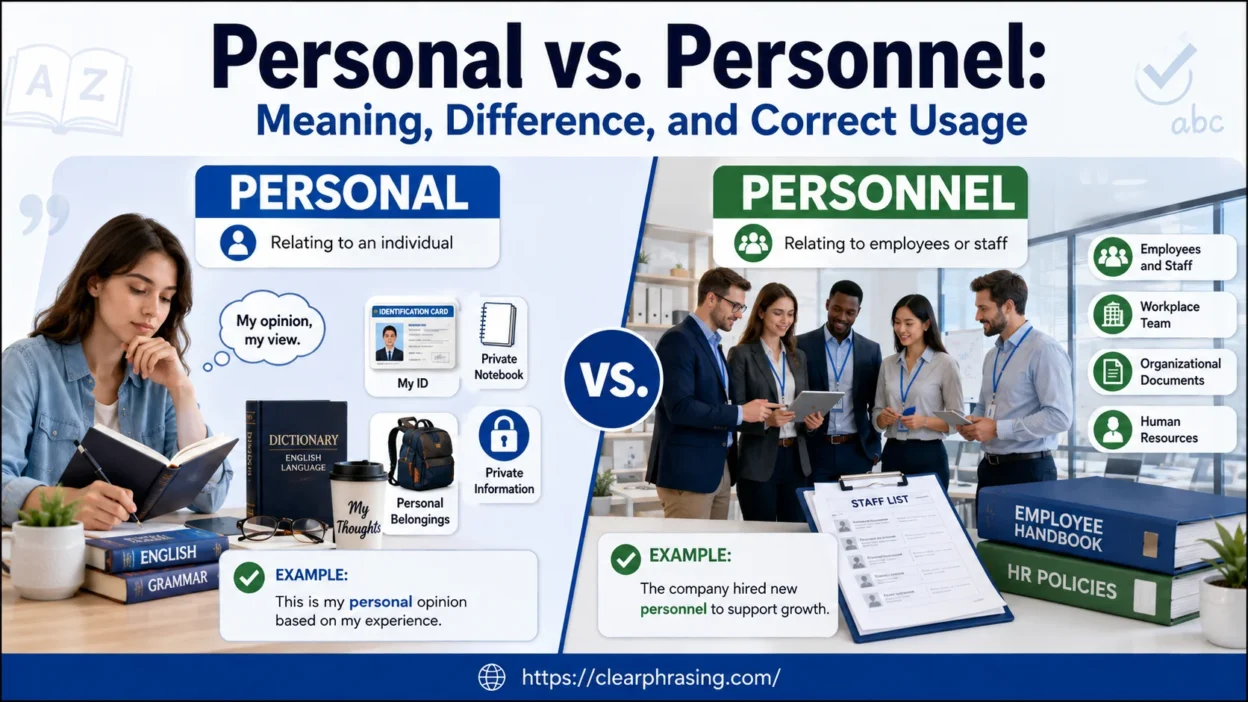
Personal vs. Personnel: Meaning, Difference, and Usage helps you understand two similar words with different meanings, word classes, and uses.
Personal is an adjective meaning private or related to an individual. Personnel is a noun for people, employees, or staff working for an organization, business, or service. Their similar sounds and spelling can cause common mistakes, especially in professional writing. Knowing the difference helps native speakers and English learners communicate more clearly and avoid errors.
From teaching English, this confusing pair often creates misunderstandings. Use personal for private life, feelings, belongings, opinions, interests, and likes. Use personnel for workers, staff, or employees within a company or organization. For example, personal interests describe what one person enjoys, while company personnel means the people who work there.
This distinction is crucial in speech, writing, and workplace communication because choosing the wrong term can make your message seem unprofessional.
Quick Answer:
The fastest way to remember the difference is this:
- Personal = related to one person, an individual, or private matters.
- Personnel = employees, staff, or workers in an organization.
- Personal is primarily an adjective.
- Personnel is a noun.
- Personal commonly appears before nouns such as information, opinion, experience, and choice.
- Personnel commonly appears in workplace expressions such as company personnel, military personnel, and security personnel.
| Word | Part of Speech | Meaning | Example |
| Personal | Adjective | Related to an individual or private life | She shared her personal opinion. |
| Personnel | Noun | Employees or staff | All personnel must attend the meeting. |
Here’s an easy test:
Can you replace the word with “private,” “individual,” or “one person’s”?
If yes, personal will usually work.
Can you replace it with “staff,” “employees,” or “workforce”?
If yes, personnel is probably the correct choice.
What Does Personal Mean?
Personal is primarily an adjective. It describes something connected with a particular person, an individual’s life, private affairs, character, choices, or direct involvement.
Merriam-Webster gives several meanings for personal, including something that relates to or affects a particular person, something private, something carried on directly between individuals, and something intended for private use.
Consider these examples:
- personal opinion
- personal information
- personal experience
- personal belongings
- personal choice
- personal responsibility
- personal life
- personal relationship
- personal account
- personal email
In each case, personal describes the noun that follows it.
Personal as an Adjective
The most useful way to understand personal is to look at what it modifies.
For example:
She gave her personal opinion.
The word personal describes the opinion. It tells us that the opinion belongs to or comes directly from the individual.
Now consider:
Please protect your personal information.
Here, personal describes information connected with an individual.
The same pattern appears in everyday English:
- That was a personal decision.
- He kept his personal belongings in the office.
- This is a personal matter.
- I learned that lesson through personal experience.
- She uses a personal account for private transactions.
The word doesn’t mean exactly “private” in every sentence. Its meaning depends on context. Still, the ideas of individual connection, private life, or direct involvement appear frequently.
Common Meanings of Personal
Personal can express several related ideas.
Related to One Individual
Each employee has a personal access code.
The code belongs specifically to that person.
Private or Not Public
I don’t discuss my personal life at work.
Here, personal contrasts with professional or public matters.
Based on Individual Experience or Opinion
That’s my personal opinion.
The statement identifies the speaker’s own view rather than an official position.
Directly Involving People
The manager conducted a personal interview with the applicant.
The word can emphasize direct interaction between individuals.
These meanings are related, but they aren’t interchangeable in every context. That’s why understanding the sentence matters more than memorizing a single synonym.
What Does Personnel Mean?
Personnel is a noun. It generally refers to the people employed by an organization, company, institution, military unit, government agency, or other organized group.
Merriam-Webster defines personnel as a body of people usually employed by an organization. It also lists a second meaning: a division of an organization concerned with employees and related matters.
For example:
- company personnel
- military personnel
- security personnel
- hospital personnel
- government personnel
- trained personnel
- authorized personnel
- medical personnel
Look at this sentence:
Only authorized personnel may enter the laboratory.
Here, personnel means authorized staff or employees.
You could rewrite the sentence as:
Only authorized staff may enter the laboratory.
The basic meaning remains intact.
Personnel Means Employees or Staff
A useful substitution test makes this word easy to recognize.
All personnel must complete the training.
Replace personnel with employees:
All employees must complete the training.
The sentence still makes sense.
Try personal instead:
All personal must complete the training.
That doesn’t work because personal isn’t functioning as a noun meaning employees.
Personnel Can Also Mean an Employee Department
There is another meaning worth knowing.
Personnel can refer to a department or organizational function that handles employee-related matters. Merriam-Webster lists this as a separate sense of the noun.
For example:
Contact personnel if you have questions about your employee records.
In some workplaces, you’ll also see:
Contact the personnel department.
Modern organizations often use human resources (HR) for this function. However, personnel remains a valid term in many contexts.
The Main Difference
The difference becomes much clearer when you compare the words by meaning, grammar, and sentence function.
| Feature | Personal | Personnel |
| Basic meaning | Related to an individual | Employees or staff |
| Typical part of speech | Adjective | Noun |
| Main focus | One person or private matters | A group of workers |
| Common contexts | Personal life, opinions, information, choices | Workplace, military, government, organizations |
| Example | personal information | company personnel |
| Easy synonym | individual, private | staff, employees |
The most important distinction is simple:
Personal describes. Personnel names a group of people.
That difference explains why the two words aren’t interchangeable.
Pronunciation
Spelling isn’t the only source of confusion. The words also sound similar.
In US English, personal is commonly pronounced approximately like:
PER-suh-nuhl
Merriam-Webster gives pronunciations including ˈpərs-nəl and ˈpər-sə-nəl.
Personnel, however, is pronounced approximately:
per-suh-NEL
Its final syllable receives the strongest stress. Merriam-Webster gives the pronunciation ˌpər-sə-ˈnel.
A Simple Pronunciation Comparison
| Word | Approximate US pronunciation | Main stress |
| Personal | PER-suh-nuhl | First syllable |
| Personnel | per-suh-NEL | Final syllable |
Try saying these aloud:
PER-sonal opinion
per-son-NEL department
The different stress can help you distinguish the words when you’re speaking.
Personal vs. Personnel in Workplace English
Workplace writing is where this distinction becomes especially useful.
A single letter can turn a clear professional sentence into an incorrect one.
Consider:
The company hired new personnel.
This means the company hired new employees.
Now compare:
The company hired new personal.
That sentence doesn’t express the intended meaning. Personal doesn’t mean employees.
The reverse problem happens just as easily:
Please protect your personal information.
This means information about you as an individual.
Using personnel would change the meaning:
Please protect your personnel information.
That could refer to information concerning employees or personnel matters. The context is now different.
Personal Information vs. Personnel Information
These phrases deserve special attention.
Personal information generally means information relating to an individual.
Examples include:
- Your name
- Contact details
- Identification information
- Personal preferences
- Other information associated with you as an individual
By contrast, personnel information usually concerns employees or staff.
For example:
The HR department keeps confidential personnel information.
The information belongs to the employee records or employment context.
Personal File vs. Personnel File
This pair can be tricky because both expressions can make sense.
A personal file may mean a file kept by an individual for private purposes.
A personnel file usually means an employee record maintained by an employer.
For example:
I saved the documents in my personal file.
This suggests a file belonging to the speaker.
Now consider:
The documents were added to her personnel file.
This normally refers to the employee’s official workplace record.
Merriam-Webster specifically identifies pairs such as personal file and personnel file as contexts where interpretation can become more complicated.
Common Mistakes
Knowing the definition isn’t always enough. You also need to recognize the mistakes that appear in real writing.
Mistake: Using Personal for Employees
Incorrect:
The company needs additional personal for the night shift.
Correct:
The company needs additional personnel for the night shift.
The intended meaning is employees or staff.
Mistake: Using Personnel for Private Information
Incorrect:
Never share your personnel information online.
If the intended meaning is information about yourself, personal is normally the better choice.
Correct:
Never share your personal information online.
Mistake: Using Personal for Staff
Incorrect:
All personal must report to the manager.
Correct:
All personnel must report to the manager.
The word personnel already carries the meaning of staff or employees.
Mistake: Using Personnel for an Individual Opinion
Incorrect:
This is my personnel opinion.
Correct:
This is my personal opinion.
The opinion belongs to the individual. Therefore, personal is the right adjective.
Examples Side by Side
Seeing the words in contrasting sentences makes the difference easier to remember.
| Personal | Personnel |
| She shared her personal opinion. | All personnel attended the briefing. |
| Protect your personal information. | Security personnel checked the building. |
| That’s a personal decision. | The company needs more personnel. |
| He described his personal experience. | Medical personnel treated the injured passengers. |
| She brought her personal belongings. | Military personnel received new equipment. |
| This is a personal matter. | The manager is handling a personnel matter. |
| Use your personal account. | Authorized personnel can access the system. |
| Take personal responsibility for the error. | Hospital personnel followed the new procedure. |
Notice the pattern. Personal normally tells us something about an individual. Personnel points toward employees or organized groups of workers.
Personal vs. Personnel in the Same Sentence
Here’s a useful twist: the two words can appear in the same sentence.
For example:
Company personnel must protect customers’ personal information.
There is no contradiction.
Personnel identifies the employees.
Personal describes the information belonging to individuals.
Another example:
Military personnel may have restrictions on using personal devices.
Again, the distinction is clear:
- military personnel = military members
- personal devices = devices belonging to individuals
Merriam-Webster notes that the two words can naturally occur together despite their different meanings.
Personal Matter vs. Personnel Matter
This is one of the most interesting areas of personal vs. personnel usage because context can influence the intended meaning.
Personal Matter
A personal matter usually concerns an individual’s private life or circumstances.
She left the office early because of a personal matter.
The sentence suggests a private issue that affects her personally.
Personnel Matter
A personnel matter concerns employees, staffing, workplace conduct, hiring, dismissal, or other employment-related issues.
The director refused to discuss the personnel matter publicly.
The issue involves an employee or employees within the organization.
Why Context Matters
Imagine two employees have an argument.
It could be called a personal matter if the disagreement involves their private relationship.
It could become a personnel matter if management must address it as a workplace issue.
That’s an important lesson: sometimes word choice depends not only on the people involved but also on which aspect of the situation you’re describing.
A Practical Memory Trick
If the two spellings keep getting tangled, use this simple rule.
Personal = Individual
Think:
personal → person → individual
Examples:
- personal opinion
- personal choice
- personal information
- personal experience
- personal belongings
Personnel = Employees
Think:
personnel → people working in an organization
Examples:
- company personnel
- military personnel
- security personnel
- medical personnel
- authorized personnel
Another useful trick is the staff test.
If you can replace the word with staff or employees, choose personnel.
All personnel must attend.
→ All employees must attend.
If you can replace it with private, individual, or one’s own, personal may be the right choice.
She shared her personal opinion.
→ She shared her own opinion.
It’s not a perfect test for every sentence. Still, it works remarkably well in everyday writing.
Is Personnel Singular or Plural?
This question often causes another layer of confusion.
Personnel is a noun that refers collectively to employees or staff. Merriam-Webster also records personnel with a plural sense referring to persons.
In American English, you’ll commonly see it treated as a collective or mass noun:
The company’s personnel is highly trained.
However, you’ll also encounter plural agreement depending on the intended meaning, style, and whether the writer views the employees as individuals.
More importantly, don’t assume you need to write personnels simply because you’re talking about several employees.
In ordinary workplace English, this is generally unnecessary:
The company hired new personnel.
Not:
The company hired new personnels.
The word already functions naturally as a collective term for employees.
Formal Writing
Correct word choice matters even more when the writing carries legal, professional, academic, or organizational weight.
Consider these settings:
- Employee handbooks
- Workplace policies
- HR documents
- Business emails
- Government communications
- Military instructions
- Academic administration
- Internal company notices
- Formal reports
A sentence such as:
Only authorized personnel may enter.
is concise and precise.
Replacing personnel with personal doesn’t create a minor spelling issue. It removes the noun needed to identify the people being discussed.
Likewise:
Employees must protect personal information.
contains two different concepts that work together:
- Employees = people
- Personal information = information connected to individuals
Precision matters because professional writing often deals with rules, responsibilities, access, privacy, and records.
A Practical Case Study: Choosing the Right Word at Work
Imagine a company sends this notice:
All personal must complete the security training by Friday.
At first glance, the sentence may look understandable. However, personal is the wrong word because the writer means employees.
The corrected version is:
All personnel must complete the security training by Friday.
Now imagine a different notice:
Employees should never share personnel information with unknown callers.
This wording could create confusion if the writer means information about each employee personally.
A clearer version would be:
Employees should never share personal information with unknown callers.
The lesson is straightforward: choose the word according to the thing you mean, not according to how similar the spellings look.
Quick Comparison:
Use this checklist when you’re unsure.
- Private life? → personal
- Individual choice? → personal
- Individual opinion? → personal
- Information about an individual? → personal
- Employees? → personnel
- Staff members? → personnel
- Workers in an organization? → personnel
- Military members? → personnel
- Security staff? → personnel
- Employee-related department? → personnel
The One-Line Rule
If you mean “individual,” think personal. If you mean “staff,” think personnel.
That rule won’t solve every unusual sentence. It will handle the overwhelming majority of everyday cases.
Read More: Raise the Bar: Meaning, Definition, and Examples
FAQs
What is the difference between personal and personnel?
Personal and personnel look and sound similar, but they have completely different meanings. Personal is an adjective that describes something connected with one person, such as private feelings, belongings, opinions, interests, or experiences. Personnel is a noun that refers to the people who work for a company, organization, or other service.
A simple way to remember the difference is to connect personal with person and personnel with people at work. For example, “Please keep your personal information private” refers to one person’s private information. “The company’s personnel attended the meeting” refers to the employees who work for the company.
Is personal an adjective or a noun?
Personal is primarily an adjective. It describes a noun and tells you that something belongs to, concerns, or relates to a particular person. You might talk about a personal opinion, personal choice, personal belongings, or personal experience.
It can also appear in familiar expressions such as “for personal reasons” or “on a personal level.” In each case, the word connects the idea to an individual rather than to a group of employees or an organization.
Is personnel singular or plural?
Personnel is a noun that usually refers to a group of people, especially employees or staff members. Although it looks somewhat like a plural word, English generally treats personnel as a collective noun when it means the workers of an organization.
For example, you can say, “The personnel are ready for the inspection.” In many contexts, staff or employees can replace personnel. You normally wouldn’t say “personnels” when referring to several groups of workers.
Can personal refer to people?
Yes, but personal doesn’t normally mean “people.” Instead, it describes something connected with an individual person. For example, personal information means information about an individual, while personal relationships involve an individual’s relationships.
That distinction matters because personnel directly refers to people working for an organization. “Personal arrived at the office” is incorrect when you mean employees. The correct sentence is “Personnel arrived at the office.”
Why do people confuse personal and personnel?
The main reason is their similar spelling and pronunciation. Both words begin with “person-,” and their forms differ by only a few letters. That resemblance can make them easy to mix up, especially when someone is writing quickly.
The problem becomes more noticeable in workplace English. A spelling mistake such as using personal instead of personnel can change the meaning of a sentence and may make formal writing look careless. Learning the function of each word makes the distinction much easier.
How do you pronounce personal and personnel?
Personal usually has stress on the first syllable: PER-son-al. Personnel places the main stress toward the end: per-son-NEL. Listening carefully to that difference can help you recognize the words in conversation.
Pronunciation alone may not always prevent confusion because accents and speaking speeds vary. It’s better to combine pronunciation with meaning. If you’re talking about someone’s private matters, personal is likely correct. If you mean employees or workers, personnel is the better choice.
What are some examples of personal in a sentence?
Personal commonly appears before nouns that relate to an individual. For example, “She shared her personal opinion during the discussion.” You could also say, “Please collect your personal belongings before leaving,” or “He made a personal choice based on his experience.”
The word can also describe private matters. “I don’t discuss my personal life at work” clearly connects the adjective with one person’s private experiences. In each example, personal tells you that the subject relates to an individual.
What are some examples of personnel in a sentence?
Personnel usually refers to employees, staff, or workers connected with an organization. For example, “All personnel must complete the safety training.” Here, the word refers to the employees who work for the organization.
You might also see phrases such as military personnel, hospital personnel, company personnel, or administrative personnel. In each phrase, personnel identifies people performing work or serving in a particular organization or professional setting.
Can I use personal and personnel interchangeably?
No. Personal and personnel aren’t interchangeable because they perform different grammatical roles and express different ideas. Replacing one with the other can make a sentence incorrect or change its intended meaning.
Compare these examples: “She keeps her personal files secure” and “The office personnel keep the records secure.” The first sentence describes files connected with an individual. The second identifies the workers responsible for the records. The context tells you which word belongs.
What is an easy trick for remembering personal vs. personnel?
Think of personal as something connected to one person and personnel as a group of people at work. If you’re describing private information, feelings, belongings, opinions, or interests, choose personal. If you’re talking about employees, staff, or workers, choose personnel.
Another useful trick is to associate personnel with workplace terms such as “staff,” “employees,” and “workers.” When you see a phrase like company personnel, you’re talking about people who work for the company. When you see personal belongings, you’re talking about something that belongs to an individual.
Conclusion
Personal vs. personnel may look like a tiny spelling problem, but the distinction carries real weight. Personal describes something connected with an individual, particularly private matters, feelings, opinions, belongings, choices, or interests. Personnel, on the other hand, refers to employees or staff members working within a company, organization, service, or other professional setting. Their similar appearance often causes confusion, yet their grammatical roles make them easier to separate once you understand the pattern. Think personal = individual and personnel = employees. That simple connection can prevent many common mistakes.
The difference becomes especially important in professional writing, workplace communication, emails, reports, and formal documents. A sentence that uses the wrong word may still look familiar at first glance, but its meaning can shift in an awkward way. When you pause for a second and ask whether you’re describing something belonging to one person or referring to a group of workers, the correct choice usually becomes obvious. Once this distinction becomes familiar, personal and personnel stop being a frustrating pair and become two predictable words with clearly defined jobs.

Ayesha Siddiqa is an English specialist and professional content writer at ClearPhrasing.com. She is passionate about making the English language easy to understand through clear, accurate, and engaging content. Her expertise includes English grammar, spelling, vocabulary, punctuation, word usage, and writing techniques.
At ClearPhrasing.com, Ayesha creates well-researched, reader-friendly articles designed to help students, professionals, writers, and English learners strengthen their language skills. She focuses on providing practical explanations, real-world examples, and up-to-date guidance that readers can confidently apply in everyday communication.
Committed to accuracy and clarity, Ayesha ensures that every article meets high editorial standards and delivers reliable, easy-to-follow information that empowers readers to write and communicate with confidence.